


TL;DR:
- Effective group travel management requires a dedicated coordinator to oversee logistics, safety, and documentation from planning through execution. This role involves handling vendor negotiations, risk assessments, emergency protocols, and maintaining organized records to ensure smooth, compliant trips. Formalizing and supporting the travel coordinator position enhances safety, reduces costs, and improves the overall experience for students, athletes, or volunteers.
When your school, sports team, or nonprofit starts planning a group trip, the question of who manages everything quickly becomes the most critical decision you’ll make. The role of a travel coordinator goes far beyond booking flights and hotel rooms. It covers itinerary management, risk assessment, vendor negotiations, traveler documentation, and emergency protocols. Get this role right, and your trip runs smoothly. Underestimate it, and you’re dealing with missed buses, lost paperwork, and panicked parents at the worst possible moments.
Table of Contents
- Key takeaways
- Role of a travel coordinator: core logistics and responsibilities
- Duty of care and risk management for group travel
- Benefits of having a dedicated travel coordinator
- Best practices for group travel coordination
- What I’ve learned after watching hundreds of group trips unfold
- Let Grouptravelnetwork handle the heavy lifting
- FAQ
Key takeaways
| Point | Details |
|---|---|
| More than booking tickets | Travel coordinators manage logistics, safety, compliance, and vendor relationships from start to finish. |
| Risk management is central | Pre-trip safety planning and emergency protocols protect travelers and reduce organizational liability. |
| Dedicated coordinators save money | Volume negotiation, policy enforcement, and supplier relationships reduce costs for group travel. |
| Documentation is non-negotiable | Master and backup paperwork systems prevent chaos during emergencies and travel disruptions. |
| Groups benefit most from dedicated support | Schools, sports teams, and nonprofits gain consistency, safety, and efficiency by formalizing this role. |
Role of a travel coordinator: core logistics and responsibilities
The most common misconception about travel coordinators is that their job is essentially a fancy version of booking a trip on a travel website. In reality, travel coordinators manage end-to-end logistics (opens in a new tab) covering flights, accommodations, and ground transportation, all while keeping costs within budget and trips within policy. For groups, that complexity multiplies fast.
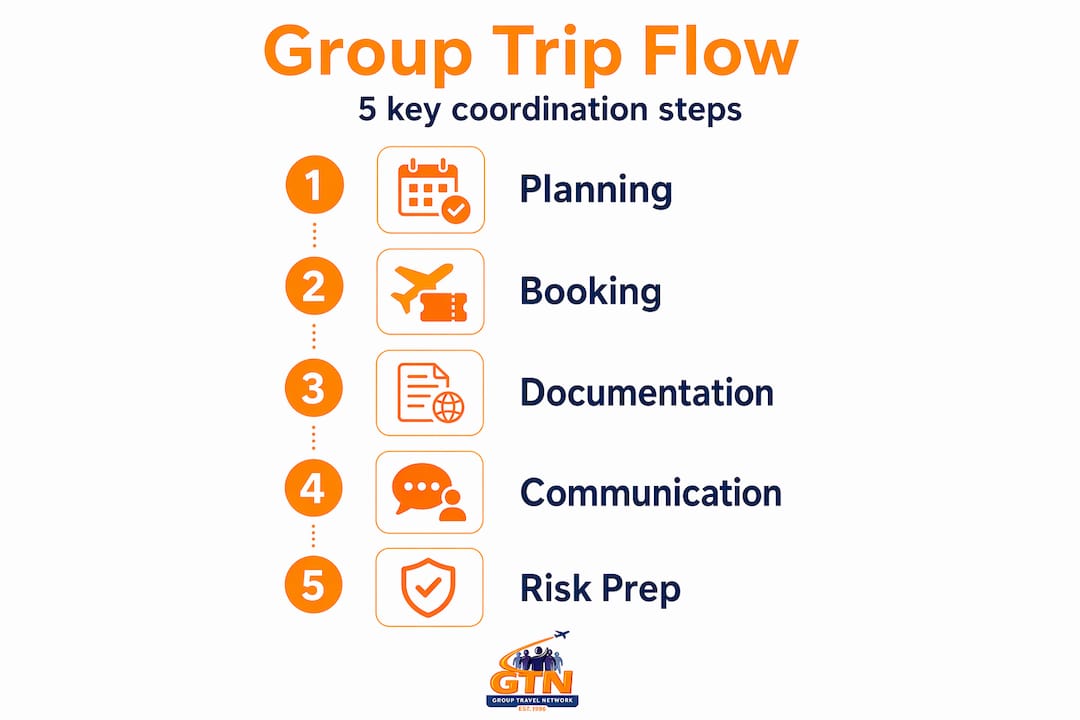
Here is what the core travel coordinator responsibilities actually look like in practice:
- End-to-end arrangement: Booking flights, hotels, ground transport, and any connecting transfers for every traveler in the group, confirmed and documented before departure.
- Itinerary creation: Building detailed day-by-day schedules with timing, contact information, meeting points, and backup plans for common disruptions.
- Traveler documentation: Managing passports, visas, and itineraries (opens in a new tab) and keeping organized records of each traveler’s requirements.
- Change management: Handling last-minute adjustments when flights change, travelers drop out, or hotels overbook. This requires fast communication and a clear process to avoid extra costs.
- Vendor and supplier management: 80% of travel coordinators (opens in a new tab) are responsible for selecting or recommending travel suppliers, which directly impacts budget outcomes.
- Policy compliance: Making sure every booking follows your organization’s travel guidelines, whether that means approved vendors, spending limits, or insurance requirements.
For a school administrator managing 60 students or a coach traveling with a sports team to a regional tournament, centralizing all of this under one person or one dedicated service is the difference between a well-run trip and a logistical nightmare. The travel management process for schools (opens in a new tab) involves even more layers, including parental consent, chaperone assignments, and school board compliance.
Pro Tip: Create a master booking reference document before departure that lists every confirmation number, supplier contact, and alternative contact in one place. Distribute it to at least two coordinators, not just one.
Duty of care and risk management for group travel
This is where the role of trip coordinators becomes genuinely high stakes. Managing risk is not optional for groups, especially those that include minors. The gap between a coordinator who treats this as an afterthought and one who owns it proactively is enormous.
Pre-trip safety planning and emergency support are considered core duties in group travel coordination. Here is how a strong coordinator approaches risk management step by step:
- Conduct a pre-trip risk assessment. Research your destination for health advisories, political stability, weather risks, and any local regulations that affect your group. Document the findings.
- Build a journey management plan. Map every leg of the trip with contingency options. If a connecting flight is missed, what happens next? Who calls whom? What is the protocol?
- Set up traveler location tracking. Know where every member of your group is at every point in the trip. For youth groups, this is non-negotiable.
- Assign emergency contacts and procedures explicitly. Formalizing emergency location and contact processes is far safer than relying on informal communication when something goes wrong.
- Manage health documentation. Collect medical forms, allergy information, and any special needs documentation before departure. Keep physical and digital copies accessible.
- Prepare visa and passport compliance. Track expiration dates, visa requirements for the destination country, and any entry restrictions that apply to group members.
For youth sports travel, the best practice for travel paperwork (opens in a new tab) is to split critical documents into categories and have two separate adults hold master and backup folders. This reduces chaos during emergencies and keeps everyone accessible to records without a single point of failure.
Pro Tip: For any trip crossing state lines or international borders with minors, create two completely separate document kits. Give one to the lead coordinator and one to a secondary adult. Store digital backups in a shared cloud folder with offline access enabled.
The Grouptravelnetwork resource on student travel safety (opens in a new tab) covers many of these protocols in detail, and it is worth reviewing before any school or youth group trip.
Benefits of having a dedicated travel coordinator
Here is a practical reality for anyone organizing group travel without a dedicated coordinator: you are either doing this work yourself or distributing it informally across multiple people, neither of which scales well.

The benefits of dedicated trip coordinators become clearest when you start counting the hours and dollars. Consider a nonprofit organizing an international service trip for 40 volunteers. Managing that informally means someone is spending dozens of hours on flights, hotels, visa research, insurance, and communication, all while also doing their regular job. That hidden cost is real, even if it never appears on the trip budget.
Beyond time savings, here is where the value concentrates:
- Volume discounts and negotiated rates: A coordinator with established supplier relationships can negotiate group rates on flights, hotels, and transportation that individual bookers simply cannot access.
- Policy enforcement reduces financial and legal risk: Consistent application of travel policy prevents out-of-pocket expenses, unauthorized bookings, and the liability exposure that comes with undocumented decisions.
- Fewer disruptions: Maintaining a single source of truth for travel documentation and change processes prevents the confusion and extra costs that come from conflicting information.
- Better traveler experience: When students, athletes, or volunteers feel supported with clear communication and organized logistics, satisfaction and trust in your organization increases.
- Organizational reputation: A smoothly run trip reflects well on the institution. A chaotic one, where students miss connections or parents cannot reach anyone in an emergency, creates lasting reputational damage.
Organizing travel for groups of 150 or more travelers is not unusual for experienced coordinators, and that scale demonstrates exactly why this role requires dedicated attention rather than a shared responsibility approach. For schools specifically, the advantages of organized group travel (opens in a new tab) extend into educational outcomes and student development, making the investment in proper coordination even more justifiable.
Best practices for group travel coordination
The difference between a coordinator who just handles tasks and one who runs an excellent trip comes down to systems. Here is how top coordinators approach the practical work, specifically in school, sports, and nonprofit contexts.
Building your documentation system
The foundation of any successful group trip is organized paperwork. Duplicating critical records both physically and digitally, with access given to multiple responsible adults, is a proven risk mitigation strategy. Coordinators should organize documents into clear categories.
| Document category | What to include |
|---|---|
| Identity and legal | Passports, ID copies, consent forms, custody documentation |
| Health and safety | Medical forms, allergy lists, insurance cards, emergency contacts |
| Travel logistics | Confirmations, itineraries, supplier contacts, transport schedules |
| Financial records | Budget tracking, receipts, payment confirmations, refund policies |
| Compliance paperwork | School board approvals, visa documentation, waiver forms |
Communication and coordination strategies
Clear, consistent communication is what prevents small problems from becoming emergencies. Effective coordinators establish communication channels before departure, assign roles to chaperones or team leaders, and set expectations for check-in protocols. This is especially critical for schools using the step-by-step group travel planning (opens in a new tab) approach, where each phase of planning has defined communication milestones.
Here are the key practices that set strong coordinators apart:
- Distribute a printed itinerary to every traveler AND their emergency contact before departure.
- Assign each sub-group or bus a designated leader with a copy of all relevant documents.
- Set up a group communication channel (a messaging app works well) with all adults on the trip.
- Conduct a pre-trip briefing covering emergency procedures, meeting points, and who to contact for what.
Using technology effectively
Modern coordinators use booking platforms that centralize reservations, automated confirmation emails, shared itinerary tools, and cloud-based document storage. The goal is reducing the number of systems anyone needs to check. One shared folder, one communication channel, one booking reference document.
Pro Tip: Before departure, run a full documentation audit 48 hours out. Confirm every traveler’s documents are complete, every booking is confirmed, and every emergency contact is reachable. Two days gives you time to fix problems. The morning of departure does not.
For field trips and school-organized travel, the field trip organization tips (opens in a new tab) from Grouptravelnetwork provide a school-specific framework that adapts well to different trip sizes.
What I’ve learned after watching hundreds of group trips unfold
I’ve seen school trips go sideways for entirely predictable reasons. Not weather. Not bad luck. Missing documentation, no one owning the emergency protocol, and a coordinator who was also doing three other jobs. What I find most underappreciated about the role of trip coordinators is how much the job is about anticipation, not reaction.
Travel coordinators balance reactive problem-solving with long-term strategic planning (opens in a new tab), and the best ones spend far more time preventing problems than solving them. That framing matters because most organizations hire or assign this role after something goes wrong, not before.
The cost-versus-experience tension is real. I’ve watched coordinators make every decision on price and arrive at destinations that frustrated students and teachers alike, which undermined the entire educational purpose of the trip. I’ve also seen coordinators overspend on comfort while ignoring safety documentation. The sweet spot is a coordinator who treats both as equally non-negotiable.
My honest advice: if you are running group travel for a school, sports team, or nonprofit, stop treating this as something someone fits into their existing schedule. The duty of care responsibilities alone require focused attention. Formalize the role. Define the responsibilities in writing. Give the coordinator the authority to enforce policy and the resources to do the job well. The trips that go smoothly are almost always the ones where that conversation happened before the planning began.
— Donovan
Let Grouptravelnetwork handle the heavy lifting

Planning a school trip, performance tour, or team travel experience involves every responsibility covered in this article, and most organizations simply do not have the internal capacity to execute all of it at a high level. That is exactly what Grouptravelnetwork exists to solve. With dedicated trip coordinators, customized itineraries, flexible payment plans, and built-in travel protection, Grouptravelnetwork takes the coordination burden off school administrators, band directors, and coaches.
Whether you are organizing your first group trip or looking to improve how an existing one runs, the school group travel planning guide (opens in a new tab) is the practical starting point your planning team needs. For groups focused on student development and memorable experiences, explore the full range of group travel for students (opens in a new tab) options Grouptravelnetwork offers. Expert coordination is not a luxury. For group travel done right, it is the baseline.
FAQ
What does a travel coordinator do for group trips?
A travel coordinator manages end-to-end logistics for group travel, including flights, accommodations, ground transport, traveler documentation, risk assessments, and emergency protocols. Their role goes well beyond booking and includes policy compliance, vendor management, and traveler communication.
Why use a dedicated travel coordinator for schools or sports teams?
Dedicated coordinators centralize planning, negotiate volume discounts, enforce travel policy, and manage duty-of-care obligations that are especially critical for groups involving minors. Without a dedicated person in this role, responsibilities fall informally across multiple people, which increases risk and reduces consistency.
What skills are needed for travel coordinators managing group travel?
Strong travel coordinators combine organizational ability, vendor negotiation skills, risk management knowledge, and clear communication. They must handle last-minute changes calmly while keeping detailed documentation accurate and accessible to all relevant parties.
How should travel paperwork be organized for youth group trips?
The best practice is to split documents into categories such as identity, health, logistics, financial, and compliance records, then create master and backup copies held by two separate adults. Storing digital backups in a shared cloud folder provides a third layer of access during emergencies.
When should an organization formalize the travel coordinator role?
The right time is before your first major group trip, not after a problem occurs. Organizations running trips for students, athletes, or volunteers should define the coordinator’s responsibilities in writing, assign authority over vendor and policy decisions, and treat the role as a dedicated function rather than a secondary task.
Recommended
- How To Coordinate Group Tours: Step-by-Step Guide For Schools • Group Travel Network (opens in a new tab)
- School Group Travel: Safe Educational Journey Coordination (opens in a new tab)
- Role Of Guides In Student Travel: Administrator’s Guide • Group Travel Network (opens in a new tab)
- Travel Management For Teams: How Schools Plan Smart Group Trips • Group Travel Network (opens in a new tab)