

May 18, 2026
Role of guides in student travel: Administrator’s guide
TL;DR:
- Guides are essential operational partners who manage safety, logistics, and engagement during student trips. They must be integrated early in planning, with clear authority, training, and contingency strategies to ensure safety and educational impact. Proper guide involvement transforms student travel into a safe, memorable, and enriching experience.
Guides are often booked last. Budget is allocated, the itinerary is locked, the permission slips are signed, and then someone asks: “Do we actually need a guide?” That question reveals a common and costly misunderstanding of the role of guides in student travel. Guides are not narrators you hire to fill silence between bus stops. They are operational partners who hold together the educational, logistical, and safety layers of a student trip simultaneously. If you are a school administrator or trip coordinator, understanding exactly what guides do, and how to integrate them properly, will determine whether your next trip is genuinely transformative or just expensive babysitting.
Table of Contents
- Understanding the multifaceted role of guides in student travel
- Legal and safety responsibilities: Integrating guides into risk management and supervision
- Enhancing educational impact through guided interaction and peer-led models
- Practical strategies for integrating guides into successful student travel planning
- Why school administrators must rethink the underestimated role of guides in student travel
- How Group Travel Network supports effective use of guides in student travel
- Frequently asked questions
Key Takeaways
| Point | Details |
|---|---|
| Guides are multifunctional | Guides manage both educational content and on-the-ground logistics for smooth student travel experiences. |
| Safety integration | Guides play a vital role in risk management and must be included in all safety protocols and training. |
| Interactive learning | Guides enhance engagement through real-time questions and tailored storytelling during tours. |
| Structured coordination | Effective guide deployment requires coordination, staffing plans, and matching guides to student needs. |
| Planning buffers | Incorporate pacing flexibility to allow guides to adjust timing and maintain group engagement. |
Understanding the multifaceted role of guides in student travel
Most people picture a guide as someone pointing at monuments and reciting facts. The reality is far more demanding. According to the U.S. Bureau of Labor Statistics, tour and travel guides plan routes, manage pacing, greet clients, answer questions, and adjust logistics on the fly, acting as both educators and coordinators. That is a broad mandate, and it becomes even broader when the group is made up of students.
For student groups specifically, a guide’s responsibilities span five overlapping areas:
- Route planning and preparation: Guides design talking points calibrated to the age and curriculum of the group, not a generic script copied from a tourism brochure.
- Pacing management: They read the room in real time, slowing down when students are engaged and moving the group along when energy drops.
- Logistics handling: From reservation check-ins to adapting when a venue runs late, guides absorb the operational friction so teachers and coordinators can focus on students.
- Safety monitoring: Guides are the frontline layer of supervision, reinforcing group rules, watching for stragglers, and flagging hazards before they become incidents.
- Active engagement: The best guides do not lecture. They ask questions, invite responses, and create moments where students become participants rather than passengers.
A good starting point for building guide integration into your planning process is a solid school group travel planning guide, which helps you identify where guide responsibilities intersect with coordinator responsibilities before the trip even begins.
Pro Tip: When briefing guides before a student trip, share not just the itinerary but the curriculum context. A guide who knows your students just finished a unit on the Civil War will make very different, and far more effective, stops at a battlefield museum.
Legal and safety responsibilities: Integrating guides into risk management and supervision
Here is where many trip coordinators leave gaps they do not even realize exist. Safety on student trips is not just a moral obligation. It carries legal duty of care weight, and school trips require thorough written risk assessments with roles and emergency plans explicitly covering guides’ responsibilities and dynamic risk updates.
That last phrase matters: dynamic risk updates. Static risk assessments written three weeks before the trip do not account for the broken escalator at the museum, the crowd surge at the historical site, or the thunderstorm that changes an outdoor route. Guides must be trained and empowered to update risk decisions in real time, within boundaries you have defined in advance.
Here is a practical framework for integrating guides into your risk management structure:
- Designate guide authority clearly in the written risk assessment. Specify what decisions guides can make independently versus what requires coordinator or teacher approval.
- Include guides in emergency escalation chains. They should know exactly who to contact, in what order, if something goes wrong.
- Brief students directly through the guide. Students respond better to the guide’s voice, especially if that relationship has been established from the start of the trip.
- Assign control measures by role. Decide in advance who is responsible for the buddy system check, high-visibility clothing distribution, and meeting point communication.
- Build in a pre-departure check-in between the guide, lead teacher, and coordinator to confirm roles are understood before students leave the bus.
Practical safety controls reinforce this structure. Implementing measures like high-visibility jackets, defined meeting points, and buddy systems helps reduce risks on educational trips, but only when guides actively enforce and remind students of these protocols throughout the day, not just at the start.
“A guide who understands their role in the risk framework is not an extra adult on the trip. They are a load-bearing part of your supervision structure.”
When building out safe educational journey coordination, treat the guide as a named role in your safety plan, not an unnamed vendor.
Enhancing educational impact through guided interaction and peer-led models
Safety matters, but you did not organize a student trip just to keep everyone accounted for. The educational return on the experience is what justifies the cost and effort. This is where the importance of travel guides shows up most clearly in measurable ways.
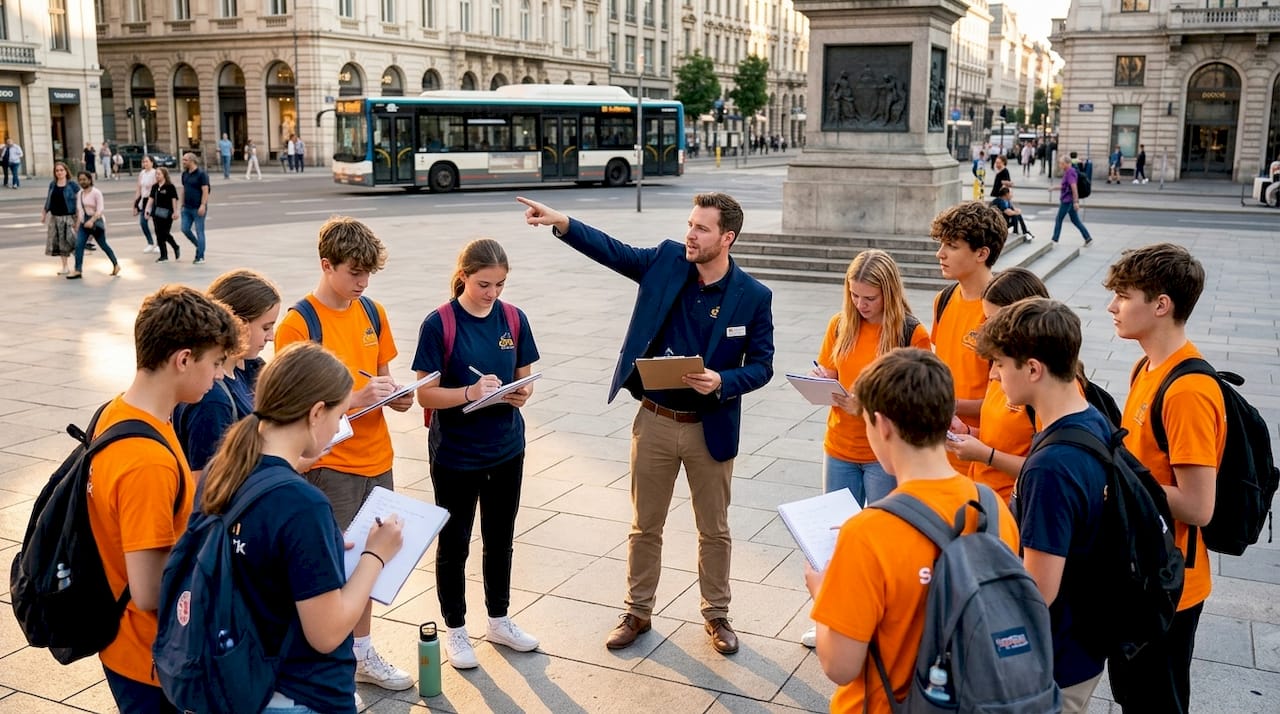
Student tour guides engage visitors through real-time interaction and dynamic question loops, promoting active involvement rather than passive receipt of information. That distinction, active versus passive, is the difference between a student who remembers a site two years later and one who barely recalls being there at all.
The benefits of student travel guides extend even further when peer-led models are introduced. Some schools have experimented with using older or more experienced students as guides for younger groups, with compelling results. Baylor’s student-led tours rely on a coordinator managing guide assignments and leadership teams matching prospective students with guides based on shared interests. That matching process is not incidental. It is the mechanism that creates genuine connection and curiosity rather than obligatory listening.
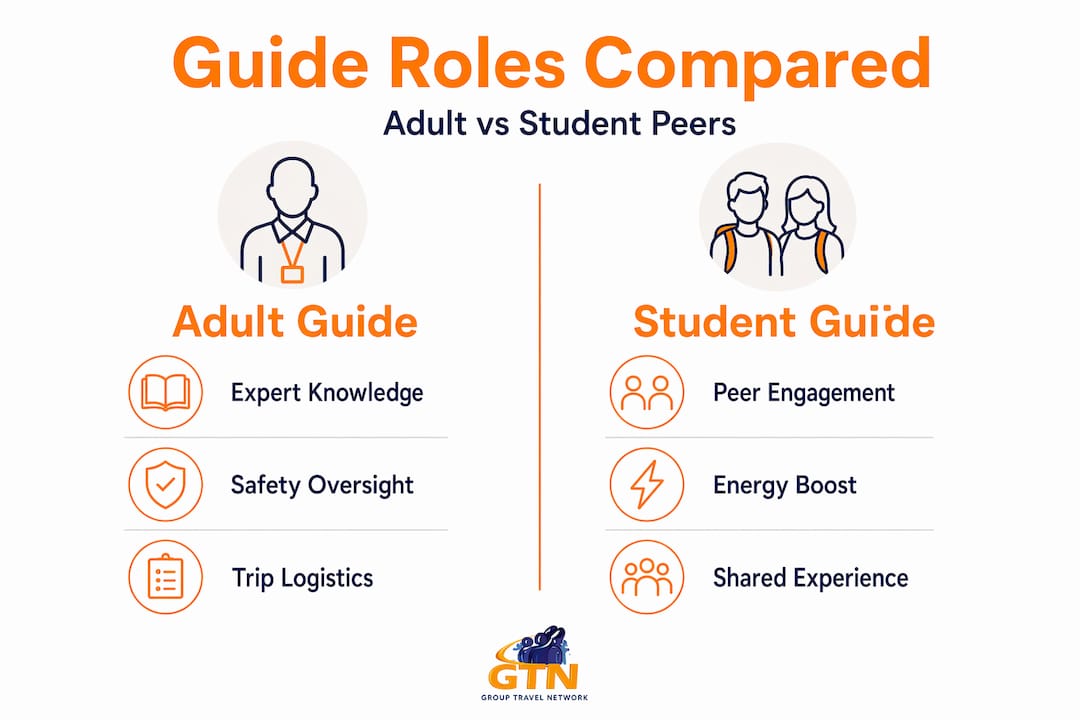
Here is a direct comparison of both models to help you decide which fits your group:
| Factor | Adult professional guide | Student peer guide |
|---|---|---|
| Content expertise | High, formal training | Moderate, personal experience |
| Relatability to students | Lower | Higher |
| Safety authority | Strong, recognized | Requires adult backup |
| Engagement style | Structured, informative | Conversational, peer-to-peer |
| Coordination overhead | Lower | Higher (requires adult oversight) |
| Best suited for | Curriculum-heavy trips | Campus visits, leadership programs |
For most K-12 school trips, a professional guide backed by a clear student guided tours approach gives you the expertise and safety authority you need. For leadership programs or high school campus visits, a peer-led layer adds authentic engagement that professional guides simply cannot replicate.
Pro Tip: If you use peer guides, assign an adult coordinator specifically to the guide team, not just to the student group. The guide relationship needs its own oversight structure to function well.
When you coordinate group tours effectively, scheduling guide workloads matters too. Overloaded guides lose effectiveness fast. A typical range of 8 to 20 active guiding hours per week keeps performance consistent, and even within a single-day trip, a mid-day break built into the guide’s schedule pays dividends in energy and engagement during afternoon sessions.
Practical strategies for integrating guides into successful student travel planning
Knowing what guides do is one thing. Building a trip structure that actually uses them well is another. The how guides enhance student trips question comes down to execution at the planning stage, not just on the day.
Start with these six steps before your trip departs:
- Train guides on your specific itinerary. Share the curriculum goals, student age range, behavioral context, and any students with special needs or accessibility requirements.
- Build pacing buffers into the schedule. Planning pacing buffers of 10 to 20 minutes between major stops gives guides space to answer questions, wait for slower walkers, or extend a moment of genuine student interest without blowing up the rest of the day.
- Define decision-making rights in writing. Clear decision-making rights for guides during the trip, covering itinerary adherence versus safety changes, prevent confusion and friction when real-time calls are needed.
- Run a pre-trip briefing with all adults. Guides, teachers, chaperones, and coordinators should know each other’s names, roles, and communication methods before students arrive.
- Establish a communication channel. Whether that is a group chat, walkie-talkies, or designated check-in points, every adult on the trip should be able to reach the guide within 90 seconds.
- Prepare contingency plans for the most likely disruptions. Long lines, weather changes, and venue closures are the top three. Have a named fallback option for each.
The educational group trip planning guide walks through how to structure these steps across the planning timeline, from 90 days out to the morning of departure.
For day-of logistics, keep the guide’s role front and center:
- Guides lead, teachers support, chaperones sweep from the back.
- Only the lead teacher or coordinator overrides the guide on pacing decisions.
- Students know the guide’s name and face before they leave the school building.
Why school administrators must rethink the underestimated role of guides in student travel
Here is an uncomfortable observation from years of watching student trips succeed and fail: the trips that go sideways almost never fail because of a bad destination or poor timing. They fail because the guide was treated as a vendor rather than a partner.
Treating guides as optional extras rather than integral safety and education partners is a misconception that risks compliance, safety, and student experience quality. The legal and educational consequences of that misunderstanding are real, and they are avoidable.
The schools that get the most out of guided student travel share a consistent pattern. They involve guides early, sometimes as far back as the initial itinerary design phase. They give guides written clarity on their authority. They invest in matching guides to the specific group rather than accepting whoever is available. And they treat the guide’s expertise as a resource to be actively used, not a service to be passively consumed.
The guides and educational travel relationship works best when it is collaborative. A guide who is looped into your curriculum goals will flag a venue as poorly suited for your age group before you book it. That is not narration. That is professional judgment that saves you time, money, and a day of disengaged students staring at exhibits designed for someone else.
The travel guide roles in education extend beyond the day of the trip itself. A strong guided experience creates reference points students return to for years, anchoring abstract classroom content to something they touched, saw, and discussed with a real person in real time. That is the actual value proposition of why student groups need guides, and it is worth designing your entire trip around.
Start integrating guides into your planning process from day one. Work through the planning safe student group travel framework to identify exactly where guide expertise fills the gaps your internal team cannot cover alone.
How Group Travel Network supports effective use of guides in student travel
Turning these insights into a well-run trip requires more than good intentions. It requires the right planning infrastructure.

Group Travel Network specializes in exactly this kind of coordination. Our team helps school administrators and trip coordinators build guided student travel programs that are operationally sound and educationally rich. From matching your group with guides suited to your curriculum goals to building pacing buffers and contingency plans directly into your itinerary, we handle the layers that make the difference between a forgettable field trip and a genuinely memorable experience.
Explore our school group travel planning guide to see how guide integration fits into every stage of the planning process. Our student guided tours expertise and step-by-step resources for coordinating group tours give you the tools to plan with confidence from the first conversation to the final debriefing with your students.
Frequently asked questions
What are the primary responsibilities of guides during student travel?
Guides plan and lead routes, manage group pacing, answer questions, handle logistics, and ensure student safety throughout the trip. The BLS confirms guides act as both educators and on-the-ground coordinators simultaneously.
How do guides contribute to safety on educational trips?
Guides implement risk control measures, reinforce safety rules with students, manage dynamic risks as conditions change, and support emergency protocols defined before departure. Written risk assessments must explicitly name guide roles and responsibilities within the safety plan.
Can student peers serve effectively as tour guides?
Yes, peer guides can engage students well when supported by structured coordination, adult oversight, and purposeful matching. Baylor’s model demonstrates that matching guides to visitors by shared interests drives stronger connection and engagement.
What training should guides receive before student trips?
Guides should be trained on the itinerary, safety procedures, communication expectations, risk assessment awareness, and emergency protocols. Pre-departure briefings on emergency procedures are a legal and operational baseline, not an optional courtesy.
How do guides improve student engagement during trips?
Guides use interactive Q&A sessions, storytelling, and real-time pacing adjustments to keep students actively involved rather than passively present. UC Davis research shows that dynamic question loops promote active involvement far more effectively than one-way information delivery.
Recommended
- Student Educational Travel: Ultimate 2025 Guide For Schools
- Music Tours: A School Administrator’s Planning Guide • Group Travel Network
- How To Coordinate Group Tours: Step-by-Step Guide For Schools • Group Travel Network
- Educational Group Trip Guide: Expert Planning For Schools • Group Travel Network

Relax with our Student Travel Expertise .
We deliver stress-free student trips backed by an exceptional array of services you won’t find anywhere else:
- Stress-free, creative planning of customized itineraries
- Dedicated GTN Service host on every trip
- Extensive travel protection plan options
- Online, individual registration system
- Flexible payment plans and online payment options
- Bulk buyer discounts for great trips that cost less
Inclusion into #MyGTNFamily for life! (you don’t even have to remember our birthday!)
Spain
There is no place like Spain to offer a student performance opportunity or cultural student trip.
Myrtle Beach
All students love the beach! Especially a beach known for its 60 miles of pristine coastline.
Boston
Have your students experience colonial charm in the city that is considered the hub of New England.
London
Provide your student group with the “Royal” treatment! One of the world’s most recognized cities.
See What People Are Saying
“This was my first time using a company to plan our band trip. It was so easy working with Justin and Group Travel Network. We had to make several changes along the way, but they were accommodating changes and worked everything out for us. I would highly recommend using Group Travel Network.”
“What wonderful trip we had to NYC! Our group of 51 never missed a beat because of Group Travel Network and our wonderful guide, Tim. It was truly a theatre trip to remember! If you are looking for a travel company who really cares about the details, Group Travel Network is for you!”
“It has been my privilege to use Group Travel Network as the exclusive travel coordinator for my band for over 10 years. I can say, without doubt or hesitation, that GTN is, by far, the best travel company for student groups currently in existence. I have often said that I wouldn’t take my band across the street without GTN and that’s not far from the truth!”