

May 2, 2026
School group travel planning: A step-by-step guide

TL;DR:
- Organizing school trips requires detailed planning, early booking, and clear communication.
- Success depends on defined learning objectives, structured itinerary, and thorough safety protocols.
- Starting planning 12 to 18 months in advance ensures better availability, pricing, and outcome measurement.
Organizing a school group trip can feel like running a small city for a week. You’re coordinating transportation, managing parental expectations, tracking consent forms, satisfying curriculum requirements, and somehow keeping 50 teenagers together in an airport. The stakes are high because one missed detail can derail the whole experience. But with the right process, structured from the ground up, you can turn that mountain of logistics into a manageable, genuinely rewarding program that students remember for years.
Table of Contents
- Understanding the scope and goals of school group travel
- Preparation: Essential requirements and checklist
- Step-by-step group travel planning process
- Troubleshooting: Common pitfalls and how to avoid them
- Success indicators: Measuring outcomes in group travel
- Our take: What schools get wrong and how to fix it
- Next steps: Partner solutions for easy group travel
- Frequently asked questions
Key Takeaways
| Point | Details |
|---|---|
| Know your group’s needs | Understanding trip objectives and group size is essential for safe and impactful travel. |
| Start early and organize | Advance planning and clear leader roles prevent confusion and boost participation. |
| Safety comes first | Prioritize leader-to-student ratios, medical documents, and crisis procedures for smooth trips. |
| Leverage expert resources | Use guides, templates, and professional support to streamline the planning process. |
| Assess and improve | Gather feedback and review outcomes to create even better school trips in the future. |
Understanding the scope and goals of school group travel
Before you book a single hotel room, you need a clear picture of what you’re actually managing. School group travel is not just a field trip scaled up. It’s a layered operation involving safety protocols, educational alignment, vendor negotiations, and communication across dozens of stakeholders simultaneously.
The numbers tell a powerful story. SYTA research shows U.S. teachers organize an average of 1.7 trips per year, typically serving around 60 students per trip. The research also found that 93% of teachers are the ones who initiate student travel, meaning administrators and educators are often carrying this entire process on their own. Average group sizes hover around 52 students for domestic trips and 27 for international ones. Those groups require leader-to-student ratios of 1:10 and 1:6, respectively.
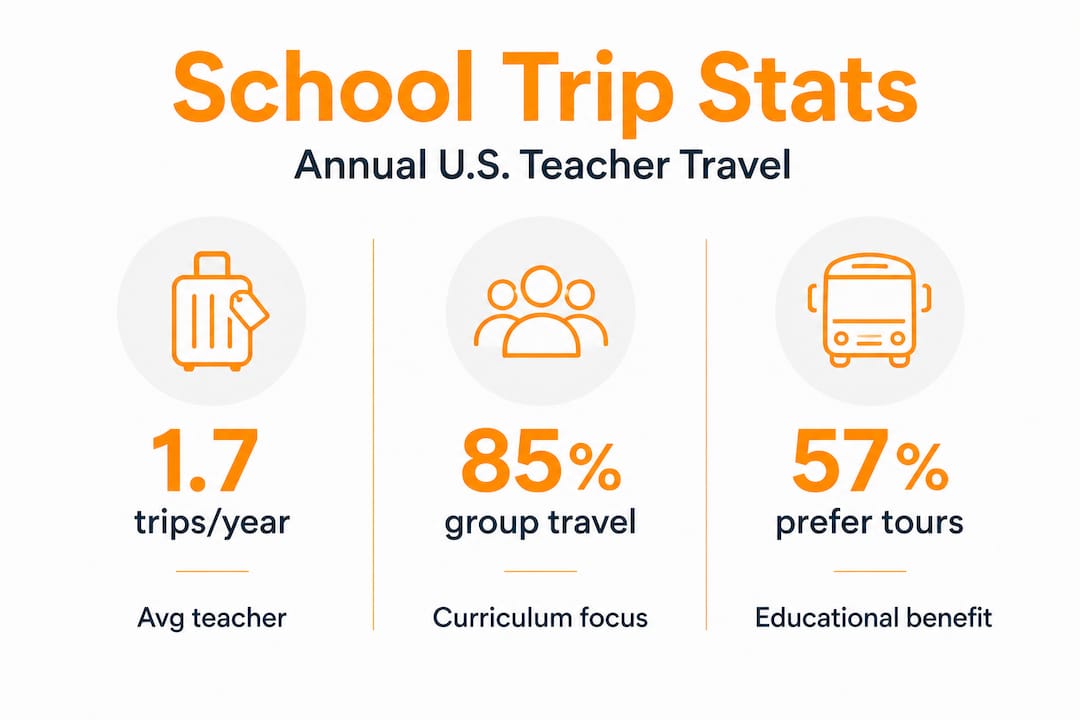
Meanwhile, the industry itself is booming. The school trip management market was valued at USD 2.34 billion in 2024, with projections reaching USD 5.45 billion by 2033 at a 10.1% annual growth rate. This growth is driven primarily by two forces: safety prioritization and demand for experiential learning. Both are values your community already holds.
Understanding the benefits of student travel is what shapes your goals before planning even begins. Here’s what most school travel programs aim to achieve:
- Curriculum alignment: Connecting the destination to classroom content
- Experiential learning: Giving students hands-on encounters they can’t get in a textbook
- Social development: Building teamwork, independence, and cultural awareness
- Performance opportunities: For band, choir, and arts groups seeking real-world stages
- Community building: Strengthening bonds between students, teachers, and families
| Goal type | Domestic focus | International focus |
|---|---|---|
| Curriculum alignment | History, science, civic sites | Language, global culture |
| Average group size | 52 students | 27 students |
| Leader ratio | 1:10 | 1:6 |
| Preferred trip type | 57% curriculum-related | Cultural immersion |
With the stage set, let’s review what you need before starting your travel plan.
Preparation: Essential requirements and checklist
Once your goals and scope are defined, gather these essentials before moving to planning. Think of this phase as building the foundation. Everything that follows rests on how solid this groundwork is.
The leader-to-student ratio is your first fixed constraint. SYTA recommends at least 1 adult for every 10 students on domestic trips and 1 for every 6 on international ones. These ratios aren’t suggestions. They’re the baseline for keeping students safe and managing group dynamics at scale. Recruit chaperones early, and make sure they understand their responsibilities before departure.
Next comes your documentation package. Missing even one form can prevent a student from traveling, which creates headaches for families and planners alike. Your standard requirements should include:
- Parental consent forms with emergency contact information
- Medical release forms and a list of allergies, prescriptions, and health conditions
- Travel insurance documentation covering medical emergencies, cancellations, and delays
- School district approval and administrative sign-off
- Passport or ID copies for international travel
- Emergency action plans tailored to each destination
Transportation and accommodation decisions deserve serious attention early. Group rates disappear quickly, and the best hotels and charter buses book out months in advance. Work through our expert trip planning guide to avoid the most common booking mistakes. Also consider accessibility requirements, dietary restrictions, room configurations, and proximity to your planned activities.

Pro Tip: Start your vendor outreach at least 9 to 12 months before your departure date. Groups that book early consistently save 15% to 25% on transportation and accommodation compared to late planners, and they get better room assignments, meal options, and scheduling flexibility.
| Preparation task | Domestic timing | International timing |
|---|---|---|
| Book transportation | 6 to 9 months out | 9 to 12 months out |
| Collect consent forms | 3 months out | 4 to 6 months out |
| Confirm insurance | 4 months out | 6 months out |
| Finalize itinerary | 2 months out | 3 months out |
Learning how to manage coordinating group tours step by step gives you a reliable process that scales across different trip types.
Step-by-step group travel planning process
With all requirements secured, use this workflow to launch your trip planning. This is where most administrators feel overwhelmed, so structure is your best friend.
Given that 93% of teachers initiate trips themselves, the planning burden often falls on one or two people. Breaking the process into numbered steps with assigned roles makes the workload manageable and prevents anything from falling through the cracks.
- Set your budget first. Calculate total per-student costs including transportation, lodging, meals, admission fees, and a 10% contingency buffer. Communicate pricing to families clearly and early.
- Define the itinerary framework. List all sites, events, or performances tied to your curriculum goals. Build in buffer time for transit, meals, and unexpected delays.
- Assign roles and responsibilities. Every team member needs a defined job: communications lead, medical contact, transportation coordinator, and chaperone scheduler. Ambiguity causes errors.
- Launch your registration system. Use an online platform that collects payments, consent forms, and medical info in one place. This reduces follow-up time dramatically.
- Build your communication plan. Families need updates at key intervals: when registration opens, 60 days before departure, 2 weeks before, and day-of.
- Create a crisis communication protocol. Identify who calls parents in an emergency, who contacts the school, and who liaises with local authorities. Write it down.
- Run a pre-trip briefing. Meet with students and chaperones at least one week before departure. Review rules, expectations, and what to do if someone gets separated.
- Debrief after the trip. Gather feedback from students, chaperones, and families within 2 weeks of returning. Use it to improve next year’s program.
The school trip management market is growing precisely because experiential learning requires careful orchestration. Schools that invest in step-by-step planning frameworks consistently deliver better outcomes than those improvising as they go.
Pro Tip: Create a shared digital folder for your planning team with subfolders for documents, vendor contacts, itineraries, and emergency procedures. When someone is unavailable, any team member can pick up exactly where they left off.
The connection between structured planning and student engagement is direct. Students who participate in well-organized trips report higher satisfaction and stronger retention of the learning objectives tied to the experience. A strong smart group trip management approach is what separates a memorable trip from a stressful one.
Troubleshooting: Common pitfalls and how to avoid them
Even the best planning can hit bumps. Here’s how to sidestep the most common problems before they become real crises.
The number one issue we see? Last-minute changes. A venue cancels. A bus breaks down. A student gets sick. Any of these can cascade into bigger problems if your itinerary has no flexibility built in. Always schedule at least one buffer hour per day and have backup options for major activities.
Poor communication is the second biggest risk factor. When families don’t receive timely updates, anxiety spikes and trust erodes. When chaperones aren’t briefed properly, student safety gaps emerge. Clear, consistent, multi-channel communication prevents most of these situations before they escalate.
Here are the most common pitfalls and their practical solutions:
- Underbudgeting: Always add a 10% to 15% contingency to your total cost estimate
- Skipping insurance: Travel protection covers cancellations, medical emergencies, and lost luggage; never skip it for student groups
- Ignoring dietary needs: Collect dietary restrictions at registration and confirm with every food vendor in advance
- Overlooking accessibility: Check every venue and transport option for ADA compliance before finalizing
- Unclear emergency contacts: Every chaperone should carry a printed list of all student emergency contacts, not just a phone-stored version
- No social media policy: Set clear rules about what students can post and when, especially for safety and privacy reasons
Safety prioritization is one of the core drivers behind the school trip management industry’s rapid growth, and for good reason. A single safety incident can damage a school’s reputation, expose administrators to liability, and traumatize students.
“Safe planning is not a cost. It’s an investment that protects students, preserves trust, and ensures every trip delivers the learning outcomes your community deserves.”
Review our top planning tips for groups and bookmark our expert tips for school travel as reference documents your whole planning team can return to throughout the process.
Success indicators: Measuring outcomes in group travel
Finally, you need to know if your hard work paid off. Here’s how to check trip results in a way that actually improves your future programs.
Most administrators plan trips and then move on, never formally evaluating whether the experience delivered on its educational promise. That’s a missed opportunity. Without measurement, you’re guessing at what worked and what didn’t.
The starting point is curriculum alignment. Since 57% of teachers prefer curriculum-related tours, your assessment should always start there. Did students connect the trip experience to what they were studying in class? Did teachers report stronger engagement after returning? These are your clearest indicators of educational value. You can explore more measurement strategies in our educational travel guide.
| Outcome area | What to measure | How to measure |
|---|---|---|
| Learning impact | Curriculum tie-in, retention | Pre and post-trip assessments |
| Participation | Registration rate, trip completion | Enrollment vs. attendance data |
| Safety | Incidents, near-misses, response time | Chaperone incident reports |
| Satisfaction | Student and family feedback | Surveys within 2 weeks of return |
| Cost efficiency | Budget adherence, per-student cost | Final expense report vs. budget |
Here’s what a strong post-trip evaluation process looks like in practice:
- Send a digital survey to students, chaperones, and parents within 10 days of returning
- Ask teachers to document one specific way the trip reinforced classroom learning
- Review all incident or near-miss reports with your safety coordinator
- Compare your actual spend against your projected budget line by line
- Hold a 30-minute debrief with your planning team to document what to replicate and what to change
The data you collect becomes the foundation for your next trip proposal. Administrators who bring outcome data to budget conversations are far more successful at securing school board approval for repeat programs.
Our take: What schools get wrong and how to fix it
Here’s an uncomfortable truth most travel planning articles won’t tell you: the biggest risk to a school trip isn’t a bad destination or a difficult vendor. It’s late starts. Schools consistently underestimate how much lead time quality group travel actually requires, and that single habit undermines everything else.
We’ve worked with enough planning teams to recognize a pattern. A well-intentioned administrator announces a trip in October for a March departure and assumes five months is plenty of time. But by then, the best group hotel rates are gone. The charter bus companies have filled their spring calendars. And the three weeks of back-and-forth over consent forms leaves almost no runway for real trip preparation.
The schools that run the smoothest, most educationally impactful trips start their planning 12 to 18 months out. Not because they have more resources, but because they’ve internalized a simple truth: time is your most valuable planning asset, and it cannot be recovered once it’s spent.
There’s also a second thing schools get wrong, and it’s subtler. They treat group travel as a logistical exercise rather than a pedagogical one. The itinerary gets built around what’s convenient instead of what reinforces learning. And then the trip happens, students enjoy it, and no one can quite explain what they learned. That’s a missed opportunity at every level.
The fix is straightforward. Before you look at a single destination, define your learning objectives. Then build your itinerary backward from those goals. Strong team travel management strategies prioritize purpose before logistics, not the other way around. When you lead with the “why,” every downstream decision becomes cleaner and easier to justify to parents, administrators, and school boards alike.
Next steps: Partner solutions for easy group travel
If you want to put all this advice into action with less effort, here’s how you can get expert help.
Group Travel Network specializes in making school and performance group trips genuinely manageable for administrators who are already stretched thin. From customized itineraries designed to make classroom lessons real to dedicated trip coordinators who handle vendor negotiations on your behalf, the platform removes the most time-consuming parts of the planning process.

Whether you’re organizing a first-time band performance tour or your school’s annual educational excursion, our ultimate student travel guide gives you the frameworks, checklists, and destination ideas to plan with confidence. Explore our tailor-made itineraries, connect with our team, and let us help you build a trip your students will talk about for years.
Frequently asked questions
What is the ideal leader-to-student ratio for school trips?
SYTA recommends a 1:10 ratio for domestic trips and 1:6 for international groups, ensuring adequate supervision for all group sizes.
How far in advance should group trips be planned?
Most experts suggest starting 6 to 12 months before departure, though 12 to 18 months is ideal for larger or international trips where vendor availability and pricing are more competitive.
What are the top safety considerations for school group travel?
Key considerations include proper chaperone ratios, collected medical forms, comprehensive travel insurance, and a written crisis communication plan. Safety prioritization is the leading driver behind growth in professional school trip management services.
Are curriculum-focused tours more beneficial than leisure trips?
Yes. 57% of teachers prefer curriculum-related tours specifically because they reinforce classroom content and produce measurable learning outcomes that justify the investment.
How can schools measure the success of their group travel programs?
Measure success through student participation rates, pre and post-trip learning assessments, chaperone safety reports, and satisfaction surveys collected within two weeks of returning.
Recommended
- Step-by-step Group Travel Planning For School Trips • Group Travel Network
- How To Coordinate Group Tours: Step-by-Step Guide For Schools • Group Travel Network
- Educational Group Trip Guide: Expert Planning For Schools • Group Travel Network
- Student Educational Travel: Ultimate 2025 Guide For Schools

Relax with our Student Travel Expertise .
We deliver stress-free student trips backed by an exceptional array of services you won’t find anywhere else:
- Stress-free, creative planning of customized itineraries
- Dedicated GTN Service host on every trip
- Extensive travel protection plan options
- Online, individual registration system
- Flexible payment plans and online payment options
- Bulk buyer discounts for great trips that cost less
Inclusion into #MyGTNFamily for life! (you don’t even have to remember our birthday!)
Spain
There is no place like Spain to offer a student performance opportunity or cultural student trip.
Myrtle Beach
All students love the beach! Especially a beach known for its 60 miles of pristine coastline.
Boston
Have your students experience colonial charm in the city that is considered the hub of New England.
London
Provide your student group with the “Royal” treatment! One of the world’s most recognized cities.
See What People Are Saying
“This was my first time using a company to plan our band trip. It was so easy working with Justin and Group Travel Network. We had to make several changes along the way, but they were accommodating changes and worked everything out for us. I would highly recommend using Group Travel Network.”
“It has been my privilege to use Group Travel Network as the exclusive travel coordinator for my band for over 10 years. I can say, without doubt or hesitation, that GTN is, by far, the best travel company for student groups currently in existence. I have often said that I wouldn’t take my band across the street without GTN and that’s not far from the truth!”
“What wonderful trip we had to NYC! Our group of 51 never missed a beat because of Group Travel Network and our wonderful guide, Tim. It was truly a theatre trip to remember! If you are looking for a travel company who really cares about the details, Group Travel Network is for you!”