

May 2, 2026
Student travel safety: Protecting students and schools

TL;DR:
- Student trip incidents are more common than most schools believe, with property loss, illness, and mental health crises posing significant risks. Legal obligations require comprehensive risk assessments, qualified first aiders, and emergency plans to ensure safety and reduce teacher anxiety. Building a safety-focused culture enhances trust, promotes more educational travel, and ensures incidents lead to confidence rather than crisis.
Most school administrators assume that student group trips are relatively low-risk events. That assumption deserves a serious second look. 1 in 65 students experiences a reportable incident during educational travel, which means a single group of 130 students statistically includes two students who will need some form of emergency response. This article walks you through the real risk landscape, the legal obligations your school carries, and the practical systems that transform student travel from a liability concern into a confident, rewarding program.
Table of Contents
- Understanding risk in student travel: The real numbers
- Legal responsibilities and frameworks every school must know
- From checklists to culture: Building a proactive safety architecture
- Critical safety scenarios and how to prepare for them
- Why prioritizing safety transforms student travel outcomes
- Next steps: Plan safer, unforgettable student travel
- Frequently asked questions
Key Takeaways
| Point | Details |
|---|---|
| Incidents are common | Even the best-run trips face property loss or health incidents so preparedness is essential. |
| Legal duty is clear | Schools must comply with strict risk assessments, emergency plans, and staffing requirements. |
| Risk culture builds trust | Embedding safety into school culture reassures parents and staff, expanding trip opportunities. |
| Mental health needs priority | Mental health crises disrupt travel more than other incident types and deserve special planning. |
| Proactive safety pays off | Investing in rigorous safety upfront enables safer, more memorable educational experiences. |
Understanding risk in student travel: The real numbers
Student travel incidents are more common than most coordinators expect, and the data shows clear patterns that help you prepare better. Empirical data from education abroad programs confirms the 1 in 65 incident rate, but the type of incidents matters just as much as the frequency.
The three most common incident categories break down like this:
| Incident type | Frequency | Likely outcome |
|---|---|---|
| Property loss or theft | Highest | Resolved with documentation |
| Physical illness or injury | Moderate | Usually recovered on-trip |
| Mental health crisis | Lower but rising | Highest withdrawal rate |
Property loss is the most frequent issue. A student loses a passport, a bag goes missing, or a phone is stolen. These incidents feel manageable, but they trigger a chain of administrative responses that consume coordinator time and resources fast. Physical illness follows closely behind. A stomach bug in a hotel room or a sprained ankle on a walking tour sounds minor, but multiply that across a group of 60 students and you see why having trained first aiders on every trip is non-negotiable.
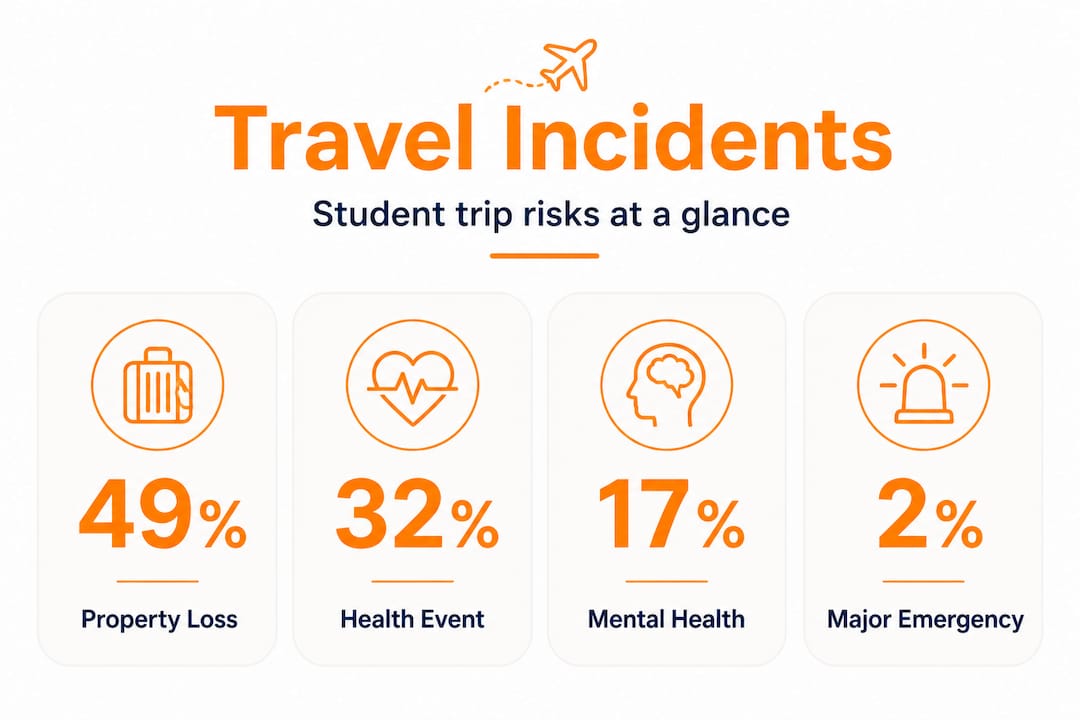
Mental health events are the category that surprises most schools. They occur less frequently than property or physical incidents, but they cause the highest rate of program withdrawals and demand the most intensive follow-up support. A student experiencing a severe anxiety episode far from home needs a very different response than a student with a twisted ankle.
One insight worth absorbing: most students involved in incidents do recover and continue their trips, especially when schools have clear response plans in place. The risk is real, but it is manageable. Understanding school group travel insurance as part of your overall risk strategy is a foundational step that many schools overlook until after an incident occurs.
The takeaway here is not to avoid travel. It is to approach it with accurate information instead of optimistic assumptions. When you understand what actually goes wrong, you can build systems that handle it well.
Legal responsibilities and frameworks every school must know
Beyond moral duty, student travel safety is a legal obligation. Legal frameworks mandate thorough risk assessments and emergency plans for every student trip, regardless of destination or duration. Schools cannot delegate these responsibilities away by hiring a travel vendor. The school remains the responsible party.
Here is what the legal minimum looks like in practice:
- Complete a written risk assessment before every trip that identifies hazards, evaluates likelihood and severity, and documents mitigation steps.
- Appoint a qualified first aider for every student group traveling. For international or extended trips, this means someone with a formal first aid qualification, not just a teacher who completed a basic course years ago.
- Develop a written emergency action plan covering medical emergencies, missing persons, severe weather, and communication protocols with parents and the school office.
- Designate an Educational Visits Coordinator (EVC) who holds institutional knowledge of your school’s processes and approvals. This person reviews plans, checks qualifications, and maintains records.
- Obtain appropriate travel insurance that covers the specific activities and destinations included in your itinerary, not just standard travel disruption.
A critical and often underappreciated issue is teacher anxiety. 84% of teachers fear legal consequences if an accident occurs during a field trip. This is not irrational. Without clear protocols and documented decision-making processes, individual teachers can feel personally exposed when things go wrong. That anxiety leads directly to declining participation in trip supervision, which shrinks your pool of qualified chaperones over time.

The solution is not reassurance. It is clarity. Teachers who understand exactly what is expected of them, who to call, what decisions they can make independently, and where the documentation lives feel far more protected. Your educational group trip planning guide for every trip should include a one-page staff role summary so no teacher has to guess their responsibilities in an emergency.
| Transport method | Key safety feature | Key risk factor |
|---|---|---|
| Charter coach | Dedicated driver, controlled stops | Limited access to medical facilities en route |
| Commercial airline | Regulated safety standards | Lost luggage, medical in transit |
| Train | Frequent stops, accessible routes | Crowding, pickpocketing at stations |
| Walking/hiking | High educational value | Weather exposure, physical fatigue |
Pro Tip: Keep a printed emergency contact folder with every group leader, not just digitally saved on a phone. Phones die. Folders don’t.
Building safety documentation into your standard operating procedures is the most effective way to reduce both liability risk and teacher anxiety simultaneously. Schools that use a structured framework through resources like safe and impactful student travel planning find that their teachers become more willing to participate over time, not less.
From checklists to culture: Building a proactive safety architecture
A checklist is the floor, not the ceiling. Schools that treat safety as a cultural value rather than a bureaucratic requirement produce consistently better outcomes for students and staff. This is the concept of risk architecture: a set of interconnected systems, roles, and norms that make safe behavior the default rather than the exception.
Risk architecture builds confidence and enables schools to pursue more ambitious programs with genuine stakeholder support. When parents trust your processes, they stop blocking trips. When teachers trust your protocols, they volunteer to lead them. When students understand the safety expectations, they self-regulate more effectively in the field.
Here is how schools embed safety into their culture rather than just their paperwork:
- Annual safety briefings for all trip staff, not just new hires. Protocols evolve, and everyone needs to be current.
- Student pre-trip safety orientation, delivered in an age-appropriate format. Students who understand why the rules exist follow them better than students who just hear a list of restrictions.
- Post-trip debrief sessions that discuss what went well and what needed adjustment, treating safety as a continuous improvement process.
- Shared incident reporting that goes to the EVC and school leadership without blame, creating a learning culture rather than a cover-up culture.
- Parent communication templates prepared in advance for common scenarios, so you are not drafting crisis messages under pressure.
“The schools that run the most ambitious educational travel programs are usually the ones with the most rigorous safety systems. Safety doesn’t limit adventure. It funds it.”
Simplifying safety planning through structured systems and vendor partnerships means your team spends less time reinventing the wheel each year and more time designing genuinely enriching experiences. When your safety architecture is solid, you can say yes to the international science expedition, the multi-week performance tour, or the wilderness leadership program without the institutional anxiety that kills those opportunities at the planning stage.
Pro Tip: Create a simple one-page “trip safety card” that every staff member carries. It should list emergency numbers, the name of the EVC back at school, the hospital nearest to your destination, and the insurance policy number. Laminate it.
Critical safety scenarios and how to prepare for them
Knowing that incidents happen is different from knowing what to do when they do. The following four scenarios account for the vast majority of high-impact situations on student trips, and each one responds well to pre-trip preparation.
Mental health emergencies deserve the most attention right now. Mental health crises cause higher program disruption than physical incidents and demand pre-trip briefings as standard practice. Before any trip, every trip leader should know which students have disclosed anxiety, depression, or trauma histories. This is not about stigma. It is about having a quiet conversation plan ready if a student is struggling at 11 PM in a foreign city.
Medical emergencies require advance preparation in three areas:
- Collect detailed medical forms from every student, including medications, allergies, and the name of their treating physician.
- Confirm that your first aider knows the location of the nearest hospital or urgent care facility at every stop on your itinerary.
- Verify that your insurance policy covers emergency medical evacuation, because some of the most affordable policies exclude it entirely.
Missing person situations are among the most stressful experiences a trip leader can face. Having a structured response plan makes an enormous difference in those first 30 minutes.
- Assign a buddy system before every public venue visit.
- Establish a designated meeting point at every location before the group disperses.
- Set a clear check-in time and a specific escalation protocol if a student does not appear.
- Know the local emergency services number for every destination before you depart.
Severe weather events are increasingly relevant as climate patterns shift. Pre-trip preparation means checking the forecast daily in the 72 hours before departure, identifying shelter options at outdoor venues, and having a communication tree ready to notify parents of itinerary changes quickly.
Post-incident follow-up is often the most neglected piece of student travel safety. A student who experienced a medical emergency or a frightening weather event may need structured support when they return home, not just a check-in text. Coordinate with expert trip planners who understand how to build post-incident protocols into your trip design, and make sure your safe educational journey coordination includes a debrief process for staff as well as students. Staff can experience secondary stress from managing crises, and ignoring that burns out your best trip leaders.
“Fast response saves the moment. Thoughtful follow-up saves the program.”
Why prioritizing safety transforms student travel outcomes
Here is a perspective that often gets missed in safety discussions: the schools that invest deeply in safety infrastructure consistently run more educational travel, not less. That seems counterintuitive. You might expect that focusing intensely on what can go wrong would make administrators more cautious and risk-averse. In practice, the opposite happens.
When your systems are solid, you stop fearing the unknown. You stop saying no to the Smithsonian trip because you are not sure what would happen if a student had a seizure on the Metro. You stop declining the international choir tour because international incidents feel too complicated to manage. You start saying yes because you have already mapped the responses, trained the staff, and confirmed the insurance coverage. That is the hidden payoff of impactful safety planning.
Shortcuts on safety do not just increase liability. They erode the educational return on every trip you run. When a trip ends in an unmanaged crisis, students remember the chaos, not the curriculum. Teachers who felt unsupported through an incident do not volunteer for the next trip. Parents who received unclear communication during an emergency become the loudest voices at the next board meeting against the travel program entirely.
Conversely, schools that handle incidents well, and incidents will happen, build enormous trust with every stakeholder group. Parents tell each other. Teachers volunteer again. Students talk about the trip for years, even the ones where things went sideways, because they felt cared for. That trust is the foundation of a durable, expanding educational travel program.
Future-focused safety practice also protects against staff burnout. Trip coordination is demanding work. Coordinators who operate inside clear systems with strong vendor support and good documentation feel capable rather than overwhelmed. That is what keeps the best educators leading trips year after year instead of stepping back after one difficult experience.
Next steps: Plan safer, unforgettable student travel
The principles outlined here work best when paired with experienced planning support that understands the unique demands of student group travel. Whether you are organizing your first overnight trip or expanding to international destinations, having a knowledgeable partner makes every stage less stressful and more effective.

At Group Travel Network, we specialize in building trips that are both educationally rich and structurally safe. From customized itineraries and vendor partnerships to travel protection options and dedicated trip coordinators, our team handles the logistics while you focus on the students. Explore how we support schools at every stage by visiting our plan group travel for students page, or start with our detailed expert group trip planning resource to see how a well-organized trip comes together from start to finish.
Frequently asked questions
What are the most common incidents during student group travel?
Property loss and health events top the list, followed by mental health crises, which have the highest withdrawal rates despite occurring less frequently than physical incidents.
What legal obligations do schools have for student travel safety?
Legal frameworks set mandatory standards requiring schools to complete written risk assessments, provide qualified first aiders, and maintain detailed emergency action plans for every student trip.
How can we reduce teacher anxiety about field trip liability?
Liability anxiety drops significantly when teachers receive clear role summaries, documented protocols, and proper training before each trip, replacing uncertainty with structured accountability.
Why is mental health support critical for student travel?
Mental health issues cause the highest withdrawal rates among all incident types, making pre-trip screening and a structured post-incident follow-up process essential components of any serious student travel program.
How does a proactive safety culture benefit educational travel?
Risk architecture enables ambitious travel by building stakeholder confidence, which gives administrators the institutional support needed to approve broader and more enriching student trip programs over time.
Recommended

Relax with our Student Travel Expertise .
We deliver stress-free student trips backed by an exceptional array of services you won’t find anywhere else:
- Stress-free, creative planning of customized itineraries
- Dedicated GTN Service host on every trip
- Extensive travel protection plan options
- Online, individual registration system
- Flexible payment plans and online payment options
- Bulk buyer discounts for great trips that cost less
Inclusion into #MyGTNFamily for life! (you don’t even have to remember our birthday!)
Spain
There is no place like Spain to offer a student performance opportunity or cultural student trip.
Myrtle Beach
All students love the beach! Especially a beach known for its 60 miles of pristine coastline.
Boston
Have your students experience colonial charm in the city that is considered the hub of New England.
London
Provide your student group with the “Royal” treatment! One of the world’s most recognized cities.
See What People Are Saying
“What wonderful trip we had to NYC! Our group of 51 never missed a beat because of Group Travel Network and our wonderful guide, Tim. It was truly a theatre trip to remember! If you are looking for a travel company who really cares about the details, Group Travel Network is for you!”
“This was my first time using a company to plan our band trip. It was so easy working with Justin and Group Travel Network. We had to make several changes along the way, but they were accommodating changes and worked everything out for us. I would highly recommend using Group Travel Network.”
“It has been my privilege to use Group Travel Network as the exclusive travel coordinator for my band for over 10 years. I can say, without doubt or hesitation, that GTN is, by far, the best travel company for student groups currently in existence. I have often said that I wouldn’t take my band across the street without GTN and that’s not far from the truth!”