


TL;DR:
- Travel risk management involves ongoing planning to identify and reduce risks during school trips. Schools must conduct dynamic risk assessments, document policies, and assign roles to ensure duty of care. Proper management enhances safety, legal compliance, and crisis response effectiveness.
Travel risk management is defined as a systematic, ongoing program that organizations use to identify, assess, and mitigate risks associated with work-related or institutional travel. For school administrators and educational trip coordinators, this means building a structured framework that protects students and staff before, during, and after every trip. The program combines risk assessment tools (opens in a new tab), real-time traveler tracking, emergency communication protocols, and documented travel risk policies. Industry standard ISO 31030 sets the recognized benchmark for what a credible travel risk management program must include. Schools that treat this as a one-time checklist rather than a living process expose themselves to serious legal and ethical liability.
What is travel risk management and why does it matter for schools?
Travel risk management (TRM) is the systematic operational program (opens in a new tab) organizations use to identify, assess, and mitigate risks during institutional travel, including natural disasters, crime, and geopolitical uncertainty. For educational institutions, TRM carries an added layer of responsibility because the travelers are minors in the care of the school.
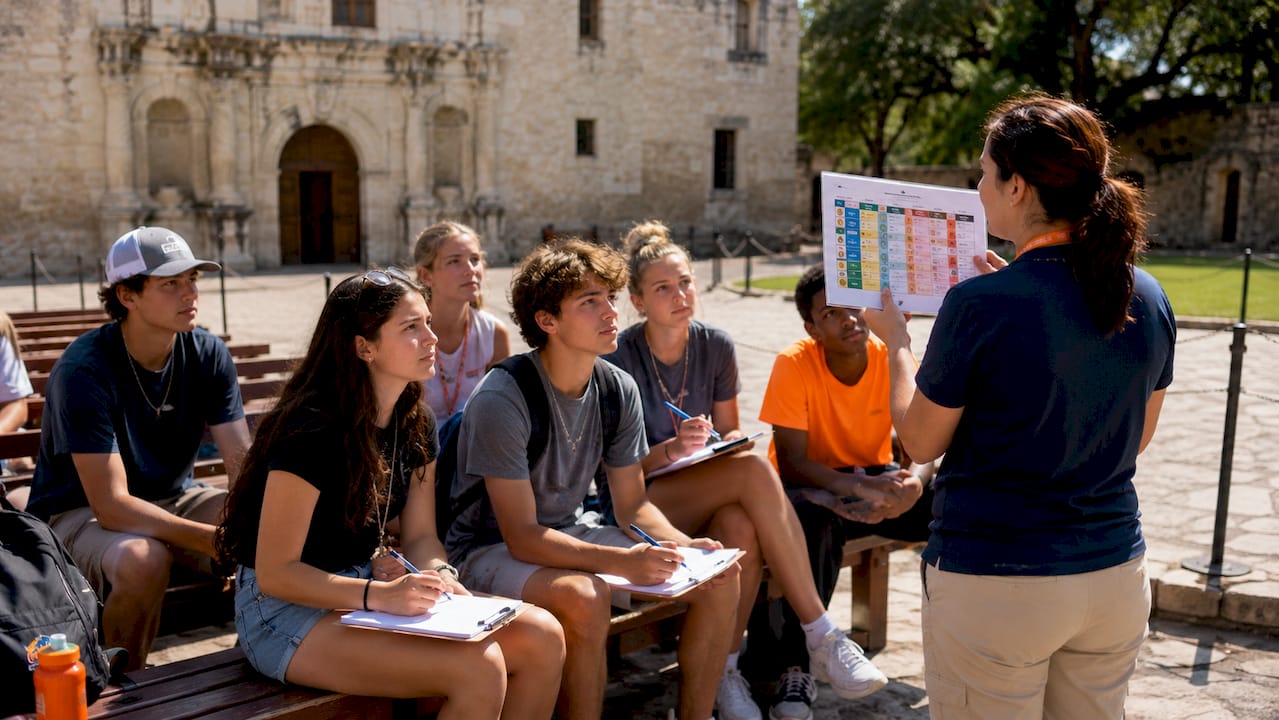
Duty of care is the legal and moral obligation schools hold toward every student and chaperone on a trip. It requires documented policies, pre-trip preparation, and a clear response plan when something goes wrong. Schools that fail to meet this standard face legal liability, regulatory penalties, and lasting reputational damage.
The core components of TRM include traveler tracking, real-time intelligence, emergency communication, and access to medical and security support. Each component works together. Tracking tells you where your group is. Intelligence tells you what threats exist at that location. Communication connects you to the group when a threat materializes. Support gets help to them fast.
ISO 31030 is the international standard that defines minimum requirements for organizational travel risk management. Aligning your school’s travel policies to this standard is the clearest way to demonstrate that your duty of care program meets a recognized global benchmark.
What are the main risks that affect educational group travel?
Educational group travel faces a wider range of risks than most coordinators initially expect. The risks fall into five broad categories, and each one requires a different response strategy.
- Medical emergencies: Students with pre-existing conditions, allergies, or injuries abroad face delays in care that would not occur at home. Access to local emergency services varies dramatically by destination.
- Crime and personal safety: Pickpocketing, scams, and in rare cases violent crime affect tourist-heavy destinations. Student groups are visible targets because of their size and predictable movement patterns.
- Natural disasters: Earthquakes, hurricanes, floods, and wildfires can disrupt travel with little warning. Destinations in Southeast Asia, Central America, and parts of Europe carry elevated seasonal risk.
- Political unrest and geopolitical instability: Protests, civil disruptions, and border closures can strand groups or create dangerous conditions. These situations can escalate within hours.
- Cybersecurity threats: Students and staff using public Wi-Fi abroad expose personal and institutional data to interception. This risk is often overlooked in school travel planning.
Risk levels shift based on destination and traveler profile. A group of high school students traveling to Japan faces very different risks than a group traveling to a country with active political instability. Destination-specific risk (opens in a new tab) profiles must be built for every trip, not copied from a generic template. Student groups also carry unique vulnerabilities: limited travel experience, group dynamics that can reduce individual awareness, and the legal status of minors requiring parental consent and guardian accountability at every step.
How is a travel risk assessment conducted?
A travel risk assessment is the structured process of scoring identified risks so that decision-makers can prioritize mitigation and determine whether travel should proceed. The standard tool is the 5×5 probability-impact matrix (opens in a new tab), which scores each risk on two dimensions.
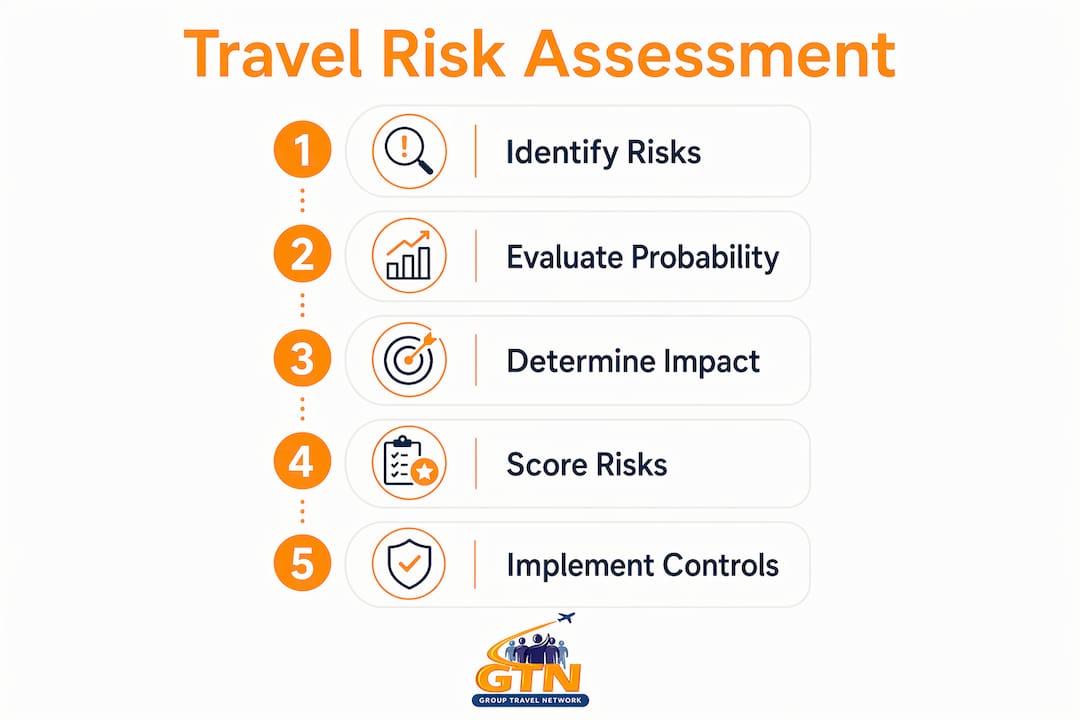
| Dimension | Scale | Description |
|---|---|---|
| Probability | 1 (Rare) to 5 (Almost Certain) | How likely is this risk to occur? |
| Impact | 1 (Insignificant) to 5 (Severe) | How serious would the consequences be? |
| Risk Score | Probability × Impact | Scores above 16 require travel to be stopped or rerouted. |
A score above 16 is not a suggestion. It is a threshold that requires action, whether that means canceling the trip, changing the destination, or implementing specific controls that reduce the score before travel is approved. This removes subjective judgment from high-stakes decisions and replaces it with a consistent, documented standard.
The assessment must be a living, dynamic document updated before, during, and after every trip. A risk that scores 8 in january can score 20 by march if political conditions deteriorate. Coordinators who complete the assessment once and file it away are not managing risk. They are creating a paper trail that offers no real protection.
For school travel, the assessment should cover every leg of the trip: departure airport, transit points, accommodation, activity venues, and return journey. Each location carries its own risk profile. A hotel in a safe neighborhood of a city does not neutralize the risk of an activity scheduled in a higher-risk district.
Pro Tip: Build your risk assessment in a shared document that your school’s legal, health, and administrative teams can all access and update in real time. A single version controlled by one person creates dangerous blind spots.
The role of the risk assessment in travel authorization is direct. Schools should require a completed and approved assessment before any trip receives final sign-off. This creates a formal gate that protects both students and the institution.
What practical steps support travel risk management in educational settings?
Effective travel safety management requires a sequence of deliberate actions, not a single policy document. The following steps form the operational backbone of a school-level TRM program.
- Conduct a destination risk assessment using the 5×5 matrix for every proposed trip. Update it as conditions change.
- Schedule pre-travel health consultations. CDC guidance (opens in a new tab) identifies the pre-travel consultation as a fundamental step for health-related risk mitigation, covering vaccinations, medication needs, and destination-specific health hazards.
- Deliver destination-specific training to students and chaperones. This covers local laws, cultural norms, emergency contact numbers, and what to do if separated from the group.
- Establish a traveler tracking system. Integrated booking data (opens in a new tab) and real-time monitoring enable rapid response and situational awareness during incidents. Know where every student is at every point in the itinerary.
- Create a tiered communication protocol. Define who contacts whom, in what order, when an incident occurs. Include local emergency services, the school’s administration, parents, and your travel provider.
- Secure travel insurance that covers medical evacuation, trip cancellation, and emergency repatriation. Standard travel insurance often excludes these for minors without specific riders.
- Document everything. Signed parental consent forms, medical disclosures, emergency contacts, and insurance certificates must travel with the group lead and exist in a secure digital backup.
Pro Tip: Assign each chaperone a specific emergency role before departure. One person manages student headcounts. One manages communication with the school. One manages contact with local emergency services. Defined roles prevent the paralysis that occurs when everyone looks to everyone else in a crisis.
Protecting travelers abroad (opens in a new tab) also means preparing students to protect themselves. Pre-trip education that covers personal safety habits, how to identify scams, and how to use local emergency services significantly improves group safety outcomes. Cultural preparation, such as learning destination basics (opens in a new tab) before a trip to Japan, also reduces the risk of misunderstandings that can escalate into safety incidents.
How does travel risk management fulfill legal and ethical duty of care?
Duty of care is mandatory, not optional. For schools, it is both a legal requirement and an ethical commitment to every family that entrusts a student to the institution’s care during travel.
The legal consequences of inadequate duty of care are concrete:
- Civil liability: Schools can face lawsuits from families if a student is harmed and the institution cannot demonstrate it took reasonable precautions.
- Regulatory penalties: Education authorities in many jurisdictions require documented risk management processes for off-campus travel. Non-compliance can result in sanctions or loss of accreditation.
- Reputational damage: A single high-profile incident that reveals poor planning can permanently affect enrollment, community trust, and staff retention.
The ethical dimension is equally clear. Students cannot fully consent to travel risks. Their parents rely on the school’s professional judgment to identify and manage those risks on their behalf. That responsibility does not transfer to a travel agency or a chaperone. It stays with the institution.
“Duty of care obligations exist worldwide and require documented travel risk policies. Failing to meet duty of care creates legal liability, regulatory penalties, and reputational damage. It is the moral and legal foundation driving every credible travel risk management program.”
The benefits of a strong TRM program extend beyond avoiding harm. Schools with documented, well-practiced travel risk policies report greater confidence from parents, smoother trip approvals from administrators, and faster, more coordinated responses when incidents do occur. Travel insurance for school groups (opens in a new tab) is one concrete layer of that protection, but it only works when the broader risk management framework is already in place.
Only about 35% of organizations believe they can mobilize teams fast enough during a crisis. That gap between policy and response speed is where students get hurt and schools face liability. Closing that gap requires practice, not just planning.
Key Takeaways
Effective travel risk management for schools requires continuous assessment, documented policies, and defined roles that connect safety planning to real-time response capability.
| Point | Details |
|---|---|
| Define TRM clearly | Travel risk management is a systematic program covering assessment, tracking, communication, and emergency response. |
| Use the 5×5 matrix | Score every risk by probability and impact; halt or reroute travel when scores exceed 16. |
| Treat assessments as living documents | Update risk assessments before, during, and after every trip as conditions change. |
| Fulfill duty of care legally | Documented travel risk policies protect schools from civil liability, regulatory penalties, and reputational harm. |
| Train travelers before departure | Pre-trip education and health consultations are the most direct way to reduce student risk abroad. |
Why I think most schools underestimate travel risk management
Most school travel programs I have seen treat risk management as a form to complete rather than a process to run. The assessment gets filed. The insurance gets purchased. The trip departs. And then something unexpected happens and nobody knows who calls whom.
The real gap is not documentation. It is coordination. Designating a dedicated travel risk manager who connects HR, legal, and security prevents travel safety from becoming a side task that falls through the cracks. In a school context, that person connects the principal’s office, the school nurse, the trip coordinator, and the travel provider into a single chain of accountability.
The other thing most programs miss is the post-trip review. Every trip produces data: what went wrong, what nearly went wrong, what the students found confusing or unsafe. That data should feed directly back into the next risk assessment. TRM that does not learn from experience is just paperwork.
Technology is changing what is possible here. Real-time traveler tracking through integrated booking platforms now gives coordinators live visibility into where every student is. That capability existed only in large corporate travel programs five years ago. Schools that adopt it now are genuinely ahead of their duty of care obligations, not just meeting them.
— Donovan
How Grouptravelnetwork supports safe school group travel
Grouptravelnetwork specializes in planning student and educational group trips with safety and compliance built into every itinerary. From dedicated trip coordinators to flexible travel protection options, the platform is built for the specific demands school administrators face.

Every student group trip (opens in a new tab) planned through Grouptravelnetwork includes structured support for risk documentation, emergency contacts, and traveler tracking coordination. The school group travel planning guide (opens in a new tab) walks coordinators through each stage of the process, from initial destination selection to post-trip review. For schools ready to move from reactive to proactive travel safety, Grouptravelnetwork provides the framework and the support team to make it work.
FAQ
What is travel risk management in simple terms?
Travel risk management is the process of identifying, assessing, and reducing risks that travelers face before and during a trip. It combines policies, tracking tools, and emergency protocols to keep travelers safe and organizations legally protected.
What is a travel risk assessment?
A travel risk assessment is a scored evaluation of the threats associated with a specific destination and trip, typically using a 5×5 probability-impact matrix. Scores above 16 require the trip to be modified or canceled.
What is the role of risk assessment in travel planning for schools?
Risk assessment determines whether a trip is safe to proceed and what controls must be in place before it does. It serves as the formal gate between trip proposal and trip approval in a compliant school travel program.
How do schools manage duty of care for student travel?
Schools fulfill duty of care by documenting travel risk policies, conducting destination-specific assessments, securing appropriate travel insurance, and maintaining real-time communication with traveling groups. Failure to document these steps creates direct legal liability.
How often should a travel risk assessment be updated?
A travel risk assessment must be updated continuously, not just at the planning stage. Conditions at a destination can change between booking and departure, and new risks can emerge during the trip itself.
Recommended
- Travel Management For Teams: How Schools Plan Smart Group Trips • Group Travel Network (opens in a new tab)
- Travel Insurance For School Group Trips Explained • Group Travel Network (opens in a new tab)
- Group Travel Insurance Explained: Protect Student Trips Easily • Group Travel Network (opens in a new tab)
- Step-by-step Group Travel Planning For School Trips • Group Travel Network (opens in a new tab)