


A good school trip deposit schedule works backward from one date: the day your vendors need the final balance. Set that date first. Then collect a non-refundable-or-limited-refund deposit early, split the rest into equal installments, and finish every family payment before the vendor’s deadline, with room to spare. The examples below come from real school and vendor documents, so you can see how the numbers fit together.
TL;DR
- Build the schedule backward: start with the vendor’s final payment deadline, then place the deposit and installments in between.
- Real 2025–2026 school schedules use a deposit of $230 to $300 followed by equal monthly or bimonthly installments.
- Spell out in writing when the deposit stops being refundable and what happens after that date.
- Send reminders before every due date and give families a way to check their balance.
- Decide in advance what you will do about a missed payment or a withdrawal, and put it in the family handout.
Table of Contents
- What the deposit does
- Work backward from the final payment deadline
- Three real schedules to learn from
- How to set the deposit amount
- Be explicit about when the deposit becomes non-refundable
- Communicating due dates and tracking balances
- When a family misses a payment or withdraws
- Mistakes that break a deposit schedule
- Our perspective
- Plan your group’s payment schedule with us
- FAQ
- Sources
What the deposit does
The first deposit has two jobs. It tells you who is serious about going, and it gives you money to reserve the things that sell out: hotel rooms, motorcoaches, venue slots and attraction tickets. Without it, you are holding space for a headcount that may change.
For that reason, the deposit should be collected as soon as the trip is approved and the family meeting has happened. If approvals are still pending, work through them first. Our school group travel planning guide (opens in a new tab) covers the approval and planning sequence that comes before the first dollar is collected.
There is no single national standard for deposit size or timing. The amount depends on what your vendors require from the school, the length of the trip, how far away it is and whether travel is domestic or international. What you can control is how clearly the schedule is written and how well it fits your vendor contracts.
Work backward from the final payment deadline
Vendors set the real deadlines. The school then builds a family schedule that finishes earlier.
A 2026 agreement between a California school district and an outdoor education institute shows how this looks on the vendor side. It lists a $36,322.50 reservation payment due October 2, 2026 (opens in a new tab) for a November 16–18, 2026 trip, and it requires full payment no later than 30 days before arrival. The school’s own collection from families has to be complete well before those dates, or the school fronts the cash.
Here is the order to work in:
- Write down the vendor deadlines. Reservation payment, interim payments, final payment, and the date the final headcount locks.
- Pick your internal final date. Make it one to two weeks before the earliest vendor deadline so late payments do not become your emergency.
- Decide the deposit date. This is usually right after the parent meeting or sign-up window.
- Divide the balance. Subtract the deposit from the per-student price and split the rest across the months you have.
- Choose due dates that match your calendar. The first or the first Wednesday of the month is easy to remember. Avoid dates that fall in school breaks.
- Publish it once, in writing, with every date and amount on one page.
Three real schedules to learn from
A long-runway music trip: 8 months, six payments
A Sidney Schools music department schedule for a May 30 to June 4, 2026 Florida trip lists a $230 deposit due October 7, 2025 (opens in a new tab), then $200 due on November 4, January 13, February 3, March 3 and April 7. The stated total is $1,230 per student.
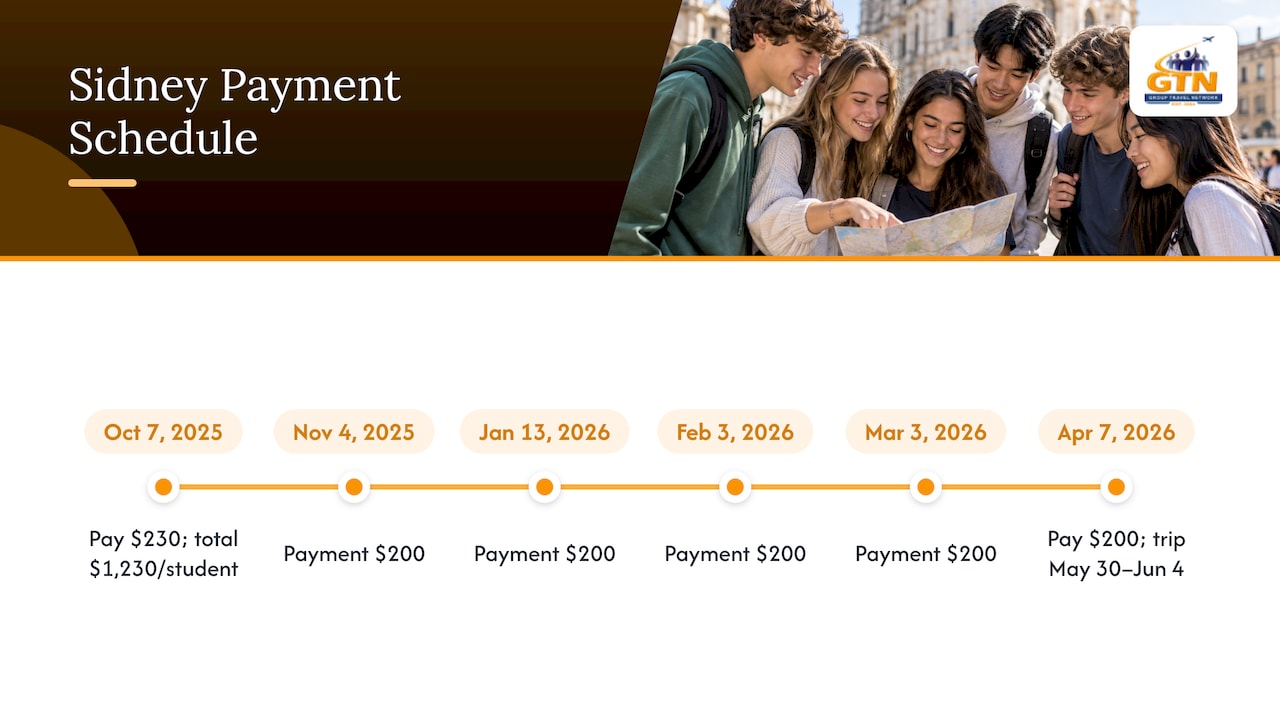
What works here: the deposit is paid roughly eight months before departure, the installments are equal, and the last payment lands almost two months before travel. Notice that the December payment is skipped, which helps families with holiday expenses.
A bimonthly plan: four payments over seven months
A 2026 parent letter from a Southwest Schools junior high lists a $1,185 Washington, D.C. trip (opens in a new tab) with $300 due March 1, $300 due May 1, $300 due July 1 and $285 due September 1, for travel November 4 to 7, 2026.
What works here: only four payment dates, spaced two months apart, and the final payment falls two months before the trip. The smaller last installment ($285) simply absorbs the remainder so the total matches the price exactly.
A vendor-side schedule: a large reservation payment, then full payment
The Pali Institute agreement above shows the third pattern: a large school reservation payment early, then the balance no later than 30 days before arrival. Schools that book this way are carrying the vendor’s schedule, so the family schedule must be tighter than the vendor’s.
Side by side
| Feature | Music trip (Sidney) | D.C. trip (Southwest) | Outdoor education (Pali) |
|---|---|---|---|
| First payment | $230 deposit | $300 | $36,322.50 school reservation payment |
| Number of payments | 6 | 4 | Reservation, then balance |
| Installment rhythm | Roughly monthly, skipping December | Every two months | Set by vendor agreement |
| Final payment | April 7, before May 30 departure | September 1, before November 4 departure | At least 30 days before arrival |
| Total per student | $1,230 | $1,185 | Not stated per student |
How to set the deposit amount
Two inputs drive the number. The first is what you owe vendors up front. The second is what families can reasonably pay at sign-up. A deposit that is too small leaves you exposed if students drop out. One that is too large turns away families before they see the value.
The published schedules above point to deposits between $230 and $300 on trips priced around $1,200. That is a useful reference range for a domestic trip at that price, not a rule. International itineraries with airfare usually need a larger up-front commitment because air and group-rate reservations are tied to firm headcounts. If you are planning one, talk through the payment structure with your travel planner before you announce a number. Our school trip payment guide (opens in a new tab) explains the costs and fees that go into the total.
An illustration you can adapt
This is a worked example for planning, not a published price. Say your trip costs $1,500 per student and the vendor needs the final payment on March 15 for an April-end departure. You open sign-up on September 15.
| Due date | Amount | Running total |
|---|---|---|
| September 30 | $250 (deposit) | $250 |
| November 1 | $250 | $500 |
| December 1 | $250 | $750 |
| January 5 | $250 | $1,000 |
| February 1 | $250 | $1,250 |
| March 1 | $250 | $1,500 |
The last payment is due two weeks before the vendor deadline. Equal amounts make the schedule easy to remember and easy to track.
Be explicit about when the deposit becomes non-refundable
Families should never discover refund terms after the fact. Your schedule should say which payments are refundable, until when, and why the rule exists.
The Sidney Schools schedule is a clear model. Its $230 deposit was refundable through November 4, 2025 (opens in a new tab), and after that date money paid would be forfeited because the school remained liable for Disney tickets, hotel rooms and motorcoach costs. Giving the reason, not just the rule, makes the policy easier for parents to accept.
Vendor terms can be stricter than yours. The Pali Institute agreement provides a full refund for written cancellations received at least 120 days before check-in, while cancellations under 120 days are generally not refundable (opens in a new tab), subject to specified rescheduling or insurance provisions. It also allows only a 50% student-cost refund for headcount reductions made less than 45 days before arrival when accompanied by a doctor’s note, and a last-minute illness may qualify for 50% if requested in writing within five days of departure with a doctor’s note.
What organizers should check in every vendor contract:
- The date the deposit stops being refundable.
- Whether a late headcount reduction is credited, partly refunded or lost.
- What medical documentation is required and the deadline for submitting it.
- Whether you can substitute a traveler.
- What insurance or rescheduling provisions apply.
Match your family-facing policy to the strictest of those terms. Our school trip cancellation policy guide (opens in a new tab) walks administrators through the wording, and our overview of travel insurance for school group trips (opens in a new tab) explains how protection can sit alongside the schedule.
Communicating due dates and tracking balances
A schedule only works if families see it. The Southwest Schools letter sends reminder emails seven days before, three days before and on each due date (opens in a new tab), and lets families check what they owe and pay early through an account link. That combination of reminders and self-service is worth copying.
A practical communication checklist:
- Put the full schedule on one page: dates, amounts, running total and the refund cutoff.
- Use the same due day each month where you can.
- Send reminders at seven days, three days and on the due date.
- Give every family a way to see their balance without calling the office.
- Accept more than one payment method and say which ones.
- Send a short confirmation after each payment.
- Post a countdown to the next date in the family newsletter or class page.
Online registration and payment tracking take the manual work out of this. For ready-to-use wording, see our school trip payment policy templates and timelines (opens in a new tab).
When a family misses a payment or withdraws
These situations come up on nearly every trip, so decide the response before the first deposit arrives. A fair, consistent approach protects the school and keeps families comfortable.
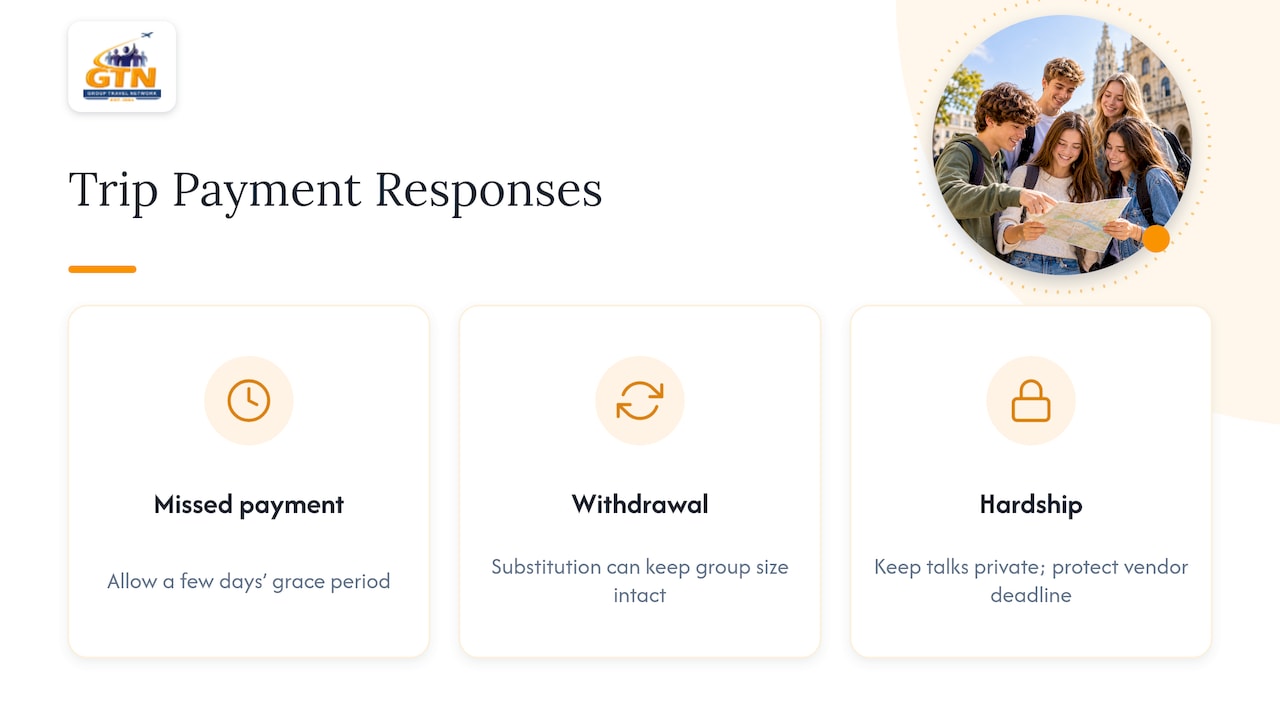
Missed payment. Set a short grace period, such as a few days, and say so in the handout. Send a reminder, then a personal call or email from a named contact. Offer to adjust the remaining dates if the final deadline can still be met. Write the consequence of continued non-payment into the schedule so nobody is surprised.
Withdrawal. Point to the refund cutoff already published. Before the cutoff, refund according to your policy. After it, explain which costs are already committed. If the vendor allows a substitution, offer it, because it can keep the group size intact without a loss.
Financial hardship. Tell families early whom to contact, and keep that conversation private. A modified plan is often possible if the final vendor deadline is protected. Our guide for families on interest-free school trip payment plans (opens in a new tab) is a helpful resource to share.
Place the policy where it is easy to find and have parents sign an acknowledgment at registration. That one step prevents most disputes.
Mistakes that break a deposit schedule
- Final family payment too close to the vendor deadline. A single late check then threatens the group’s booking.
- Unequal, unexplained amounts. Odd numbers confuse families. If the last payment differs, say why, as the D.C. schedule above does by absorbing the remainder.
- Due dates in vacation weeks. Payments slip when nobody is checking email.
- Vague refund language. “Non-refundable” without a date or reason invites arguments.
- No headcount lock date. The vendor will need a number; the family schedule should reflect when it is final.
- Collecting before approvals. If the board or principal has not approved the trip, a refund may become necessary.
Our perspective
We see the same pattern in the trips that run smoothly: the schedule was written before the first family heard about the trip. When the deposit date, installments and refund cutoff are all on one page at the parent meeting, the questions that follow are about the itinerary, not the money.
That is why we pair every group with a dedicated trip coordinator, online registration and flexible payment plans. The coordinator helps you map family payments to vendor deadlines, and the online system handles reminders and balances so your office does not have to chase checks.
We also encourage groups to look at travel protection options at the same time they set the schedule, not after. Knowing what is covered before families commit makes the refund conversation calmer for everyone.
A deposit schedule is a promise to families about how their money will be handled. We help you make that promise clear, and keep it.
Donovan
Plan your group’s payment schedule with us
If you are building a schedule for a band tour, a classroom trip or a senior class getaway, we can help you set it up around your vendor deadlines. Our team handles customized itineraries, vendor coordination, online registration and flexible payment plans, so you spend less time on spreadsheets.

Explore our performance tours (opens in a new tab) and educational trips (opens in a new tab), or start at Group Travel Network (opens in a new tab) to talk through your dates.
FAQ
What is the trip deposit date?
It is the first due date on your payment schedule, usually set right after the parent meeting or the sign-up window closes. In one published example, a music department set its $230 deposit due October 7, 2025 (opens in a new tab) for a trip the following May and June. Your date should fall early enough to secure vendor reservations.
How many installments should a school trip have?
There is no fixed number. Published examples run from four payments over seven months to six payments over eight months. Choose the count that gives families equal, manageable amounts and finishes before your vendor’s final deadline.
Are school trip deposits refundable?
It depends on the school’s policy and vendor contracts. One published schedule made the deposit refundable until a stated date and then non-refundable because the school remained liable for tickets, rooms and coaches. State your cutoff date in writing and match it to your vendor terms.
What should we do if a family falls behind?
Send a reminder, offer a short grace period and contact the family personally. If needed, adjust the remaining dates while keeping the final vendor deadline protected. Having the consequences written in the original schedule keeps the conversation simple.
Sources
- San Bernardino County Unified School District and Pali Institute agreement, 2026 (opens in a new tab)
- Southwest Schools Harrison Junior School D.C. trip parent letter, 2026 (opens in a new tab)
- Sidney Schools Music Department Florida trip payment schedule (opens in a new tab)
Recommended
- School Trip Payment Policy: 2026 Templates And Timelines (opens in a new tab)
- Parents: 7 Steps To Secure An Interest Free School Trip Payment Plan (opens in a new tab)
- How To Organize School Tours: 2026 Planning Guide (opens in a new tab)
- School Trip Cancellation Policy: 2026 Guide For Administrators (opens in a new tab)