

May 20, 2026
How to Organize School Tours: 2026 Planning Guide

TL;DR:
- Effective school tour organization relies on clear objectives, early planning, and a dedicated team led by an experienced Educational Visits Coordinator. Creating an itinerary that links destinations to learning goals, incorporates transition time, and assigns student-led activities enhances engagement and educational value. Post-trip feedback, strong communication, and a focus on safety ensure continuous improvement and memorable learning experiences.
Knowing how to organize school tours effectively separates a memorable learning experience from a logistical nightmare. Between managing parent permissions, aligning the trip with curriculum goals, tracking transportation, and keeping every student safe, the sheer number of moving parts can overwhelm even experienced educators. This guide cuts through that complexity with practical, step-by-step strategies built specifically for school administrators, trip coordinators, and educators who need a reliable framework for planning school field trips in 2026.
Table of Contents
- Key takeaways
- How to organize school tours: laying the groundwork
- Building a school tour itinerary that actually works
- Managing logistics and safety on the ground
- Communicating with students, parents, and staff
- Post-trip follow-up and continuous improvement
- My honest take on what makes or breaks school tours
- Let Grouptravelnetwork handle the heavy lifting
- FAQ
Key takeaways
| Point | Details |
|---|---|
| Start with educational objectives | Define curriculum-aligned goals before selecting a destination to keep the trip purposeful. |
| Build your planning team early | Assign an Educational Visits Coordinator with real authority before any logistics are confirmed. |
| Follow chaperone ratio requirements | Many districts mandate a 1:5 chaperone-to-student ratio with at least half of chaperones being school staff. |
| Use pre-trip orientation | Preparing students with lessons and expectations before departure significantly reduces on-site management issues. |
| Evaluate after every trip | Structured post-trip feedback and reflection sharpens planning for every future school excursion. |
How to organize school tours: laying the groundwork
Before you book a single bus or contact a venue, you need a solid foundation. The preparatory phase determines whether your trip has a clear purpose or becomes an expensive day out with no measurable outcome.
Start by writing down specific educational objectives. What do you want students to know, understand, or be able to do after this trip? Objectives tied directly to classroom units give your tour both focus and justification when seeking administrative approval. A history class visiting a civil rights museum, for example, should have concrete learning targets connected to the unit being taught, not just a general appreciation for history.
Once objectives are established, move to securing approvals. Most districts require documentation well ahead of departure. You will typically need:
- Formal approval from school administration and, in many cases, the district
- Written parental or guardian consent for every student
- Medical and allergy information for all participants
- Proof of travel insurance where required
- Budget authorization with itemized cost breakdowns
Assembling your planning team early is one of the most overlooked tips for school tours. Appoint an Educational Visits Coordinator (EVC) who has genuine authority to advise staff and administration. Research confirms that EVCs must be experienced visit leaders capable of embedding safety culture into the planning process, not simply a title handed to the most available teacher. The EVC role is your single most important structural decision.
Pro Tip: Start the approval process at least three months before your intended travel date. For overnight or international trips, six months is a more realistic minimum.
Building a school tour itinerary that actually works
A well-built school tour itinerary is not just a schedule. It is a learning design tool. The best itineraries create structured moments for discovery while leaving enough breathing room for students to process what they are experiencing.
Here is a practical sequence for developing your school tour itinerary ideas:
- Select destinations linked to learning goals. Every stop should connect directly to a classroom unit or skill. A science cohort visiting a natural history museum benefits most from stops tied to current topics, not a general wander through every exhibit.
- Build in transition time. Most planners underestimate how long it takes to move a group of 60 students from one location to another. Add 15 to 20 minutes between activities as a buffer.
- Design student-led components. Research shows that student exploration with guided questions improves engagement and reduces behavioral challenges compared to passive listening. Give students observation tasks, data collection roles, or short inquiry challenges.
- Confirm accessibility requirements. Identify mobility, sensory, or dietary needs early and verify that every venue can accommodate them before finalizing the itinerary.
- Use inquiry mapping. Develop two or three guiding questions students carry throughout the day to focus their attention and give teachers a debrief framework.
Comparing itinerary approaches helps clarify which format fits your group:
| Format | Best for | Trade-off |
|---|---|---|
| Single-site, deep dive | Elementary groups, focused units | Less variety, demands strong venue content |
| Multi-site sampler | Secondary students, survey topics | Logistics-heavy, less depth at each location |
| Student-choice hybrid | Upper secondary, project-based learning | Requires strong chaperone coordination |
Pro Tip: Offering tailored, interest-specific components within your itinerary — such as STEM labs or arts workshops — increases family satisfaction and improves student engagement throughout the day.
Managing logistics and safety on the ground
Solid school excursion organization depends on clear protocols and assigned responsibilities, not hope that things will work out. Start with your chaperone structure. Many districts require a chaperone ratio of 1:5 with at least 50% of chaperones being school staff rather than parent volunteers. Know your district’s specific requirements before recruiting parent help.
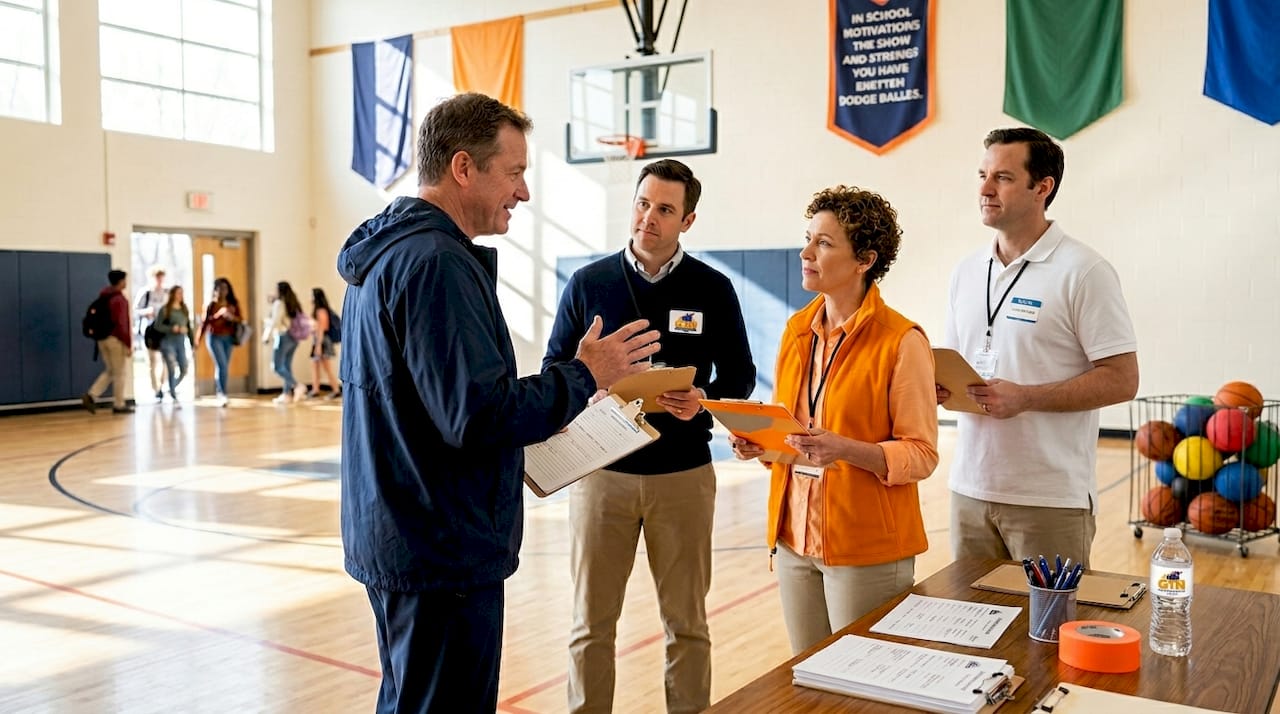
Assigning chaperones by student group rather than letting them self-organize is a critical distinction. Chaperones assigned to specific segments with defined roles such as bus monitor, first aid contact, or group supervisor improve accountability and response speed during incidents.
| Role | Responsibility | Key tool |
|---|---|---|
| Lead coordinator | Overall trip management and stakeholder updates | Group messaging app |
| Bus monitor | Headcounts and behavior during transit | Printed roster |
| First aid chaperone | Medical kit, allergy tracking, incident reporting | Medical binder |
| Group supervisor | On-site supervision of assigned students | Color-coded badges |
For safety protocols, apply dynamic risk assessment principles. This means your risk plan is a living document, not a form you complete and forget. Dynamic risk assessment involves adjusting plans in real time when unexpected changes occur, such as weather shifts, venue access issues, or a student medical situation. Document any adjustments as soon as possible after the event.
Pro Tip: Create a group messaging thread for all chaperones before departure day. Real-time coordination during a trip is nearly impossible without a communication channel that everyone already knows how to use.
Communicating with students, parents, and staff
Clear communication is the connective tissue of effective school excursion organization. Even the best-planned itinerary falls apart if students arrive unprepared, parents are anxious, or chaperones are unsure of their responsibilities.
For students, preparation should begin in the classroom at least one week before the trip. Pre-trip orientation with vocabulary and context transforms a passive outing into active learning. Teachers who front-load relevant background knowledge report significantly smoother on-site behavior and deeper student engagement. Think of it this way: students who already know what they are looking for pay far closer attention when they find it.
For parents, effective communication covers several non-negotiable areas:
- A detailed itinerary with departure and return times
- Emergency contact procedures for the trip
- Packing lists and appropriate clothing guidance
- Clear information on any cost breakdowns or payment deadlines
- Details on supervision ratios and safety protocols
For staff and chaperones, a dedicated briefing session before the trip date is not optional. Walk through emergency procedures, group assignments, behavioral expectations, and the schedule in detail. Staff who feel prepared supervise more confidently and respond more calmly when problems arise.
Cultural sensitivity and inclusivity deserve explicit attention during the communication phase. If your tour involves students from diverse backgrounds, confirm that activities, food options, and scheduling account for religious observances, dietary restrictions, and accessibility needs.
Pro Tip: Use a digital platform for collecting permissions, distributing updates, and tracking payments. Centralizing these documents reduces last-minute scrambling and creates a clear audit trail if questions arise.
Post-trip follow-up and continuous improvement
The trip is over. The buses are back. Now do the work that most organizers skip. Post-trip follow-up activities consolidate student learning and provide the feedback you need to make every future tour sharper.
Follow these steps to build a useful post-trip process:
- Collect feedback within 48 hours. Survey students, chaperones, and parents while the experience is fresh. Ask specific questions about what worked, what felt unclear, and what they wish had been different.
- Conduct a staff debrief. Bring the planning team together to review logistics against the itinerary. Were the time buffers adequate? Did any safety protocols need to be activated? What would you change?
- Share outcomes with administration. A brief summary report showing how the tour met its stated educational objectives builds institutional support for future trips and demonstrates accountability.
- Maintain vendor relationships. Follow up with venues, transport providers, and any partner organizations. Strong ongoing relationships often translate into better rates, priority booking, and smoother service next time.
- Integrate student reflections into class. Reflective writing, presentations, or project work following the trip reinforces learning and gives the experience lasting academic value.
Pro Tip: Archive your planning documents, risk assessments, approval paperwork, and vendor contacts in a shared folder. Starting the next trip with a complete reference file cuts planning time considerably.
My honest take on what makes or breaks school tours
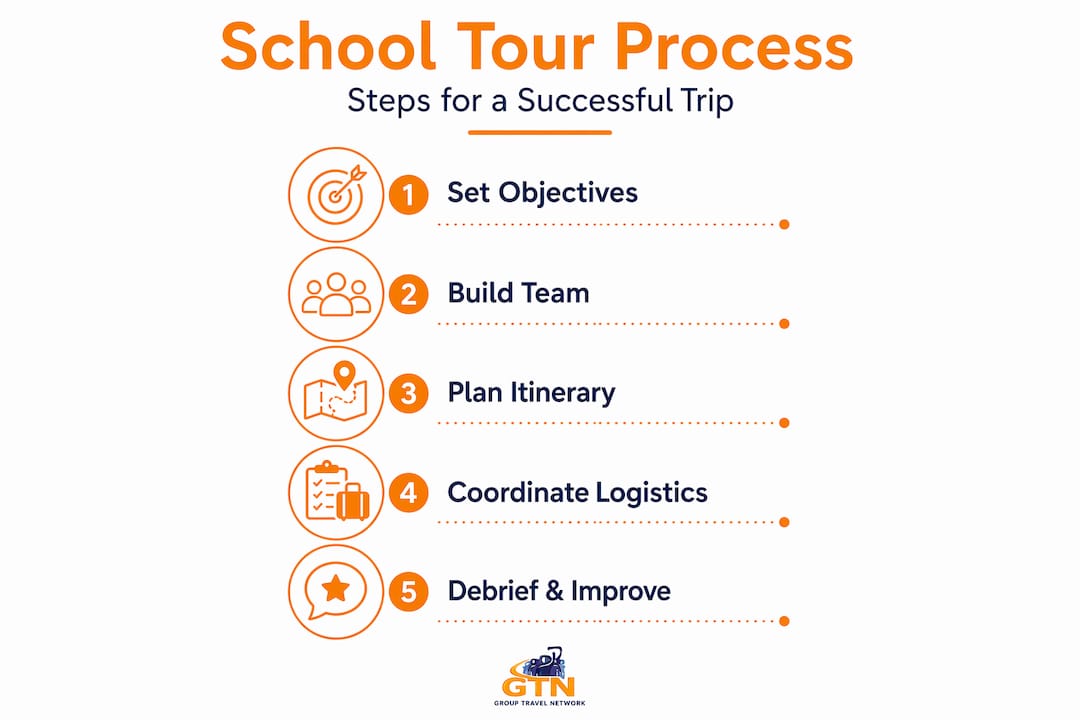
Over the years, I’ve seen more school tours succeed or fail on organizational decisions made months before departure day than on anything that happened during the trip itself.
The single biggest gap I see is the EVC role being treated as paperwork coordination rather than genuine leadership. An experienced EVC embedded in the school’s culture catches problems early, mentors less experienced teachers through the planning process, and maintains safety standards without turning the trip into a bureaucratic obstacle course. When that role is taken seriously, the whole operation runs differently.
I’ve also learned that over-restricting experiences in the name of risk management is its own form of failure. Risk assessment is about balancing hazards against educational benefits, not eliminating every possible uncertainty. The trips students remember for life usually involve some degree of authentic challenge or discovery. Your job is to make those moments safe enough to happen, not to prevent them entirely.
Finally, giving students a role during the tour changes everything. Student roles and guided quests reduce behavioral issues, improve retention, and make students active participants rather than passive passengers. That shift is free to implement and produces measurable results.
— Donovan
Let Grouptravelnetwork handle the heavy lifting
Planning a school tour well takes hundreds of hours of coordination across approvals, logistics, communication, and safety. Grouptravelnetwork exists specifically to shoulder that burden for schools, administrators, and educators who need results without the administrative overload.

Their school group travel guide covers every phase of the planning process with tools built for exactly the decisions described in this article: centralized itinerary management, vendor coordination, real-time updates, and flexible payment options designed for school budgets. Grouptravelnetwork works directly with trip coordinators to build custom programs that meet curriculum requirements, satisfy safety protocols, and create experiences students actually remember. If you are ready to move from planning theory to a confirmed itinerary, their team is the right starting point. You can also explore their resources for student group travel to see how other schools have built trips that balance education, safety, and genuine enjoyment.
FAQ
What is the standard chaperone-to-student ratio for school tours?
Many districts require a ratio of 1 chaperone for every 5 students, with at least 50% of those chaperones being school staff rather than parent volunteers. Always verify your specific district’s policy before recruiting volunteers.
How far in advance should you start planning a school field trip?
For day trips, three months is a reasonable minimum. For overnight or international educational trips, begin planning at least six months ahead to allow time for approvals, vendor booking, and parent communication.
What should a school tour itinerary include?
A strong itinerary includes destination details with arrival and departure times, activity descriptions tied to learning objectives, transition buffers, emergency contact information, and clear chaperone assignments for each segment of the day.
How do you manage student behavior during educational trips?
Pre-trip orientation with clear behavioral expectations and vocabulary preparation significantly reduces on-site management issues. Assigning students specific roles or inquiry tasks during the tour also keeps engagement high and minimizes disruptive behavior.
Why is post-trip evaluation important for school excursion organization?
Post-trip feedback from students, parents, and staff reveals gaps in planning and informs improvements for future tours. It also reinforces learning retention when student reflections are integrated into classroom follow-up activities.
Recommended

Relax with our Student Travel Expertise .
We deliver stress-free student trips backed by an exceptional array of services you won’t find anywhere else:
- Stress-free, creative planning of customized itineraries
- Dedicated GTN Service host on every trip
- Extensive travel protection plan options
- Online, individual registration system
- Flexible payment plans and online payment options
- Bulk buyer discounts for great trips that cost less
Inclusion into #MyGTNFamily for life! (you don’t even have to remember our birthday!)
Spain
There is no place like Spain to offer a student performance opportunity or cultural student trip.
Myrtle Beach
All students love the beach! Especially a beach known for its 60 miles of pristine coastline.
Boston
Have your students experience colonial charm in the city that is considered the hub of New England.
London
Provide your student group with the “Royal” treatment! One of the world’s most recognized cities.
See What People Are Saying
“It has been my privilege to use Group Travel Network as the exclusive travel coordinator for my band for over 10 years. I can say, without doubt or hesitation, that GTN is, by far, the best travel company for student groups currently in existence. I have often said that I wouldn’t take my band across the street without GTN and that’s not far from the truth!”
“This was my first time using a company to plan our band trip. It was so easy working with Justin and Group Travel Network. We had to make several changes along the way, but they were accommodating changes and worked everything out for us. I would highly recommend using Group Travel Network.”
“What wonderful trip we had to NYC! Our group of 51 never missed a beat because of Group Travel Network and our wonderful guide, Tim. It was truly a theatre trip to remember! If you are looking for a travel company who really cares about the details, Group Travel Network is for you!”