

August 15, 2026
School Trip Payment Policy: 2026 Templates and Timelines

A solid school trip payment policy tells parents exactly four things upfront: how much the deposit is and when it’s due, the full payment schedule with milestone dates, which payment methods are accepted, and what happens if they cancel, pay late, or need help. Post this policy in the trip packet, on the school website, and in the enrollment email before you collect a single dollar.
Six elements belong in every parent-facing policy:
- Deposit amount and purpose — how much secures a spot and whether any of it is refundable
- Full payment schedule — milestone dates, amounts due, and the final payment deadline
- Accepted payment methods and any transaction fees — card, ACH, check, or cash, and who absorbs the processing cost
- Refund, cancellation, and change rules — tiered deadlines tied to supplier penalties
- Travel protection note — whether insurance is optional or required and how it affects refunds
- Late-payment consequences and assistance options — holds, removal timelines, and where families can get help
Pro Tip: Post the same policy text in three places simultaneously: the permission slip, the school website trip page, and the first enrollment email. Families who see the same language in all three places ask far fewer clarifying questions.
Key Takeaways
A clear school trip payment policy, published before enrollment opens and tied to real supplier deadlines, is the single most effective way to protect organizers, families, and the trip itself.
| Point | Details |
|---|---|
| Publish before enrollment opens | Post the policy on the school website, permission slip, and enrollment email simultaneously. |
| Tie milestones to supplier dates | Align each payment deadline to a vendor invoice date to prevent cash-flow gaps. |
| Use a single payment link | One collection link per trip reduces reconciliation errors and speeds funds in 2–3 business days. |
| Plan for cancellations | A contingency fund of 3–5% of total revenue covers most surprise expenses and change requests. |
| Grouptravelnetwork | A dedicated trip coordinator manages payment collection, supplier deadlines, and reconciliation for you. |
Table of Contents
- What does a complete school trip payment policy checklist look like?
- Copy-and-paste parent-facing policy template
- Three sample payment schedules you can adapt today
- Which payment methods work best for school trip collection?
- How should you handle refunds, cancellations, and changes?
- How to handle late payments and non-payment fairly
- What records should you keep and how do you protect payment data?
- Week-by-week implementation checklist for a 6-month trip window
- An organizer’s perspective on what actually prevents cancellations
- How Grouptravelnetwork takes the payment admin off your plate
- Sources
- FAQ
What does a complete school trip payment policy checklist look like?
Building the policy element by element prevents the gaps that cause disputes later. Here is what to draft for each item and why it matters.
Deposit. It is standard practice to require a deposit representing a fraction of the per-student cost to secure a spot. Specify the exact dollar amount, the due date, and whether it is refundable before a cutoff date. Tie the deposit deadline to your first supplier payment so you are never fronting money out of pocket. Budgeting guidance from K&S Travel recommends starting with realistic headcounts (interested, likely, and committed) and mapping a deposit plus two to four milestone payments aligned to supplier billing.
Payment schedule. Present milestone dates as calendar dates, not “30 days before the trip.” Parents need to put specific dates on their calendars, and you need dates that match your vendor invoices.
Fee breakdown. State clearly what the trip price covers (transportation, lodging, admission, chaperone costs) and what it excludes (personal meals, gratuities, elective activities, and souvenir spending). Ambiguity here is the single biggest source of parent complaints.
Accepted methods and fees. List every accepted method. If you pass card-processing fees to families, say so explicitly and state the percentage. Hiding fees erodes trust fast.
Refund and cancellation tiers. Map your supplier’s cancellation penalty schedule into parent-facing language. See Section 6 for sample clause text.
Travel protection. Clarify whether travel insurance for school groups is optional or required and explain in one sentence what it covers. Parents who understand the insurance are far less likely to dispute a non-refund later.
Late-payment rules. Define “late” (e.g., more than 7 days past a milestone date), the hold process, and the deadline to pay before a spot is released.
Sibling and multi-student discounts. If you offer a discount for families enrolling more than one student, state the exact amount and whether it applies to each milestone or only the final balance.
Accessibility and assistance. Point families to fundraising resources, payment-plan extensions, and school assistance programs. Student travel fundraising tips can meaningfully reduce per-student cost exposure and keep participation high.
Recordkeeping owner. Name the person responsible for payment records, note that full card numbers are never stored (PCI DSS compliance), and state how long records are retained.
Pro Tip: Align every milestone payment date to a supplier invoice date rather than an arbitrary calendar month. This prevents the painful scenario where you owe a vendor before families have paid you.
Copy-and-paste parent-facing policy template
Paste the block below into your permission form, trip webpage, and enrollment email. Customize the bracketed fields.
[School Name] — [Trip Name] Payment Policy
Total per-student cost: $[AMOUNT]. A non-refundable deposit of $[DEPOSIT] is due by [DATE] to secure your child’s spot.
Payment schedule:
- Deposit: $[DEPOSIT] due [DATE]
- Payment 2: $[AMOUNT] due [DATE]
- Final balance: $[AMOUNT] due [DATE]
Accepted methods: Online card or ACH payment via [payment link]; checks payable to [School/Organization Name] delivered to [Office]. A [X]% convenience fee applies to card payments. Cash is not accepted.
Refunds and cancellations: Cancellations received before [DATE] receive a full refund minus the deposit. Cancellations between [DATE] and [DATE] receive a [X]% refund. No refund is issued after [DATE]. Travel protection is [optional/required]; see the insurance section of the trip packet.
Late payments: Accounts more than 7 days past a milestone date are placed on hold. Accounts unpaid 14 days after a milestone date may forfeit their spot. Contact [NAME] at [EMAIL] immediately if you need a short-term extension.
Need help? Contact [NAME] at [EMAIL] to discuss payment-plan options, fundraising opportunities, or school assistance programs.
Sample enrollment email (subject line: “[Trip Name] — Enrollment Is Open”):
Provide the policy as a downloadable PDF and an accessible plain-text version to meet ADA readability expectations.
Three sample payment schedules you can adapt today
K&S Travel’s logistics guide makes the case that families trust a single, authoritative source for trip costs. A clear schedule is that source. The three timelines below assume a $800 per-student trip cost for a group of 40 students.
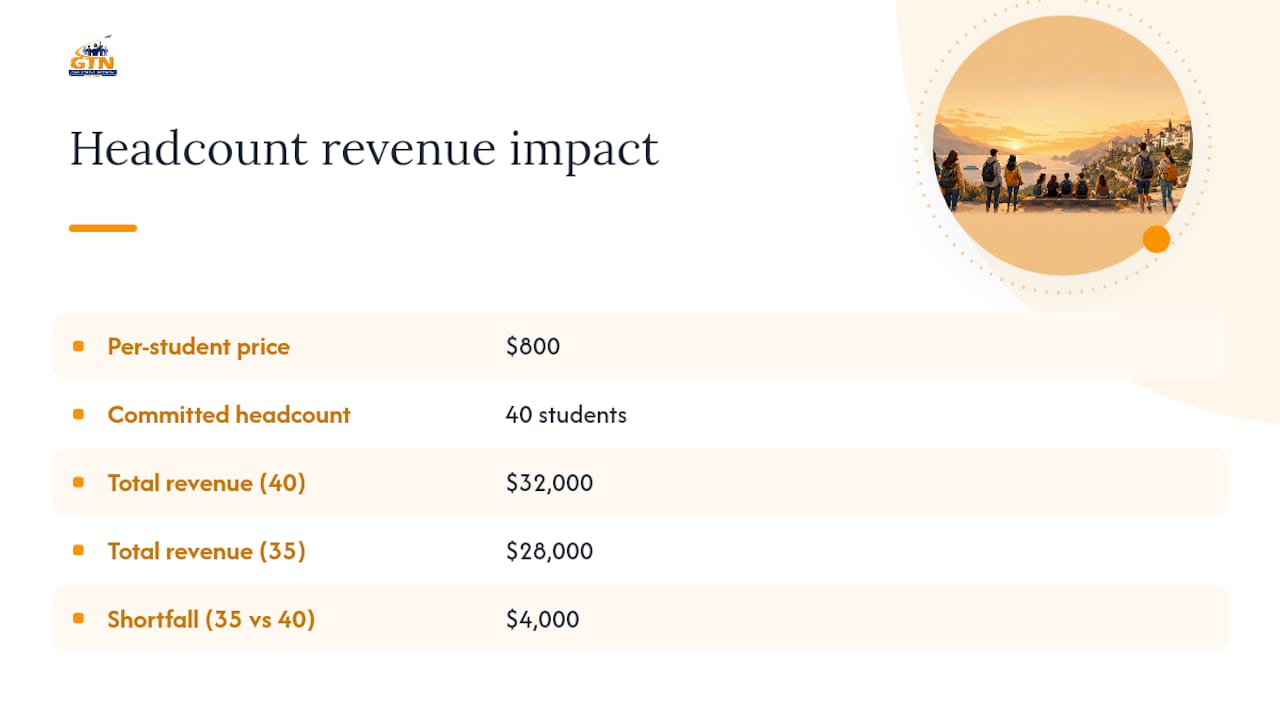
Headcount math matters. At 40 students paying $800 each, total revenue is $32,000. Drop to 35 students and you collect $28,000 — a $4,000 shortfall that may not cover fixed supplier costs. Build your budget at your “committed” headcount, not your “interested” count, and set a minimum enrollment threshold in the policy. Families who want to plan student educational travel with confidence need that number stated upfront.
Which payment methods work best for school trip collection?
Online payment platforms are the fastest and easiest to reconcile. Card and ACH payments via an online campaign can deposit funds in 2–3 business days and give you a live dashboard showing exactly who has paid. That visibility alone saves hours of manual tracking.
School cashier or office checks carry no processing fee and are familiar to families. The downside is manual reconciliation — someone has to log each check, match it to a student, and deposit it. Checks also slow your cash flow by days.
Cash creates the most reconciliation risk. If you accept it at all, require a signed receipt at the point of collection and log it immediately. Many organizers simply exclude cash from the policy.
School internal payment systems (where the district already has a parent-pay portal) are worth using when available. They often integrate with student information systems, which cuts duplicate data entry.
Pro Tip: Use a single payment link per trip. Multiple links for the same trip create split records that are painful to reconcile when a supplier asks for a headcount confirmation.
A quick reconciliation checklist:
- Designate one person to update the payment roster after each milestone date
- Mark partial payments separately from completed payments
- Lock the headcount number to vendors 72 hours before the supplier deadline, not the day of
- Cross-reference the payment dashboard against the student roster weekly during the collection window
For deeper guidance on reconciliation workflows, Grouptravelnetwork’s group travel payment management guide covers the full process.
How should you handle refunds, cancellations, and changes?
Map your supplier’s penalty schedule first, then write parent-facing tiers that sit inside those penalties.
Sample refund clause language:
- Full refund (minus deposit): Written cancellation received more than 75 days before departure.
- 50% refund: Written cancellation received 45–74 days before departure.
- No refund: Cancellation received fewer than 45 days before departure.
Change requests (name swaps, room changes, itinerary additions) should require written approval from the organizer and may carry a $25–$50 administrative fee if the supplier charges one. State this in the policy so it is not a surprise.
Travel protection changes the math significantly. Families with travel insurance for school group trips can file claims for covered cancellation reasons directly with the insurer, which removes pressure on the organizer to issue refunds outside the policy. As K&S Travel notes, plan for at least one cancellation, one change request, and one surprise expense — a small contingency fund of 3–5% of total revenue covers most of those scenarios.
How to handle late payments and non-payment fairly
A repeatable escalation path prevents both awkward conversations and last-minute financial shortfalls.
- Day 1 past due: Automated reminder email with the payment link and the next milestone date.
- Day 7 past due: Personal email or phone call from the trip coordinator. Note the account is on hold.
- Day 14 past due: Written notice that the spot will be released in 48 hours unless payment or a written extension request is received.
- Day 16 past due: Spot released; family notified in writing. Refund issued per the cancellation policy.
Sample Day 7 message: “Hi [Parent Name], we noticed your [Trip Name] payment of $[AMOUNT] due [DATE] hasn’t come through yet. Your child’s spot is currently on hold. Please pay at [LINK] or reply to this email to discuss options. We want to make this work.”
For equity, keep a short-term extension policy (up to 10 days) for families who proactively reach out. Refer families in financial need to school assistance programs, student sinking-fund strategies, or the trip’s fundraising campaign before removing a student from the roster.
What records should you keep and how do you protect payment data?
Minimum records for every trip:
- Signed payment agreement or permission slip for each student
- Payment receipts (date, amount, method, payer name)
- Student roster with payment status at each milestone
- Supplier invoices and confirmation numbers
- Written change requests and approvals
PCI DSS basics: Never write down or store full card numbers, CVV codes, or card expiration dates. Use a payment processor that tokenizes card data — the processor holds the sensitive data, not you. This is not optional; it is the baseline standard for anyone accepting card payments.
Limit financial record access to the trip coordinator and the school finance office. Retain records for a minimum of three years or per your district’s document-retention policy, whichever is longer.
Pro Tip: At the end of the trip, send a one-page reconciliation summary to the school finance office: total collected, total paid to suppliers, refunds issued, and closing balance. It takes 20 minutes and prevents audit headaches later.
Week-by-week implementation checklist for a 6-month trip window
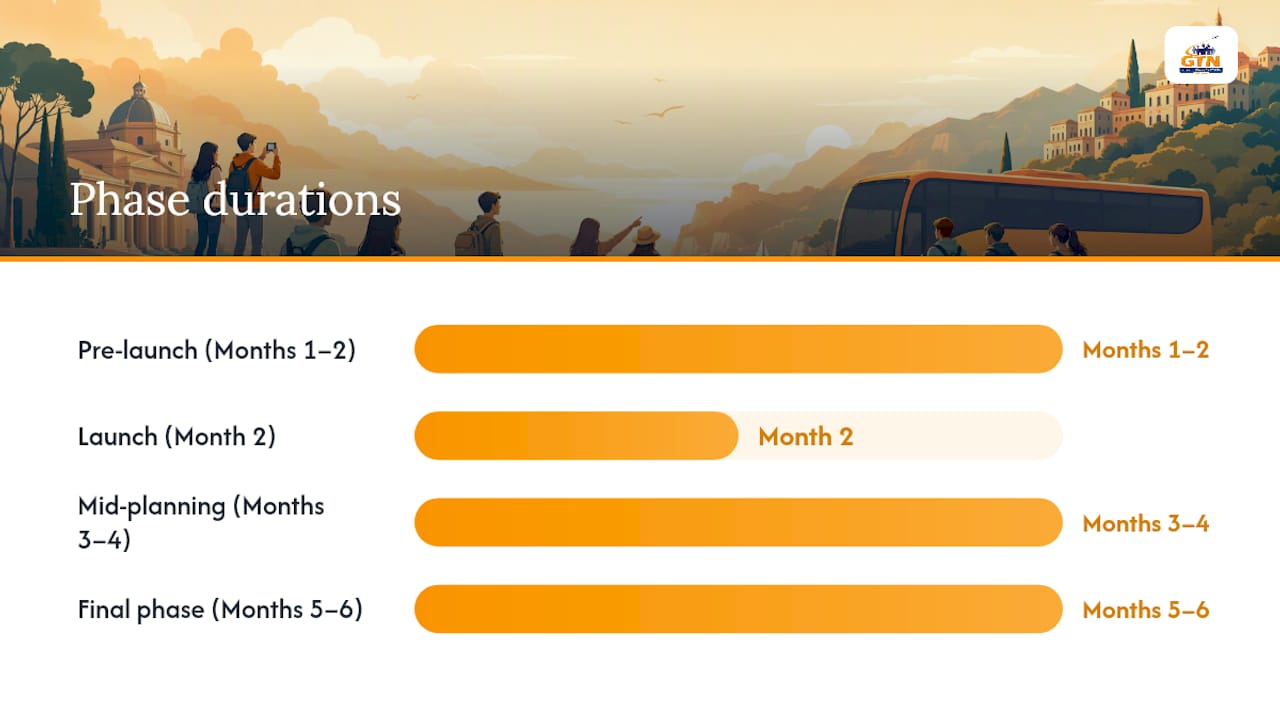
Pre-launch (Months 1–2):
- Confirm supplier terms, deposit amounts, and cancellation penalty schedule.
- Set per-student price based on committed headcount (not interested count).
- Choose your payment collection method and set up the payment link.
- Draft the parent-facing policy and obtain principal or district approval.
- Prepare the enrollment email, permission slip, and trip webpage.
Launch (Month 2):
- Publish the policy on the school website and trip page.
- Send the enrollment email with the payment link and deposit deadline.
- Open the payment link and collect deposits.
Mid-planning (Months 3–4):
- Send milestone payment reminders 14 days and 3 days before each due date.
- Monitor the payment dashboard weekly; follow up on holds.
- Confirm chaperone count and update the supplier with final headcount.
Final phase (Months 5–6):
- Collect final balances; close the payment link 2 weeks before departure.
- Pay all supplier invoices; retain confirmation numbers.
- Issue any approved refunds within 5 business days of cancellation.
- Reconcile the ledger and submit the summary to the school finance office.
For a full step-by-step planning framework, the school group travel planning guide covers vendor coordination and timeline management in detail.
An organizer’s perspective on what actually prevents cancellations
The most common reason a school trip falls apart financially is not a bad economy or a difficult parent. It is an organizer who waited too long to publish the payment terms. Families make competing financial commitments in the months before enrollment opens. A policy that arrives late competes with those commitments and loses.
The second most common reason is misaligned deadlines. When your payment milestones do not match your supplier invoice dates, you end up either chasing families for money you already owe a vendor or sitting on collected funds with no clear obligation to pay. Neither is comfortable.
The fix is mechanical: publish the policy before enrollment opens, tie every milestone to a real supplier date, and communicate through one authoritative channel.
Families who receive consistent information from a single source trust the process and pay on time.
How Grouptravelnetwork takes the payment admin off your plate
Running a school trip means managing itineraries, chaperones, permissions, and a dozen supplier relationships at once. Payment collection should not be the thing that keeps you up at night.

Grouptravelnetwork assigns a dedicated trip coordinator to every booking. That coordinator aligns your payment milestones to supplier invoice dates, manages the collection dashboard, and handles parent payment questions directly — so you are not fielding calls at 9 PM about a missed deadline. The platform supports online card and ACH collection, tracks partial payments, and generates reconciliation reports your finance office can use without translation.
For band directors planning student guided tours or performance trips, the coordinator also manages vendor confirmations and itinerary adjustments as headcounts shift. Visit the youth travel services page to see how a managed booking works and to request a planning consultation for your next trip.
Sources
- How to Budget for School Trips: A Stress-Free Guide | K&S Travel
- School Field Trip Fundraiser | Collect for Travel | PayIt2
FAQ
What should a school trip payment policy include?
A complete policy covers six elements: deposit amount and refundability, the full payment schedule with milestone dates, accepted payment methods and any fees, refund and cancellation tiers, a travel protection note, and late-payment consequences with assistance options.
How much should the deposit be for a school trip?
It is standard practice to require a deposit representing a fraction of the per-student cost to secure a spot. Set the deposit deadline to coincide with your first supplier payment so you are not fronting costs before families have committed.
What happens if a family can’t make a payment on time?
A fair escalation path places the account on hold at 7 days past due, sends a personal follow-up, and releases the spot at 16 days if no payment or extension request is received. Always refer families to fundraising resources or school assistance programs before removing a student.
Does travel insurance affect the organizer’s refund obligations?
Yes. Families with travel protection can file claims directly with the insurer for covered cancellation reasons, which reduces pressure on the organizer to issue out-of-policy refunds. Grouptravelnetwork’s travel insurance explainer details how coverage interacts with standard refund tiers.
How do I collect school trip payments securely?
Use a payment processor that tokenizes card data — never store full card numbers yourself. A single online payment link per trip speeds funds to your account in 2–3 business days and provides a dashboard that simplifies reconciliation against your student roster.
Recommended

Relax with our Student Travel Expertise .
We deliver stress-free student trips backed by an exceptional array of services you won’t find anywhere else:
- Stress-free, creative planning of customized itineraries
- Dedicated GTN Service host on every trip
- Extensive travel protection plan options
- Online, individual registration system
- Flexible payment plans and online payment options
- Bulk buyer discounts for great trips that cost less
Inclusion into #MyGTNFamily for life! (you don’t even have to remember our birthday!)
Spain
There is no place like Spain to offer a student performance opportunity or cultural student trip.
Myrtle Beach
All students love the beach! Especially a beach known for its 60 miles of pristine coastline.
Boston
Have your students experience colonial charm in the city that is considered the hub of New England.
London
Provide your student group with the “Royal” treatment! One of the world’s most recognized cities.
See What People Are Saying
“What wonderful trip we had to NYC! Our group of 51 never missed a beat because of Group Travel Network and our wonderful guide, Tim. It was truly a theatre trip to remember! If you are looking for a travel company who really cares about the details, Group Travel Network is for you!”
“This was my first time using a company to plan our band trip. It was so easy working with Justin and Group Travel Network. We had to make several changes along the way, but they were accommodating changes and worked everything out for us. I would highly recommend using Group Travel Network.”
“It has been my privilege to use Group Travel Network as the exclusive travel coordinator for my band for over 10 years. I can say, without doubt or hesitation, that GTN is, by far, the best travel company for student groups currently in existence. I have often said that I wouldn’t take my band across the street without GTN and that’s not far from the truth!”