

TL;DR:
- A nonprofit group trip guide is a crucial planning tool that ensures safe, ethical, and organized mission-driven travel. Proper timelines, budgeting, safety measures, and community engagement are essential for successful trips, which should start planning 10 to 12 months in advance. Effective preparation, ethical partnerships, and thorough vetting prevent common challenges and maximize positive impact for communities, participants, and organizations.
A nonprofit group trip guide is a structured planning resource that helps community leaders organize safe, affordable, and mission-driven group travel for youth and volunteers. Without a clear framework, even well-intentioned trips collapse under budget shortfalls, safety gaps, or misaligned expectations. The industry term for this type of travel is service-learning travel or mission travel, and it covers everything from domestic community service excursions to international volunteer programs. This guide gives you the full picture: timeline, fundraising, safety, ethical engagement, and how to handle the inevitable surprises.
What is a nonprofit group trip guide and why does it matter?
A nonprofit group trip guide is the planning backbone for any organization sending youth or volunteers into the field. It defines the mission, sets the timeline, assigns roles, and builds the accountability structure that keeps a trip on track from day one to the final debrief.

Group travel for charities and nonprofits differs from standard school trips in one critical way: the trip itself is the program. The destination, the service work, and the cultural exposure are not extras. They are the deliverables. That means every planning decision, from transportation to provider vetting, carries program weight.
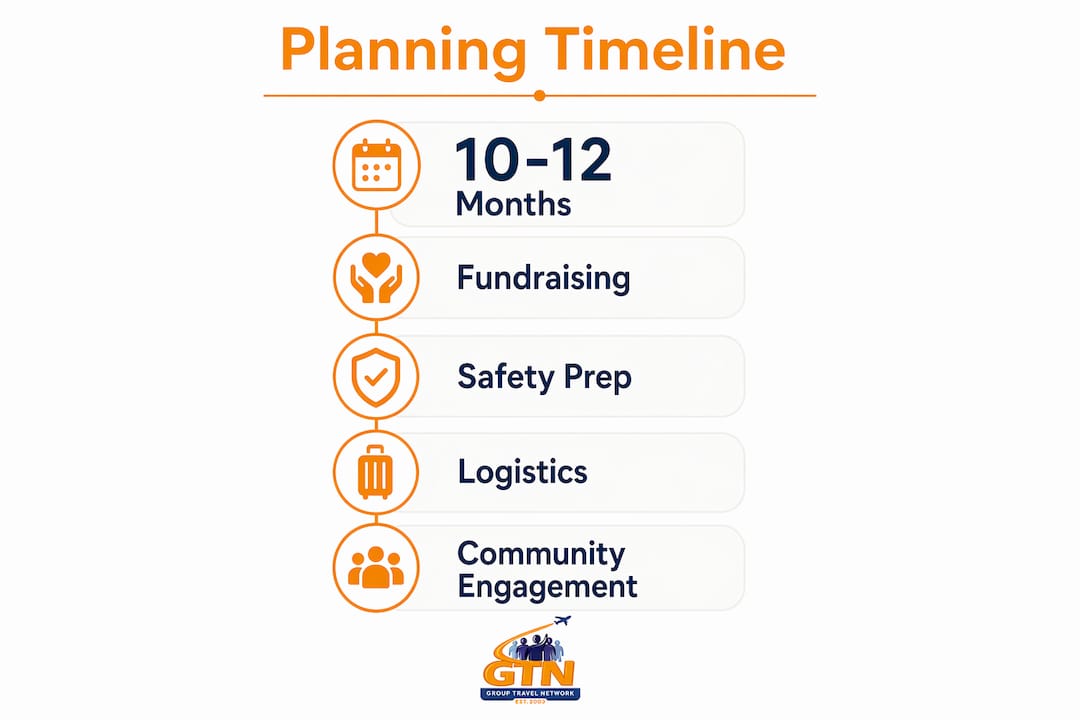
The most common mistake nonprofit leaders make is starting too late. A 4-phase planning structure (opens in a new tab) divides the work into foundation (12–6 months out), blueprint (6–3 months out), final prep (3 months to departure), and post-trip activities. Starting 10–12 months ahead is not excessive. It is the minimum required to handle passports, visas, fundraising, and logistics without crisis management.
How to build a solid planning timeline for group trips
Time-phased planning with clear milestones reduces last-minute budget overruns and prevents the kind of scrambling that burns out trip leaders before the group even boards a plane.
Here is how the four phases break down in practice:
-
Foundation Phase (12–6 months out): Define the trip’s mission and learning objectives. Recruit your leadership team and assign roles. Identify your destination and begin vetting program providers. Start the passport and visa process immediately, since delays here derail everything else.
-
Blueprint Phase (6–3 months out): Lock in your itinerary, accommodations, and transportation. Finalize your budget and launch your fundraising campaign. Begin participant registration and collect medical and emergency contact information.
-
Final Prep Phase (3 months to departure): Conduct pre-departure training sessions covering cultural sensitivity, safety protocols, and volunteer role expectations. Confirm all travel documents. Run a full communication drill with participants and guardians.
-
Trip and Post-Trip Phase: Execute daily debriefs on the ground. Document outcomes and participant reflections. Within 30 days of return, complete a full program evaluation and share results with stakeholders and donors.
For step-by-step planning tools (opens in a new tab) tailored to educational and nonprofit groups, Grouptravelnetwork offers structured resources that map directly to this framework.
Pro Tip: Build a shared digital project tracker using Google Sheets or Asana from day one. Assign every task an owner and a deadline. Visibility kills procrastination.
How to fundraise and budget for a nonprofit group trip
Fundraising trip planning starts with a detailed, honest budget. Vague cost estimates destroy donor confidence and leave participants scrambling for money two months before departure.
Your budget must include these line items:
- Transportation: Flights, ground transfers, and local transit
- Lodging: Per-person nightly cost multiplied by trip length
- Meals: Daily per-person allowance with a buffer for dietary needs
- Program fees: Service-learning provider costs, site access, or activity fees
- Insurance: Travel protection and medical coverage for every participant
- Contingency fund: A minimum of 10% of total budget for unexpected costs
Individual fundraising pages (opens in a new tab) with milestone tracking significantly improve results for youth groups. Platforms like GoFundMe Charity, Fundly, and DonorBox all support nonprofit group campaigns with tax-receipt features that matter to donors.
Coaching participants on fundraising communication is as important as the platform itself. Teach every participant to write a personal appeal that explains the trip’s mission, their specific role, and the community impact. Generic asks raise less money. Personal stories raise more.
Pro Tip: Set a per-participant fundraising goal with a clear deadline and a public progress tracker. Peer visibility drives accountability far better than private reminders.
On the legal side, confirm your organization’s 501©(3) status covers trip-related fundraising. Some states require separate charitable solicitation registration. A one-hour conversation with your accountant before you launch saves significant headaches later.
What are best practices for safety and transportation on youth trips?
Safety on nonprofit youth trips is an operational design problem, not a luck problem. Risk management treats transportation (opens in a new tab) as the first variable to control, not the last.
The non-negotiable safety standards for group travel for charities include:
- Default to school buses or chartered coaches with professional, licensed drivers for all ground transportation
- Pre-approve all volunteer drivers with proof of insurance, a clean driving record check, and mandatory seatbelt enforcement
- Assign supervision ratios before departure, with a recommended minimum of one adult per eight youth participants
- Create an emergency communication plan that includes a group messaging app, a designated emergency contact at home base, and a written protocol for medical incidents
- Enroll all travelers in STEP, the U.S. government’s Smart Traveler Enrollment Program (opens in a new tab), which gives embassies the ability to contact your group during a crisis
- Verify travel insurance covers medical evacuation, trip interruption, and lost documents for every participant
“Designing safety into operations through assigned roles and communication improves incident response and group confidence.” — Field Trip Tips: Leadership and Planning
For a deeper look at youth travel safety protocols (opens in a new tab), Grouptravelnetwork covers supervision policies and risk frameworks specifically built for nonprofit and school group contexts.
How to partner ethically and prepare participants for community engagement
Ethical community engagement is the defining quality of a high-impact nonprofit trip. Vetting providers thoroughly (opens in a new tab) prevents the ethical pitfalls that undermine both community benefit and participant learning.
When evaluating a service-learning provider, ask these questions directly:
- Does the program address a need identified by the local community, not just by outside volunteers?
- Are participant roles clearly defined, supervised, and matched to actual skills?
- Does the organization publish transparent financials and community outcome reports?
- What is the long-term relationship between the provider and the host community?
Confirming participant roles and supervision before departure prevents confusion and safety risks on-site. Volunteers who arrive without a clear understanding of their role create friction for local staff and reduce program effectiveness.
Pre-departure training should cover cultural norms, basic language phrases, the history of the host community, and a frank discussion of the limits of short-term volunteering. Participants who arrive with realistic expectations contribute more and extract more learning from the experience.
Pro Tip: Schedule a 90-minute pre-departure session with a facilitator from EmpowerED (opens in a new tab) or a similar professional learning organization. Structured reflection before the trip produces measurably better outcomes than orientation packets alone.
Post-trip communication matters as much as preparation. Share outcomes with donors, participants, and the host community within 60 days of return. This closes the loop and builds the trust that funds your next trip.
What common challenges arise on nonprofit group trips?
Even well-planned trips hit friction. The leaders who handle challenges well are the ones who anticipated them before departure.
-
Group dynamics and behavior: Establish a clear code of conduct before departure and review it with participants and guardians. Address behavioral issues privately and immediately. Unresolved tension spreads fast in group settings.
-
Travel disruptions: Flight cancellations, weather delays, and transportation breakdowns happen. Build buffer days into international itineraries and keep a list of backup accommodations and local contacts. Consistent communication systems during planning reduce confusion when real-time changes are needed.
-
Health incidents: Carry a full first aid kit, a list of participant medical conditions, and the location of the nearest hospital or clinic at every destination. Designate one leader as the medical point of contact.
-
Participant disengagement: Daily debrief sessions of 20–30 minutes keep participants connected to the trip’s purpose. Use structured reflection prompts, not open-ended check-ins. Specific questions produce specific insights.
-
Post-trip drop-off: The energy that builds during a trip often disappears within two weeks of return. Plan a post-trip event within 30 days to share stories, present outcomes, and channel participant motivation into the next phase of your organization’s work.
Key takeaways
A nonprofit group trip succeeds when planning starts 10–12 months out, safety is built into operations, and ethical provider partnerships are confirmed before departure.
| Point | Details |
|---|---|
| Start planning 10–12 months early | Passports, visas, fundraising, and provider vetting all require long lead times. |
| Use a 4-phase timeline | Divide work into foundation, blueprint, final prep, and post-trip phases to stay on track. |
| Build a detailed budget first | Include transportation, lodging, meals, program fees, insurance, and a 10% contingency fund. |
| Design safety into operations | Assign supervision ratios, pre-approve drivers, and enroll all travelers in STEP before departure. |
| Vet providers for ethical alignment | Confirm community-identified needs, clear volunteer roles, and transparent program outcomes. |
Why i think most nonprofit trip leaders underestimate the planning work
I have worked with dozens of nonprofit and school group leaders over the years, and the pattern I see most often is the same: a passionate leader with a great mission and a six-month runway who believes enthusiasm will cover the gaps. It rarely does.
The trips that go well share one trait. The leader treated the planning process with the same seriousness as the trip itself. They built a team, assigned ownership, and tracked every deadline. They did not wait for fundraising to feel comfortable before booking. They booked, then fundraised with urgency.
The trips that struggled usually had one of two problems. Either the provider was selected based on price and a good website rather than a real vetting conversation, or the safety plan existed only on paper. Both failures are preventable.
What I find most underrated in nonprofit trip volunteer training is the pre-departure reflection work. Groups that spend real time before departure discussing their assumptions about the host community arrive more humble, more curious, and more useful. That shift in mindset produces better outcomes for everyone involved.
My honest advice: if you cannot commit to a 10-month planning timeline, push the trip back. A rushed trip with an underprepared group does more harm than good, to the community, to your participants, and to your organization’s reputation. The mission is worth doing right.
— Donovan
Plan your next nonprofit group trip with Grouptravelnetwork
Planning trips for volunteers and youth groups takes real infrastructure: itinerary coordination, fundraising support, vendor relationships, and safety planning that holds up under pressure. Grouptravelnetwork specializes in exactly this kind of work for educational institutions, nonprofits, and youth organizations.

From customized itineraries to flexible payment plans and dedicated trip coordinators, Grouptravelnetwork removes the logistical weight so you can focus on the mission. Whether you are organizing a domestic service trip or an international educational adventure, the team handles the details that trip leaders should not have to manage alone. Explore student group trip planning (opens in a new tab) services built for organizations like yours, and take the first step toward a trip your participants will carry with them for years.
FAQ
What is a non-profit group tour?
A non-profit group tour is organized travel led by a nonprofit organization for youth, volunteers, or community members, with a mission-driven purpose such as service learning, cultural exchange, or community engagement. It differs from commercial tours in that the primary goal is impact, not profit.
How far in advance should nonprofit trip planning start?
Nonprofit youth trips require a minimum of 10–12 months of planning to handle passports, visas, fundraising, provider vetting, and participant training without last-minute crises.
What fundraising platforms work best for nonprofit group trips?
GoFundMe Charity, Fundly, and DonorBox all support nonprofit group fundraising with individual participant pages and tax-receipt features. Individual fundraising pages with milestone tracking consistently improve results for youth groups.
What is STEP and why does it matter for nonprofit travel?
STEP is the U.S. government’s Smart Traveler Enrollment Program. Enrolling your group gives the nearest embassy the ability to contact travelers during emergencies and provides real-time safety alerts for your destination country.
How do you vet a service-learning provider for ethical alignment?
Ask whether the program addresses a community-identified need, whether volunteer roles are clearly defined and supervised, and whether the provider publishes transparent outcome reports. Ethical provider vetting prevents misaligned expectations and protects both participants and host communities.
Recommended
- What Is Student Trip Fundraising: A 2026 Guide • Group Travel Network (opens in a new tab)
- How To Create Group Itineraries That Work For Everyone • Group Travel Network (opens in a new tab)
- How To Organize School Tours: 2026 Planning Guide • Group Travel Network (opens in a new tab)
- Field Trip Organization Tips: A School Administrator’s Guide • Group Travel Network (opens in a new tab)