


TL;DR:
- Creating a group itinerary involves designing a flexible plan that balances shared experiences with individual needs. The Core/Optional/Free framework helps organize activities, with limited daily core events, voluntary options, and unstructured free time to prevent burnout. Using centralized tools, structured voting, and a draft-first process streamlines planning and ensures safety and clarity, especially for school and youth groups.
Creating a group itinerary is the process of designing a structured, flexible travel plan that meets the needs of every participant while keeping logistics manageable for the organizer. Whether you’re a school administrator planning a field trip, a sports team leader coordinating a tournament trip, or a community program coordinator organizing a cultural excursion, the same core challenge applies: how do you satisfy a diverse group without burning yourself out? Tools like Google Sheets, TripIt, Wanderlog, and AI planners like Travo have changed how organizers approach this task. This guide gives you a proven framework for planning group trips that run smoothly from day one.
How to create group itineraries using the Core/Optional/Free framework
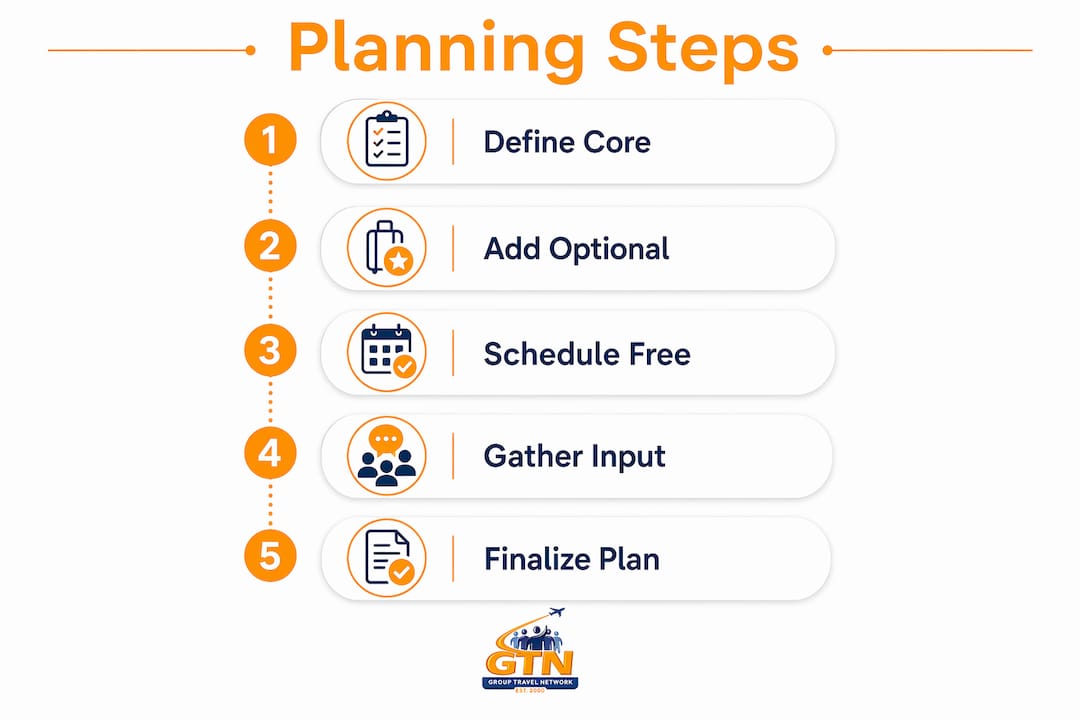
The most effective structure for any group travel itinerary template is the “Core / Optional / Free” model, a framework that separates non-negotiable group moments from voluntary activities and unstructured time. This approach works because it gives everyone a shared experience while respecting individual energy levels and interests.
Here is how each layer breaks down:
- Core Events are non-negotiable group activities that every participant attends. These anchor the day and define the trip’s purpose, whether that’s a museum visit for a school group or a match for a sports team. Limit these to two per day maximum (opens in a new tab) to prevent exhaustion and keep morale high.
- Optional Add-Ons are voluntary activities that appeal to a subset of the group. A cooking class, a walking tour, or a local market visit might attract half the group while others rest. These give participants agency without fragmenting the group entirely.
- Free Time Blocks are unstructured periods built directly into the schedule. One rest day on long trips (opens in a new tab) and open evenings are not wasted time. They are recovery time that prevents the burnout that derails the second half of most group trips.
The recommended ratio is roughly 70% planned to 30% free time per day. For a school or youth group, this might mean two structured activities in the morning and early afternoon, followed by a free evening. For a sports team on a multi-day trip, it means one team commitment per day with personal time built around it.
Pro Tip: Build a 15 to 20 minute buffer between every scheduled activity. Travel time between stops always runs longer than mapping apps predict, and a single delay without buffer time cascades through the entire day.
Strong itineraries also include role-aware details: the address of each venue, the cost per person, and what participants need to bring. This one addition reduces last-minute questions dramatically and makes delegation to chaperones or team captains far easier.

Which tools make creating itineraries for groups faster and easier
The right tools cut planning time in half and keep everyone on the same page throughout the trip. Here is a comparison of the most practical options for group travel organizers:
| Tool | Best for | Key strength |
|---|---|---|
| Google Sheets / Docs | Shared drafting and editing | Real-time collaboration, free, universally accessible |
| TripIt | Centralizing bookings | Automatically parses confirmation emails into a master itinerary |
| Wanderlog | Visual trip mapping | Map-based planning with shareable links |
| Notion | Template-based planning | Flexible databases for complex multi-day trips |
| Travo | AI-generated first drafts | Generates a starting itinerary from basic inputs in minutes |
The single most important principle when organizing group travel plans is centralization. Centralizing all trip info to one shared platform prevents the scattered communication that causes missed departures and confused participants. Post the day’s schedule in a group chat each morning as a backup, but keep the master document in one place.
For activity decisions, structured voting beats open discussion every time. Use Google Forms or a WhatsApp poll with 3 to 5 options and a 24-hour deadline. This method produces a decision faster than any group thread and gives participants a genuine sense of input without derailing the planning process.
You can also distribute the research workload. Assign each group member or sub-team a specific area to investigate, such as restaurant options, local transportation, or venue hours. This keeps one person from carrying the entire planning burden and surfaces better local knowledge.
How to gather group input and finalize decisions without endless debate
Committee planning fails (opens in a new tab) because groups cannot efficiently build from scratch. The solution is a draft-first workflow that gives people something concrete to react to rather than an open canvas to fill.
Follow this sequence for any group trip:
- Set hard constraints first. Lock in dates, total budget per person, and group size before collecting any preferences. These constraints eliminate 80% of potential conflicts before they start.
- Designate one organizer to write the first draft. A single planner’s draft speeds planning and prevents the cyclical delays that come from committee decision-making. Use Travo or Wanderlog to generate a skeleton itinerary in under an hour.
- Collect feedback with closed questions. Ask “Which of these three dinner options do you prefer?” not “Where should we eat?” Targeted, multiple-choice questions produce usable answers. Open-ended questions produce noise.
- Book logistics in waves. Secure flights and accommodation first, then activities. For international trips, set an 8 to 12 week deadline for flight bookings to lock in pricing and itinerary accuracy.
- Communicate deadlines clearly and once. Set a payment and commitment deadline, state it in writing, and do not extend it. Groups that treat deadlines as flexible create cascading logistical problems.
Pro Tip: When managing diverse preferences, use a “must-have vs. nice-to-have” list at the start of planning. Each participant submits one non-negotiable and one wish-list item. This surfaces real priorities fast and gives the lead organizer a clear mandate.
What school and youth group organizers need to know about itinerary safety
School and youth group itineraries carry responsibilities that adult leisure travel does not. Safety, compliance, and parental communication are not afterthoughts. They are the foundation the itinerary is built on.
Finalizing logistics before parent outreach (opens in a new tab) reduces rework and ensures the itinerary is operationally executable before families commit. Here is what to lock in before you send a single permission slip:
- Headcount and chaperone ratios. Standard ratios run from 1 chaperone per 5 students to 1 per 8, depending on age group and destination. Confirm this with your school administration before planning activities.
- Student information collection. Gather allergies, emergency contacts, dietary restrictions, and medical needs in a single online form. Tools like Google Forms or Jotform work well for this. Collect it once and store it centrally.
- Emergency action plans. Every organized safety program (opens in a new tab) requires documented emergency plans, communication protocols, and verified driver qualifications. Write these into the itinerary itself, not as a separate document that gets lost.
- Chaperone group assignments. Assign each chaperone a specific set of students before departure. This makes headcounts faster and accountability clear at every transition point.
- Transportation safety checkpoints. Treat every bus boarding, venue entry, and departure as a safety-critical checkpoint. Consistent headcounts at transitions are the single most effective way to prevent a student from being left behind.
“Pre-plan paperwork and chaperone ratios before detailed scheduling to build a safe, compliant, and affordable school group itinerary.” — Lome
Automating parent communication saves significant time. Schedule reminder messages through your school’s communication platform at key milestones: permission slip deadline, payment deadline, packing list distribution, and day-before departure reminders. This keeps families informed without requiring manual follow-up from the organizer. For a deeper look at how to structure the full planning process, the school group travel planning guide (opens in a new tab) from Grouptravelnetwork covers the end-to-end workflow in detail.
Key takeaways
Effective group itinerary creation requires a structured framework, the right collaborative tools, and a draft-first decision process that prevents planning paralysis.
| Point | Details |
|---|---|
| Use Core/Optional/Free structure | Limit group activities to two per day and build in free time to prevent burnout. |
| Apply the 70/30 time ratio | Plan 70% of each day and leave 30% unstructured to balance engagement and recovery. |
| Draft first, vote second | One organizer creates a draft; the group reacts with structured polls, not open debate. |
| Centralize all trip information | Use one shared platform like Google Docs or TripIt to avoid scattered communication. |
| Lock in safety logistics first | For school groups, confirm chaperone ratios and collect student data before parent outreach. |
Why over-scheduling is the real enemy of a great group trip
After working through dozens of group travel plans, the pattern I see most often is not poor logistics. It is over-scheduling. Organizers feel responsible for filling every hour, and the result is a group that arrives home exhausted and underwhelmed, despite a technically impressive itinerary.
The trips that generate the best feedback are the ones that leave room for the unexpected. A free afternoon in a new city produces better stories than a fourth scheduled museum. A rest morning before a big performance gives a band or sports team the mental space to actually perform well. The Core/Optional/Free approach (opens in a new tab) is not just a planning tool. It is a philosophy about respecting the group’s energy.
The other mistake I see consistently is the absence of a single decision-maker. Groups that plan by committee spend three times as long making half as many decisions. Designating one lead organizer does not mean ignoring everyone else’s input. It means someone has the authority to break ties and move the plan forward. That person is the difference between a trip that happens and one that stays in a group chat forever.
Contingency planning is the third element most organizers skip. What happens if the venue cancels? What if weather closes an outdoor activity? Having two backup options per day is not pessimism. It is the mark of an organizer who has done this before. The groups that handle disruptions well are the ones that planned for them.
— Donovan
Plan your next group trip with Grouptravelnetwork
If you’re organizing a school field trip, a band performance tour, or a sports team travel program, the planning complexity scales fast. Grouptravelnetwork specializes in exactly this: customized itineraries, dedicated trip coordinators, and logistics support built specifically for educational and youth groups.

From flexible payment plans to comprehensive travel protection and vendor partnerships, Grouptravelnetwork handles the details that consume most of an organizer’s time. Explore the educational group trip guide (opens in a new tab) to see how professional planning support works in practice, or browse youth travel packages (opens in a new tab) designed for schools, bands, and sports teams. Your next group trip deserves a plan built by people who do this every day.
FAQ
What is the best structure for a group travel itinerary?
The Core/Optional/Free framework is the most effective structure. It limits non-negotiable group activities to two per day, adds voluntary options, and builds in free time blocks to prevent exhaustion.
How much free time should a group itinerary include?
Plan roughly 70% of each day with structured activities and leave 30% as free time. On trips longer than four days, include at least one full rest day.
How do you get a large group to agree on activities?
Use structured polls in Google Forms or WhatsApp with 3 to 5 options and a 24-hour voting deadline. Open-ended group discussions rarely produce decisions and create planning fatigue.
What safety steps are required for school group itineraries?
Confirm chaperone ratios (typically 1 per 5 to 8 students), collect student medical and emergency information before departure, and document emergency action plans within the itinerary itself.
How far in advance should you book a group trip?
For international group trips, set a flight booking deadline of 8 to 12 weeks before departure. Accommodation and activities can follow once flights are confirmed.
Recommended
- How To Design Educational Itineraries That Actually Teach • Group Travel Network (opens in a new tab)
- How To Coordinate Group Tours: Step-by-Step Guide For Schools • Group Travel Network (opens in a new tab)
- How To Organize School Tours: 2026 Planning Guide • Group Travel Network (opens in a new tab)
- How To Build A School Team Trip Itinerary That Works • Group Travel Network (opens in a new tab)