


TL;DR:
- Hassle-free trip planning centralizes all travel details, reducing decision fatigue and organizing logistics efficiently. AI-powered tools and clear priorities streamline processes, making trip preparation less stressful. Prioritizing and booking early prevent common mistakes and ensure a smoother travel experience.
Hassle-free trip planning is the practice of organizing all travel logistics, budget, and itinerary into manageable steps using clear priorities and centralized tools. Most travelers make this harder than it needs to be. 68% visit up to 10 websites (opens in a new tab) during the planning process, and 66% end up dissatisfied with the result. That fragmentation is the core problem. The solution is not more research. It is a structured approach that reduces decisions, consolidates information, and puts you in control from the first step to the last.
What is hassle-free trip planning?
Hassle-free trip planning is a structured method for organizing a trip that reduces stress by consolidating decisions, tools, and timelines into a single, clear process. The industry term for this approach is integrated travel planning, which covers everything from booking and budgeting to itinerary design and document management. Both terms describe the same goal: fewer surprises, less wasted time, and a trip that actually matches what you wanted.
The five core components of integrated travel planning are:
- Centralized booking and itinerary management. Keep all reservations, confirmations, and schedules in one place, whether that is a shared document, a travel app, or a dedicated folder. Scattered bookings across email threads and browser tabs create confusion.
- Budget planning and cost tracking. Set a total budget before you book anything. Assign amounts to flights, accommodation, food, and activities. Track spending as you go so there are no surprises at checkout.
- Itinerary crafting with realistic priorities. Build your schedule around two or three non-negotiable experiences. Fill the rest with flexible options. Overpacked itineraries are one of the leading causes of trip stress.
- Digital tools and apps. Use apps that store boarding passes, hotel confirmations, and maps offline. Digital document storage reduces the panic of lost paperwork.
- Time management and decision windows. Set deadlines for each planning task. Booking flights, choosing accommodation, and finalizing activities should each have a fixed window. Open-ended research leads to decision fatigue.
Pro Tip: Treat your planning like a project with a deadline. Assign one task per session, such as flights on Monday and hotels on Wednesday, and close the browser when the session ends.
How can technology simplify trip planning and reduce stress?
The biggest source of planning stress is fragmentation. Travelers bounce between airline sites, hotel aggregators, review platforms, and mapping apps, each requiring separate logins and separate decisions. 56% cite poor customization as a key driver of decision fatigue. That number reflects a real problem: generic results force travelers to do extra filtering work that a well-designed tool should handle automatically.
AI-powered travel superapps address this directly. These platforms act as a centralized planning hub, pulling together flights, hotels, local experiences, and real-time updates in one interface. AI as a centralized travel brain reduces the need to juggle multiple tabs and adapts recommendations based on your stated preferences. The result is a planning experience that feels personal rather than generic.
The most useful features to look for in any travel planning tool are:
- Fare monitoring. Alerts you when flight prices drop within your target window. Booking flights 4–10 months ahead (opens in a new tab) secures the best prices for popular seasonal routes, so automated monitoring within that window removes the need to check manually.
- Itinerary syncing. Pulls all bookings into a single timeline so you can see your full trip at a glance.
- Document storage. Stores passports, visas, insurance cards, and booking confirmations in one secure location accessible offline.
- Real-time updates. Sends gate change alerts, weather warnings, and delay notifications so you are never caught off guard.
- Offline maps and guides. Removes dependence on data connections in unfamiliar locations.
Choosing the right tool matters as much as choosing to use one. A platform with too many features and a confusing interface adds friction rather than removing it. Test any app with a short domestic trip before relying on it for a complex international itinerary.
What practical mindset and process strategies support stress-free travel?
Technology solves the logistics problem. Mindset solves the decision problem. The two work together, but most planning guides focus only on tools and ignore the mental habits that determine whether planning feels manageable or exhausting.
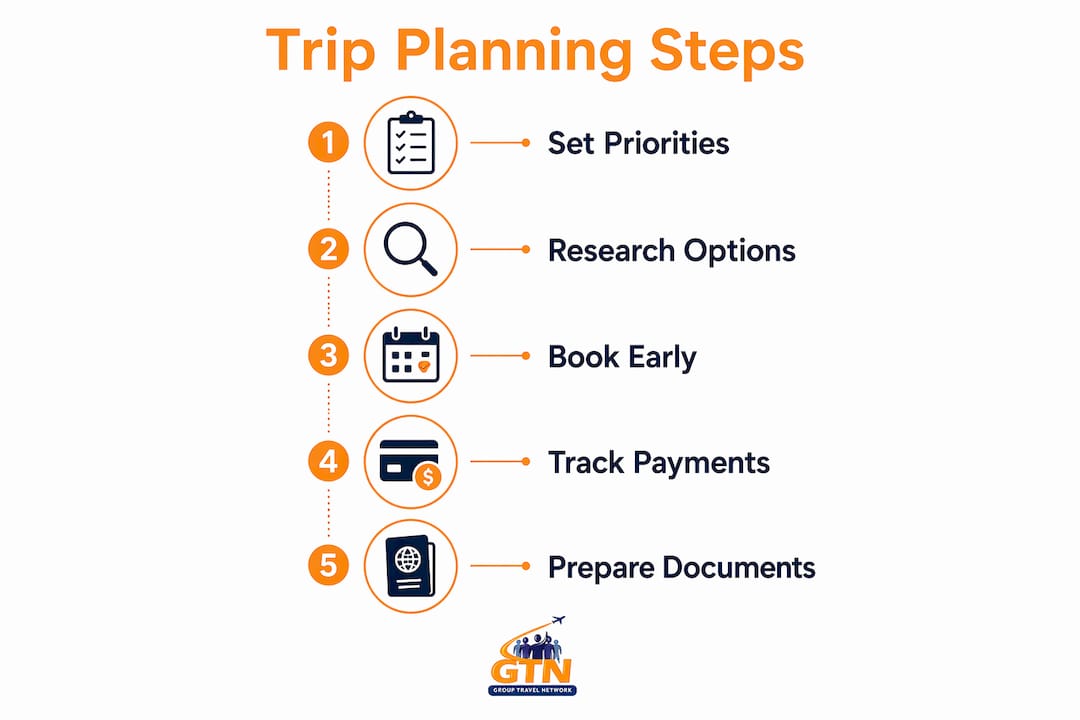
Limiting planning time (opens in a new tab) and focusing on non-negotiables is the single most effective way to prevent burnout during the planning phase. This means deciding in advance which two or three experiences are truly important, then accepting good-enough options for everything else. A hotel that is clean, well-located, and reasonably priced is a good decision. Spending four hours comparing 47 hotels to find the theoretically perfect one is not.
Practical strategies that work:
- Set a hard time limit for each planning session. Thirty to sixty minutes per session is enough for most decisions. When the timer ends, close the browser.
- Separate planning into phases. Compartmentalizing tasks (opens in a new tab) into dedicated sessions, such as one day for flights, another for accommodation, and a third for activities, reduces anxiety and improves focus.
- Identify your non-negotiables first. Book those immediately. Everything else can be decided later or left flexible.
- Accept imperfect decisions. A good-enough hotel booked today beats a perfect hotel researched for three weeks. Accepting good-enough options prevents decision fatigue and irrational stress.
- Use incremental progress as motivation. Each completed booking reduces the total number of decisions remaining. Track what is done, not what is left.
Pro Tip: Write your two or three non-negotiables on a sticky note before you open any booking site. Keep it visible during every planning session. It stops you from getting pulled into options that do not serve your actual priorities.
How to organize group travel plans efficiently without hassle?
Group travel multiplies every planning challenge. Coordinating flights, accommodation, meals, and activities for ten, thirty, or one hundred people requires a level of organization that individual travel does not. The most common failure point is communication. When information lives in multiple email threads, text chains, and spreadsheets, someone always misses something critical.

Centralized communication and document sharing (opens in a new tab) are the foundation of efficient group travel planning. A single shared platform where all participants can access the itinerary, payment status, and packing lists eliminates the need for repeated announcements and follow-up messages.
The key differences between individual and group planning approaches:
| Planning area | Individual approach | Group approach |
|---|---|---|
| Booking timeline | 4–10 months for flights | 6–12 months for group rates and venue holds |
| Communication | Personal email or app | Shared platform with group access |
| Budget tracking | Personal spreadsheet | Transparent shared tracker with per-person breakdown |
| Decision-making | Solo | Structured group input with a designated decision-maker |
| Document storage | Personal phone or cloud | Centralized folder accessible to all organizers |
For school groups, sports teams, and performance ensembles, the logistics layer is even more complex. Grouptravelnetwork specializes in exactly this type of planning, providing dedicated trip coordinators, group travel logistics (opens in a new tab) support, and flexible payment plans that distribute costs across participants over time.
Advance bookings are the single biggest lever for reducing last-minute chaos in group travel. Venues, buses, and group restaurant reservations fill up months ahead of peak travel periods. Booking early locks in availability and often secures group discount rates that individual bookings cannot access.
What common pitfalls cause trip planning stress and how to avoid them?
Most planning stress comes from a small number of predictable mistakes. Recognizing them in advance is the fastest way to avoid them.
- Over-researching and decision paralysis. Reading 200 reviews for a single restaurant is not research. It is avoidance. Set a maximum number of sources per decision, such as three reviews and one expert recommendation, then commit.
- Ignoring travel document organization. Storing digital copies of passports, visas, and insurance on both your phone and a cloud service prevents last-minute emergencies. A physical backup in a separate bag adds another layer of security.
- Using public WiFi for bookings. Public WiFi presents real security risks (opens in a new tab). Avoid making purchases or accessing financial accounts on unsecured networks. Use a mobile data connection or a VPN for any sensitive transaction.
- Waiting too long to book critical components. Flights, popular hotels, and group venues book out months in advance. Waiting until six weeks before departure for a summer Europe trip means paying significantly more or accepting inferior options.
- Failing to set clear priorities. Without defined priorities, every decision feels equally important. That is the direct path to burnout. Decide what matters most before you start, and let that guide every booking choice.
Key takeaways
Hassle-free trip planning works because it replaces open-ended research with a structured process built around clear priorities, centralized tools, and firm decision deadlines.
| Point | Details |
|---|---|
| Define your non-negotiables first | Identify two or three must-have experiences before opening any booking site. |
| Centralize all information | Keep bookings, documents, and itineraries in one shared location to avoid confusion. |
| Use technology selectively | AI-powered planning tools reduce fragmentation, but only if the interface is simple enough to use consistently. |
| Book critical components early | Flights booked 4–10 months ahead and group venues reserved 6–12 months out secure better rates and availability. |
| Compartmentalize planning sessions | Dedicate separate sessions to flights, accommodation, and activities to reduce decision fatigue. |
Why most people make trip planning harder than it needs to be
I have watched hundreds of group trips get planned, and the pattern is almost always the same. The organizer starts with genuine enthusiasm, opens twelve browser tabs, and within two weeks is so deep in options that every decision feels impossible. The trip that was supposed to be exciting becomes a source of dread.
The uncomfortable truth is that most planning stress is self-inflicted. It comes from treating every decision as equally important and every option as worth researching. That is not thoroughness. It is a failure to prioritize.
The travelers and group leaders who plan well share one habit: they decide what matters before they start looking. They book the non-negotiables fast, accept good-enough options for everything else, and stop researching once a decision is made. They treat planning as a logistical task with a finish line, not a creative project with unlimited iterations.
Technology helps, but it is not the fix. An AI-powered superapp still requires you to know what you want. A shared group platform still requires someone to make the final call. The tools reduce friction. The mindset determines whether you actually finish planning and enjoy the trip.
My advice: give yourself a planning deadline that is two weeks earlier than you think you need. Book the big items. Accept the rest. The trip will be better for it.
— Donovan
How Grouptravelnetwork takes the complexity out of group trips
Planning a group trip for a school, band, or sports team involves a level of coordination that individual travel tools simply are not built for. Grouptravelnetwork handles the full scope of that complexity, from school group travel planning (opens in a new tab) and customized itineraries to dedicated trip coordinators who manage vendor relationships on your behalf.

Every group gets online registration, transparent payment tracking, and travel protection options built into the process. Educators and administrators do not have to chase down payments or manage last-minute vendor calls. Grouptravelnetwork’s coordinators handle those details so the focus stays on the students and the experience. For school administrators and band directors who want a step-by-step school trip guide (opens in a new tab) without the guesswork, Grouptravelnetwork is the resource built specifically for that need.
FAQ
What does hassle-free trip planning actually mean?
Hassle-free trip planning is the process of organizing travel logistics, budget, and itinerary into a structured, low-stress system using centralized tools and clear priorities. It reduces decision fatigue by limiting options and setting firm deadlines for each planning task.
How far in advance should I book flights for a stress-free trip?
Booking flights 4–10 months ahead secures the best prices for popular seasonal routes. For group travel, venue and accommodation holds often require 6–12 months of lead time.
What is the biggest mistake people make when planning a trip?
Over-researching without a decision framework is the most common mistake. Decision fatigue sets in when every option feels equally important. Setting non-negotiables before you start and accepting good-enough options for the rest prevents this.
Is it safe to book travel on public WiFi?
Public WiFi carries real security risks for financial transactions. Use a mobile data connection or a VPN when booking flights, hotels, or any service that requires payment or personal information.
How is planning a group trip different from planning an individual trip?
Group travel requires centralized communication, shared document access, and transparent budget tracking that individual planning does not. Advance bookings and coordinated logistics are the two factors that most reduce last-minute stress for groups of any size.
Recommended
- How To Organize School Tours: 2026 Planning Guide • Group Travel Network (opens in a new tab)
- Step By Step School Trip Guide For Stress-free Travel • Group Travel Network (opens in a new tab)
- Top Student Travel Trends In 2026 For School Groups (opens in a new tab)
- Student Group Trips: Top 10 Planning Tips For 2026 Tours (opens in a new tab)