

Arts travel grants do exist for school ensembles and youth arts groups, but they are narrow, local and tied to specific rules. Most are funded by a regional foundation, a state arts agency or a performing arts center, and most reward an invitation or a documented achievement rather than a trip planned for its own sake. This guide shows which programs are real, who can apply, what they pay for and how to prepare, so you can decide in an afternoon whether a grant belongs in your trip budget.
TL;DR
- Arts travel grants are mostly regional or state programs. Check your own state arts agency and local arts foundations first, because national funders rarely pay for student travel directly.
- The strongest fit is an invitation or recognition: a festival invitation, a competitive selection or a documented record of excellence.
- Many grants reimburse or match costs and say nothing about covering your own transportation and lodging. Read the cost rules before you count the money.
- Individual schools are often not eligible for federal arts funding, but a school district, a booster nonprofit or a partner organization sometimes is.
- Apply early, and plan the trip itinerary and budget before the application opens, since deadlines recur on the same annual cycle.
Table of Contents
- What counts as an arts travel grant
- Grants that fund student ensemble travel
- Grants that pay for performances, not your bus
- Federal funding: the NEA and what schools can do with it
- International exchange funding
- Who can actually apply
- What grants usually pay for, and what they do not
- How to build a winning application
- A realistic funding timeline
- Our perspective
- How Group Travel Network helps you prepare
- Other ways to fund the trip
- Common mistakes to avoid
- FAQ
- Sources
What counts as an arts travel grant
The phrase covers three different kinds of money, and mixing them up is the most common reason applications fail.
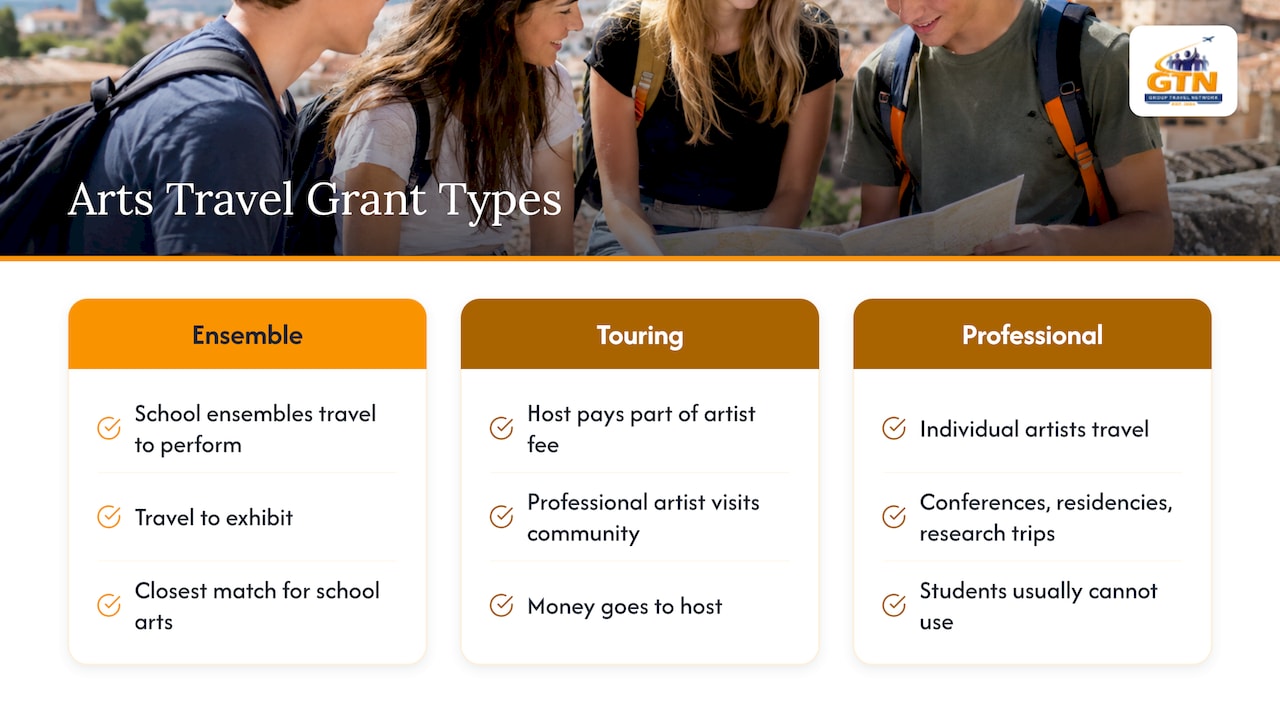
Ensemble travel grants help a school band, choir, orchestra, dance team or theater program travel to perform or exhibit. They are the closest match to what band directors and arts administrators look for.
Touring and presenting grants pay part of an artist’s fee when a school or nonprofit brings a professional artist to its community. The money flows to the host, not to a traveling student group.
Professional travel grants help individual artists attend conferences, residencies or research trips. Students and school programs usually cannot use these, but they show up in search results for the same keyword.
Knowing which type you are looking at saves hours. If a page talks about artist rosters, presenters and performance fees, it is a touring grant. If it talks about ensembles, invitations and travel, it is the one you want.
Grants that fund student ensemble travel
Woodlands Center Arts Travel Grants (Texas)
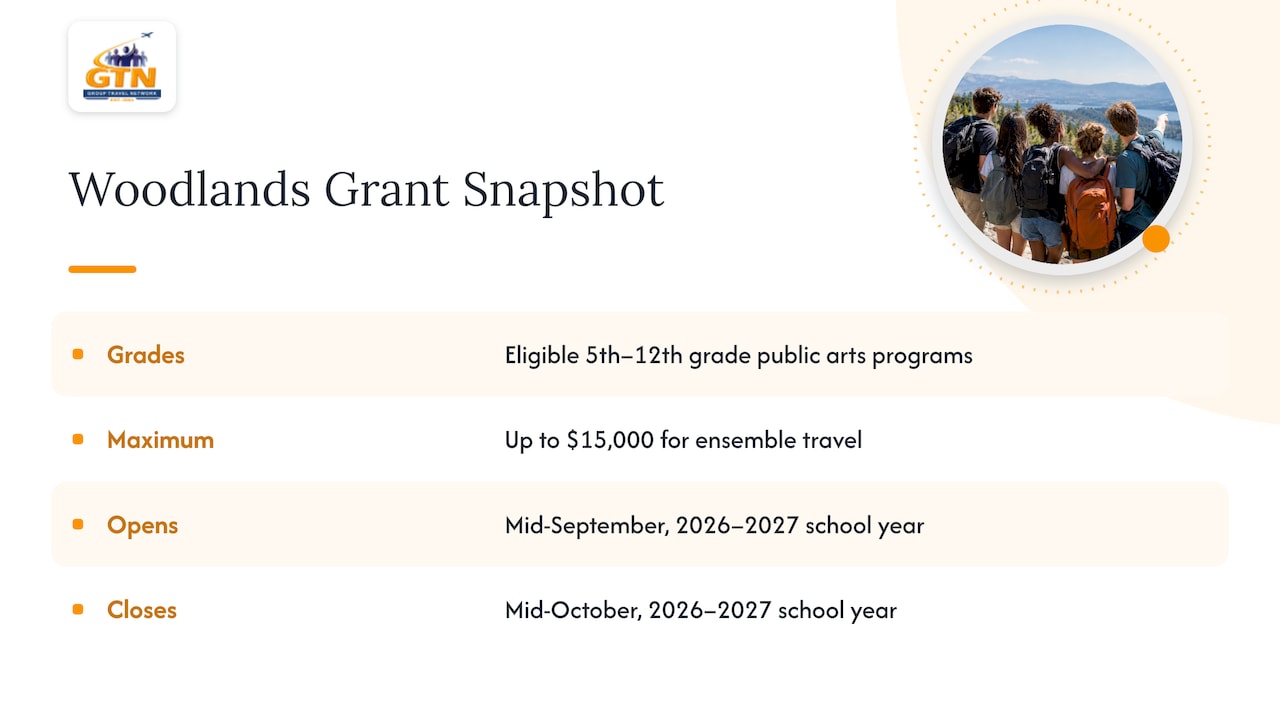
The clearest example of a true ensemble travel grant is the Woodlands Center Arts Travel Grants program (opens in a new tab). It supports eligible 5th through 12th grade public school arts programs with up to $15,000 for ensemble travel to invitational or competitive performances and exhibitions. The trip must rest on a special invitation or recognition of excellence or achievement, and it has to go beyond the group’s usual annual performances.
Eligibility is geographic: the program serves public school arts curriculum programs in specified Texas counties, including active TEA-approved charter schools. Funds may be paid to a school, a school district, a school arts curriculum program or a related 501©(3) booster or support organization. For the 2026-2027 school year, applications opened in mid-September and closed in mid-October. If you read this after the window, treat that as the annual pattern and confirm next year’s dates on the program page.
Even if you are outside Texas, this program is a useful template. It shows what funders look for: a verified invitation, a clear educational purpose and a nonprofit or school entity that can receive the money.
Texas Cultural Trust Arts Inspire Grants
For Title I schools in Texas, the Arts Inspire Grants (opens in a new tab) support arts programming, including field trips to professional arts experiences and visits from professional artists to campus. These are not performance-tour grants, but they can fund the kind of local cultural field trip that anchors an arts curriculum.
Network-based travel grants for ensembles
Some membership networks offer small travel awards. The Network of Ensemble Theaters, for example, runs travel grants for its members (opens in a new tab) ranging from $500 to $2,000, awarded twice a year, for relationship-building activities in the U.S. or abroad. They are for member ensembles and individuals, not school trips, but they show how small, membership-linked awards work, and a community theater or youth ensemble that already belongs to a network should check.
Grants that pay for performances, not your bus
These programs matter because many groups confuse them with travel funding.
Virginia Touring Grants
Virginia Touring Grants (opens in a new tab) reimburse eligible Virginia nonprofits, local and tribal governments and federally tax-exempt schools for up to 50% of performance fees. The performance must be by an artist on the state’s Touring Artist Roster and held in an ADA-compliant facility. Applicants submit signed contracts with roster artists, and travel, lodging and other local fees remain the presenter’s responsibility. The Virginia commission also notes that individual students or organizations made up mainly of pre-K-12 or undergraduate students cannot join the roster, so this is for a school hosting professionals, not for a student group traveling.
Deadlines work on a rolling basis: applications are due at least two weeks before the activity, with a final annual cutoff. Check the page for the current fiscal-year dates.
NEFA Crossroads: Touring New England
NEFA Crossroads (opens in a new tab) provides up to 60% of artist fees, capped at $10,000, for tours presented by New England nonprofits, schools included. A tour must include at least three New England organizations in three geographically distinct communities presenting the same artist, with organizations from at least two New England states. Applicants document compliance with Section 504 of the Rehabilitation Act and the ADA and provide a public presentation of the named artist. The annual deadline is the first business day of March.
NEFA reviews applications on artistic excellence and merit, alignment with program goals, collaboration and community access. Grantees file an online report with supporting documents within 40 days after the event.
Federal funding: the NEA and what schools can do with it
The National Endowment for the Arts is the biggest name in arts funding, and the one most often misunderstood by school staff. NEA Grants for Arts Projects (opens in a new tab) support project-based arts activity, including arts education. The Arts Education discipline serves pre-K-12 students through Direct Learning and Collective Impact projects, and serves educators and artists through Professional Development projects.
Two rules shape what you can realistically do:
- Individual elementary and secondary schools are generally ineligible. School districts, local education agencies and state or regional education agencies may apply.
- Organizations without their own nonprofit status may take part in a project submitted by another NEA-eligible organization, but they cannot submit their own application.
The NEA also expects substance. Arts Education projects require robust assessment of student or teacher learning, and student assessment should align with state or national arts standards. The agency’s arts education page (opens in a new tab) says its focus is arts education for all students and closing the opportunity gap for students with the least access. A pure performance trip for an already well-resourced ensemble is a poor fit. A district-led project that brings students from underserved schools to a cultural institution, with measured learning outcomes, is a stronger one.
NEA funds generally support project activities proposed by the applicant, so read the program details for what costs are allowable before building a budget around travel.
International exchange funding
If your trip crosses borders, the U.S. Department of State’s Bureau of Educational and Cultural Affairs publishes funding opportunities for programs that support exchanges and build relationships between the U.S. and other countries. These are typically competitive and aimed at organizations that can run large exchange programs, not a single school’s performance tour. A school or youth arts group is more likely to take part as a partner in a larger project than to apply alone.
Who can actually apply
Use this quick screen before you invest time in any application.
| Applicant type | Usually eligible for | Usually not eligible for |
|---|---|---|
| Public school arts program in a funder’s service area | Regional ensemble travel grants, local foundation awards | Federal NEA project grants as an individual school |
| School district or education agency | NEA Arts Education projects, state agency programs | Grants limited to individual artists |
| Booster club or school foundation with 501©(3) status | Funds paid on behalf of the school program | Grants that require a public school as the applicant |
| Youth arts nonprofit | State and regional touring and education grants | Programs restricted to schools |
| Private or homeschool ensemble | Often local foundation or community awards | Programs limited to public school curriculum programs |
The pattern is consistent: the money goes to an entity that can sign a grant agreement, hold funds and report on outcomes. If your band or choir has no such entity, the booster organization is usually the answer.
What grants usually pay for, and what they do not
Be skeptical of any assumption that a grant covers “the trip.” In practice:
- Ensemble travel grants may cover transportation, lodging or registration for an invited performance. Read each program’s allowable-cost list. Meals, chaperone costs and souvenirs are commonly excluded or capped.
- Touring grants pay part of artist fees. Virginia’s program, for example, leaves travel, lodging and other local fees to the presenter.
- Education project grants pay for activities that serve learning goals, which often means program costs, not leisure time.
- Matching rules are common. NEFA Crossroads pays a percentage of artist fees, and Virginia’s program reimburses up to half, so you must have the rest in hand.
The practical lesson: a grant rarely replaces fundraising. It anchors it. A $15,000 award covers a meaningful slice of a bus, hotel rooms and festival fees for a mid-sized ensemble, and it also signals credibility to parents and other donors.
How to build a winning application
Funders in this space repeat the same priorities. Build your file around them.
1. Document the invitation or achievement
The Woodlands program ties its funding to invitations or recognition of excellence. Keep the invitation letter, the festival’s selection criteria and your group’s results, such as superior ratings or state-level recognition. If your trip is a standard annual tour, you are applying for the wrong program.
2. Show educational value
Funders such as the NEA expect measurable learning. Name the standards your students will work on, how you will assess them and what you will report afterward. Workshops with professional musicians, clinician feedback sessions and adjudication scoresheets all count as evidence. Our guide to performance tour festivals and adjudication (opens in a new tab) explains how to turn festival feedback into rehearsal material.
3. Build the budget before you write
Get itemized quotes for transportation, lodging, registration, insurance and instrument transport. A line-by-line budget with realistic figures reads as competence. Instrument transport in particular is often underestimated, and our piece on booking performance trip equipment transport (opens in a new tab) covers lead times.
4. Name the right applicant
Decide early whether the school, the district or the booster organization applies. Check the funder’s rules on who receives payment, and make sure the entity has the tax status the guidelines require.
5. Plan for accessibility and reporting
Some programs require ADA and Section 504 documentation, and almost all require a post-event report. NEFA, for example, asks for one within 40 days. Assign a person to collect attendance numbers, photos, receipts and a short narrative while the trip is happening.
6. Choose destinations that suit the grant
A funder is more convinced by a destination with an obvious artistic or educational reason. Cities with well-known festivals and competitions give you that. If a West Coast trip is on your list, this Southern California festivals guide (opens in a new tab) is a handy way to compare event timing and logistics. We also break down options in our overview of performance tour destinations for educators (opens in a new tab).
A realistic funding timeline
Grant cycles run well ahead of travel, which is why trip planning and grant writing have to start together.
| When | What to do |
|---|---|
| 12 to 18 months before | Identify the festival or invitation, shortlist funders, confirm who the applicant will be |
| 9 to 12 months before | Collect quotes, draft the budget, line up letters of support and documentation |
| 6 to 9 months before | Submit applications during the funder’s annual window |
| 3 to 6 months before | Open parent payments, start booster fundraising, confirm vendors |
| After the trip | Submit the final report, thank funders, document outcomes for next year |
The exact windows differ by funder: Woodlands runs a fall window, NEFA a March deadline and Virginia a rolling schedule within its fiscal year. Always confirm the current dates on each official page. If you are weighing how to sequence the whole project, our step-by-step school group travel planning guide (opens in a new tab) shows a full timeline.
Our perspective
After years of helping school music and arts programs get on the road, we see the same pattern. Directors tend to ask, “Which grant will pay for our trip?” The better question is, “Which trip is strong enough that a funder wants to be part of it?” Funders in this space reward invitations, educational purpose and clear reporting. A trip with a documented festival invitation, an adjudicated performance, a clinician workshop and a clean budget is far easier to fund than a general sightseeing tour with a concert added.
We also encourage groups not to treat a grant as the whole plan. Most awards are partial, and many are announced after you must commit to deposits. A flexible payment schedule for families, a booster fundraising plan and a grant application working together are what make a trip dependable. Whatever the grant outcome, you should know your break-even cost per student before applications go in.
Finally, keep your documentation tidy. Itineraries, vendor quotes, safety plans and insurance details are the same documents funders ask for, so a well-run trip planning file doubles as an application file.
— Donovan
How Group Travel Network helps you prepare
We plan performance tours (opens in a new tab) for bands, choirs, orchestras and dance teams, with customized itineraries, a dedicated trip coordinator, online registration, flexible payment plans and travel protection options. If you are putting together a grant application, we can provide itinerary details and the vendor documentation a funder asks to see. Tell us the invitation or festival you are aiming for through Group Travel Network (opens in a new tab), and we will help you shape a trip that fits your budget and your funding plan. For a wider look at the options, see our guide to performing arts trips (opens in a new tab).
Other ways to fund the trip
When a grant is limited to individual artists or misses your trip, these alternatives usually carry the load:
- Partner with an eligible organization. The NEA allows organizations without nonprofit status to participate in a project submitted by an eligible organization, even though they cannot apply on their own.
- Use a booster organization. A 501©(3) support group can receive grant payments and run fundraising for the program.
- Stage community concerts. A home-send-off performance for local donors and businesses raises money and builds goodwill.
- Offer flexible family payment plans. Spreading payments across several months reduces dropouts and gives you a clear cash flow.
- Seek local sponsors. Local businesses, service clubs and community foundations often fund student arts experiences that stay visible in the community.
For band programs specifically, our band trip planning guide (opens in a new tab) walks through budgeting and fundraising together.
Common mistakes to avoid
- Applying for the wrong grant type. A presenter grant will not pay a student bus.
- Ignoring eligibility geography. Many programs serve specific counties or states.
- Missing the annual window. Most programs run once a year, and a late application waits twelve months.
- Underbudgeting. Instrument transport, insurance and chaperone costs are the usual gaps.
- Skipping the report. Late or missing reports can damage your chance of future awards.
FAQ
Are there grants that pay for a school band or choir to travel?
Yes, but they are local. The Woodlands Center program in Texas offers up to $15,000 for eligible public school arts ensembles traveling to invitational or competitive performances. Look for similar programs from community foundations, performing arts centers and your state arts agency.
Can an individual school apply for an NEA grant?
Generally no. Individual elementary and secondary schools are typically ineligible, but school districts, local education agencies and state or regional education agencies may apply. A school can also take part in a project led by an eligible organization.
Do arts grants cover transportation and lodging?
It depends on the program. Ensemble travel grants can fund trip costs, while touring grants such as Virginia’s leave travel and lodging to the presenter. Always check each program’s allowable costs before you build your budget.
When should we apply?
As early as the funder allows. Cycles are annual and tied to the school year or fiscal year: Woodlands opens in the fall, NEFA Crossroads is due the first business day of March, and Virginia requires applications at least two weeks before the activity. Confirm current dates on each funder’s page.
What if a grant is only for individual artists?
Skip it for the group trip, and look at ensemble, district or nonprofit-based programs instead. Individual artists’ travel grants exist, but they rarely accept a school program as the applicant.
Sources
- Woodlands Center Arts Travel Grants (opens in a new tab)
- Texas Cultural Trust Arts Inspire Grants (opens in a new tab)
- NET/TEN Travel Grants (opens in a new tab)
- Virginia Touring Grants (opens in a new tab)
- NEFA Crossroads: Touring New England (opens in a new tab)
- NEA FY26 Grants for Arts Projects program details (opens in a new tab)
- NEA Arts Education (opens in a new tab)
Recommended
- Student Performances Tours: Showcasing Talent In 2025 (opens in a new tab)
- Secure $5,000–$10,000 In Group Funding: Student Travel Scholarships For Coordinators (opens in a new tab)
- Performing Arts Trips Explained: 2026 Planning Guide (opens in a new tab)
- Youth Group Travel Planning 2026: The Educator’s Guide (opens in a new tab)