


TL;DR:
- Choosing destinations based on educational value, venue accessibility, and safety ensures a successful student performance tour.
- Building itineraries around key performance anchors and structured reflection maximizes engagement and learning outcomes.
Choosing the wrong destination can turn a promising student tour into a logistical headache that drains your budget and delivers little educational value. Performance tour destinations explained through a real planning lens look very different from the glossy brochure version, where every city seems equally exciting and every venue seems equally accessible. The truth is that location selection shapes everything: the quality of performances, the depth of cultural engagement, student safety, and whether the trip survives your principal’s approval process. This guide cuts through the noise and gives you a practical framework for making decisions that hold up in real life.
Table of Contents
- Key takeaways
- Performance tour destinations explained: what really matters
- A look at popular performance tour locations
- Building an itinerary around your destination
- Safety and supervision across different tour segments
- My honest take on destination selection
- Plan your next student performance tour with Grouptravelnetwork
- FAQ
Key takeaways
| Point | Details |
|---|---|
| Destination fit matters most | Choose locations based on educational value, venue access, and safety rather than prestige or popularity. |
| Performance anchors drive itineraries | Build schedules around one or two high-impact performance events to reduce fatigue and maximize focus. |
| Supervision must be dynamic | Staffing plans need segment-by-segment risk assessments, not a fixed ratio applied across the whole trip. |
| Learning objectives unlock funding | Clear, measurable outcomes tied to performance components strengthen grant applications and program credibility. |
| Compact itineraries work best | Two-day formats combining performances with targeted cultural visits minimize school absence and travel fatigue. |
Performance tour destinations explained: what really matters
Most coordinators start destination research by Googling famous cities and assume the biggest names will produce the best tours. That assumption misses the point. A destination is only as good as what it can deliver for your group, at your budget, with your supervision capacity.
Start by asking four foundational questions before any destination makes your shortlist.
- Educational value: Does this location offer genuine performance opportunities at student-appropriate venues, or are you paying for proximity to a famous skyline? Cultural engagement should connect to what students are already studying or practicing.
- Venue accessibility: Historic theaters, amphitheaters, and community performance halls vary wildly in booking policies for school groups. Some world-famous venues rarely accommodate student performances, while mid-size regional centers actively court them.
- Logistical reality: Travel time, direct flight availability, accommodation proximity to venues, and local transportation costs compound quickly. A destination that looks affordable in isolation can become your most expensive option once ground logistics are factored in.
- Curriculum alignment: Erasmus+ youth exchanges (opens in a new tab) require structured learning objectives tied to every activity, not just sightseeing. Even if you are not pursuing that funding stream, that same standard of rigor makes your program stronger and easier to defend to school boards.
Safety is the fifth variable, and it deserves its own weight. Urban destinations with high foot traffic, large festivals, or complex transit systems introduce supervision challenges that a rural or campus-based venue does not. Build a destination-specific risk profile before committing.
Pro Tip: Request venue sample contracts before finalizing any destination. The terms for rehearsal time, load-in windows, and technical support reveal more about a location’s suitability than any promotional listing.
A look at popular performance tour locations
Understanding what different destination categories offer helps you match your program to the right environment. Here is a comparison of the most common options coordinators evaluate.
| Destination type | Best for | Key advantage | Watch out for |
|---|---|---|---|
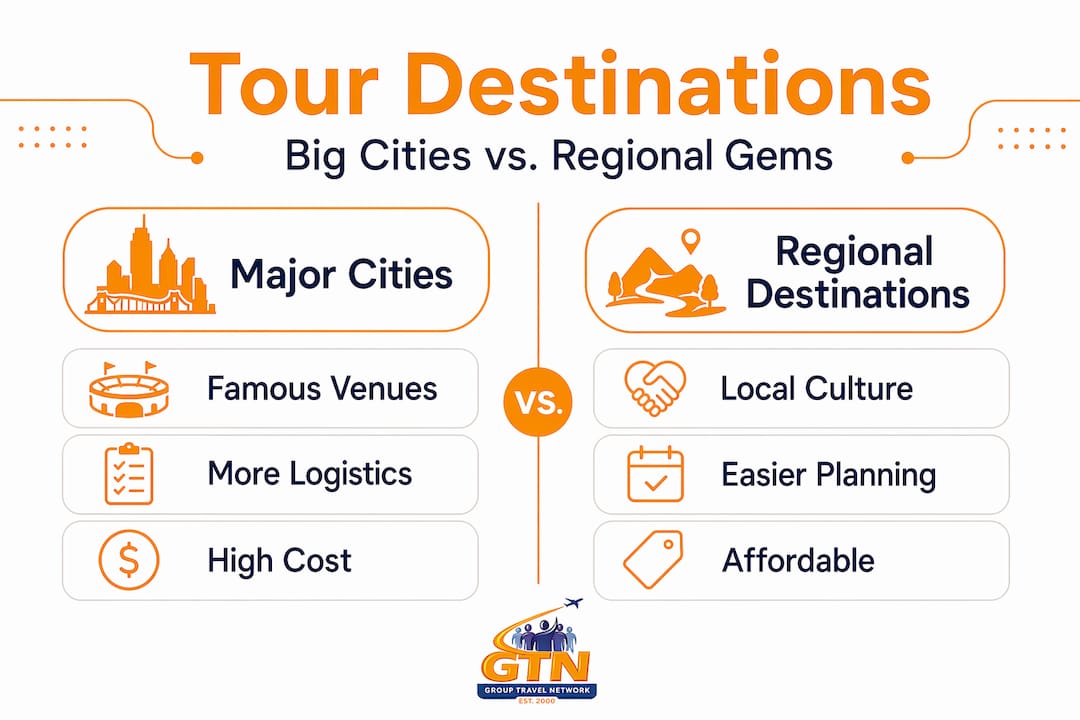
| Major U.S. cities (New York, Chicago, Nashville) | Band, choir, orchestra, theater | Iconic venues, professional exposure | High cost, complex logistics, limited rehearsal access |
| Regional U.S. cities (Asheville, Savannah, Branson) | All performing arts groups | Affordable venues, student-friendly programs | Fewer international cultural touchpoints |
| European capitals (Vienna, Prague, Edinburgh) | Classical music, theater, choir | Deep cultural immersion, festival circuits | Longer travel, cost, language logistics |
| South Korea (Seoul) | Modern music, cultural exchange | Dynamic arts scene, structured exchange programs | Requires thorough preparation; see school exchange tips |
| Domestic festival locations | Competition-focused groups | Built-in adjudication, peer benchmarking | Variable venue quality, heavy scheduling |
Popular destinations vary widely (opens in a new tab) in language accessibility, cost, venue types, and cultural enrichment, so no single category dominates. Your group’s performance discipline, age range, and budget determine which tier makes sense.
A few destination-specific points worth knowing:
- Nashville offers working studio visits alongside live performance venues, giving music students exposure to the industry side of the art form.
- Vienna and Prague have long histories of hosting student ensembles at chapels and smaller concert halls, often through established tour operators familiar with school group requirements.
- Edinburgh’s summer festival circuit creates a rare environment where student performers can watch professional acts, perform in open venues, and absorb theatrical culture simultaneously.
- Seoul is increasingly popular for cultural exchange programs, particularly for schools interested in connecting Western music traditions with contemporary East Asian performance culture.
For coordinators building their first performance tour, a domestic regional city is almost always the right starting point. The logistics are manageable, costs are predictable, and venues are often eager to work with school groups.
Building an itinerary around your destination
An itinerary is not a list of things to do. It is the structural plan that determines whether students arrive energized or exhausted at the moment that matters most: the performance itself.

Effective performance tour itineraries (opens in a new tab) focus on a few key performance anchors rather than many scattered venues. Spreading students across five performance slots in two days does not create five memorable experiences. It creates five mediocre ones.
Here is a structure that works for a two-day domestic performance tour:
- Arrival and orientation (Day 1, morning). Keep this short and purposeful. A brief walkthrough of the main venue gives students spatial awareness before rehearsal without exhausting them.
- Primary rehearsal (Day 1, afternoon). This is the technical anchor of the trip. Students need sufficient time on the actual performance space, not just a practice room. Negotiate this window during the booking process.
- Cultural visit (Day 1, evening). One focused cultural activity, directly tied to the performance program. A museum exhibit connected to the musical period, a neighborhood known for the art form, or a professional performance students can watch and discuss.
- Main performance (Day 2, morning or midday). Schedule the performance when students are rested. Morning slots consistently outperform evening slots for student groups on tour.
- Reflection and debrief (Day 2, afternoon). Structured youth exchanges treat reflection as a mandatory component, not an afterthought. A 30-minute facilitated debrief with specific prompts produces learning outcomes you can document and share with your school board.
Compact itineraries that maintain strong performance anchors optimize student engagement while minimizing classroom time lost, which matters enormously when you need administrative approval.
Pro Tip: Build a 90-minute buffer into Day 2 before departure. Unexpected delays during load-out, student medical needs, or transportation issues are not rare events. They are predictable variables.
Safety and supervision across different tour segments
Supervision on a performance tour is not a single ratio you apply across the whole trip. It is a series of distinct plans, one for each segment of the itinerary.
Supervision ratios must be determined dynamically (opens in a new tab) through risk assessment, accounting for the specific environment, activity, and student group at each point in the tour. A rehearsal in a controlled venue requires a different staffing model than free time in a public urban space.
Here is how to think about each segment:
- Transit: Students are moving through public environments with luggage and potential distractions. Designate a lead adult at the front of the group and a trailing adult at the rear. Account for the possibility that one adult may need to leave the group unexpectedly to handle an individual student issue.
- Rehearsal: Lower physical risk but higher organizational complexity. Students may move between spaces. Ensure an adult has line-of-sight to every student at all times, even in a theater environment.
- Performance: The venue itself often creates a contained environment, but pre-show and post-show transitions are higher-risk moments. Brief students on expectations before arrival, not after.
- Cultural excursions: Risk increases with venue type. An outdoor market requires closer supervision than a guided museum tour. Adjust your adult-to-student ratio accordingly.
- Free time: This requires the most deliberate planning. Supervision plans should be revisited as conditions change, which means the free-time plan you created three weeks in advance may need updating once you see the actual environment.
Plan for leader absence from the start. If your lead coordinator becomes ill or needs to attend to a student emergency during the tour, the remaining adults must know exactly how to proceed. Document a contingency plan and share it with every adult on the trip before departure.
One more thing coordinators consistently underestimate: remote or international settings dramatically increase the consequence of any gap in your supervision plan. The standard that works at a domestic day trip does not translate directly to a multi-day international tour.
My honest take on destination selection
I’ve spent years watching coordinators get pulled toward famous cities because the name alone convinces parents and students that the trip will be worth it. In my experience, the opposite is often true.
The schools that report the most meaningful student growth are not always the ones that went to New York or Vienna. They are the ones that chose a destination where the performance actually happened under real conditions, where students had time to reflect, and where the cultural visit connected directly to what they were doing on stage.
What I’ve learned is that the single biggest predictor of a successful performance tour is not the destination. It is whether the coordinator built learning outcomes into the program before selecting the destination. Measurable learning outcomes from performance components, such as specific skills practiced or reflection sessions completed, make the whole program defensible, fundable, and genuinely educational.
My advice to any coordinator starting this process: resist the urge to anchor on location first. Anchor on what you want students to be able to say, feel, or do differently after the tour. Then find the destination that makes that possible at a price your families can actually afford. The student performance travel (opens in a new tab) programs that endure are always built on that sequence.
— Donovan
Plan your next student performance tour with Grouptravelnetwork
Ready to move from planning framework to actual trip? Grouptravelnetwork specializes in exactly this kind of work, helping school coordinators and band directors translate educational goals into fully planned student performance tours with real venues, safety protocols, and manageable budgets.

Whether you are looking at your first domestic tour or considering an international destination for an advanced ensemble, the school group travel guide (opens in a new tab) at Grouptravelnetwork walks you through every planning stage, from destination selection and itinerary design to supervision logistics and travel protection. You can also explore the step-by-step planning resource (opens in a new tab) for a coordinator-specific breakdown of timelines and vendor coordination. The team at Grouptravelnetwork brings dedicated trip coordinators, flexible payment options, and years of experience working with youth performing arts programs.
FAQ
What are performance tour destinations?
Performance tour destinations are cities, regions, or venues specifically selected for their ability to host student performing arts groups, offering a combination of quality performance venues, cultural engagement opportunities, and logistical support for school-age travelers.
How do I choose the best performance tour locations?
Start with your learning objectives and budget, then evaluate destinations by venue availability, travel logistics, and safety conditions rather than prestige. Regional cities often deliver better value and more accessible venues for student groups than major metropolitan areas.
How long should a student performance tour itinerary be?
Youth exchanges with structured learning objectives typically run 5 to 21 days, but domestic school performance tours often achieve strong outcomes in a two-day format that minimizes classroom absence while maintaining one or two high-quality performance anchors.
What supervision ratio is required for performance tours?
There is no universal fixed ratio. Supervision requirements must be assessed dynamically for each segment of the tour, including transit, rehearsal, performance, and free time, with contingency planning for potential leader absence.
Do performance tour destinations need to align with curriculum?
Yes, and not just for funding purposes. Tours with clear curricular connections produce stronger learning outcomes, generate better reflection content, and are far easier to justify to school administration and parents when securing approval and managing budgets.
Recommended
- Student Travel Agency • Group Travel • Performance Tours (opens in a new tab)
- Student Performances Tours: Showcasing Talent In 2025 (opens in a new tab)
- Educational Music Tours 2026: Turn Travel Into Classrooms (opens in a new tab)
- Student Performance Travel: Showcasing On Educational Stages (opens in a new tab)