


Instrument travel insurance is a specialist policy that covers a musical instrument against loss, theft and damage while it travels. Standard travel insurance usually does not do that job. If you run a band, orchestra or choir trip, the safe plan is to pair your group’s trip protection with an all-risks instrument policy, or to confirm in writing that an existing policy covers each instrument on the road.
This guide is for band directors, administrators and trip coordinators. It covers what ordinary policies leave out, what airlines will and will not pay, what coverage costs, what insurers ask for, and how to handle a claim.
TL;DR
- Standard travel insurance generally does not cover musical instruments. Plan on a separate instrument policy or a documented add-on.
- Airline liability for lost or damaged bags is capped, and the cap is far below the value of many band instruments.
- Look for all-risks wording, agreed value, worldwide coverage, and any clause that excludes instruments left unattended in vehicles.
- Insurers want a description of each instrument, and often a receipt or appraisal for valuable ones. Gather it before departure.
- Book instrument transport early and write down who is responsible for each case at every handoff.
Table of Contents
- Why standard travel insurance falls short for instruments
- Does homeowners or renters insurance help?
- What airlines will and won’t cover
- What specialist instrument insurance typically covers
- How much does instrument travel insurance cost?
- Documents insurers will ask for
- Protecting instruments before a claim is ever needed
- Perspective: how we think about instruments on tour
- Making insurance part of a stress-free performance tour
- If you need to make a claim
- How to choose a policy: a quick checklist
- FAQ
- Sources
Why standard travel insurance falls short for instruments
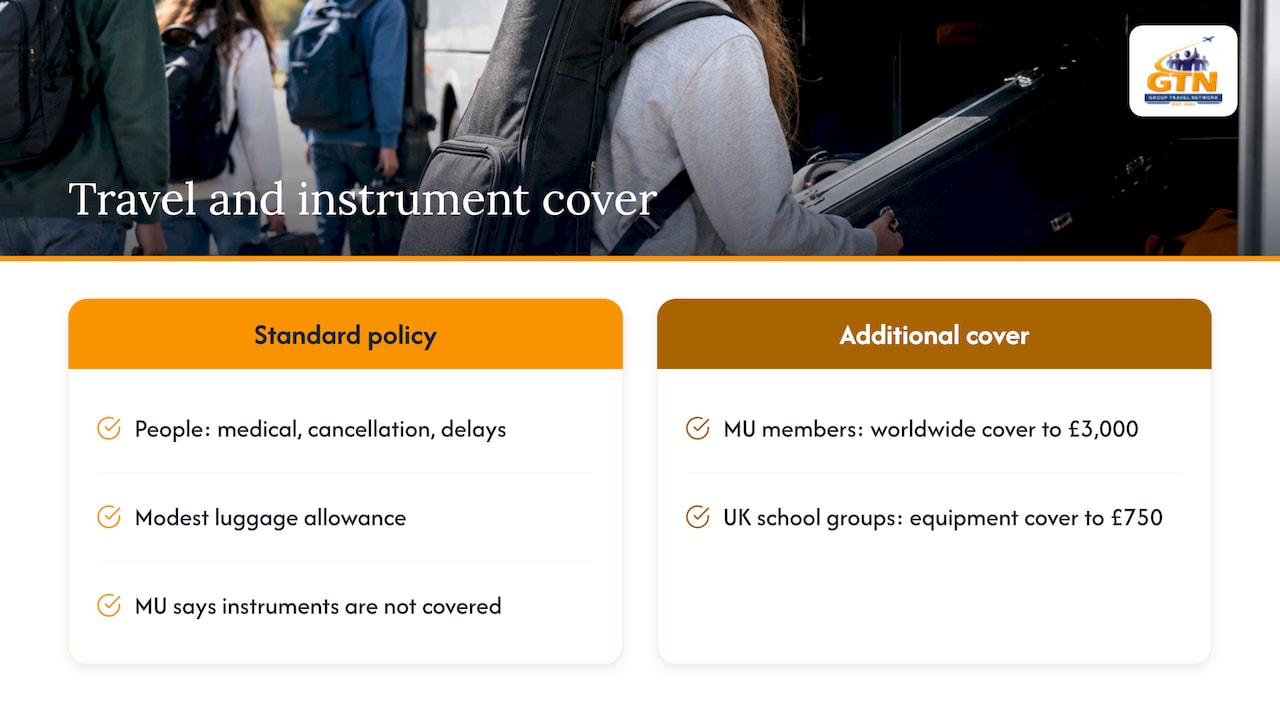
A typical trip policy is built around people: medical costs, cancellation, delays, and a modest allowance for luggage. Instruments are a special case because they are valuable, fragile and often irreplaceable at short notice.
The Musicians’ Union in the UK (opens in a new tab) states that travel insurance does not cover musical instruments, and offers its registered members separate worldwide instrument and equipment cover up to £3,000. That is a UK membership benefit, not a US product, but the underlying point applies in the United States too. The UK’s ISM (opens in a new tab) makes the same case: standard travel insurance is generally insufficient for professional instruments, and musicians should add specialized coverage.
Some group products do include an equipment allowance. One UK insurer’s youth and school group travel insurance (opens in a new tab) can include group equipment cover up to £750. That shows the idea exists, and it also shows the scale: a modest allowance is a long way from the replacement cost of a professional-grade trumpet, a cello or a marimba.
For the people-side of protection, our guides on travel insurance for school group trips (opens in a new tab) and group travel insurance for student trips (opens in a new tab) walk through medical, cancellation and liability cover. Instruments sit on top of that layer.
Does homeowners or renters insurance help?
Sometimes, but read the fine print. Many families assume a homeowners or renters policy follows an instrument everywhere. Personal property coverage may apply away from home, yet it often carries low limits and may not cover every kind of loss.
Use of the instrument matters as well. USAA (opens in a new tab) says its musical instrument policy will not cover instruments or equipment while they are used for business, and suggests musicians earning income consider small business insurance. For a school, the owner of the instrument changes the picture entirely:
- School-owned instruments are usually the district’s or school’s property, so they belong under the institution’s own property or inland marine arrangements. Ask your risk manager or business office whether those policies cover the instruments off campus, out of state and out of the country.
- Student-owned instruments are the family’s property. Their personal policy may or may not respond on a school trip. Send families a short notice asking them to check before departure.
- Director-owned or rented equipment needs its own confirmation, particularly if you are paid for performances.
The practical step is to ask each insurer one question in writing: “Does this policy cover this instrument, on this trip, in these countries, while checked as baggage and while in a rented bus or trailer?” Keep the reply with your trip file.
What airlines will and won’t cover
Most band travel involves at least one flight, and that is where the gap between airline liability and instrument value shows up.
The U.S. Department of Transportation’s tip sheet on flying with a musical instrument (opens in a new tab) notes that carry-on allowances vary by airline, and an instrument over an airline’s limits may have to be checked. It also lists the liability limits at the time of writing: $3,400 per passenger for domestic trips, and 1,131 SDRs (then US $1,686.50) for international trips. Those are caps per passenger, not per instrument, and they cover all of that traveler’s baggage. Check the current figures on the DOT page before you plan.
For checked instruments, the American Federation of Musicians guide (opens in a new tab) says U.S. carriers must accept musical instruments as checked baggage if they meet specific size (maximum 150 linear inches) and weight (maximum 165 pounds) limits, subject to aircraft-specific restrictions. It also notes that DOT has encouraged airlines to allow passengers to buy a seat for larger instruments, though not every airline permits it. That guide dates from 2015, so confirm each airline’s present policy directly.
Two things follow for a group:
- Airline liability is a ceiling, not a plan. A single tuba, bass or percussion case can exceed it, and one traveler may have several items in the same bag allowance.
- Policies differ in what they cover during air travel. Look for wording that names checked baggage specifically, as one German insurance broker’s blog on instrument cover when travelling (opens in a new tab) notes all-risks cover can apply to transport damage by plane, train or car.
If you are moving large equipment ahead of the group, see our advice on booking performance trip gear transport weeks ahead (opens in a new tab).
What specialist instrument insurance typically covers
Specialist policies are written around the way instruments actually get lost or damaged. Here is what to look for.
All-risks wording
Huntington T. Block describes its musical instrument policy (opens in a new tab) as covering all perils except those specifically excluded, unlike standard property policies that list the perils they cover. For a traveling band, that difference matters. A dropped case, a baggage handler’s mistake or a bus accident should not depend on whether someone thought to name it.
Agreed value
The same insurer explains that if an instrument is stolen or destroyed beyond repair, the scheduled agreed value is the maximum payable. So the number you put on the schedule is the number you can collect. Keep it current: an instrument bought five years ago may now cost more to replace.
Replacement versus market value
The nextsure blog advises checking whether a policy pays replacement value or current market value, to avoid being underinsured after a total loss. For a school buying a new instrument to replace a stolen one, replacement value is generally the more useful promise.
Hire costs
Some specialist policies cover the cost of hiring a substitute. Dubois (opens in a new tab) says its specialized insurance can cover hire costs if an instrument is damaged or destroyed during a trip. That is a UK provider’s feature, but it is worth asking any US insurer whether a rental is included, because a concert that goes ahead with a rented trombone beats one that is canceled.
Exclusions worth reading twice
The nextsure blog also points to “night-time clauses”: wording that can exclude instruments left unattended in vehicles during certain hours, for example 10 p.m. to 6 a.m. For a band moving by motorcoach or trailer, this is the exclusion most likely to bite. Overnight, the instruments should go inside the hotel or a secured venue, never stay in a parked vehicle.
How much does instrument travel insurance cost?
Prices depend on what you insure and for how much. USAA (opens in a new tab) says its personal musical instrument rates start as low as $2 per month, with actual cost depending on the item’s value and the coverage limits chosen. Treat that as a floor for a single personal instrument, not a quote for a school.
For your own comparison, the factors that usually move the premium are:
| Factor | Why it matters |
|---|---|
| Total insured value | Higher agreed values mean higher premiums |
| Instrument type | Fragile or very valuable instruments are priced differently |
| Deductible | A higher deductible usually lowers the premium |
| Geographic scope | Domestic-only versus worldwide cover |
| Use | Personal, student, school or paid performance use can be rated differently |
| Transport method | Checked baggage, freight or vehicle transport may carry conditions |
For a group, the sensible approach is to ask the school’s property insurer first, then request a quote from a specialist instrument insurer for the most valuable items only. Insuring a $400 student clarinet separately rarely makes sense. Insuring a $12,000 cello does.
To budget the rest of the trip’s protection, see what administrators pay for school trip insurance in 2026 (opens in a new tab).
Documents insurers will ask for
Get this ready before you request a quote, and again before departure.
- A description of each instrument: make, model, serial number and condition.
- Proof of value: USAA says it generally requires a detailed description of each item, and that high-value instruments or accessories may need a receipt, appraisal or other documentation showing ownership and value.
- Photos: clear images of each instrument and case, with serial numbers visible.
- An owner list: school-owned, student-owned or rented, with names.
- The itinerary: dates, destinations, and how instruments will be transported.
Keep digital copies with a second adult who is not traveling, so you can reach them if something goes wrong.
Protecting instruments before a claim is ever needed
Insurance pays after a loss. Good habits prevent most losses.
- Label every case with the school name and a contact number, inside and out.
- Use hard cases for checked items, and tag them as fragile.
- Assign a case captain for each section so there is always one named person responsible at every handoff.
- Hold a pre-departure inventory and repeat it at each hotel and at the return. Missing items are found faster when the count is fresh.
- Never leave instruments in a parked vehicle overnight, in line with the unattended-vehicle exclusions described above.
- Photograph instruments at drop-off so condition can be shown if a freight carrier or airline disputes damage.
- Plan the people too. Performers who protect their voices on tour perform better, and this piece on protecting a touring singer’s voice (opens in a new tab) is a good complement for choirs on the road.
If you are building the whole trip from scratch, our band trip planning guide (opens in a new tab) and the director’s guide to school band travel (opens in a new tab) cover scheduling, chaperones and logistics around the equipment.
Perspective: how we think about instruments on tour
We plan performance travel for school music programs, and the pattern is consistent: directors worry about the bus, the hotel and the venue, and the instruments get a line on a checklist. We think they deserve more. An instrument is often the one thing on a trip that can’t be replaced by tomorrow’s rehearsal.
Our view is simple. Decide who owns each instrument. Confirm in writing what covers it. Insure the few high-value items properly rather than hoping a general policy stretches. And treat transport as part of the plan, not an afterthought. Our coordinators build these questions into the itinerary so a director isn’t discovering a gap at the airport counter.
We also encourage families and administrators to see trip protection as layered: medical and cancellation cover for people, liability protection (opens in a new tab) for the group, and instrument cover for the gear. Each layer answers a different question.
— Donovan
Making insurance part of a stress-free performance tour
If you would rather not coordinate all of this alone, our Performance Tours (opens in a new tab) are planned around your group’s repertoire, schedule and equipment. We offer dedicated trip coordinators, online registration, flexible payment plans and travel protection options, so questions about instruments, transport and coverage are settled before you leave. Prices are not published, so contact us for a custom plan for your program.
If you need to make a claim
Exact steps depend on the insurer, so read your policy’s claims section before departure. In general:
- Secure the scene and the evidence. Photograph the damage and the case.
- Report theft to the police and get a report number. Report airline damage or loss to the airline, in writing, before leaving the airport where possible.
- Notify your insurer promptly, using the contact on your policy.
- Send the documents you gathered: description, photos, proof of value and the incident report.
- Keep receipts for any rental instrument you hire while waiting, since some policies cover hire costs.
- Keep communication in writing and note names and dates of every call.
School-owned instruments should go through your business office, since it usually holds the policy.
How to choose a policy: a quick checklist
- Does it cover all risks, or only named perils?
- Is the value agreed, and is it paid as replacement value?
- Does it apply worldwide, or only in the US?
- Does it name checked baggage, freight and vehicle transport?
- Is there an unattended-vehicle or night-time exclusion?
- Is rental or hire cost covered while the instrument is repaired?
- Does it still apply when the instrument is used for a school or paid performance?
- What is the deductible, and who pays it?
If an insurer cannot answer these in writing, keep looking.
FAQ
Does regular travel insurance cover musical instruments?
Usually not. Sources including the Musicians’ Union (opens in a new tab) say travel insurance does not cover instruments. Some group policies include a small equipment allowance, so ask for the limit and read the exclusions.
Is instrument insurance worth it for a school band trip?
For high-value instruments, yes. Airline liability is capped per passenger, and a single professional instrument can exceed that cap. For inexpensive student instruments, the school’s existing property coverage, or the family’s policy, may be enough if confirmed in writing.
How much does instrument insurance cost?
It depends on value, instrument type, deductible and location. USAA says personal rates start as low as $2 per month, but a school’s total will depend on what it insures. Request quotes using your instrument inventory.
Can I buy a seat for a large instrument on a plane?
Sometimes. DOT has encouraged airlines to let passengers buy a seat for larger instruments, but not all airlines allow it, according to the AFM guide (opens in a new tab). Ask each airline before booking.
Sources
- Flying with a Musical Instrument, U.S. Department of Transportation (opens in a new tab)
- A Guide to Flying with Musical Instruments, AFM Local 47 (opens in a new tab)
- Musical Instrument Insurance, USAA (opens in a new tab)
- Musical Instrument Insurance, Huntington T. Block (opens in a new tab)
- Travel Insurance for Musicians and Musical Instruments, Musicians’ Union (opens in a new tab)
- Travel Insurance for Musicians, ISM (opens in a new tab)
- Youth and school group travel insurance, Howden UK (opens in a new tab)
- Musical instrument insurance, Dubois (opens in a new tab)
- Musical instrument insurance when travelling, nextsure (opens in a new tab)
- Touring singer voice care (opens in a new tab)