

TL;DR:
- School band travel is a structured educational experience combining live performances, cultural exposure, and team development. Effective planning, budgeting, and adult preparation are crucial to ensuring safety, student growth, and program success. Fundraising, early organization, and professional support help make these impactful trips accessible and memorable for students.
Band travel is one of the most misunderstood programs in music education. Many assume it’s a reward trip dressed up as curriculum. In reality, what is travel for school bands represents a structured performing arts travel program that combines live performance, cultural exposure, and team development into one of the most powerful experiences a student musician can have. This guide breaks down exactly what band travel involves, how to plan it responsibly, how to fund it, and how to execute it so that every student comes back changed for the better.
Table of Contents
- Key takeaways
- What travel for school bands actually means
- Logistical essentials before your band hits the road
- Planning and budgeting for band travel
- Executing the trip so it actually delivers
- My honest take on what makes or breaks band travel
- How Grouptravelnetwork simplifies your next band trip
- FAQ
Key takeaways
| Point | Details |
|---|---|
| Band travel is educational | Performance tours serve academic goals, not just entertainment, which strengthens administrator support. |
| Logistics require serious planning | Supervision ratios, documentation, and communication plans must be established before departure. |
| Funding is achievable | Transparent cost breakdowns and organized fundraising make trips accessible to all students. |
| Safety systems must be explicit | Pre-assigned chaperone groups and practiced headcount methods reduce risk dramatically. |
| Professional support pays off | Delegating logistics to experienced tour coordinators lets directors stay focused on their students. |
What travel for school bands actually means
When band directors and administrators ask about school band travel opportunities, they’re really asking one question: what exactly does this look like in practice? The short answer is that it varies widely, and that variety is part of what makes it worth doing.
Band travel, formally known as a performance tour or music tour, falls into several distinct categories. Understanding which type fits your program’s goals shapes every decision that follows.
- Competition travel: Bands travel to regional or national competitions judged by music educators. These trips have high musical stakes and tight schedules, and they often produce the biggest leaps in student performance.
- Festival performances: Traveling bands perform (opens in a new tab) at local schools, music-in-parks festivals, and theme park events. These feel celebratory but still carry real performance pressure.
- Educational tours: Trips to cities like Washington, D.C., New York, or New Orleans that blend performances with museum visits, historical sites, and cultural experiences. Music becomes the lens through which students understand a place.
- Invitational showcases: Bands are invited to perform at college venues, concert halls, or community events, often alongside other school groups, building cross-school community and professional-level experience.
Popular school band tour destinations in the United States include Orlando, Chicago, Nashville, and New York City, each offering a mix of performance venues and educational attractions. Internationally, bands travel to places like London, Paris, and various European music festivals, though these trips require significantly more planning and budget.
The educational objectives embedded in these trips are not incidental. Students who perform in real venues before real audiences develop stage confidence no rehearsal room can replicate. They encounter musical traditions outside their own, build responsibility through shared travel, and return as better musicians and stronger people.
Pro Tip: When selecting a destination, choose one that offers at least two distinct educational experiences beyond the performance itself. This strengthens your case with administrators and creates richer memories for students.
Logistical essentials before your band hits the road
Planning band trips is where most directors feel the weight of responsibility most acutely. And they should. You’re moving dozens of minors across state lines or national borders, managing schedules, medications, dietary needs, and behavioral expectations simultaneously. Getting the logistics right isn’t optional.
Here are the non-negotiable areas to address before any trip:
- Supervision and chaperone ratios. Districts vary, but most require one adult chaperone per 10 students as a baseline. Critically, student leaders cannot serve (opens in a new tab) as official chaperones, even if they are 18 years old. Drum majors and band captains do not count regardless of how mature they are.
- Documentation and forms. Students need completed medical forms, emergency contact information, behavior agreements, and permission slips before departure. Many trips also require mandatory online forms submitted by parents, covering health status, payment confirmation, and conduct rules.
- Transportation and accommodations. Charter buses with licensed, vetted drivers are the standard for ground travel. Hotel arrangements should specify room assignments, floor plans for adult supervision, and clear curfew enforcement protocols.
- Insurance coverage. Trip cancellation insurance, medical coverage, and instrument protection are three separate considerations. Review each one. Knowing your school group trip insurance (opens in a new tab) options before you book saves significant financial pain later.
- Communication plans. Districts must establish clear protocols for pickups, drop-offs, and real-time communication between chaperones, administrators, and parents. A communication failure during a trip is not a minor inconvenience. It’s a liability event.
“Planning band travel as a legally managed activity reduces risk and protects schools and students. The difference between a successful trip and a crisis often comes down to how thoroughly the protocols were defined before departure.” — NJPSA and FEA
Before your group departs, walk your chaperone team through every scenario: student illness, missed bus, lost student, weather delays. Preparation at this level is what separates programs that travel confidently from those that scramble in the moment.
Pro Tip: Hold a chaperone orientation meeting at least two weeks before departure. Cover roles, communication protocols, and what to do if a student goes missing. Written handouts reinforce the conversation.

Planning and budgeting for band travel
The financial side of travel experiences for student musicians stops more trips than any other obstacle. But with the right strategy, the cost rarely needs to fall entirely on families.
Breaking down the real costs
A typical overnight band trip includes transportation, hotel, meals, performance or entry fees, and a contingency fund. When you present this to administrators, include an estimated cost per student (opens in a new tab) alongside your proposed fundraising plan. Vague budget requests get rejected. Specific ones move forward.
Fundraising strategies that actually work
- Sell concessions at sporting events, school performances, and community gatherings
- Apply for music education grants through organizations like the National Association for Music Education
- Partner with local businesses for sponsorships in exchange for program recognition
- Launch student-driven campaigns through platforms designed for school fundraising
- Host a ticketed community concert where proceeds go directly to the travel fund
Transparent fundraising strategies (opens in a new tab) reduce financial barriers and build community investment in the trip before it even happens. Parents who helped raise the money care more about the outcome.
Getting administrators on board
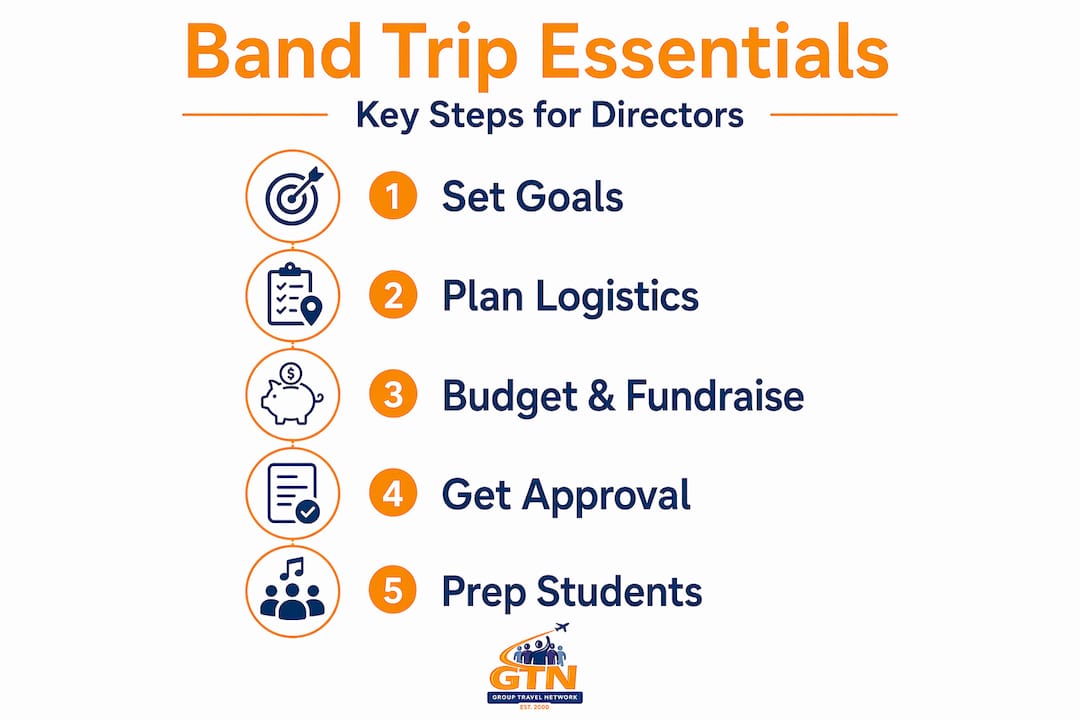
Administrator buy-in requires a structured proposal that connects the trip to curriculum standards, documents safety plans, and outlines educational objectives clearly. Tie the trip to specific learning goals: music literacy, cultural awareness, ensemble teamwork. Administrators approve programs that look like education, not vacations.
| Proposal element | Why it matters |
|---|---|
| Educational objectives | Connects the trip to curriculum and state standards |
| Detailed cost breakdown | Builds credibility and reduces budget-related pushback |
| Safety and supervision plan | Demonstrates legal awareness and duty of care |
| Fundraising strategy | Shows the trip won’t burden the district budget |
| Equity access plan | Addresses concerns about excluding lower-income students |
Addressing equity upfront is also smart strategy. If some students cannot afford to participate, what is your plan? Scholarship funds, sliding-scale payment structures, or internal program subsidies show administrators you’ve thought past the excitement to the practical reality.
Executing the trip so it actually delivers
The best-planned trip can still fall apart during execution without the right systems in place. These steps give you the operational backbone to keep things moving safely.
- Pre-assign chaperone groups before departure. Pre-assigned groups and rehearsed headcount methods (opens in a new tab) are more effective than ad hoc counting at every stop. Every chaperone should know their eight to ten students by name, face, and phone number before the bus leaves.
- Build in wellness checkpoints. Long travel days drain students physically. Schedule hydration breaks, accommodate food allergies in every meal arrangement, and build rest into the itinerary rather than cramming it with activities.
- Use creative check-in systems during free time. One method gaining traction among experienced directors: selfie check-ins with recognizable backgrounds at theme parks or open venues. Students send a photo from a visible landmark on a schedule, confirming their location without requiring constant adult presence.
- Delegate logistics to a professional tour coordinator. Delegating logistical details to experienced tour managers frees directors to focus on what they do best: supporting students and preparing for performances. You cannot conduct a rehearsal and manage a hotel check-in at the same time.
- Document the experience for program visibility. Photos, video, student testimonials, and performance recordings become advocacy material. A yearbook photography checklist (opens in a new tab) helps coordinators capture the moments that matter most, creating content you can use in newsletters, board presentations, and next year’s recruitment push.
Pro Tip: Send a daily recap email to parents during the trip. Two to three sentences with a photo is enough. It builds trust, reduces anxiety-driven calls, and creates a record of the program’s success.
My honest take on what makes or breaks band travel
I’ve watched programs plan beautiful trips on paper that unraveled the moment something went sideways. And I’ve seen underfunded programs run trips that changed students for life because the director was utterly prepared for the unexpected.
In my experience, the single biggest predictor of a successful band trip is not the destination or the performance venue. It’s how thoroughly the director prepared the adults. Students rise to expectations when the adults around them are calm, clear, and coordinated. Chaperones who don’t know their role create gaps that problems walk through.
What I’ve also learned is that travel does something music rehearsal cannot replicate. I’ve seen quiet students become leaders during a late-night navigation challenge in an unfamiliar city. I’ve watched competitive sections of a band become genuinely close after sharing a bus for twelve hours. The educational benefits of group travel (opens in a new tab) show up in the music when the group returns. The cohesion is audible.
The uncomfortable truth is that many directors underestimate how long good planning takes. Six months is the minimum for a serious overnight trip. Twelve months is better for anything involving flights or international destinations. Start earlier than you think you need to. Every week of additional preparation is insurance against a week of crisis management on the road.
Use the trip as evidence afterward. Student growth, performance reviews, community response. These are the building blocks of a proposal for next year’s trip, and the year after that. Programs that travel consistently grow faster and retain students longer. That data should be in front of your administration every time you ask for support.
— Donovan
How Grouptravelnetwork simplifies your next band trip
Planning a performance tour from scratch is a full-time project layered on top of your actual full-time job. Grouptravelnetwork specializes in exactly this kind of organized chaos.

Whether you’re organizing your first overnight trip or your tenth international tour, Grouptravelnetwork offers school group travel planning (opens in a new tab) built around the specific needs of band directors and school administrators. From customized itineraries and vendor negotiations to dedicated trip coordinators and flexible payment options for families, every service is designed to take the logistical burden off your plate. Explore student group tour options (opens in a new tab) tailored for performing arts groups, or connect with a coordinator directly to start building a trip your students will talk about for years.
FAQ
What is travel for school bands?
Travel for school bands, also called a performance tour or music tour, is an organized trip in which student musicians travel to perform at competitions, festivals, or educational venues while gaining cultural and real-world musical experience.
What are the most popular school band tour destinations?
Popular domestic destinations include Orlando, Nashville, New York City, and Washington, D.C., all of which offer a mix of notable performance venues and educational attractions well-suited for student musicians.
How do you fund a school band trip?
Most programs combine student fundraising, local business sponsorships, music education grants, and family payment plans to cover trip costs. Presenting a transparent cost breakdown alongside a fundraising plan significantly improves administrative approval rates.
How many chaperones are required for a school band trip?
Most districts require one adult chaperone per 10 students, though this ratio varies by district policy. Student leaders such as drum majors cannot legally serve as chaperones regardless of their age.
How far in advance should you plan a band trip?
Plan at least six months ahead for domestic overnight trips and twelve months or more for international tours. Early planning gives you time to secure venues, complete documentation, run fundraising campaigns, and prepare chaperones thoroughly.
Recommended
- Music Tours: A School Administrator’s Planning Guide • Group Travel Network (opens in a new tab)
- Band Trip Planning Guide: Organize Student Music Travel (opens in a new tab)
- Role Of Guides In Student Travel: Administrator’s Guide • Group Travel Network (opens in a new tab)
- School Group Travel Planning: A Step-by-step Guide • Group Travel Network (opens in a new tab)