


TL;DR:
- Liability protection for group travel shields organizers from legal claims due to injuries or damage during trips.
- Effective safeguarding requires layered insurance, legal contracts, and accurate medical disclosures to prevent gaps.
Liability protection for group travel is the financial and legal coverage that shields trip organizers from claims related to injuries, property damage, or accidents occurring during a group trip. For school administrators, band directors, and trip coordinators, this protection is not optional. When you organize travel for minors, you carry a legal duty of care that exposes you and your institution to significant risk if something goes wrong. Understanding group travel liability (opens in a new tab) is the first step toward running compliant, safe student trips in 2026.
What is liability protection for group travel?
Liability protection for group travel is formally known as third-party liability coverage. It protects the organizer financially when a participant, vendor, or bystander files a claim for injury or property damage caused during the trip. This is distinct from trip cancellation insurance or medical coverage, which protect the traveler. Third-party liability coverage protects you, the organizer.

Group travel insurance (opens in a new tab) typically covers groups of 10 or more travelers under a single contract, which simplifies risk management and reduces cost compared to individual policies. The personal liability component within that policy is what covers legal claims. Without it, a single injury claim can result in out-of-pocket legal costs and settlements that fall on the school or the organizer personally.
The core coverages relevant to school group trips include:
- Third-party liability: Covers claims from non-participants injured or whose property is damaged during the trip
- Medical expense coverage: Pays for treatment costs when a student is injured, reducing the organizer’s financial exposure
- Trip cancellation and interruption: Reimburses non-refundable costs when a trip is canceled for covered reasons
- Insolvency protection: Covers financial loss if a travel supplier, such as an airline or hotel, goes bankrupt
- 24/7 emergency assistance: Coordinates evacuation, repatriation, and medical logistics during an incident
Pro Tip: Emergency assistance services (opens in a new tab) are often more critical than the medical benefit dollar limit. For student groups, the ability to coordinate evacuation and repatriation quickly can determine the outcome of a serious incident.
24/7 emergency assistance (opens in a new tab) is frequently more decisive than medical benefit limits in managing group travel liability, especially for student groups needing logistical coordination. A high coverage limit means little if no one is available at 2:00 AM to arrange a medical evacuation.
How do legal frameworks affect organizer liability?
Regulations governing group travel have grown stricter, and 2026 compliance standards reflect that trend. The UK’s Package Travel and Linked Travel Arrangements Regulations 2018 serve as a benchmark framework. These rules impose strict duty-of-care obligations (opens in a new tab) on organizers who combine multiple travel services, such as flights and accommodation, into a single package price.
The practical impact for school trip coordinators is significant. Even informal group arrangements can be legally classified as “package arrangements” if they bundle two or more travel components. That classification triggers mandatory insolvency protection and refund mechanisms that go beyond standard insurance requirements.
Key legal obligations for group travel organizers include:
- Duty of reasonable care: You must take all reasonable steps to prevent foreseeable harm to participants
- Accurate medical disclosure collection: You must gather complete health information for every minor in your group
- Insolvency protection: You must have financial protection in place if a supplier fails
- Clear terms and conditions: Participants must receive written documentation of their rights and your liability limits before departure
“Legal frameworks can designate informal group trips as package arrangements, substantially increasing organizer liabilities, including mandatory insolvency protection and refund requirements. Even small, non-commercial groups may be subject to package travel regulations if multiple components are combined.”
Failure to comply carries real consequences. Non-compliance can result in personal liability for the organizer, not just institutional liability for the school. A band director who books flights and hotel rooms together for a performance tour may unknowingly trigger package travel regulations. Knowing the rules before you book protects you from that exposure.
Common pitfalls in group travel liability coverage
Most liability gaps in school group travel come from assumptions, not negligence. Organizers assume their general group insurance covers all personal liability scenarios. It often does not.
1. Assuming one policy covers everything
General group travel insurance covers many risks, but personal liability coverage (opens in a new tab) is a distinct component that protects against third-party legal claims. Confirm explicitly that your policy includes this coverage before departure.
2. Skipping complete medical disclosures
Group organizers have a duty of reasonable care and must collect accurate medical disclosures for every minor. Incomplete medical information can lead insurers to deny claims, leaving organizers personally liable for medical costs and legal settlements. Use a direct online portal or secure form to collect this data privately and accurately.
3. Relying on a single layer of protection
Overreliance on one element of protection leaves serious gaps. A three-part protection stack (opens in a new tab) covers the full range of risks: commercial liability insurance, attorney-reviewed terms and conditions, and participant travel insurance. Each layer addresses risks the others do not.
4. Failing to confirm coverage for minors and specific activities
Not all group travel policies automatically cover minors or high-activity excursions like white-water rafting or skiing. Confirm in writing that your policy covers every planned activity and every participant age group.
Pro Tip: Request a written coverage confirmation letter from your insurer before departure. This document strengthens your legal defense if a negligence claim is filed after the trip.
Practical steps to implement liability protection for school trips
Effective liability protection does not happen at the last minute. It requires deliberate steps built into your planning timeline.
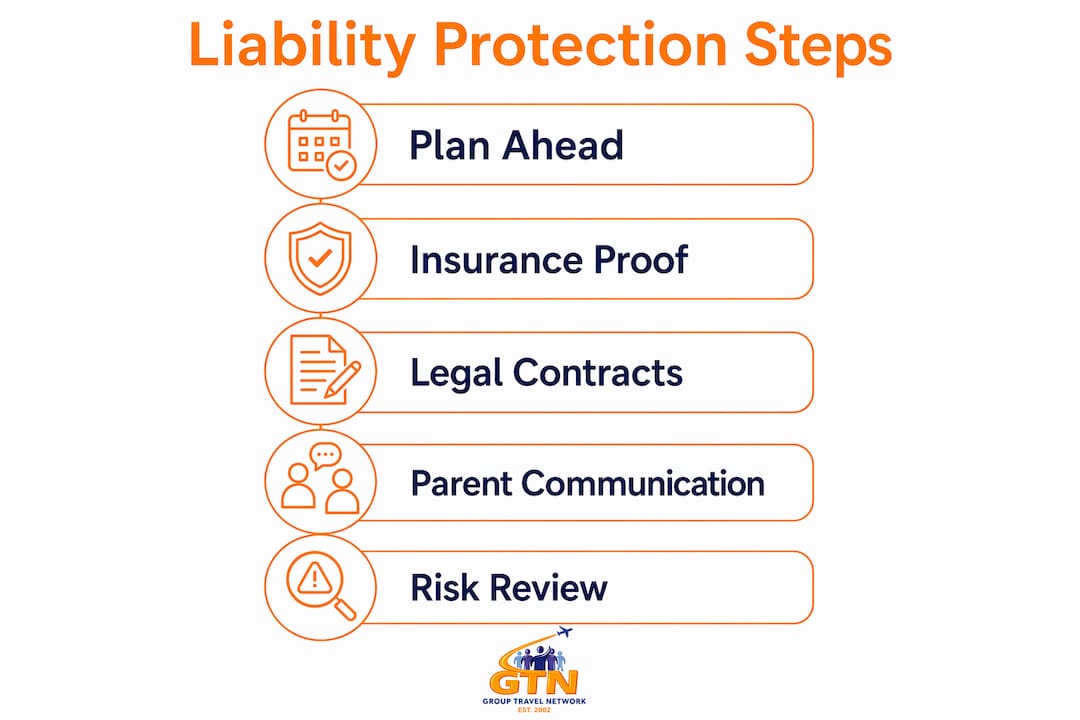
Build a layered protection strategy
Liability protection works best as a layered strategy combining commercial liability insurance, attorney-reviewed terms and conditions, and participant travel insurance. Assign responsibility for each layer to a specific person on your planning team.
Use two mandatory insurance proof checkpoints
Implementing two insurance proof checkpoints, one at booking and one before departure, documents active risk management and strengthens your legal defense in negligence claims. Make proof of coverage a required step in your registration process, not an afterthought.
Communicate clearly with parents and staff
Send written liability disclosures to parents before the trip. Explain what the group insurance covers, what it does not cover, and what participants are responsible for. Clear communication reduces disputes and demonstrates your duty of care.
The table below outlines the key protection checkpoints for a school group trip:
| Planning Stage | Action Required |
|---|---|
| Initial booking | Confirm commercial liability insurance is active and covers the destination |
| Registration | Collect signed terms and conditions and medical disclosures from all participants |
| 30 days before departure | Verify participant travel insurance is in place for every traveler |
| Pre-departure briefing | Confirm 24/7 emergency assistance contact details with all staff |
| Post-trip | File incident reports and document any claims immediately |
Student travel safety (opens in a new tab) depends on this kind of structured approach. Ad hoc planning creates the gaps that lead to denied claims and personal liability.
Key Takeaways
Liability protection for group travel requires a layered strategy combining commercial insurance, legal contracts, and participant disclosures to fully protect school trip organizers.
| Point | Details |
|---|---|
| Third-party liability is distinct | Personal liability coverage protects the organizer from legal claims, not just the traveler from medical costs. |
| Medical disclosures are mandatory | Incomplete health information for minors can void coverage and expose organizers to personal liability. |
| Legal classification matters | Bundling flights and hotels can trigger package travel regulations, requiring insolvency protection. |
| Two insurance checkpoints reduce risk | Verifying coverage at booking and pre-departure documents proactive risk management. |
| Layered protection closes gaps | Insurance alone is insufficient. Attorney-reviewed contracts and duty of care policies complete the strategy. |
Why I think most school trip organizers underestimate their exposure
After working with educational travel for years, the pattern I see most often is not recklessness. It is a quiet assumption that “we have insurance, so we are covered.” That assumption is the most expensive mistake a trip coordinator can make.
The reality is that group travel liability is not a single product you buy. It is a system you build. Commercial liability insurance covers your organization. Participant travel insurance covers the students. Attorney-reviewed terms and conditions define what you are and are not responsible for. Miss any one of those three layers, and you have a gap that a plaintiff’s attorney will find before you do.
What surprises most administrators is how quickly an informal arrangement becomes a regulated package. Book a charter bus and a hotel block for a band competition, and you may have just created a legal package arrangement with insolvency protection requirements. That is not a hypothetical. Regulatory bodies have applied package travel rules to school trips that organizers believed were entirely informal.
The other thing I have seen trip coordinators overlook is the medical disclosure process. Collecting a paper health form at the start of the school year is not sufficient. You need current, trip-specific disclosures collected through a secure channel, reviewed before departure, and filed where your insurer can access them if a claim arises. That process protects the student and it protects you.
My advice is simple. Treat liability protection as a planning deliverable, not a checkbox. Build it into your timeline, assign ownership, and verify it twice.
— Donovan
How Grouptravelnetwork helps school coordinators plan with confidence
School trip planning carries real legal and financial weight. Grouptravelnetwork specializes in organizing student, school, and performance group trips with dedicated support for insurance coordination, risk management, and compliance documentation.

Grouptravelnetwork’s step-by-step planning guide (opens in a new tab) walks administrators and band directors through every stage of a compliant group trip, from initial booking to pre-departure verification. The platform connects coordinators with vetted travel vendors, flexible payment plans, and travel protection options built for educational groups. For coordinators who want expert guidance on educational group travel (opens in a new tab) without the legal guesswork, Grouptravelnetwork provides the structure and support to get it right.
FAQ
What does liability protection for group travel cover?
Liability protection for group travel covers the organizer’s financial and legal exposure when a third party files a claim for injury or property damage during the trip. It is distinct from medical or trip cancellation coverage, which protect the traveler directly.
Is group travel insurance required for school trips?
Many school districts and regulatory frameworks require liability coverage for organized student trips, particularly when minors are involved. Organizers should confirm requirements with their district’s legal counsel and their destination’s local regulations.
What is the minimum group size for group travel insurance?
Groups of 10 or more travelers generally qualify for broad group travel insurance policies, though some providers extend coverage to groups of five or more. Confirm minimum size requirements with your insurer before booking.
Can a school trip be classified as a package arrangement?
Yes. Combining two or more travel components, such as transportation and accommodation, at a single price can legally classify a school trip as a package arrangement, triggering additional regulatory obligations including insolvency protection.
What happens if a participant’s medical disclosure is incomplete?
Incomplete medical disclosures can result in claim denial by the insurer, leaving the organizer personally liable for medical costs and legal settlements. Collect current, trip-specific health information from every participant through a secure, documented process before departure.
Recommended
- What Is Student Travel Liability? A 2026 Guide • Group Travel Network (opens in a new tab)
- Group Travel Insurance Explained: Protect Student Trips Easily • Group Travel Network (opens in a new tab)
- Safe Travel Planning Steps For Student Groups In 2026 • Group Travel Network (opens in a new tab)
- Travel Insurance For School Group Trips Explained • Group Travel Network (opens in a new tab)