


A school trip cancellation policy is a written document that tells families what happens to their money if a student withdraws, the school cancels, or a supplier fails. A good one mirrors the refund deadlines in your vendor contracts, separates the cost of withdrawing from the cost of a cancelled trip, and points families to insurance for the reasons a refund schedule cannot cover. This guide shows administrators and trip leaders how to build that policy and where it usually goes wrong.
TL;DR
- Your policy can only be as generous as your suppliers’ contracts. Refund tiers for families should follow the deadlines at which you stop getting money back.
- Vendor cancellation terms and travel insurance are two different protections. The policy should explain both and never blur them.
- Standard insurance covers listed reasons only. “Cancel for Any Reason” (CFAR) coverage is an upgrade, partial, and sold in a short window after the first deposit.
- Put it in writing before you collect the first dollar, and get a signed acknowledgment from every family.
- Plan for the three cancellations that hurt most: one student withdrawing, the school cancelling the whole trip, and a supplier or event cancelling on you.
Table of Contents
- Why the policy has to start with your contracts
- The three cancellations your policy must cover
- Vendor cancellation terms are not insurance
- Where cancel for any reason fits
- International trips raise the stakes
- A sample policy structure
- How to roll the policy out
- Mistakes that cost schools money
- Our perspective
- Plan a trip with the policy built in
- FAQ
- Sources
Why the policy has to start with your contracts
Most administrators want to be generous with families. The trouble is that a school rarely controls the money once it has been paid out. Guidance written for school trip organizers in Aberdeenshire, Scotland, makes the point plainly: schools often cannot guarantee refunds because they are bound by the terms of third-party suppliers (opens in a new tab). The setting is British, but the logic holds for any US school booking airlines, hotels, bus companies and venues.
So the first step is not drafting family-facing language. It is building a timeline of every date on which your own refund drops. Collect these from each supplier:
- The deposit amount and whether any part is refundable.
- The date the final payment is due.
- The date or dates your refund percentage steps down.
- The date after which nothing comes back.
- What happens if you reduce the head count, and by how much you may reduce it without penalty.
- Who bears the loss if the supplier cancels.
Tiered schedules are standard in educational and youth programming. One university outdoor program, for example, describes full refunds 30 or more days out, stepping down to 50% a few days before and nothing inside the last few days (opens in a new tab). Your suppliers will have their own numbers, but the shape is the same: the closer to departure, the less you recover.
The three cancellations your policy must cover
Write a separate section for each. Families confuse them, and the money works differently in each.
1. A student withdraws
This is the common one. Illness, a family change, a discipline issue, a scheduling conflict with a sports season. Your refund to the family depends on whether you can recover that student’s share from suppliers, and whether you can fill the seat with a replacement.
A workable approach:
- Early withdrawal: refund payments minus any non-refundable deposit and any costs already committed on the student’s behalf, such as a booked airline ticket.
- Mid-window withdrawal: refund only what suppliers refund to you, and say so.
- Late withdrawal: state clearly that little or nothing is recoverable, and explain that insurance is the route for covered reasons.
- Replacement: say whether a student on a waitlist may take the seat, and whether names on airline tickets can be changed. Many tickets cannot be, which is a good reason to ask before you pay.
2. The school or district cancels the trip
This covers low enrollment, a board decision, a chaperone shortage, a safety advisory or a budget cut. It is the cancellation where families expect a full refund, and it is the hardest one to promise. If the school cancels in October for a March trip, you may lose a deposit that you cannot pass back.
Decide in advance, with your business office, whether the school will absorb that loss or share it. Then say which. A line such as “If the school cancels the trip, families will receive a refund of all payments less any non-recoverable supplier costs” is honest. A line promising a full refund in every case is a liability unless the school has agreed to cover the gap.
Set a minimum enrollment number and a decision date in the policy, and make that date earlier than your first major supplier penalty. If you find in November that you cannot reach 30 students, you want to learn it before the bus and hotel deposits become non-refundable.
3. A supplier, event or destination cancels
A festival closes, a venue double-books, a tour operator fails, a hurricane closes an airport. Here the refund comes from the supplier, from insurance, or from neither. Your policy should state that you will pursue available refunds on behalf of families and pass on whatever is recovered. For weather specifically, see our explainer on what trip cancellation coverage actually pays for weather (opens in a new tab).
Vendor cancellation terms are not insurance
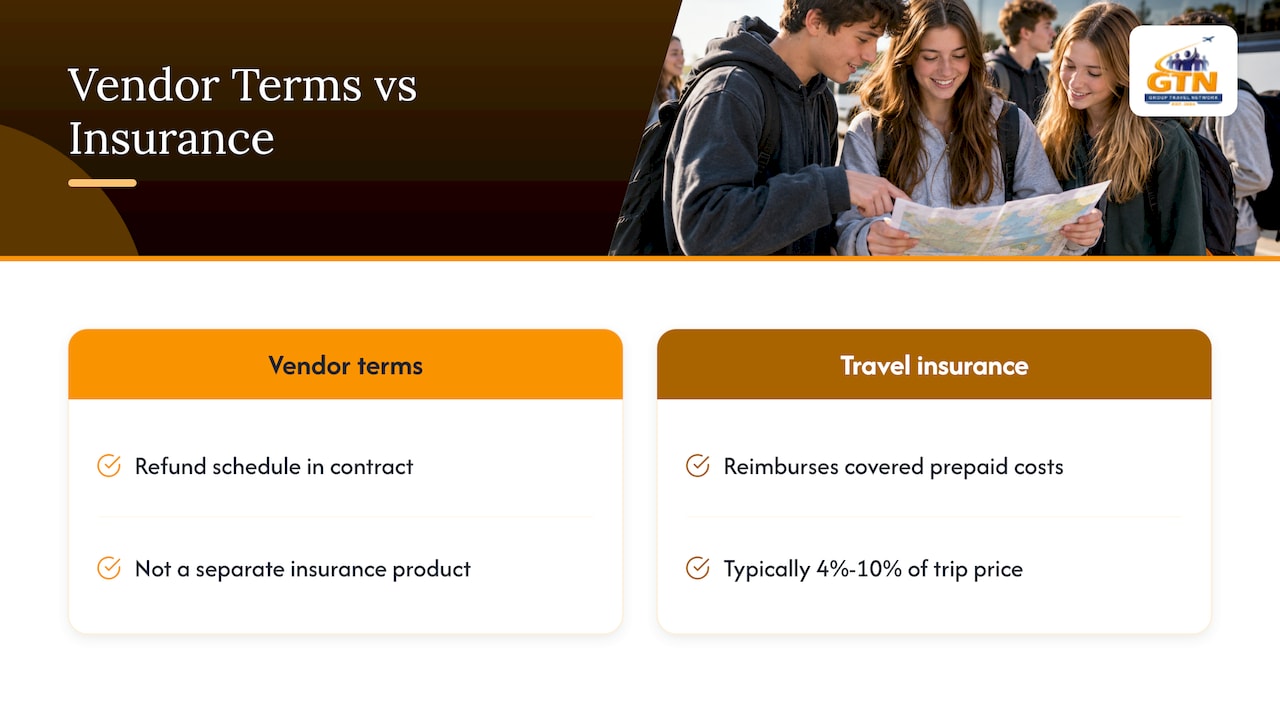
This is the distinction that causes most angry emails. Vendor terms are the refund schedule in your contract. Travel insurance is a separate product that reimburses prepaid, non-refundable costs when a covered reason stops someone from traveling.
The National Association of Insurance Commissioners (NAIC) says standard policies reimburse pre-paid, non-refundable expenses for covered reasons such as an unexpected illness or injury, a death in the family or severe weather (opens in a new tab), and that these policies typically cost 4% to 10% of the trip price. On a $5,000 trip that is roughly $200 to $500 per traveler, according to the same source. For group-plan pricing in the school context, see our breakdown of what administrators pay for school trip insurance (opens in a new tab).
The consequence for your policy: a family that withdraws for a reason insurance does not list is not entitled to an insurance payout, and a family that withdraws for a covered reason still needs to have bought the plan before the deadline.
Where cancel for any reason fits
Standard policies almost never cover a plain change of mind, which the industry calls disinclination to travel. The upgrade for that is CFAR. According to the NAIC, CFAR policies typically return 50% to 75% of the insured cost (opens in a new tab), can raise the premium by close to half, and must usually be bought within a set window after the first trip deposit. They also usually require you to cancel at least 48 hours before departure.
For your policy, that means three practical things:
- Tell families about CFAR at the same moment you announce the trip, not after the deposit window has closed.
- State the purchase deadline in calendar dates, not in “days after deposit”, since families count differently.
- Say plainly that CFAR is partial. A family expecting 100% will be disappointed.
Plans differ by insurer and by state, so read the actual plan document before you describe it to parents. Our guide to how travel insurance works for school group trips (opens in a new tab) and the companion piece on protecting student trips with group coverage (opens in a new tab) walk through the options. If a student has a known health condition, timing matters even more, and we cover it in pre-existing condition coverage for student trips (opens in a new tab).
Pandemics and other known events
The NAIC notes that standard policies generally exclude epidemics and pandemics (opens in a new tab), and that coverage is unreliable once an event is publicly known. Read the policy language on this before you finalize anything for a large group, and do not promise parents pandemic refunds in your policy.
International trips raise the stakes
For trips abroad, cancellation is only half the question. The U.S. Department of State says the U.S. government does not pay medical costs or unexpected travel expenses for citizens abroad (opens in a new tab) and that U.S. health insurance, including Medicare and Medicaid, generally does not cover care outside the country. It also notes that trip cancellation insurance usually does not pay for medical costs in other countries.
So an international trip needs two things written down: the cancellation schedule, and a requirement or strong recommendation for coverage that includes emergency medical care and evacuation. Keep those as separate lines in your policy so a family does not assume one product does both jobs.

A sample policy structure
Adapt the numbers to your own contracts. The percentages below are an illustration, not a standard, and should match the dates your suppliers give you.
| When the student withdraws | What the family receives | Why |
|---|---|---|
| After sign-up, before the deposit deadline | Full refund | No supplier costs committed yet |
| After deposit, 120+ days before departure | All payments minus the non-refundable deposit | Deposit is typically held by suppliers |
| 60 to 119 days out | Payments minus deposit and any costs already committed | Some supplier penalties begin |
| 30 to 59 days out | Only amounts recovered from suppliers | Penalties are steep |
| Fewer than 30 days out | No refund from the school; insurance claim for covered reasons | Most contracts are fully non-refundable |
The fine print that makes this work:
- Name the date for every row, not just the number of days.
- State that refunds are issued after supplier refunds are received, and give a realistic window.
- Say who processes insurance claims. The family files; the school does not.
- Include a line on replacements and name changes.
- Include late-payment consequences. Many contracts treat missed milestones as automatic cancellation, and the same should be true of your payment schedule. Our school trip payment policy templates and timelines (opens in a new tab) show how to align the two.
How to roll the policy out
A policy nobody reads protects nobody. The sequence that works:
- Before the interest meeting, finalize contract dates with your supplier or trip planner.
- At the meeting, present the policy aloud along with the insurance options and the CFAR deadline.
- At sign-up, collect a signed acknowledgment from a parent or guardian. Our note on the role of travel waivers for school trip coordinators (opens in a new tab) explains what these forms do and do not do. Have your district counsel review the final language.
- After sign-up, repeat the key dates in each payment reminder. The approach in our parent trip communication guide (opens in a new tab) helps here.
- When a cancellation happens, respond in writing, quote the policy line that applies, and give the next step.
Pair the policy with an emergency plan (opens in a new tab) so that cancellation, interruption and on-trip emergencies are all handled by the same set of documents.
Mistakes that cost schools money
- Promising refunds the contract does not give. If you tell families “full refund if you cancel for any reason” and your supplier gives nothing back, the school pays.
- Setting the decision date too late. The cancellation deadline for the whole trip should land before your first large non-refundable payment.
- Treating insurance as optional information. If the first mention of insurance is after the window closes, CFAR is gone.
- Ignoring the chaperone. If a trip leader resigns or changes jobs, the trip may need cancelling. Name a second lead educator in the policy and say what happens if both are unavailable.
- Mixing deposit and payment language. Say which is which, and which is refundable.
Our perspective
We plan student, performance and educational trips for schools, so the cancellation conversation is one we have with administrators constantly. What we see is that the disputes rarely come from the rules themselves. They come from surprise. A family that read the schedule at sign-up and saw it again in each reminder rarely argues with it. A family that heard “we’ll sort it out” argues with everything.
Our advice is to be exact rather than generous. Promise what your contracts let you deliver, point to insurance for the rest, and bring the trip planner into the room early so the dates in the policy are the dates in the paperwork. A dedicated coordinator who tracks supplier deadlines for you makes this far easier, because the deadline table stays current as the trip changes. And if your group is large or traveling abroad, treat protection as part of the plan from the first announcement, not as an add-on.
— Donovan
Plan a trip with the policy built in
If you are a band director, principal or trip coordinator who wants deadlines, payment plans and travel protection options laid out before families commit, Group Travel Network (opens in a new tab) builds custom itineraries with dedicated trip coordinators, online registration and flexible payment plans. Explore performance tours (opens in a new tab), educational trips (opens in a new tab), senior class trips (opens in a new tab) or international adventures (opens in a new tab), and ask how the cancellation schedule would work for your group.
FAQ
Can a school guarantee a full refund if a trip is cancelled?
Only if the school is willing to cover whatever suppliers do not return. Most schools are bound by the terms of airlines, hotels and venues, so the safest wording promises a refund of everything recovered, less non-recoverable costs. Check this wording with your business office and counsel.
Does trip cancellation insurance cover a student who simply changes their mind?
Not under a standard policy, which pays for listed reasons such as illness, injury or severe weather. A CFAR upgrade can cover it, but it usually returns only 50% to 75% and must be bought within a short window after the first deposit.
What should a school do if the trip leader can no longer go?
Treat it as a school-side cancellation risk and decide in advance whether another staff member can lead. If not, the trip falls under your school-cancels section, and refunds depend on supplier terms. Naming a backup leader in the policy avoids the scramble.
When should the cancellation policy be shared with parents?
Before any money is collected, at the information meeting and in the sign-up packet, with a signed acknowledgment. Repeat the key dates in payment reminders, and mention the insurance purchase deadline at the same time.
Sources
- NAIC: Should I get travel insurance? (opens in a new tab)
- NAIC: Travel insurance (opens in a new tab)
- U.S. Department of State: Travel insurance (opens in a new tab)
- Southern Adventist University: Outdoor programming FAQs (opens in a new tab)
- Aberdeenshire parents trip handbook (UK) (opens in a new tab)
Recommended
- School Trip Payment Policy: 2026 Templates And Timelines (opens in a new tab)
- Field Trip Organization Tips: A School Administrator’s Guide (opens in a new tab)
- School Trip Insurance Cost: What Administrators Pay In 2026 (opens in a new tab)
- Parent Trip Communication: Your 2026 Guide For Schools (opens in a new tab)