


TL;DR:
- Travel waivers allow fee-free flight changes during specific airline disruptions but are limited to clear conditions and timeframes. Coordinators must verify each booking’s eligibility and understand that waivers do not cover fare differences or all costs. Combining waivers with travel insurance offers comprehensive protection, reducing liability and ensuring group safety during disruptions.
Travel waivers are temporary airline policy exceptions that permit fee-free itinerary changes or cancellations under specific disruption conditions. For school administrators, sports team managers, and educational trip coordinators, understanding the role of travel waivers is not optional. A single weather event, airspace closure, or airline strike can affect dozens of students at once. Knowing exactly what waivers cover, what they exclude, and how they interact with travel insurance determines whether your group gets home smoothly or faces unexpected costs and liability exposure.
How do travel waivers function and what limits should coordinators expect?
A travel waiver is a carrier-issued exception, not a blanket protection. Airlines activate waivers in response to specific triggering events such as severe weather, labor strikes, or airspace closures. Once active, a waiver allows travelers to change dates or routes without paying standard change fees, but the window is narrow. Waiver windows are typically 7–14 days (opens in a new tab), covering only specific airports and original travel dates. That tight timeline matters enormously when you are coordinating 40 students across multiple booking dates.

The most common misconception among trip coordinators is that “free change” means all costs are covered. Waivers waive change fees but not fare differences (opens in a new tab), meaning if the replacement flight costs more than the original, your group pays the gap. That distinction can translate to hundreds of dollars per student on a large trip.
Eligibility depends heavily on when tickets were purchased. Bookings outside the airline’s waiver window do not qualify for waiver benefits, even if the flight itself is disrupted. For group trips where tickets are purchased at different times, some students may qualify while others do not. That creates an uneven situation that coordinators must anticipate and document before departure.
Key restrictions to review in any waiver policy:
- Triggering event specificity: The waiver applies only to the named event, not general disruptions.
- Eligible origin and destination airports: Coverage is route-specific, not network-wide.
- Rebooking deadline: Most waivers require rebooking within 7–14 days of the original travel date.
- Fare class restrictions: Some waivers exclude basic economy or non-refundable fare classes entirely.
- Fare difference charges: Waiver fine print on fare differences is the single most important clause to read before assuming cost savings.
Pro Tip: Always read the “fare difference treatment” clause in any waiver before rebooking. If the replacement flight costs more, confirm in writing whether your group is responsible for the price increase before committing to the change.
What is the relationship between travel waivers and insurance for group trips?
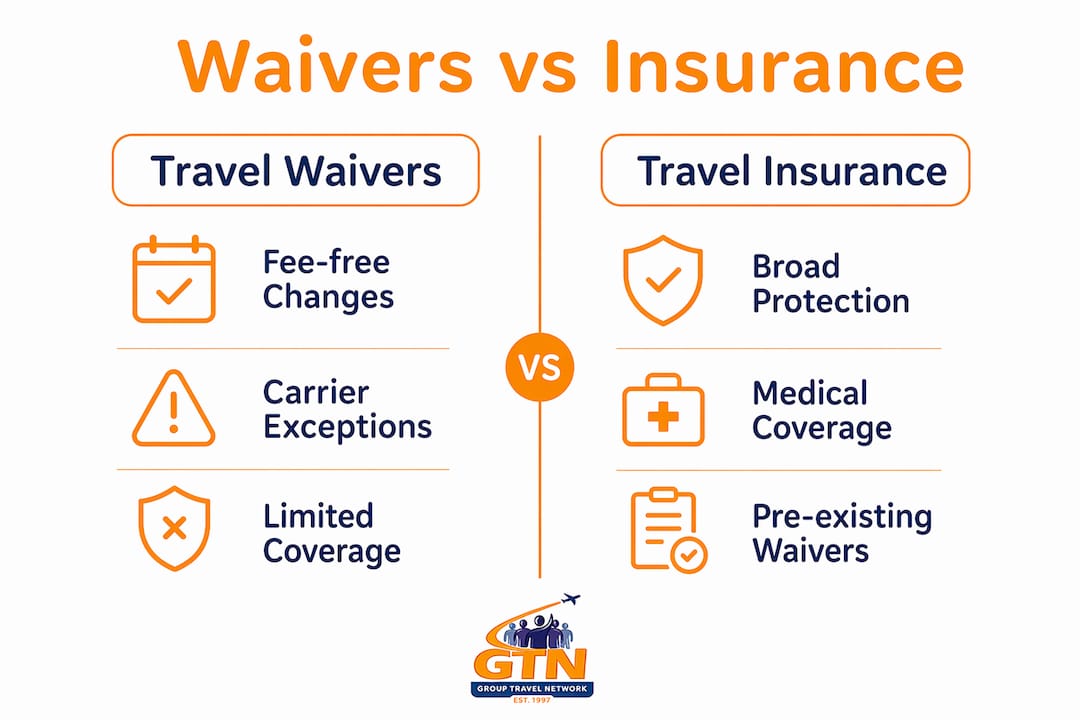
Travel waivers and travel insurance solve different problems. Waivers enable immediate rebooking flexibility during carrier-recognized disruptions, while insurance covers broader trip losses including non-refundable expenses and medical emergencies. Neither replaces the other. The most effective approach to group travel risk management combines both.
Here is how the two tools compare in practical terms:
| Situation | Travel Waiver | Travel Insurance |
|---|---|---|
| Flight canceled by airline | Fee-free rebooking within window | May reimburse non-refundable costs |
| Weather delay requiring hotel | No coverage | Covered under trip delay benefits |
| Student medical emergency abroad | No coverage | Covered under medical/evacuation benefits |
| Fare difference on rebooking | Traveler pays the difference | May reimburse under trip interruption |
| Pre-existing medical condition claim | Not applicable | Covered only with a pre-existing condition waiver |
The pre-existing condition waiver in travel insurance deserves special attention for group coordinators. This waiver removes medical exclusions (opens in a new tab) if the policy is purchased within a strict window, usually 14–21 days after the trip deposit. Missing that deadline eliminates coverage for that participant entirely. For a school trip with 50 students, communicating this deadline clearly to parents is a legal and logistical priority.
Strict look-back periods for pre-existing conditions (opens in a new tab) mean that even one missed deadline can expose your organization to a claim dispute. Coordinators should send written reminders to families at the time of deposit, not weeks later. Grouptravelnetwork recommends building insurance purchase deadlines directly into your trip registration timeline so nothing slips through.
Pro Tip: Pair your school trip insurance guide (opens in a new tab) with your waiver tracking process. The two documents together give you a complete picture of what is covered at every stage of a disruption.
Why does understanding travel waiver policy matter for liability and risk management?
Assuming a waiver covers your entire group automatically is the most expensive mistake a coordinator can make. Traveler rights depend on airline contracts and waiver language, not on government travel advisories or NOTAMs alone. A government warning does not obligate an airline to issue a waiver. Your group’s protection exists only in the specific language of the carrier’s published waiver policy.
For school administrators, this has direct liability implications. If a waiver does not cover all students due to staggered booking dates, and you fail to communicate that gap to parents, your institution may face complaints or claims. Clear waiver documentation including flight numbers, booking dates, and official waiver language protects your organization and reduces disputes.
Integrating waiver knowledge into your risk management framework means addressing these specific points before every trip:
- Confirm all booking dates fall within the waiver eligibility window for any known risk periods such as hurricane season or major events.
- Review fare class eligibility for every ticket in the group booking, since basic economy fares are frequently excluded.
- Document the official waiver language from the airline’s website at the time of booking and store it with trip records.
- Communicate coverage gaps to parents in writing, including which students may not qualify if tickets were purchased outside the window.
- Align waiver awareness with school travel policies, particularly around refund obligations and duty-of-care standards.
Understanding student travel liability (opens in a new tab) means recognizing that waivers reduce operational friction but do not transfer legal responsibility. The school or organization remains accountable for student welfare regardless of what the airline covers.
How can coordinators monitor and maximize travel waiver benefits during disruptions?
Speed is the defining factor in waiver use. Monitoring official airline pages directly (opens in a new tab) rather than waiting for automated alerts gives coordinators the best chance of securing preferred rebooking options before availability disappears. Waivers can be updated multiple times daily during active crises. Waiting even a few hours can mean losing access to the most convenient alternative flights.
A practical action sequence when a waiver applies:
- Identify the triggering event. Confirm the disruption matches the waiver’s named event and that your travel dates and airports fall within the covered scope.
- Pull the official waiver text. Go directly to the airline’s website and screenshot or save the full waiver language with a timestamp.
- Check every ticket’s purchase date. Cross-reference each student’s booking date against the waiver’s eligibility window before calling the airline.
- Calculate fare differences before rebooking. Price the alternative flights first. If fare differences apply, get written confirmation of the total cost before committing.
- Rebook within the deadline. Most waivers expire within 7–14 days of the original travel date. Set a calendar alert the moment you identify a qualifying waiver.
- Document everything. Record confirmation numbers, agent names, rebooking dates, and any fare difference payments. Store this with your trip liability records.
Vague or marketing-driven waiver language (opens in a new tab) is a warning sign of limited actual protection. If a waiver does not clearly state the triggering event, coverage scope, and fare difference policy, escalate to the airline’s group travel desk rather than assuming coverage applies.
Pro Tip: Build a one-page waiver checklist into your team travel coordination (opens in a new tab) process. Train your co-coordinators to run through it the moment a disruption is announced, not after flights start changing.
Key Takeaways
Effective group travel risk management requires combining airline waivers for immediate rebooking flexibility with travel insurance for comprehensive financial protection across all disruption scenarios.
| Point | Details |
|---|---|
| Waivers are time-bound and specific | Coverage applies only to named events, eligible routes, and tickets booked within the waiver window. |
| Fare differences are not waived | Coordinators must budget for price increases when rebooking under a waiver, even when change fees are eliminated. |
| Insurance fills the gaps waivers leave | Travel insurance covers non-refundable costs, medical events, and delays that airline waivers do not address. |
| Pre-existing condition deadlines are critical | Insurance waivers for medical conditions must be purchased within 14–21 days of the trip deposit or coverage is lost. |
| Documentation protects your organization | Recording flight numbers, booking dates, and official waiver language reduces disputes and supports liability defense. |
What I have learned about waivers after years of school trip planning
The single biggest gap I see among coordinators is the assumption that a waiver is a safety net for the whole group. It rarely is. Waivers are surgical tools. They apply to specific flights, specific dates, and specific fare classes. When a storm hits and 45 students need to rebook, the coordinator who already knows which tickets qualify and which do not is the one who gets everyone home without a financial crisis.
The other lesson I keep coming back to is the false choice between waivers and insurance. Coordinators sometimes treat them as alternatives, picking one and ignoring the other. That is a mistake. A waiver gets you on a different flight. Insurance pays for the hotel when the new flight is not until tomorrow. You need both working together, and you need to understand the limits of each before the disruption happens, not during it.
My strongest advice for 2026 is to build waiver monitoring into your pre-trip protocol the same way you build in emergency contact lists. Assign one person on your team to check airline advisory pages the moment a weather event or strike is announced. That 30-minute head start can mean the difference between a manageable delay and a full rebooking crisis. The coordinators who treat waivers as a reactive tool always end up scrambling. The ones who treat them as a proactive planning layer rarely do.
— Donovan
Planning your next school trip with waiver and insurance coverage built in
Group travel planning works best when liability protection is part of the process from day one, not an afterthought added after something goes wrong.

Grouptravelnetwork specializes in school, band, and sports team travel with dedicated trip coordinators who understand waiver policies, insurance timelines, and group booking requirements. Every trip plan includes built-in guidance on travel protection options so your school is covered before departure. The school group travel planning guide (opens in a new tab) walks coordinators through each planning stage, including how to align waiver eligibility with your booking timeline. For coordinators managing safe student travel planning (opens in a new tab), Grouptravelnetwork provides the structure and vendor relationships that turn complex logistics into a clear, manageable process.
FAQ
What is the role of travel waivers in group educational trips?
Travel waivers are carrier-issued exceptions that allow fee-free date changes or rebooking during specific disruptions such as weather events or strikes. For group coordinators, they reduce immediate out-of-pocket costs but require fast action within a narrow eligibility window.
Do travel waivers cover all students in a group booking?
Not automatically. Tickets purchased outside the airline’s waiver eligibility window do not qualify, even if the flight is disrupted. Coordinators must verify each student’s booking date against the waiver terms before assuming full group coverage.
How do travel waivers and travel insurance work together?
Waivers handle immediate rebooking flexibility during carrier-recognized disruptions, while travel insurance covers broader losses including non-refundable costs, medical emergencies, and trip delays. Using both together provides the most complete protection for group trips.
What is a pre-existing condition waiver in travel insurance?
A pre-existing condition waiver removes standard medical exclusions from a travel insurance policy if purchased within 14–21 days of the trip deposit and while the traveler is medically able to travel. Missing this window eliminates coverage for that participant’s pre-existing conditions.
How should coordinators document waiver use for liability protection?
Coordinators should save the official waiver language with a timestamp, record each student’s flight number and booking date, and document all rebooking confirmations including any fare difference payments. This record reduces disputes and supports the organization’s liability defense.
Recommended
- Team Travel Coordination Tips For Schools In 2026 • Group Travel Network (opens in a new tab)
- The Role Of Travel Chaperones: 2026 Guide For Schools (opens in a new tab)
- School Group Travel: Safe Educational Journey Coordination (opens in a new tab)
- Role Of Guides In Student Travel: Administrator’s Guide • Group Travel Network (opens in a new tab)