


Travel insurance can cover a trip cancellation due to weather, but whether it pays out depends on three things: when you bought the policy, whether the weather event was foreseeable at that time, and whether your policy includes trip cancellation benefits or a Cancel For Any Reason (CFAR) upgrade. Standard trip cancellation coverage typically applies when a severe weather event makes your destination uninhabitable, triggers a mandatory evacuation order, or causes your airline to cancel the flight entirely. If you bought the policy after a storm was already named or forecasted, most insurers will deny the claim.
Take these steps immediately after a weather-related cancellation:
- Contact your airline first to request a refund or rebooking. Under U.S. DOT rules (opens in a new tab), you are entitled to a cash refund if your flight is canceled and you choose not to accept the alternative transportation or a voucher.
- Screenshot or download the official airline cancellation notice with a timestamp.
- Save all receipts for meals, lodging, and transportation incurred because of the disruption.
- Pull the official weather advisory or evacuation order from a government source (NOAA, your state emergency management agency, or federal disaster pages).
- Check your policy’s effective date and purchase date to confirm the event was unforeseeable when you bought coverage.
Pro Tip: The FAA notes that weather is the leading operational constraint on U.S. air traffic. That means weather-related cancellations are common enough that insurers have built specific exclusions around them. Read your policy’s “covered reasons” list before you assume you’re protected.
Key Takeaways
Travel insurance covers a trip cancellation due to weather only when the policy was purchased before the event was foreseeable and the cancellation meets a specific covered trigger, such as a mandatory evacuation or uninhabitable lodging.
| Point | Details |
|---|---|
| Timing determines coverage | Buy travel insurance at the time of your first nonrefundable deposit, before any storm is named or forecast. |
| Airlines owe you a refund | Under DOT rules, airlines must refund your ticket if they cancel and you decline rebooking or a voucher. |
| CFAR covers voluntary cancellations | Cancel For Any Reason upgrades let you cancel for any reason, typically recovering 50–75% of prepaid costs. |
| Documentation drives claim approval | Collect airline cancellation notices, official weather advisories, and all receipts before filing. |
| Grouptravelnetwork coordinates group coverage | Dedicated trip coordinators handle master insurance, vendor contracts, and claims documentation for school and youth groups. |
Table of Contents
- How travel insurance helps when weather causes delays (not full cancellations)
- When trip cancellation coverage applies to a weather-related cancellation
- When weather is considered “foreseeable” and why your purchase date matters
- What airlines must (and usually don’t) do when weather cancels your flight
- Which weather events are typically covered and which are usually excluded
- If you cancel because the weather looks bad (but no official order exists), will insurance cover you?
- How to pick the right travel insurance when weather is a realistic risk
- How to file a claim after a weather cancellation
- Special considerations for group trips when weather threatens
- What group trip planners often get wrong about weather coverage
- Grouptravelnetwork takes the weather risk off your plate
- Sources
- FAQ
How travel insurance helps when weather causes delays (not full cancellations)
Delay coverage and trip cancellation coverage are two separate benefits, and confusing them is one of the most common reasons travelers leave money on the table.
Travel delay benefits typically reimburse meals, lodging, and local transportation when your trip is delayed beyond a certain threshold depending on the policy. They do not reimburse the full cost of your trip. Most policies cap delay benefits at a daily per-person amount, up to a total limit.
Here is a concrete scenario: your connecting flight through Atlanta is canceled because of a severe thunderstorm. You are rebooked on a flight the next morning. Your policy’s travel delay benefit covers the hotel room and dinner, up to the daily cap, as long as you keep the receipts and the airline provides written confirmation of the delay. That written confirmation is the document that makes or breaks the claim.
The key distinction: Travel delay benefits cover your extra out-of-pocket costs while you wait. Trip cancellation benefits cover the prepaid, nonrefundable costs of a trip you never took. Knowing which benefit applies to your situation tells you exactly what to submit and to whom.
Steps to claim travel delay benefits:
- Get written confirmation of the delay or cancellation from the airline (email, text, or printed gate notice).
- Keep every receipt for meals, lodging, and transportation during the delay period.
- Note the exact start and end time of the delay so you can demonstrate you crossed the policy’s trigger threshold.
- Submit receipts along with the airline notice to your insurer within the claim filing window stated in your policy.
Credit cards with travel protections, such as certain Visa Signature or World Mastercard products, sometimes provide parallel delay coverage. Check whether your card’s benefit applies before filing with your insurer, since some policies require you to exhaust other coverage first.
When trip cancellation coverage applies to a weather-related cancellation
Trip cancellation benefits pay for prepaid, nonrefundable costs when you cancel before departure for a covered reason. Weather qualifies as a covered reason only under specific conditions.
Common covered triggers:
- Your destination is declared uninhabitable due to severe weather damage.
- A mandatory evacuation order is issued for your destination by a government authority.
- Your booked accommodations are destroyed or rendered uninhabitable by the weather event.
- A government travel ban is issued for the destination.
- Your common carrier (airline, cruise line) cancels service due to severe weather.
What “covered” means in practice: the insurer reimburses your prepaid, nonrefundable trip costs up to the policy’s stated limit, minus any refunds you already received from suppliers.
Common exclusions:
- Named storms or hurricanes that were forecast before your policy purchase date.
- Minor weather advisories that do not result in an official order or uninhabitable conditions.
- Personal fear or discomfort about traveling in bad weather, with no official order backing it.
- Cancellations made before any official action is taken, simply because the forecast looks bad.
Pro Tip: When reviewing a policy, search for these exact words in the “covered reasons” section: “uninhabitable,” “mandatory evacuation,” “advisory issued by,” and “effective date.” If those terms are absent or vaguely defined, the policy may not cover the scenarios you are worried about. Policies that use precise language are generally easier to claim against.
When weather is considered “foreseeable” and why your purchase date matters
The foreseeability rule is the single most misunderstood aspect of travel insurance for weather. Buy before the storm is on the radar, and you are likely covered. Buy after it is named, and you almost certainly are not.
Insurers define a weather event as “foreseeable” once it has been publicly named, forecast, or widely reported. For hurricanes, that typically means the moment the National Hurricane Center assigns a name. For winter storms, it can mean the moment the National Weather Service issues a watch or warning for your destination. According to InsureMyTrip’s Suzanne Morrow (opens in a new tab), coverage for hurricanes and severe storms is highly dependent on timing, and travelers must buy policies well before a storm is named to be eligible for trip cancellation or interruption benefits.
Practical timing rules:
- Your policy’s effective date is usually the day after purchase, not the day of purchase.
- CFAR upgrades typically must be purchased within 14–21 days of your initial trip deposit, depending on the insurer.
- If you book a trip during hurricane season (June 1 through November 30) and do not buy insurance until a storm is already developing, you have likely missed the window for that event.
- Last-minute purchases made the day before departure rarely cover any weather event that is already in the forecast.
Statistic callout: The FAA reports that weather is the leading cause of aviation delays and cancellations in the U.S. — which is precisely why insurers have built foreseeability exclusions into standard policies. The risk is too predictable once a storm is named.
The practical takeaway: buy travel insurance at the same time you make your first nonrefundable trip payment. That is the only way to guarantee the effective date precedes any foreseeable weather event.
What airlines must (and usually don’t) do when weather cancels your flight
Airlines and travel insurers operate under completely different rules, and travelers often expect airlines to cover costs that only insurance can address.
Under U.S. DOT rules, if an airline cancels your flight for any reason, including weather, you are entitled to a full cash refund if you choose not to accept the carrier’s alternative transportation or a travel voucher. The airline cannot force you to take a credit. AP News coverage of Hurricane Milton (opens in a new tab) confirmed this rule applies even when weather is the cause, a point many travelers do not realize until after they have already accepted a voucher.
What airlines are not required to do: provide hotel rooms, meals, or cash compensation beyond the ticket refund when weather is the cause. Weather is classified as an “extraordinary circumstance” outside the airline’s control, so the DOT’s compensation rules for controllable delays do not apply.
Practical steps when your flight is canceled by weather:
- Check the airline’s travel-alert or waiver page immediately. Airlines publish waivers during major weather events that allow fee-free rebooking.
- Use the airline’s app to rebook. JohnnyJet’s guidance is clear: the app often processes rebooking faster than airport lines or phone queues during mass disruptions.
- If phone lines are overloaded, call the airline’s international customer service number, which typically has shorter wait times.
- If you decide not to travel, request a cash refund explicitly. Do not accept a voucher unless you are certain you will use it.
| Situation | Airline obligation | Typical airline goodwill |
|---|---|---|
| Flight canceled (any cause) | Full cash refund if you decline rebooking | Waiver for fee-free rebooking |
| Weather delay (no cancellation) | None beyond the ticket | Meal vouchers at some carriers |
| Missed connection due to weather | Rebooking on next available flight | Hotel at some carriers, not guaranteed |
Monitor the DOT airline cancellation dashboard to document the scope of a disruption, which can support an insurance claim.
Which weather events are typically covered and which are usually excluded
Coverage depends less on the type of weather and more on two factors: whether the event was foreseeable when you bought the policy, and whether it actually made travel impossible rather than just inconvenient.
Typically covered (when policy was purchased before the event was forecast):
- Sudden, unpredicted severe storms that damage your destination or lodging.
- Mandatory evacuation orders issued by government authorities.
- Tornadoes or flash floods that render accommodations uninhabitable.
- Localized lightning events that cause sudden airport closures. Aviation research from RAL/UCAR (opens in a new tab) documents how lightning strikes can force sudden operational cancellations that are genuinely unforeseeable.
Sometimes covered, with conditions:
- Hurricanes: covered if the policy was purchased before the storm was named; excluded if purchased after.
- Blizzards: covered if the storm was not yet forecast at purchase; excluded if a winter storm watch was already issued.
- Wildfires: covered if the fire started after the policy effective date and makes the destination uninhabitable.
Typically excluded:
- Named hurricanes or tropical storms that were already forecast at the time of purchase.
- Predictable seasonal weather (summer thunderstorms in Florida, winter snow in the Rockies) that does not rise to the level of an official order.
- Smoke or air quality advisories that do not trigger an evacuation or uninhabitability declaration.
- Extreme temperatures that make travel uncomfortable but do not result in official closures.
The word “severity” in a policy does not mean wind speed or storm category. It means the storm’s impact on your specific trip, measured by whether an official order was issued or your lodging was formally declared uninhabitable. A Category 1 hurricane that triggers a mandatory evacuation is covered. A Category 3 that passes offshore without affecting your destination is not.
If you cancel because the weather looks bad (but no official order exists), will insurance cover you?
Standard trip cancellation policies will not cover a voluntary cancellation made purely because you feel unsafe or the forecast looks threatening. No official order, no coverage. That is the rule in nearly every standard policy.
Narrow exceptions that may apply:
- CFAR (Cancel For Any Reason): If you purchased this optional upgrade, you can cancel for any reason, including a bad forecast, and typically recover 50–75% of your prepaid nonrefundable costs. CFAR must be purchased within a short window after your initial deposit, usually 14–21 days.
- Mandatory evacuation: If an official government order is issued for your destination after you decide to cancel, that order may retroactively qualify your cancellation as a covered event, depending on policy timing.
- Accommodation declared uninhabitable: If your hotel or rental property is formally declared uninhabitable by a government authority, that qualifies as a covered reason even if you canceled before the declaration.
Pro Tip: If you are on the fence about canceling and no official order has been issued yet, wait. Canceling before an order is issued may disqualify you from coverage that would have applied if you had waited 24 hours. Check your airline’s waiver page and your insurer’s guidance before pulling the trigger.
When no insurance coverage applies, you still have options: credit card travel protections, supplier refund windows (some hotels and tour operators offer voluntary refunds during declared emergencies), and airline rescheduling waivers. Review booking refund policies (opens in a new tab) for activity-based suppliers, since outdoor and water-based providers often have separate terms for weather-related cancellations.
How to pick the right travel insurance when weather is a realistic risk
Start with trip cancellation limits and CFAR availability. Everything else is secondary.
Questions to ask before buying a policy:
- What is the purchase window for CFAR? (Usually 14–21 days from initial deposit.)
- How does the policy define “uninhabitable”? Is an official declaration required, or does documented damage suffice?
- What evacuation-order language is used? Does it require a government-issued mandatory order, or does a voluntary advisory qualify?
- What are the per-person, per-day limits for travel delay benefits?
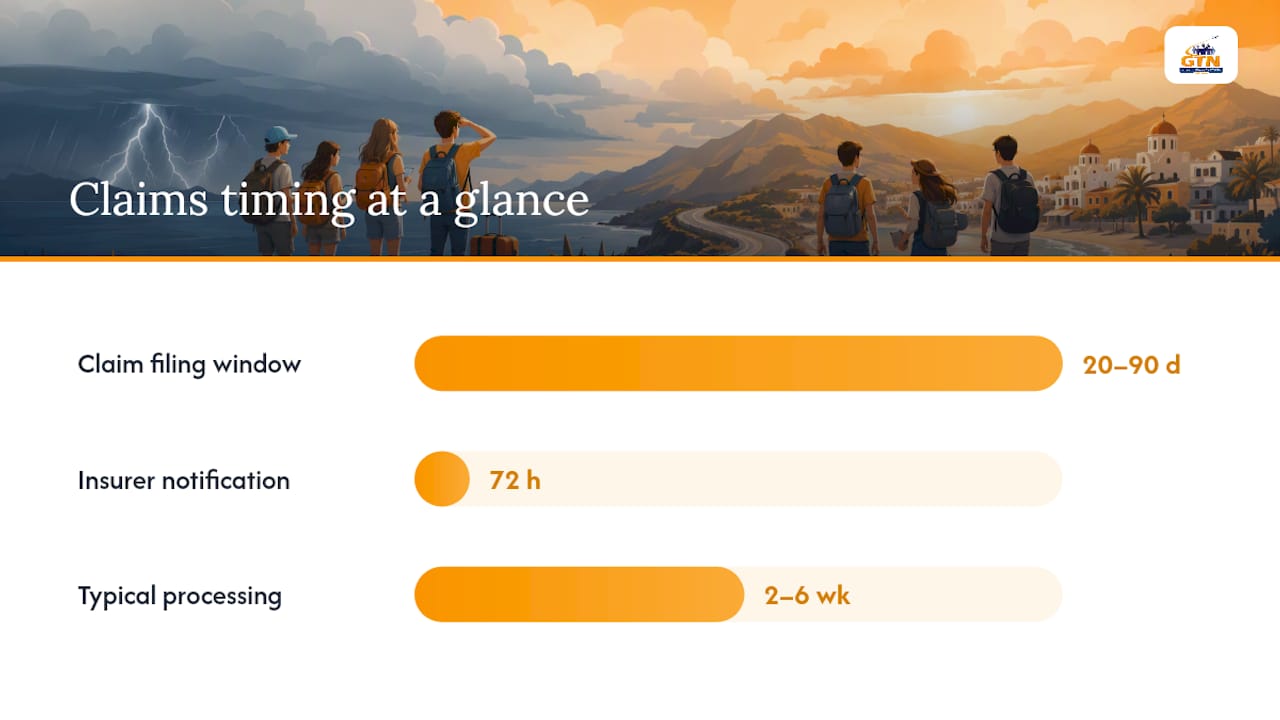
- What is the claim filing deadline? (Many policies require filing within 20–90 days of the event.)
- Are there exclusions for named storms, seasonal weather, or specific geographic regions?
For group organizers specifically:
- A single master policy covering the entire group is often more cost-effective than individual policies, but confirm that the master policy’s cancellation triggers apply to the group’s specific vendor contracts.
- Individual policies may be necessary if travelers have different departure cities or personal health conditions that affect coverage.
- Confirm vendor refund and cancellation terms in writing before purchasing insurance, since supplier terms for accommodations during foreseeable weather events may not align with what your insurance covers.
- Review liability protection considerations for school groups (opens in a new tab) before finalizing any group policy structure.
For expensive, nonrefundable group bookings during hurricane season or winter travel to storm-prone regions, that cost is usually worth it. For a $50,000 group trip deposit, CFAR is cheap insurance against a forecast that arrives after you have already committed.
How to file a claim after a weather cancellation
File as fast as possible. Most policies have claim filing windows of 20–90 days from the date of the event, and missing that window is one of the most common reasons claims are denied.
Step-by-step claims workflow:
- Contact your airline first. Get written confirmation of the cancellation or delay, including the stated reason. This document is the foundation of any insurance claim.
- Pull official weather documentation. Download the relevant NOAA advisory, National Weather Service warning, or government evacuation order. Time-stamp everything.
- Photograph damage if applicable. If your lodging was damaged or your destination was affected, photograph or screenshot news coverage with dates visible.
- Compile all receipts. Meals, hotels, transportation, and any other out-of-pocket costs incurred because of the disruption.
- Notify your insurer. Call or log in to the insurer’s claims portal and open a claim. Most insurers require notification within 72 hours of the event, even if you are not ready to submit all documents yet.
- Submit the full documentation package. Airline cancellation notice, weather advisory, receipts, and a completed claim form.
- Follow up in writing. Keep a record of every communication with the insurer, including dates and the name of the representative you spoke with.
Pro Tip: JohnnyJet recommends keeping a shared cloud folder (Google Drive or Dropbox) with all booking confirmations, receipts, and airline notices from the moment you book. During a weather emergency, you will not have time to hunt for documents. Everything in one folder, accessible from your phone, cuts claim preparation time dramatically.
Typical processing times for travel insurance claims range from two to six weeks for straightforward cases. Complex claims involving group policies, multiple suppliers, or disputed coverage reasons can take longer. FOX 35 Orlando’s reporting on winter storm cancellations notes that speed is critical: travelers who document and submit quickly tend to recover faster and with fewer disputes.
Special considerations for group trips when weather threatens
Group travel adds layers of complexity that individual travelers never face: master policies, nonrefundable deposits spread across multiple vendors, and the need to communicate with dozens of families simultaneously.
Immediate guidance for group organizers:
- Buy comprehensive coverage at the time of the first group deposit, not after the itinerary is finalized.
- Consider CFAR for the entire group when large, nonrefundable deposits are involved. A single storm during peak season can wipe out a year’s worth of fundraising.
- Confirm every vendor’s cancellation and refund policy in writing before signing contracts. Verbal assurances are not enforceable.
- Designate one person as the claims coordinator and give them access to all booking documentation from day one.
- Review travel insurance options for school group trips (opens in a new tab) before selecting a policy structure.
Group leader checklist when a weather event threatens:
- Activate your notification plan immediately. Parents and students need clear, consistent communication, not rumors.
- Document the evacuation order or uninhabitability declaration with official sources and share it with your insurer and all vendors.
- Create a centralized claims folder with airline notices, hotel cancellation confirmations, vendor refund correspondence, and weather advisories.
- Track every additional expense the group incurs (meals, alternative lodging, rebooking fees) with receipts.
- Consult safe travel planning steps for student groups (opens in a new tab) for communication templates and risk-management protocols.
Pro Tip: When negotiating supplier contracts, push for a “force majeure” or “weather event” clause that allows cancellation without penalty when a government evacuation order is issued. Many vendors will agree to this language, especially for large group bookings. It is far easier to negotiate before you sign than after a storm is named.
What group trip planners often get wrong about weather coverage
Most group organizers focus on the wrong variable. They spend time comparing premium prices when they should be comparing the policy’s definition of “uninhabitable” and the CFAR purchase window.
Here is the practical reality: a standard trip cancellation policy protects you against the weather events you did not see coming. CFAR protects you against the ones you did see coming but hoped would not materialize. For school trips and performance tours booked six to twelve months in advance, you will almost always face at least one forecast that makes someone nervous. CFAR is not a luxury for those bookings. It is the only coverage that gives you a real exit.
The other mistake is treating the airline refund as the end of the story. The DOT refund gets your ticket cost back. It does not touch your hotel deposits, your performance venue fees, your charter bus contracts, or the nonrefundable registration costs that make up the bulk of a group trip’s budget. Travel insurance, structured correctly, covers all of that. The airline refund and the insurance claim are two separate processes that both need to happen.
Grouptravelnetwork takes the weather risk off your plate
When a storm threatens a school trip or performance tour, the difference between a manageable disruption and a financial disaster usually comes down to one thing: whether someone with experience handled the contracts, the insurance, and the vendor relationships before the weather arrived.

Grouptravelnetwork provides dedicated trip coordinators who negotiate supplier cancellation clauses, coordinate travel protection for the entire group, and manage the documentation process when weather forces a change of plans. For school administrators and band directors booking nonrefundable group packages, that means flexible payment plans, master insurance options, and a coordinator who already knows your vendors’ refund terms before the storm is named.
Ready to protect your next group trip from the start? Start planning your school group trip (opens in a new tab) with a coordinator who handles the weather risk so you can focus on the experience.
Sources
These are the primary official and industry sources cited in this article. Bookmark the government pages before your trip so you can pull documentation quickly if weather disrupts your plans.
- Transportation (opens in a new tab)
- NEW YORK (AP) — What to do if Hurricane Milton delayed or canceled your flight | AP News (opens in a new tab)
- Hurricane Erin: What to do if your vacation is canceled by weather | USA Today (opens in a new tab)
Bottom line from the experts: Buy early, document everything, and act fast. Those three habits determine whether a weather disruption costs you a few hours or thousands of dollars.
This article is general information, not a substitute for advice from a qualified financial advisor. Consult a qualified financial professional about your own circumstances before acting on anything here.
FAQ
Does travel insurance cover trip cancellation due to weather?
Yes, but only under specific conditions: the policy must have been purchased before the weather event was foreseeable, and the cancellation must meet a covered trigger such as a mandatory evacuation order, uninhabitable lodging, or a carrier cancellation. Voluntary cancellations based on a bad forecast are not covered under standard policies.
Can you cancel a trip due to weather and get a refund?
You can get a partial or full refund through a combination of sources: your airline owes you a cash refund under DOT rules if your flight is canceled and you decline rebooking, and your travel insurance may cover nonrefundable prepaid costs if the cancellation meets a covered reason.
Do airlines have to compensate passengers for weather cancellations?
Airlines must refund your ticket if they cancel the flight and you choose not to accept alternative transportation or a voucher. They are generally not required to provide additional cash compensation, hotel rooms, or meals for weather-caused cancellations, since weather is outside their control.
Does travel insurance cover hurricanes?
Travel insurance covers hurricanes only if the policy was purchased before the storm was named or forecast. InsureMyTrip’s Suzanne Morrow notes that buying after a storm is named is one of the most common reasons hurricane-related claims are denied.
What is Cancel For Any Reason (CFAR) coverage?
It must be purchased within 14–21 days of your initial trip deposit, depending on the insurer.
Recommended
- What Is Student Travel Liability? A 2026 Guide • Group Travel Network (opens in a new tab)
- Travel Insurance For School Group Trips Explained • Group Travel Network (opens in a new tab)
- Student Travel Agency • GTN • Insurance And Certifications (opens in a new tab)
- Group Travel Insurance Explained: Protect Student Trips Easily • Group Travel Network (opens in a new tab)