

August 30, 2026
U.S. Organizers: 8 Must Have Fields in Minor Travel Consent Forms

A minor travel consent form for school or group trips must combine trip details, explicit parental permission, and a signed medical-treatment authorization, which you need to collect before departure. Trip-specific circumstances (overnight stays, international travel, or students on daily medication) demand extra fields and sometimes extra documentation. Send the forms out with sufficient lead time before you leave, and keep verified copies with the trip leader the entire time you’re on the road.
TL;DR:
- Most consent forms should include medical authorization on a separate page with signatures, and electronic signatures are legally valid under the ESIGN Act.
- Confirm state-specific medication administration rules with district counsel and coordinate with the school nurse to ensure proper physician orders and medication handling.
- Keep sensitive health data limited to staff and chaperones with a genuine need, and store physical copies securely to comply with FERPA privacy requirements.
- Distribute and collect completed forms at least two weeks before trips, with longer lead times for overnight or international trips involving additional documentation.
- Use trip-specific, digital forms to prevent medical details from being overlooked and to catch potential gaps in authorization before departure.
Table of Contents
- What Must a Minor Travel Consent Form Include?
- Who Can Give Students Medication on a Trip?
- How Should Schools Handle Health Data Privacy?
- Do You Need Notarized Forms or Electronic Signatures?
- How Do You Distribute and Collect Forms Without Losing Track?
- Why Trip-Specific Forms Matter More Than a Generic Template
- Let Group Travel Network Handle Your Trip Paperwork
- Sources
- FAQ
What Must a Minor Travel Consent Form Include?
Every consent packet you build should function as one document with clearly separated parts, not a single vague permission slip. A parent should be able to glance at it and know exactly what they’re authorizing and who is responsible for their child at each step of the trip.
Here’s the field list that covers the actual risk exposure schools and youth groups face, based on how complete permission forms are structured across districts nationwide:
- Student’s full legal name, date of birth, grade, and school or group affiliation
- Trip dates, destination, mode of transportation, and names of supervising adults and chaperones
- Emergency contacts (at least two), family physician name and phone number, and health insurance carrier and policy number
- A dedicated medical section covering allergies, chronic conditions, current medications, dosage schedules, and any physical accommodations needed
- A standalone medical-treatment authorization paragraph with its own signature line, separate from the general permission signature
- Media release language and a brief statement of behavior expectations for the trip
- Liability and assumption-of-risk language placed directly above the signature block, not buried on an earlier page
- A date field and a signature method, ink or electronic
That separation between general permission and medical-treatment authorization isn’t a formality. Legal guidance on field trip forms makes clear that a general waiver doesn’t automatically give a chaperone or urgent-care provider the authority to treat a student in an emergency. You need a separate signature that says so explicitly.
Pro Tip: Put the medical-treatment authorization on its own page with its own header. Parents skim multi-page PDFs, and a signature buried inside a liability paragraph is easy to miss entirely.
Electronic signatures are enforceable here under the federal ESIGN Act, so you don’t need wet-ink signatures for domestic trips in most cases. A step-by-step guide to preparing student travel forms walks through building a fillable template that captures all of this in one pass.
Who Can Give Students Medication on a Trip?
This is where most trip paperwork falls apart, and it’s the part district counsel worries about most. State rules on who may administer medication to a minor during a school-sponsored activity vary widely, and risk-management guidance from Venable recommends confirming your state’s specific rule with legal counsel rather than assuming your standard permission form covers it.
Start by coordinating with the school nurse before you finalize any trip roster. If a student takes daily medication, the nurse should help collect physician orders where state law requires them, and confirm exactly who on the trip is authorized to hand a student their pills or use an EpiPen if needed. Some districts require that a licensed nurse travel with the group for medication-heavy rosters; others allow a documented staff member to administer medication once a parent has signed a specific authorization naming that person.
- Confirm state-specific rules on medication administration with district counsel before the trip
- Coordinate with the school nurse on physician orders and dosage schedules
- Require medications to travel in original, labeled containers, never in a shared pouch
- For extended or international trips, consider a Limited Power of Attorney covering medical decisions
- Name the specific authorized staff member on the medication authorization form itself
Longer trips, or ones involving controlled substances, sometimes call for a notarized Limited Power of Attorney rather than a standard school form. Sample district forms, including one from Saint Paul Public Schools, show exactly when that extra document gets attached to the standard packet.
Pro Tip: Log every medication authorization in writing and confirm it with the nurse before students board the bus, not after. A missing signature discovered at a rest stop is a problem you cannot fix from the road.

How Should Schools Handle Health Data Privacy?
Student health details and roster information collected for a trip count as education records under FERPA, which means access has to stay limited to staff and chaperones who genuinely need it, not the entire trip committee.
That has practical consequences for how you distribute and store forms. Don’t email a full roster with medical notes to every parent volunteer; instead, give each chaperone only the medical information relevant to the students in their direct group. On the trip itself, carry physical copies in a locked binder, or use an encrypted offline device if you’re going digital, rather than a shared cloud folder anyone can open.
- Restrict roster and medical-info access to staff and chaperones with a direct supervisory need
- Never send full student rosters or health notes over unsecured email
- Use locked binders or encrypted devices for on-trip copies
- Retain signed originals according to your district’s records-retention schedule after the trip ends
Districts that want a tighter framework for this often look at broader K-12 student data privacy guidance for handling roster information beyond just travel forms, and Grouptravelnetwork’s own student medical form templates build these access limits into the layout from the start.
Do You Need Notarized Forms or Electronic Signatures?
Most schools can rely on electronic signatures for domestic trips. The federal ESIGN Act treats a properly captured e-signature as legally equivalent to ink, provided you keep a timestamped record of who signed and when. That’s a meaningful shift from a decade ago, when every permission slip had to come home in a backpack.
Notarization is a different story, and it’s not something most domestic school trips need. It becomes more common for international travel, especially when a student is traveling with only one parent or a group leader who isn’t a legal guardian, or in unusual custody situations where a school wants extra documentation on file. Here’s the practical timeline to work from:
- Distribute forms at least two weeks before departure for standard day or short overnight trips.
- Add extra lead time, often three to four weeks, for overnight or international trips that require additional documentation.
- Verify every returned form for a complete medical section and both required signatures before finalizing the roster.
- Bring originals or secure digital copies with the trip leader, not just a folder left in the front office.
That two-week window isn’t arbitrary. Guidance on field trip consent timing points to a strict “no form, no trip” policy as the single most effective way to prevent a last-minute compliance gap. Grouptravelnetwork’s electronic consent guide covers how to set that workflow up without chasing paper.
How Do You Distribute and Collect Forms Without Losing Track?
A consistent process beats a good template every time. Here’s the workflow that keeps forms from piling up unread three days before a trip.
- Draft the form and, for higher-risk trips, get sign-off from district counsel or your risk-management committee before sending it home.
- Distribute it with a firm deadline, at least two weeks out, offering both a fillable PDF and an online submission option so parents without a printer aren’t stuck.
- Confirm every medical-treatment authorization is complete and loop in the school nurse on any medication logistics flagged on the form.
- Build chaperone binders with scanned offline copies, and keep one master copy retained at the school office.
- After the trip, log who accessed medical records and file signed originals per your retention schedule.
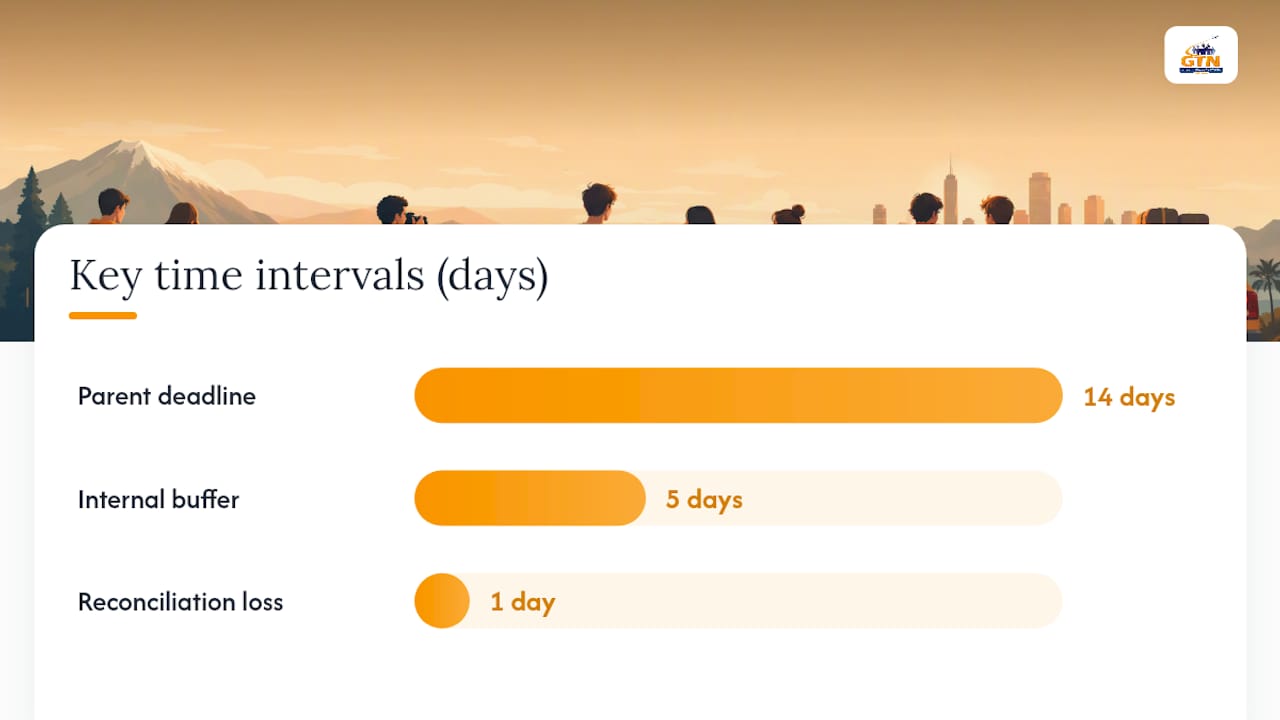
Pro Tip: Set your internal deadline five days earlier than the parent-facing deadline. That buffer is what actually lets you chase down the three families who forgot, instead of discovering the gap at check-in.
Organizers running this manually for a 60-student band trip often lose a full day to spreadsheet reconciliation. A safe travel planning framework built around this exact sequence removes most of that friction.
Why Trip-Specific Forms Matter More Than a Generic Template
The mistake I see most often isn’t a missing signature. It’s organizers reusing last year’s form for a completely different trip, one that now involves a flight, an overnight stay, or a student with a new medication regimen the template never anticipated. A generic slip built for a museum visit doesn’t ask the questions an international performance tour actually needs answered.
Group Travel Network builds trip-specific fields into online registration precisely because of this. One band program we’ve supported nearly had a student left off the departure manifest because a last-dose insulin note sat on a paper form that never made it into the nurse’s binder. Switching to a tracked digital submission caught the gap two days out, not two hours out.
That’s the real value of a standardized, digital process: it forces the medical question to surface before the bus leaves, not during a layover.
— Donovan
Let Group Travel Network Handle Your Trip Paperwork
Group Travel Network gives you a faster path to compliant paperwork than building forms from scratch every season. Instead of assembling a template, chasing signatures over email, and hoping the medical section gets filled out correctly, you get online registration built for school and youth trips, fillable form templates with the medical and authorization fields already structured, and a dedicated trip coordinator who flags incomplete submissions before departure day.

Travel protection options are built into the booking process too, so medication logistics and emergency contacts aren’t sitting in a separate spreadsheet from your itinerary. If you’re planning a student trip this year, start with Grouptravelnetwork’s guide to student educational travel to see how registration, forms, and coordinator support fit together for your group, or reach out directly to request a trip coordinator for your next departure.
Sources
For deeper reference on the legal and logistical details covered here, these sources are worth bookmarking:
- What Belongs on a Field Trip Permission Slip?
- How to Create and Fill Out a Field Trip Permission Form
- Rules of the road: risk-management processes
- Field trips and class trips form with medical questionnaire and power of attorney
FAQ
What Must a Minor Travel Consent Form Include?
It needs student identity and trip details, emergency contacts, a full medical section, a separate medical-treatment authorization with its own signature, and liability language placed just above the signature block.
Can Parents Sign Electronically Under the ESIGN Act?
Yes, the federal ESIGN Act generally makes electronic signatures on consent forms legally valid, provided the school keeps a timestamped record of the submission.
When Is Notarization Required for a Student Trip?
Notarization is rarely required for domestic school trips but becomes more common for international travel or situations involving custody complications and single-parent travel.
Who Can Administer Medication to a Student on a Trip?
That depends on state law; some states require a licensed nurse for certain medications, while others allow a specifically named, authorized staff member once a parent signs a documented authorization.
How Early Should Schools Distribute Consent Forms?
Distribute forms at least two weeks before a standard trip, and extend that to three or four weeks for overnight or international trips requiring extra documentation.
Recommended

Relax with our Student Travel Expertise .
We deliver stress-free student trips backed by an exceptional array of services you won’t find anywhere else:
- Stress-free, creative planning of customized itineraries
- Dedicated GTN Service host on every trip
- Extensive travel protection plan options
- Online, individual registration system
- Flexible payment plans and online payment options
- Bulk buyer discounts for great trips that cost less
Inclusion into #MyGTNFamily for life! (you don’t even have to remember our birthday!)
Spain
There is no place like Spain to offer a student performance opportunity or cultural student trip.
Myrtle Beach
All students love the beach! Especially a beach known for its 60 miles of pristine coastline.
Boston
Have your students experience colonial charm in the city that is considered the hub of New England.
London
Provide your student group with the “Royal” treatment! One of the world’s most recognized cities.
See What People Are Saying
“What wonderful trip we had to NYC! Our group of 51 never missed a beat because of Group Travel Network and our wonderful guide, Tim. It was truly a theatre trip to remember! If you are looking for a travel company who really cares about the details, Group Travel Network is for you!”
“This was my first time using a company to plan our band trip. It was so easy working with Justin and Group Travel Network. We had to make several changes along the way, but they were accommodating changes and worked everything out for us. I would highly recommend using Group Travel Network.”
“It has been my privilege to use Group Travel Network as the exclusive travel coordinator for my band for over 10 years. I can say, without doubt or hesitation, that GTN is, by far, the best travel company for student groups currently in existence. I have often said that I wouldn’t take my band across the street without GTN and that’s not far from the truth!”