


TL;DR:
- Complete and organized forms are essential to ensure student safety and legal protection during trips.
- Special trip types like band or international travel require additional forms, procedures, and documentation compliance.
- Using checklists, early communication, and professional support simplifies planning and reduces last-minute issues.
Incomplete student travel forms are not just a paperwork problem. They can cancel a trip, expose your school to liability, or leave a student stranded without medical authorization when every minute counts. Missing documentation (opens in a new tab) can derail even the most carefully planned trip. But when your documentation is tight, you walk into every departure with confidence. Parents trust you. Administrators support you. Students are protected. This guide walks you through every step: what forms you need, how to gather and organize information, special considerations for band trips, international travel requirements, and how to verify and store everything before you go.
Table of Contents
- Core components every student travel form needs
- Gathering and organizing required information
- Special considerations for band trips and performance groups
- Documents for international and overnight trips
- Verification, distribution, and compliance best practices
- What most guides miss about preparing student travel forms
- Let Group Travel Network simplify your student trip preparation
- Frequently asked questions
Key Takeaways
| Point | Details |
|---|---|
| Custom forms for each trip | Prioritize event-specific forms instead of blanket consent to maximize protection and compliance. |
| Band and performance group protocols | Add separate medical, instrument, and TSA documentation for all music-related travel. |
| International trip requirements | International or overnight travel demands notarized letters, proper ID, and higher chaperone ratios. |
| Verification prevents headaches | Thoroughly checking and digitally storing forms reduces last-minute issues and keeps trips smooth. |
| Clear communication is key | Regular updates with parents and staff help avoid confusion and ensure all documentation is in place. |
Core components every student travel form needs
With the importance established, let’s break down exactly what your forms must include. The biggest mistake coordinators make is using a single generic form for every trip. A blanket consent form signed at the start of the year offers very limited legal protection. Per-event forms are preferred because they give parents specific details about each trip, allowing them to make an informed decision about risk.
Every solid student travel form should cover these core form sections: trip details, student information, parental consent, medical authorization, emergency contacts, a code of conduct agreement, and a liability waiver. Each section serves a distinct purpose and removing any one of them creates a gap in your protection.
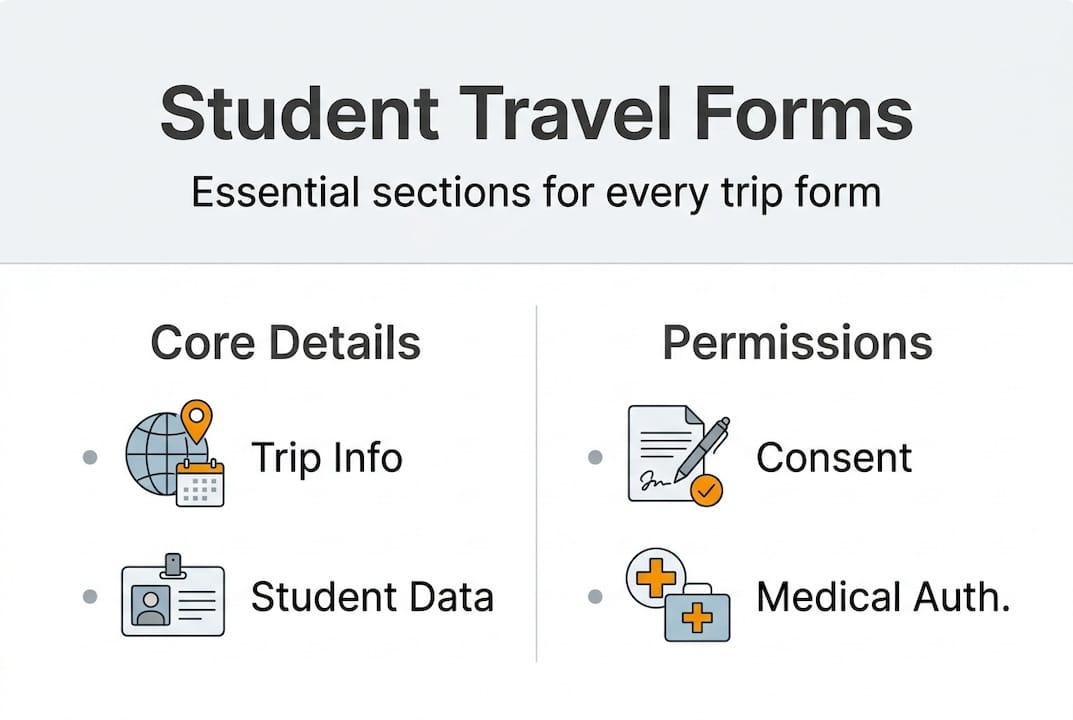
| Form section | What it covers | Why it matters |
|---|---|---|
| Trip details | Dates, destination, activities | Sets context for consent |
| Student info | Name, grade, ID number | Links form to the right student |
| Parental consent | Signature for participation | Legal authorization |
| Medical authorization | Allergies, medications, treatment consent | Enables emergency care |
| Emergency contacts | Parent, guardian, backup | Ensures reachable contact |
| Code of conduct | Behavioral expectations | Reduces disciplinary issues |
| Liability waiver | Risk acknowledgment | Reduces school exposure |
Beyond the table above, consider adding activity-specific disclosures. A trip to a ropes course needs different risk language than a museum visit. Reviewing school travel essentials before you build your forms will help you catch gaps early.
Here are the core elements every strong form package includes:
- Full legal name and date of birth
- School ID and grade level
- Parent or guardian wet signature (not typed)
- Specific destination and activity list
- Medical conditions and current medications
- Insurance provider and policy number
- Emergency contact hierarchy (at least two contacts)
Pro Tip: For any trip involving water, heights, or physical challenge, add a separate activity-specific risk acknowledgment section. Courts look favorably on explicit, activity-level disclosure.
For broader guidance on simplifying group travel forms, a streamlined template system can cut your prep time significantly without sacrificing compliance.
Gathering and organizing required information
Once you know what your forms need, the next challenge is gathering that information in an organized, timely way. Chasing down incomplete forms a week before departure is stressful and avoidable. A structured collection process solves this.
Student info, emergency contacts, parental consent, and separate medical forms are all required components, and each one needs to be verified individually. One missing signature or a blank medication field can create real problems at the worst moment.
Follow these steps to keep collection organized:
- Send home a parent information packet at least four weeks before travel.
- Set a firm form return deadline two weeks before departure.
- Flag incomplete forms within 24 hours of the deadline.
- Follow up with a phone call or email for any outstanding documents.
- Conduct a final review one week before departure.
- Store all completed forms in one secure physical binder and one digital backup.
For band directors, band trips must include (opens in a new tab) medical forms and instrument policies alongside standard field trip documentation. That means you are managing more form types per student and the collection timeline needs to account for that extra volume.
Use a tracking table like this to monitor progress:
| Student name | Consent form | Medical form | Emergency contacts | Instrument policy | Status |
|---|---|---|---|---|---|
| J. Rivera | ✓ | ✓ | ✓ | ✓ | Complete |
| T. Okafor | ✓ | Pending | ✓ | N/A | Incomplete |
| M. Patel | ✓ | ✓ | Pending | ✓ | Incomplete |
This kind of tracker gives you a real-time snapshot of where gaps exist. Reviewing group travel planning steps early in your planning process helps you build timelines that actually work. Pair this with safe journey coordination resources to ensure nothing slips through.
Core items to collect for every student:
- Completed permission form with wet signature
- Medical authorization with allergy and medication details
- Health insurance card copy
- Emergency contact list (minimum two contacts)
- Signed code of conduct form
Special considerations for band trips and performance groups
While most organizers deal with standard forms, band directors face unique challenges. You are not just moving students. You are moving instruments, coordinating performance schedules, and managing logistics that a typical field trip does not involve.

Band trips require separate medical forms, instrument policy forms, air travel preparation for parents, and properly labeled luggage, all of which are crucial for a smooth trip. Skipping any one of these creates friction at airports, venues, or hotel check-in.
Here is what your band trip form package should include beyond the standard set:
- Instrument transport and handling agreement
- Case labeling requirements and tag attachment instructions
- Air travel prep sheet for parents (what cannot fly in cabin vs. checked)
- Performance schedule and dress code expectations
- Room assignment and chaperone contact list
- Medication handling protocol during performance days
- Parent communication timeline for the full trip duration
Important: Never assume TSA rules for instruments are common knowledge. Many parents do not realize that certain instrument cases trigger extra screening. A one-page prep sheet sent home three weeks before departure prevents gate-side surprises.
Instrument tags and TSA awareness (opens in a new tab) prevent problems at airport gates. Every instrument case should have a durable, clearly labeled tag with the student’s name, the school name, a contact phone number, and the destination. Color-coded tags by section (brass, woodwind, percussion) also speed up loading and unloading from buses.
Pro Tip: Contact the airline at least 60 days before travel to confirm instrument carry-on policies. Rules vary by carrier, and some instruments that fit in overhead bins on one airline must be checked on another. Getting this confirmed in writing protects you.
For strategies on group travel simplification tips specific to performance groups, planning around these details early prevents last-minute scrambles.
Documents for international and overnight trips
Domestic trips set the foundation, but adding international or overnight destinations brings extra requirements. The paperwork load increases significantly, and the consequences of missing a document are more severe.
International trips require (opens in a new tab) passports or birth certificates, notarized consent letters, visas where needed, and schools may need to supply letters on official letterhead. These are not optional courtesies. Border agents can and do turn groups back for missing documentation.
| Requirement | Domestic | International |
|---|---|---|
| Permission form | Required | Required |
| Passport or ID | State ID sufficient | Passport required |
| Notarized consent | Rarely needed | Strongly advised |
| Visa | Not applicable | Check by destination |
| School letterhead | Optional | Often required |
| Chaperone ratio | 1 per 10 students | 1 per 8 students |
| Travel insurance | Recommended | Strongly recommended |
High chaperone ratios are required: 1 chaperone per 10 students for domestic and 1 per 8 for international trips. Build this into your planning early because recruiting qualified chaperones takes time.
Review these items before any international departure:
- Confirm passport expiration dates (must be valid 6 months beyond travel).
- Obtain notarized parental consent letters for every minor.
- Verify visa requirements for the destination country.
- Prepare a school letterhead authorization letter.
- Confirm travel insurance coverage for medical evacuation.
- Register your group with the U.S. State Department’s STEP program.
Embassy note: Contact the embassy or consulate of your destination country directly to confirm current entry requirements. Requirements change, and a policy from two years ago may not reflect current rules.
Understanding minor travel legalities (opens in a new tab) is essential before crossing any international border with students. For a full walkthrough of international trip preparation, start at least six months out. You can also review questions for travel agencies to make sure your vendor understands international student travel law.
Verification, distribution, and compliance best practices
After preparing and collecting all forms, final checks and distribution keep you audit-ready and safe during travel. This stage is where many coordinators relax too early. The work is not done when forms are collected. It is done when every form is verified, copied, and distributed to the right people.
Groups that use structured checklists report 80% fewer last-minute issues with documentation, which means less stress at the gate and more focus on your students. That number reflects something real: preparation is a skill, and checklists are how you practice it consistently.
Follow these verification and filing practices:
- Review every form for blank fields, missing signatures, and illegible entries.
- Make three copies: one for the lead coordinator, one for the school office, one for the travel binder.
- Share a medical summary sheet with each chaperone (name, condition, medication, emergency contact).
- Store originals in a locked cabinet at the school.
- Upload digital scans to a password-protected folder accessible to the lead coordinator.
- Prepare a departure-day emergency binder with all critical information in one place.
- Confirm with your administrator that all forms meet school and district policy.
Pro Tip: Use a cloud-based storage service with offline access so you can pull up any student’s form from your phone even without Wi-Fi at your destination.
For coordinators managing age-appropriate student travel, the complexity of verification scales with the age group. Younger students require more detailed medical authorization, while older students may need additional conduct agreements for overnight settings.
What most guides miss about preparing student travel forms
Here is a perspective gained from hands-on experience managing group travel for years. Most form guides hand you a template and call it done. But no template was designed for your specific school, your students, or the particular mix of activities on your next trip.
The real risk is assuming that one form fits all situations. A permission slip that works for a local museum visit will leave you exposed on an overnight performance tour. Every trip deserves a fresh review of what documentation is actually needed, not just a copy-paste from last year.
Clear communication with parents and staff matters as much as the forms themselves. A perfectly filled form sent home without an explanation leaves parents confused and more likely to call with questions or delay returning paperwork.
“No checklist replaces experience. Learn from each trip, adjust your process, and your forms will get stronger every year.”
Adaptability is your best safeguard. When something goes wrong on a trip, it is rarely because a form was missing one checkbox. It is usually because someone assumed the process was the same as last time. For practical guidance on planning smart group trips, building in a post-trip review keeps your documentation improving year over year.
Let Group Travel Network simplify your student trip preparation
Managing student travel forms, chaperone ratios, instrument logistics, and international requirements is a lot to carry alone. Group Travel Network works directly with school trip coordinators and band directors to make the entire process manageable from the first form to the final boarding call.

Our team handles custom itineraries, vendor coordination, and compliance support so you can focus on your students. Whether you are planning a local performance tour or an international educational journey, we offer dedicated coordinators and flexible support for every stage of planning. Explore our student group travel services to see what is possible, or browse inspiring class trips to find the perfect destination for your next group.
Frequently asked questions
What are the minimum requirements for student travel forms?
You need trip details, student info, consent signature, medical authorization, code of conduct, emergency contacts, and a liability waiver for every student trip. Core requirements are clearly outlined in professional templates and should be customized for each specific trip.
Are notarized forms needed for international student trips?
Notarized consent letters are strongly advised for international travel, especially for minors, and may be required by border authorities. Notarization is a best practice that protects you and your students at any international crossing.
How do band trip forms differ from regular field trips?
Band trips add separate medical forms, instrument and TSA policies, and require extra coordination for luggage and air travel. Band trips add form sections and documentation that academic field trips simply do not require.
What is the recommended chaperone ratio for student group travel?
Best practice is 1 chaperone per 10 students for domestic trips and 1 per 8 for international or overnight trips. Chaperone ratio requirements increase for international travel to account for higher coordination demands.
How can I prevent missing forms before departure?
Use a detailed checklist and verify all documentation for each student well in advance, ideally with digital backups stored in a secure cloud folder. Checklists and verification significantly lower the risk of last-minute documentation gaps on departure day.