


Every school-sponsored trip requires a complete set of student medical forms before a single student boards the bus. Collect these core fields: student identifiers, emergency contacts, health conditions, allergies, current medications (prescription and OTC), physician and insurance information, and signed parental authorization for emergency treatment and trip-specific risk disclosure. Once you have your form built, send it to families and set a hard return deadline at least one month before departure, so your school nurse has time to review every packet.
Before departure, confirm you have collected:
- Full student name, date of birth, grade, and homeroom
- Primary and secondary parent/guardian names, cell and work numbers
- Two emergency contacts (not a parent/guardian)
- Diagnosed health conditions and current treatment status
- Allergy list with triggers, reaction description, and whether epinephrine is required
- All medications (name, dose, frequency, original container) with provider signature for prescriptions
- Insurance carrier, policy number, and primary physician contact
- Activity limitations, dietary restrictions, and mobility or personal care needs
- Signed authorization for emergency medical treatment, OTC medication administration, and trip-specific risk acknowledgment
Immediate next steps: Send the form packet to families, set the return deadline, and notify your school nurse so she can schedule review appointments.
Key Takeaways
Collecting complete, nurse-reviewed student medical forms at least 30 days before departure is the single most effective step a trip coordinator can take to protect students and reduce liability.
| Point | Details |
|---|---|
| 30-day submission deadline | Return all forms at least 30 days before departure so the nurse can review and act on findings. |
| Nurse as planning partner | Engage the school nurse at trip inception, not after forms are collected, to identify IHP/EAP needs early. |
| Provider signatures for prescriptions | Prescription medications and delegated injectable care require a provider-signed order, not parent consent alone. |
| FERPA limits sharing | Share full records only with nurse and administrators; give chaperones redacted EAP summaries only. |
| Grouptravelnetwork | Grouptravelnetwork’s trip coordinators help schools build organized intake workflows from the first planning stage. |
Table of Contents
- What fields must every student medical form include?
- When should forms be collected, and who reviews them?
- What are the medication administration rules for school trips?
- Which students need Individual Health Plans or Emergency Action Plans?
- How does FERPA apply to trip medical information?
- What should parental consent and release language say?
- How should you collect and store school trip medical forms?
- Who must sign which sections of a trip medical form?
- Copy-ready form snippets and a one-page organizer checklist
- What most coordinators get wrong about trip medical planning
- How Grouptravelnetwork supports your trip medical logistics
- Sources
- FAQ
What fields must every student medical form include?
A trip-specific student medical release form (opens in a new tab) is not the same as a school enrollment health form. It must capture everything a first responder or ER physician would need if a parent is unreachable at 11 PM in another city.
Student and family identifiers
- Legal name, preferred name, date of birth, grade, and student ID
- Parent/guardian 1 and 2: relationship, cell, work, and email
- Two additional emergency contacts with relationship and phone
Health history and conditions
- Current diagnoses (asthma, seizures, diabetes, cardiac conditions, severe anxiety, mobility limitations)
- Recent hospitalizations or surgeries relevant to travel
Allergies
- Allergen name, typical reaction (hives vs. anaphylaxis), and whether prescribed epinephrine auto-injector is required
- Food, environmental, and medication allergies listed separately
Medications
- Drug name, dose, route, and administration times
- Original container requirement noted on the form
- Provider signature block for any prescription medication
Insurance and physician
- Insurance carrier, group number, policy number, and member ID
- Primary care physician name and phone; preferred hospital if known
Activity and access needs
- Physical limitations, dietary restrictions, toileting or personal care needs, and any equipment (wheelchair, hearing aid, feeding tube)
Authorization checkboxes
- Emergency medical treatment consent
- OTC medication administration (list specific drugs authorized)
- Medication self-carry permission (if applicable)
- Trip-specific risk acknowledgment
- Photography and media consent
The FCS Field Trip Parental Consent and Student Medical Form notes that forms not returned by the stated deadline may result in the student being excluded from the trip, emphasizing timely submission. Put that language on your form.
Pro Tip: Add a “none known” checkbox next to every health-history field. A blank field is ambiguous; a checked “none known” is a documented attestation.
When should forms be collected, and who reviews them?
Timing is where most coordinators fall short. A form returned two days before departure gives the nurse no time to act on what she finds.
- Set the return deadline at least one month before departure for day trips; extend the deadline for overnight or out-of-state travel to allow sufficient nurse review time. The FCS consent template confirms this window allows the nurse to review medication plans and emergency protocols before travel.
- Trip coordinator sends the form packet, tracks returns, and follows up on missing submissions.
- School nurse reviews every completed form, flags students needing IHPs or EAPs, and determines whether care can be delegated or whether a nurse must attend. The National Association of School Nurses (opens in a new tab) states that early nurse engagement is what turns medical planning from a liability checklist into an inclusion plan.
- Designated medication administrator receives training from the nurse on any delegated tasks before departure.
- Building administrator gives final trip approval only after nurse sign-off is documented.
- Parent/guardian communications lead handles translation requests and follow-up calls for incomplete forms.
- Pre-trip check (48 hours out): Verify medication bags match the medication log, confirm emergency contacts are reachable, and complete a final roster sign-off.
Pro Tip: Make nurse sign-off a conditional requirement in your board-approval workflow. If the nurse hasn’t cleared the medical packet, the trip doesn’t get approved. That single policy change eliminates last-minute scrambles.
What are the medication administration rules for school trips?
Medication rules on trips are stricter than most coordinators expect, and the gap between school-day consent and trip consent is where liability lives.
Prescription vs. OTC medications
- Prescription medications require a provider signature or medical order, especially for overnight trips or administration outside normal school hours. The Wisconsin DPI toolkit (opens in a new tab) is explicit: written authorization is required for every medication administered on a field trip.
- OTC medications (ibuprofen, antihistamines, antacids) require written parent authorization listing the specific drug, dose, and condition.
- All medications travel in original, labeled containers. No exceptions.
Medication administration log — record for every dose given:
| Field | What to Record |
|---|---|
| Student name | Legal name and student ID |
| Medication and dose | Exact drug name and amount given |
| Time administered | Date and time (12-hour clock with AM/PM) |
| Administrator | Printed name and initials |
| Reason | Scheduled dose or as-needed with symptom noted |
| Reaction observed | None, or describe any response |
Self-carry policies
Students may self-carry epinephrine auto-injectors or inhalers when a signed self-carry agreement is on file, the provider has authorized self-carry in writing, and the student has demonstrated competency to the nurse. The Colorado DOE checklist includes self-carry contracts as a required planning component.
What staff may not do:
- Administer any medication without written parent and, where required, provider authorization
- Accept medications in unlabeled or non-original containers
- Administer a prescription medication without a provider order when one is required by state or district policy
- Delegate medication tasks without nurse-directed training specific to that student and medication
Pro Tip: When a trip crosses state lines, nursing delegation rules may change. Check whether the Nurse Licensure Compact applies and consult your nurse on destination-state scope-of-practice rules before finalizing staffing.
Which students need Individual Health Plans or Emergency Action Plans?
Not every student with a health condition needs a full IHP, but some conditions make one non-negotiable.
Conditions that typically require an IHP or EAP:
- Asthma (especially exercise-induced)
- Anaphylaxis risk (food, insect, latex)
- Seizure disorders
- Type 1 or insulin-dependent Type 2 diabetes
- Severe anxiety with documented crisis protocol
- Significant mobility limitations or equipment dependence
Minimum EAP components for a trip:
- Student name, photo (optional but helpful), and condition
- Clear signs and symptoms that trigger the plan
- Step-by-step emergency response actions in plain language
- Location of medications or equipment on the trip
- Names of trained staff and their contact numbers
- When to call 911 vs. manage on-site
When a provider order is required: Insulin dosing changes, injectable epinephrine delegation to non-licensed staff, and ostomy or feeding-tube care all require a provider-signed order before a trip. The Colorado DOE and NASN both identify provider input as a prerequisite for these situations.
Share EAP summaries with lead chaperones using a redacted version that includes only the response steps and medication location, not the full health history. That protects privacy while keeping responders informed.
How does FERPA apply to trip medical information?
Many school-held health records are education records under FERPA, which means disclosing them without parent or eligible-student consent is generally prohibited. The U.S. Department of Education’s FERPA guidance (opens in a new tab) confirms a limited health or safety emergency exception exists, but it requires documentation every time it is used.
Practical sharing rules:
- School nurse and designated administrator: full records
- Lead chaperones: redacted EAP summary only (response steps, medication location, emergency contacts)
- Volunteers and other chaperones: no health records
- External providers (hotels, venues): no health records unless a specific emergency requires it
When you disclose under the health/safety emergency exception, document the date, recipient, information shared, and the specific threat that justified disclosure. Keep that log with the trip file.
Eligible students (age 18 or enrolled in postsecondary): Rights transfer to the student. Obtain the student’s written consent for any disclosure, not the parent’s.
Treatment records maintained solely by a treating provider (a school nurse acting in a treatment capacity) may be treated differently from standard education records. Consult your district’s legal counsel on how your state applies this distinction.
What should parental consent and release language say?
Generic waivers don’t hold up. Venable LLP advises that failing to disclose trip-specific risks can weaken a release of liability. Your consent language must name the actual trip.
Core consent clauses to include:
- Trip name, destination, dates, and mode of transportation
- Emergency medical treatment authorization: “I authorize school personnel to consent to emergency medical treatment for my child if I cannot be reached in a timely manner.”
- OTC medication consent: “I authorize the administration of the following OTC medications: [list]. Dose: [dose]. Condition: [condition].”
- Insurance and financial responsibility: “I understand that my insurance is primary and I am responsible for costs not covered.”
- Trip-specific risk acknowledgment: “I understand this trip includes [hiking on uneven terrain / international travel / water activities] and the associated risks.”
- Limits on authorization: “I do NOT authorize administration of [specific drug or procedure].”
For families who speak languages other than English, provide translated forms or arrange for a qualified interpreter to walk through the consent language. Document that the translation or interpretation occurred. For international trips, also consider emergency travel documentation (opens in a new tab) requirements for minors.
Have district legal counsel review consent language for high-risk activities, international travel, or any trip involving water, heights, or adventure sports. See also Grouptravelnetwork’s guide on travel waivers for school trip coordinators (opens in a new tab) for additional framing on liability and consent strategy.
Pro Tip: Add a deadline line directly above the parent signature block: “This form must be returned by [DATE] or your student may not participate.” Parents respond to concrete consequences.
How should you collect and store school trip medical forms?
Online vs. paper:
Online forms (Google Forms with restricted access, district portals, or a platform with encrypted storage) speed up collection, allow digital signatures, and make it easier to flag incomplete submissions. The trade-off is that digital signatures may not satisfy every district’s legal standard, and some families lack reliable internet access.
Paper forms with original signatures remain the safest option for medication authorization and provider orders. Many districts use a hybrid: digital intake for health history and consent, paper originals for provider-signed medication orders.
Access control:
- Full records: school nurse, trip coordinator, building administrator
- Redacted EAP summaries: lead chaperones (one per student group)
- No records: general volunteers, venue staff, transportation providers
Emergency packet for the trip:
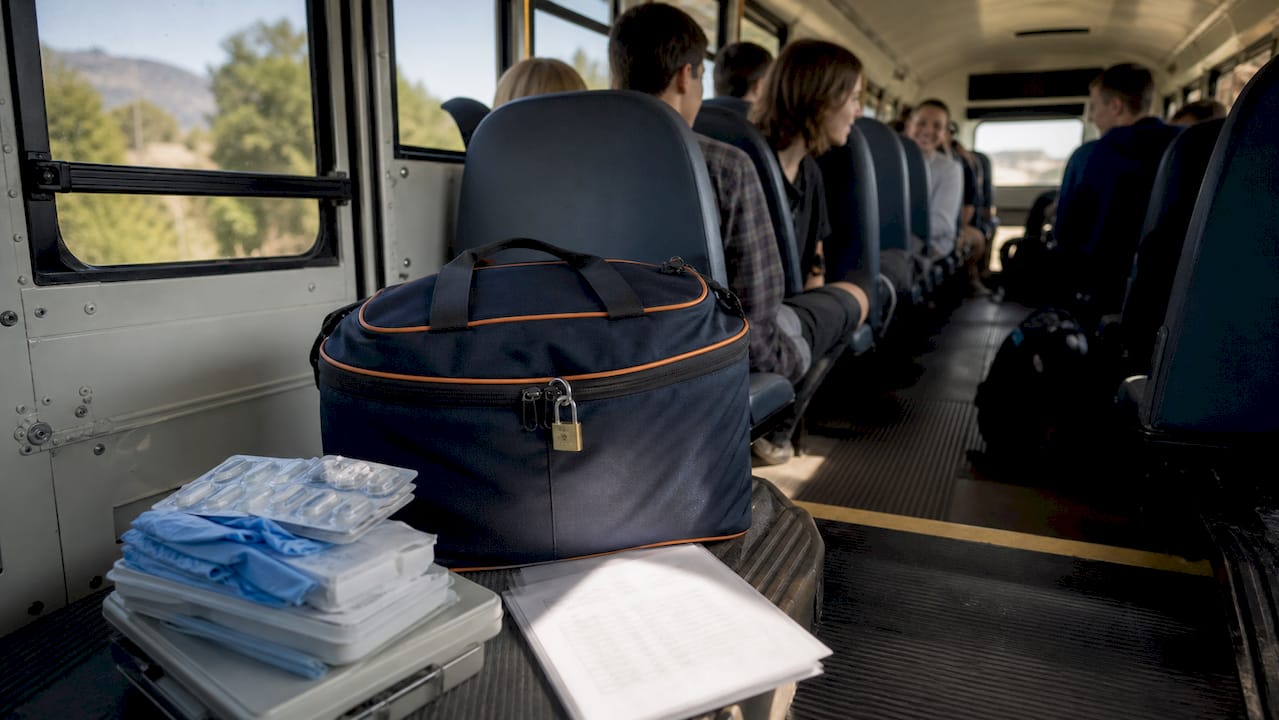
Every trip should travel with a locked or secured emergency packet containing: a student roster with photos, IHP/EAP summaries, the medication log and all medications, physician and insurance information for each student, and primary/secondary parent contact numbers. Store a duplicate encrypted file accessible to the building administrator back at school.
Record retention: Keep trip medical records for the period your district’s records-retention policy requires for student health records, typically three to seven years. Shred paper records securely; delete digital records per your district’s data-disposal policy.
Who must sign which sections of a trip medical form?
| Form Section | Required Signer | Typical Timeframe |
|---|---|---|
| Student health history and emergency contacts | Parent/guardian (or eligible student if 18+) | At form distribution, 30+ days before trip |
| Emergency treatment authorization | Parent/guardian (or eligible student if 18+) | Same as above |
| OTC medication consent | Parent/guardian | Same as above |
| Prescription medication administration | Parent/guardian AND prescribing provider | Allow 2 weeks for provider signature |
| Self-carry agreement | Parent/guardian, prescribing provider, and student | Allow 2 weeks; nurse confirms competency |
| IHP/EAP acknowledgment | Parent/guardian and school nurse | Completed after nurse review |
| Insulin or injectable medication order | Prescribing provider | Allow 2–3 weeks; may require office visit |
Key signature rules:
- A parent signature alone is not sufficient for prescription medications requiring a provider order. The Wisconsin DPI toolkit confirms prescriptions may require a medical order, especially for overnight trips.
- For students with Section 504 plans or IEPs, the plan itself may specify who authorizes medication administration. Check the plan before building the form packet.
- Self-carry agreements require three signatures: parent, provider, and the student themselves.
Copy-ready form snippets and a one-page organizer checklist
Emergency treatment authorization:
“I, [Parent/Guardian Name], authorize school personnel to seek emergency medical treatment for [Student Name] (DOB: [Date]) if I cannot be reached. I understand I will be notified as soon as possible.”
OTC medication consent:
“I authorize the following OTC medications for my child during [Trip Name]: [Drug name, dose, condition]. I confirm these medications are in original labeled containers.”
Prescription administration order (provider block):
“I, [Provider Name, License #], authorize [Drug, Dose, Route, Frequency] for [Student Name] during [Trip Name, Dates]. Administration may be performed by trained school personnel.”
Self-carry agreement:
“[Student Name] has demonstrated competency in self-administering [Medication]. I authorize self-carry during [Trip Name]. Provider: [Name, Signature]. Parent: [Signature]. Student: [Signature].”
Trip-specific risk acknowledgment:
“I understand [Trip Name] includes [specific activities and risks]. I have read the itinerary and consent to my child’s participation with full knowledge of these conditions.”
One-page organizer checklist:
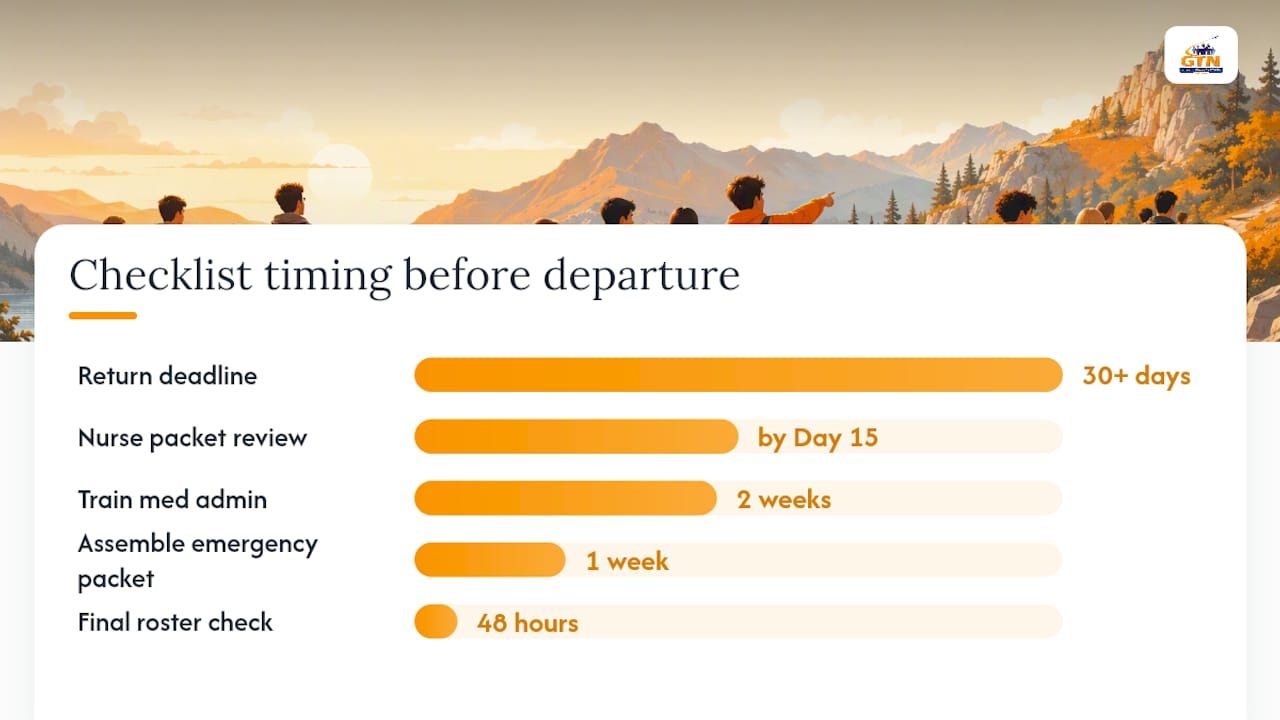
- Send form packet to families (Trip Coordinator, Day 1 of planning)
- Set return deadline 30+ days before departure (Trip Coordinator)
- Track returns and follow up on missing forms (Trip Coordinator, ongoing)
- Nurse reviews all completed packets (School Nurse, by Day 15 before trip)
- Identify students needing IHPs/EAPs and request provider orders (School Nurse)
- Train designated medication administrator (School Nurse, 2 weeks before trip)
- Assemble and lock emergency packet (Trip Coordinator + Nurse, 1 week before trip)
- Final roster and medication bag check (All roles, 48 hours before departure)
Adaptation notes: State rules on medication delegation, self-carry, and provider-order requirements vary. Always run your final form language past your district nurse and legal counsel, especially for overnight, out-of-state, or international trips. The West Salem School District overnight form is a solid model for how a real district structures these fields.
Pro Tip: Build your form in a fillable PDF so families can type responses. Legibility problems with handwritten forms cause delays when the nurse is trying to read a medication name at 7 AM the morning of departure.
What most coordinators get wrong about trip medical planning
The single most common failure isn’t a missing signature. It’s treating the school nurse as a final checkpoint rather than a planning partner.
Most coordinators send forms out, collect them back, and then hand the stack to the nurse a week before the trip. By that point, if a student needs an IHP, a provider order, or a staff training session, there’s no time. The nurse is forced to either clear a student she hasn’t properly assessed or recommend exclusion, which is the outcome everyone wanted to avoid.
Engaging the nurse at the moment you set the trip date changes everything. She can flag which students will need extra documentation before families even receive the form. She can identify whether the trip requires a nurse to attend or whether care can be safely delegated. That early conversation is what the NASN position statement is built around, and it’s the difference between a trip that runs smoothly and one where a student with a seizure disorder boards a bus without a completed EAP.
The other failure mode: unlabeled medications. A parent sends a pill in a plastic bag with a sticky note. Staff can’t administer it, can’t verify the dose, and can’t log it. The student goes without medication for two days. That outcome is entirely preventable with one line on your form: “All medications must arrive in original, labeled containers. Unlabeled medications will not be administered.”
How Grouptravelnetwork supports your trip medical logistics
Collecting and managing required student medical documentation is one of the most time-consuming parts of trip planning, and it’s the part where a missed detail carries real consequences. Grouptravelnetwork’s dedicated trip coordinators work alongside school administrators, band directors, and coaches from the earliest planning stages, helping you build intake timelines, organize form collection workflows, and coordinate with vendors who understand school-group requirements.

From class trips (opens in a new tab) to performance tours (opens in a new tab), Grouptravelnetwork handles the logistics that eat your planning hours, so you can focus on the nurse review, the parent communications, and the students who need extra attention. Online registration, flexible payment plans, and travel protection options are built into every package. To start planning a trip where the paperwork is organized from day one, visit the educational group trip planning guide (opens in a new tab) and connect with a coordinator.
Sources
- National Association of School Nurses Position Statement: School-Sponsored Trips—Equitably Addressing Student Health Needs (opens in a new tab)
- FERPA Guidance for School Officials on Student Health Records (opens in a new tab)
- Meeting Student Health Needs While on Field Trips –Tool Kit for Wisconsin Schools (opens in a new tab)
For complex, overnight, or international trips, involve district legal counsel before finalizing consent and release language.
This article is general information, not a substitute for advice from a qualified doctor. Consult a qualified healthcare professional about your own circumstances before acting on anything here.
FAQ
What is a trip-specific student medical form?
A trip-specific student medical form collects health history, allergies, medications, emergency contacts, physician and insurance information, and signed parental consent for emergency treatment and trip-specific risk disclosure. It is separate from school enrollment health forms and must reflect the actual trip dates, destination, and activities.
When must student medical forms be submitted before a school trip?
Forms should be returned at least 30 calendar days before departure for day trips, with an extended deadline for overnight or out-of-state travel, so the school nurse has time to review packets, create IHPs or EAPs, and train designated staff.
Does a parent signature cover prescription medications on a trip?
Not always. Prescription medications, especially those administered outside normal school hours or on overnight trips, typically require a provider-signed medical order in addition to parent consent, as confirmed by the Wisconsin DPI toolkit.
Who can see a student’s medical information on a trip?
Under FERPA, full health records go only to the school nurse, trip coordinator, and building administrator. Lead chaperones receive redacted EAP summaries with response steps and medication locations only. Volunteers and venue staff receive no health records.
What happens if a family doesn’t return the medical form by the deadline?
A student whose form is not returned by the stated deadline may be excluded from the trip. The FCS parental consent template includes this language directly on the form, and coordinators should state the consequence clearly at the time forms are distributed.
Recommended
- How To Prepare Student Travel Forms: Step-by-Step • Group Travel Network (opens in a new tab)
- Student Travel Accommodation Standards: 2026 Guide For Schools • Group Travel Network (opens in a new tab)
- Safe Travel Planning Steps For Student Groups In 2026 • Group Travel Network (opens in a new tab)
- Step By Step School Trip Guide For Stress-free Travel • Group Travel Network (opens in a new tab)