

TL;DR:
- Travel chaperones are trained adults who supervise student groups by ensuring safety, managing logistics, and providing mentorship during educational trips. Their responsibilities include emergency response, cultural guidance, and communication with families, which are crucial for trip success. Proper training and preparation enable chaperones to handle unexpected challenges effectively and support teachers in maintaining a safe, educational experience.
Travel chaperones are defined as trained adults who supervise, support, and lead student groups throughout educational excursions, taking on responsibilities that go far beyond simply counting heads. The role of travel chaperones covers safety oversight, logistical coordination, mentorship, emergency response, and cultural guidance. These responsibilities make chaperones the operational backbone of any school trip. Whether you are a trip planner, a parent volunteering for the first time, or a teacher coordinating a multi-day tour, understanding what chaperones actually do, and how to prepare them, determines whether a trip succeeds or falls apart.
What are the key responsibilities of travel chaperones?
Travel chaperones carry a set of duties that span the entire arc of a school trip, from departure to return. Their functions are active, not passive. The industry term for this role is “group travel supervisor,” though “chaperone” remains the standard term used by schools, youth organizations like States’ 4-H International Exchange Programs, and travel agencies alike.
The core responsibilities include:
- Student safety and well-being. Chaperones monitor students at all times, track attendance at every transition point, and respond immediately to health or behavioral concerns. Increased adult presence (opens in a new tab) correlates directly with safer, more disciplined student groups.
- Group logistics. Chaperones manage schedules, coordinate transportation transitions, and keep the group moving on time. A missed bus or a lost student at an airport can derail an entire itinerary.
- Cultural guidance and role modeling. On international trips, chaperones guide students (opens in a new tab) through airport procedures, host family relations, and local customs, modeling cultural respect and maturity throughout.
- Emergency and behavioral management. Chaperones handle medical incidents, student conflicts, and unexpected disruptions. They are the first line of response before teachers or administrators are even notified.
- Parent and school communication. Chaperones serve as a communication link between the traveling group and families back home, providing updates and fielding concerns in real time.
Pro Tip: Stay one step ahead by walking each venue or transition point before students arrive. Spotting a potential bottleneck or hazard early prevents the incident entirely.
How does specialized training prepare chaperones for their roles?

Preparation is what separates a confident chaperone from an overwhelmed one. Specialized chaperone training programs (opens in a new tab) typically last about 5 hours and cover risk assessment, emergency protocols, and the legal duties that apply when traveling with minors. That is not a long time, which means every minute of training must count.
Effective training programs follow a structured sequence:
- Risk assessment fundamentals. Chaperones learn to identify hazards before they become incidents, using frameworks like the Lodestone risk management methodology, which blends legal, ethical, and situational awareness for managing minor travelers.
- Emergency protocols. Training covers medical emergencies, missing students, natural disasters, and travel disruptions. Chaperones practice the exact steps to take, not just read about them.
- Legal and ethical responsibilities. Traveling with minors creates specific legal obligations. Chaperones learn what consent, duty of care, and incident reporting require in practice.
- Real-time communication exercises. Trainees practice communicating with parents, school administrators, and local partners under pressure, because calm and clear communication during a crisis is a skill, not an instinct.
- Scenario-based learning. Practical exercises build confidence and skills to respond calmly under pressure far better than handbook study alone.
Pro Tip: Before departure, build a personal chaperone action plan that lists emergency contacts, communication protocols, and your specific role within the group. A personal action plan developed before travel integrates everything you need for rapid, calm responses to incidents.
Why are travel chaperones important for educational trip success?
The importance of travel chaperones becomes clear the moment something goes wrong on a trip without enough of them. Teachers are responsible for the educational program. They cannot simultaneously lead a museum discussion and manage a student who is sick, lost, or in conflict with a peer. Chaperones fill that gap completely.
Youth organizations view leadership as the primary chaperone responsibility, not just attendance. That distinction matters. A chaperone who leads confidently during a crisis frees the teacher to stay focused on the trip’s educational mission. This division of labor is what makes well-chaperoned trips run smoothly.
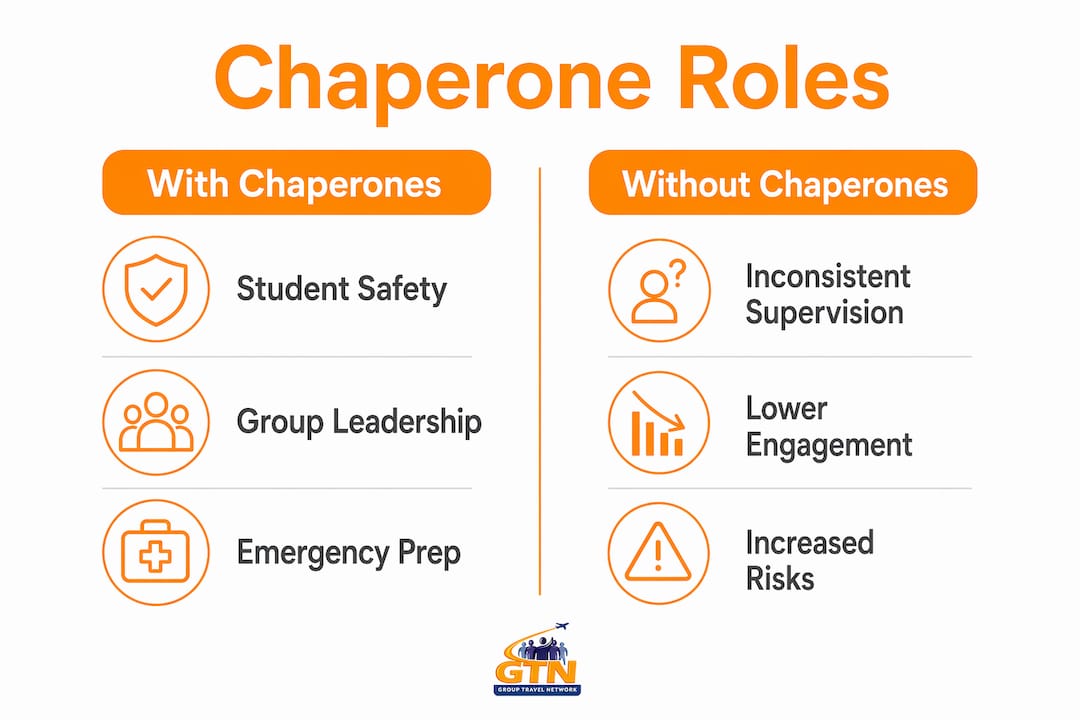
The difference between a trip with dedicated chaperones and one without is measurable:
| Trip factor | With dedicated chaperones | Without dedicated chaperones |
|---|---|---|
| Student supervision | Consistent, proactive | Reactive, gaps likely |
| Teacher focus | Educational objectives | Split between teaching and managing |
| Emergency response | Trained, role-defined | Ad hoc, slower |
| Student behavior | Monitored, corrected early | Issues escalate more often |
| Parent confidence | Higher, regular updates | Lower, communication gaps |
| Group dynamics | Positive, mentored | Variable, less supported |
Beyond safety, chaperones who engage personally improve group dynamics, encouraging curiosity and creating interactive learning moments during trips. A chaperone who asks students what they noticed at a historical site turns a walk-through into a conversation. That kind of engagement makes the trip more meaningful for everyone.
Some programs recognize the weight of these responsibilities financially. States’ 4-H International Exchange Programs, for example, subsidize up to 75% of fees for chaperones, acknowledging the real value they bring to the group.
What are best practices for organizing and managing chaperones effectively?
Selecting and preparing the right chaperones is as important as any other part of trip planning. A poorly matched chaperone creates more problems than they solve. Effective collaboration (opens in a new tab) between chaperones, teachers, and planners is what enables smoother trips, and that collaboration starts before anyone boards a plane.
Strong chaperone selection and management practices include:
- Choose for responsibility and cultural sensitivity. The best chaperones are calm under pressure, respectful of diverse backgrounds, and genuinely interested in students. Communication skills matter as much as reliability.
- Define roles before departure. Every chaperone should know exactly which students they are responsible for, what their emergency role is, and who they report to. Ambiguity during a crisis costs time.
- Hold a pre-trip coordination meeting. Bring chaperones, teachers, and administrators together to walk through the itinerary, review protocols, and answer questions. This meeting prevents the most common miscommunications.
- Use digital tools for itinerary and incident tracking. Apps and shared documents keep everyone aligned on schedules and allow real-time updates when plans change. For school tour planning (opens in a new tab), digital coordination tools reduce the margin for error significantly.
- Encourage genuine student engagement. Chaperones who interact with students beyond supervision build trust and rapport. That trust makes students more likely to report a problem or ask for help when they need it.
- Review and debrief after the trip. A short debrief with chaperones after returning identifies what worked and what to improve for next time.
How do chaperones navigate challenges and unexpected situations?
No school trip goes exactly as planned. Medical emergencies, student conflicts, travel delays, and lost luggage are all part of the reality. The chaperone’s job is to manage these situations without letting them derail the group.
Formal travel frameworks surpass common sense for handling unexpected events during student trips. Common sense tells you to stay calm. A formal framework tells you exactly who to call, what to document, and how to keep the rest of the group safe while you handle the incident.
Practical approaches to common challenges:
- Medical emergencies. Know the location of the nearest medical facility at every stop. Carry a list of student allergies, medications, and emergency contacts. Act immediately and notify the school contact within minutes.
- Student conflicts. Address behavioral issues privately and early. Public confrontations escalate quickly in group settings. Separate students if needed and document the incident.
- Travel delays. Keep students informed and occupied. Uncertainty breeds anxiety in young travelers. A calm, matter-of-fact update from a chaperone prevents panic.
- Lost or separated students. Every chaperone should have a pre-agreed protocol for this scenario, including a designated meeting point and a contact chain. Practice this before the trip, not during it.
Staying adaptable and empathetic is not a soft skill in this context. It is a professional requirement. Students remember how adults handled difficulty. A chaperone who stays composed and kind during a hard moment leaves a lasting impression on the group. For more on student travel safety (opens in a new tab), building these protocols into your planning process is the most reliable way to protect your group.
Key takeaways
Travel chaperones are the operational core of any successful school trip, combining safety supervision, emergency leadership, and student mentorship into a single, trained role.
| Point | Details |
|---|---|
| Role definition | Chaperones actively supervise, lead, and support students, not just accompany them. |
| Training matters | A structured 5-hour program covering risk, law, and scenarios prepares chaperones far better than informal guidance. |
| Teacher support | Chaperones free teachers to focus on educational goals by managing logistics and behavioral issues. |
| Selection criteria | Choose chaperones for responsibility, cultural sensitivity, and communication skills, then define their roles clearly. |
| Crisis readiness | A personal action plan with emergency contacts and defined protocols is the single most effective preparation tool. |
What I have learned after years of watching chaperones make or break school trips
Most people think chaperoning is about keeping students in line. That framing misses the point entirely. The chaperones I have seen make the biggest difference are the ones who treat the role as a form of leadership, not crowd control.
The most common mistake I observe is chaperones who wait to be told what to do. Effective chaperoning is proactive. You are reading the group, anticipating problems, and stepping in before a situation becomes a scene. That requires preparation and confidence, both of which come from training and clear expectations set before departure.
There is also a misconception that chaperoning is a burden. In my experience, the adults who approach it that way tend to disengage, and disengaged chaperones are worse than no chaperones at all. The ones who lean into the role, who ask students questions, share observations, and stay curious alongside the group, report that the experience is genuinely rewarding.
My honest advice to anyone taking on this role: read the itinerary until you know it cold, build your personal action plan, and decide in advance that you are going to lead, not just attend. The students in your group will feel the difference, and so will you. For stress-free school trips (opens in a new tab), the chaperone’s mindset is the variable that matters most.
— Donovan
How Grouptravelnetwork supports your next student group trip
Grouptravelnetwork specializes in organizing school and student group trips with the kind of structure that makes chaperone coordination straightforward rather than stressful. From customized itineraries to dedicated trip coordinators, every service is built around the reality that educators and chaperones need clear plans, reliable partners, and support when things change.

If you are planning a school excursion and want a framework that sets your chaperones up for success, explore the student group trips (opens in a new tab) resources at Grouptravelnetwork. The platform offers flexible planning tools, travel protection options, and destination expertise across cultural, nature, and performance travel. Your chaperones will be better prepared, and your students will have a trip worth remembering.
FAQ
What is the primary role of a travel chaperone?
A travel chaperone’s primary role is to supervise student safety, manage group logistics, and provide leadership during educational trips. Youth organizations define leadership, not just attendance, as the core chaperone responsibility.
Why are chaperones important on school trips?
Chaperones are important because they allow teachers to focus on educational objectives while ensuring consistent student supervision and faster emergency response. Increased adult presence directly correlates with safer, more disciplined student groups.
How long does chaperone training typically take?
Specialized chaperone training programs typically last about 5 hours, covering risk assessment, emergency protocols, legal duties, and real-time communication exercises for traveling with minors.
Who qualifies to be a travel chaperone?
Effective chaperones are selected based on responsibility, cultural sensitivity, and communication skills. Most programs require background checks and a pre-trip orientation before adults take on the role with student groups.
What should a chaperone do during a medical emergency on a trip?
A chaperone should act immediately using the group’s emergency protocol, notify the school contact within minutes, and use the pre-prepared list of student medical information. A personal action plan developed before travel makes this response faster and calmer.
Recommended
- Role Of Guides In Student Travel: Administrator’s Guide • Group Travel Network (opens in a new tab)
- How To Organize School Tours: 2026 Planning Guide • Group Travel Network (opens in a new tab)
- The Role Of A Travel Coordinator For Group Trips • Group Travel Network (opens in a new tab)
- Field Trip Organization Tips: A School Administrator’s Guide • Group Travel Network (opens in a new tab)