


TL;DR:
- Online trip management consolidates all stages of group travel into a single digital system, enhancing safety, compliance, and operational control. It enforces policy, tracks travelers, and provides real-time visibility, which are critical for effective school trip planning and emergency response. Prioritizing workflow controls, mandatory platform booking, and staff training maximizes the system’s safety and efficiency benefits.
Online trip management is defined as a centralized digital system that unifies every stage of group travel, from initial booking and approvals to real-time safety tracking and post-trip reporting. For school administrators, educational trip coordinators, and youth organization leaders, this system replaces the scattered emails, spreadsheets, and phone calls that traditionally derail group travel planning. The role of online trip management goes far beyond booking flights and hotels. It enforces policy, tracks every traveler, and gives coordinators the operational visibility they need to respond quickly when plans change or emergencies arise.
How does online trip management improve group travel coordination?
Online trip management improves group travel coordination by replacing fragmented, manual processes with a single platform that tracks every stage of the trip lifecycle. A centralized system with rules (opens in a new tab) covers booking, approvals, supplier selection, reporting, and traveler safety in one place. This matters enormously for school trips, where a coordinator might be managing 60 students, 8 chaperones, 4 vendors, and a school board approval process simultaneously.

The practical gains are concrete. Travel managers using centralized platforms gain time savings, better cost control, and improved coordination clarity across every trip phase. That means fewer last-minute surprises, tighter budgets, and less time spent hunting down confirmation emails.
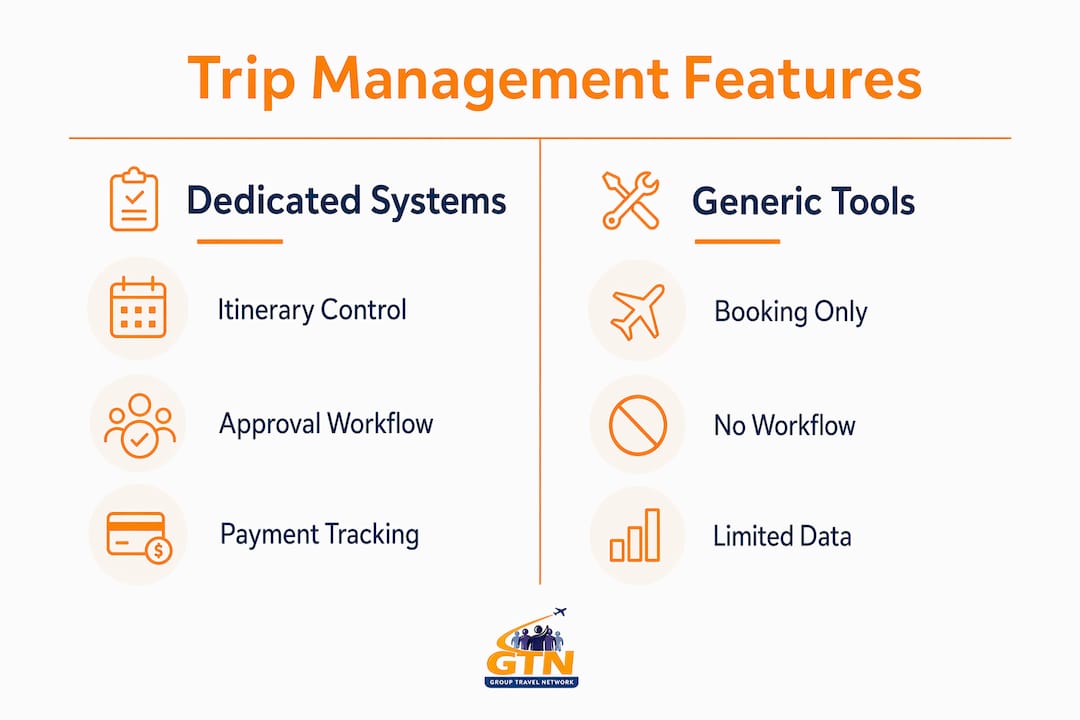
What separates a true trip management system from a generic CRM or booking tool is its depth across the trip lifecycle. Dedicated platforms track inquiry, itinerary versions, approvals, vendor blocks (opens in a new tab), traveler lists, payments, and pre-departure tasks in a way that generic sales or contact management tools simply cannot replicate. A school coordinator using a generic CRM to manage a band tour is essentially using a hammer to perform surgery.
Key coordination benefits include:
- Centralized traveler records with up-to-date roster information and itinerary versions accessible to all authorized staff
- Automated approval workflows that route permission forms, budget sign-offs, and vendor confirmations without manual follow-up
- Milestone payment tracking that alerts coordinators before deadlines, preventing costly cancellation fees
- Operational visibility across the entire group, so nothing falls through the cracks between planning and departure
Pro Tip: When evaluating digital travel planning platforms, prioritize tools that mirror your actual group travel workflow, including approval routing and pre-departure checklists, rather than tools that simply offer the most booking options.
What is the role of online trip management in ensuring travel safety?
The role of online trip management in travel safety is to maintain continuous visibility of every traveler from departure to return. When a student or chaperone books outside the approved platform, they become invisible to the duty-of-care program. Travelers who book outside the platform (opens in a new tab) break the chain of visibility that emergency response depends on. For a school administrator responsible for minors, that gap is not acceptable.
This is the concept the industry calls “duty of care,” which refers to an organization’s legal and ethical obligation to protect travelers under its supervision. Online trip management enforces duty of care by making off-platform booking structurally difficult or impossible.
“Without preventing shadow bookings, duty of care dashboards fail because some travelers become untracked at critical moments, compromising safety response.” — Duty of Care in Corporate Travel 2026
Real-time monitoring takes this further. Advanced platforms provide real-time dashboards showing traveler positions worldwide, with AI-generated alerts and automated check-ins. If a bus is delayed or a student misses a connection, the coordinator knows immediately rather than learning about it from a panicked parent phone call.
Safety planning through these platforms also includes structured pre-trip communication. Booking.com for Business recommends (opens in a new tab) defining preferred group communication channels and listing approved safety apps like International SOS before departure. That preparation, embedded directly into the platform’s pre-departure checklist, builds a culture of readiness rather than reactive scrambling.
Critical safety features to look for in a trip management platform:
- Mandatory booking enforcement to eliminate shadow bookings
- Real-time location tracking with automated check-in alerts
- Emergency contact database accessible to all authorized coordinators
- Integration with safety apps such as International SOS
- Pre-departure communication templates covering protocols and emergency procedures
Pro Tip: Distribute pre-trip safety instructions covering communication protocols and emergency contacts through the platform itself, not a separate email chain. This keeps everything in one auditable record.
Which features distinguish effective trip management systems from basic tools?
Effective trip management systems are distinguished by workflow control, not booking convenience. Platforms that mirror actual trip operations prevent patchwork manual processes and reduce the administrative burden on coordinators. A platform that makes booking easy but lacks approval routing, itinerary versioning, and vendor confirmation tracking will create more work, not less.
The table below contrasts what dedicated trip management software delivers versus what generic booking tools or CRMs typically offer:
| Feature | Dedicated trip management system | Generic booking tool or CRM |
|---|---|---|
| Itinerary versioning | Locks versions with approval history | No version control; edits overwrite data |
| Approval routing | Automated multi-level sign-off workflows | Manual email chains |
| Vendor management | Confirms blocks, tracks commitments | Basic contact records only |
| Payment milestones | Alerts and tracks deposits and balances | No payment lifecycle tracking |
| Traveler safety tracking | Real-time location and duty-of-care dashboards | Not available |
| Role-based access | Coordinators, admins, and parents see different data | Flat access for all users |
| Pre-departure checklists | Built into the workflow | Not available |
The financial tracking capability deserves specific attention. A single source of truth that locks itineraries, approvals, and vendor confirmations is operationally vital, especially during last-minute changes. When a venue cancels two weeks before a performance tour, the coordinator needs to see every vendor commitment, payment status, and itinerary dependency in one screen, not across 14 email threads.
Scalability also separates strong platforms from weak ones. A system built for a 20-person field trip should handle a 200-person international performance tour with the same structural logic. Role-based access control allows a school principal to see budget summaries while a trip coordinator manages granular logistics and a parent sees only their child’s itinerary and payment status. That layered visibility is what makes school group travel planning (opens in a new tab) manageable at any scale.
How can school administrators apply online trip management to improve outcomes?
School administrators and trip coordinators can apply online trip management most effectively by embedding policy and compliance rules directly into the booking workflow before any traveler makes a selection. Managed travel systems automatically flag non-compliant choices and route approvals inline with policy. This means a chaperone cannot book a non-approved hotel without triggering a review, eliminating the need for after-the-fact corrections.
Here is a practical application sequence for educational trip coordinators:
- Build your policy into the platform first. Set approved vendors, spending limits, and required approval steps before opening booking to participants. Policy embedded in the system is policy that gets followed.
- Configure group communication channels within the platform. Assign roles, set up messaging groups, and distribute emergency contact lists through the system so all communication is logged and searchable.
- Use payment milestone alerts to manage cash flow. Set alerts for deposit deadlines and balance due dates so neither the school nor the vendor is caught off guard.
- Run budget reports for stakeholder updates. Platform data produces real-time spend summaries that administrators can share with school boards or parent organizations without manual compilation.
- Conduct a pre-departure platform walkthrough with all staff. Every chaperone and coordinator should know how to access the traveler roster, emergency contacts, and communication tools before the group leaves.
Consider a practical scenario: a high school band director managing a performance tour to Washington, D.C. discovers three days before departure that the chartered bus company has a mechanical issue. With a dedicated trip management system, the director pulls up the vendor confirmation, identifies the contract terms, contacts the backup vendor already listed in the system, and pushes an updated itinerary to all travelers through the platform. Without that system, the same situation involves frantic calls, lost paperwork, and parents receiving conflicting information. The importance of trip coordination (opens in a new tab) becomes undeniable the moment something goes wrong.
Pro Tip: Schedule a 30-minute platform training session for all trip staff at least two weeks before departure. Coordinators who know the system before they need it in an emergency respond faster and make fewer errors.
Key takeaways
Online trip management is the single most effective tool school administrators have for maintaining safety, compliance, and operational control across the full group travel lifecycle.
| Point | Details |
|---|---|
| Centralize the full trip lifecycle | Use one platform for booking, approvals, vendor tracking, and safety to eliminate fragmented processes. |
| Enforce mandatory platform booking | Shadow bookings break duty-of-care visibility; all travelers must book through the approved system. |
| Prioritize workflow over booking ease | Approval routing, itinerary versioning, and payment milestones matter more than a slick booking interface. |
| Embed policy before booking opens | Build compliance rules into the system so non-compliant choices are flagged automatically, not corrected later. |
| Train staff before departure | Platform familiarity before travel begins directly improves emergency response speed and accuracy. |
Why I think most school trip coordinators underestimate this technology
After working with dozens of educational group travel programs, the pattern I see most often is this: a coordinator spends weeks building a detailed itinerary in a shared Google Doc, tracks payments in a spreadsheet, manages approvals through email, and then wonders why the last 72 hours before departure feel like controlled chaos. The problem is not effort. The problem is architecture.
The real value of a dedicated trip management system is not that it does more things. It is that it holds everything together when one thing breaks. And something always breaks. A vendor cancels. A student’s payment bounces. A parent calls demanding to know exactly where their child will be on day three. A platform built for group travel answers all three of those problems in under five minutes. A spreadsheet and an email inbox do not.
What I find most underappreciated is the safety dimension. Most coordinators think about safety in terms of physical precautions, first aid kits, and chaperone ratios. Those matter. But the digital safety layer, knowing exactly where every traveler is and being able to reach them instantly, is what determines how fast you can respond when something serious happens. Technology’s effectiveness depends on preserving traveler visibility end-to-end through mandatory platform booking. That is not a feature. That is the foundation.
My honest recommendation: treat your trip management platform as a strategic tool, not administrative software. The coordinators who get the most out of these systems are the ones who configure them thoughtfully before the trip starts, train their staff properly, and use the data they generate to improve every subsequent trip. The technology is only as good as the process behind it. For a deeper look at how schools are putting this into practice, the smart group trip planning (opens in a new tab) resources at Grouptravelnetwork are worth your time.
— Donovan
Plan your next group trip with Grouptravelnetwork
Grouptravelnetwork specializes in exactly the kind of organized, safety-focused group travel that benefits most from strong digital planning. From performance tours for school bands to educational excursions for student groups, every program includes dedicated trip coordinators, flexible payment plans, and built-in travel protection.

Whether you are planning your first major school trip or managing an annual tour program, Grouptravelnetwork provides the structure and support to make it work. Explore their student group trips (opens in a new tab) to see destination options, itinerary frameworks, and safety features designed specifically for educational groups. For coordinators who want a step-by-step approach, the 2026 planning tips (opens in a new tab) resource covers the latest best practices for managing group travel online with confidence.
FAQ
What is online trip management for school groups?
Online trip management is a centralized digital system that handles booking, approvals, vendor coordination, payment tracking, and traveler safety for group travel. For schools and youth organizations, it replaces manual spreadsheets and email chains with a single platform that maintains visibility across the full trip lifecycle.
How does online trip management support duty of care?
Duty of care requires that every traveler remain visible and reachable throughout the trip. Booking outside the platform makes travelers invisible to safety dashboards, so enforcing mandatory platform booking is the foundation of any effective duty-of-care program for school groups.
What features should school trip coordinators prioritize?
Coordinators should prioritize approval routing, itinerary versioning, and payment milestone tracking over basic booking convenience. These workflow controls are where group risk management is concentrated, particularly during last-minute changes or emergencies.
How is trip management software different from a regular booking tool?
A dedicated trip management system tracks the full group travel lifecycle including vendor commitments, traveler rosters, and pre-departure checklists, while a generic booking tool handles only reservations. The difference becomes critical when coordinating large groups where a single missed approval or payment deadline can disrupt the entire trip.
How can administrators use platform data to improve future trips?
Platform data provides real-time spend summaries, approval timelines, and vendor performance records that administrators can review after each trip. Using this data to identify bottlenecks and refine workflows makes each subsequent trip faster to plan and easier to manage.
Recommended
- Travel Management For Teams: How Schools Plan Smart Group Trips • Group Travel Network (opens in a new tab)
- School Group Travel Planning: A Step-by-step Guide • Group Travel Network (opens in a new tab)
- Step-by-step Group Travel Planning For School Trips • Group Travel Network (opens in a new tab)
- Group Travel Services: 8 Ways To Simplify Planning In 2025 (opens in a new tab)