

Sustainable school trips combine a nearby, learning-rich destination with low-emission transport and hands-on activities tied to what students are already studying. The three moves that matter most: pick a site close enough to cut passenger-miles, choose bus or rail over flying whenever the itinerary allows it, and build the day around data collection or physical work instead of passive sightseeing. The ideas and planning steps below show how to put all three into practice without blowing the budget.
TL;DR:
- Choosing bus or rail over flying and minimizing stop scatter in routing can cut a trip’s carbon footprint by a substantial margin.
- Incorporating hands-on, data collection activities aligned with NGSS and SDGs enhances real learning outcomes without increasing environmental impact.
- Prioritizing local destinations and low-emission transport options helps schools deliver immersive lessons while avoiding unnecessary travel.
- A trip coordinator can streamline planning, vet vendors’ sustainability claims, and ensure accessibility without adding extra staff burden.
Table of Contents
- 8 Sustainable School Trip Ideas That Maximize Learning Per Mile
- Planning Logistics That Actually Reduce a Trip’s Footprint
- Aligning Trips With NGSS and UN SDGs for Real Learning Outcomes
- Hands-On Activities That Reinforce the Lesson After the Bus Leaves
- Keeping Low-Impact Trips Accessible and Safe for Every Student
- Measuring Impact Without Overpromising
- How Group Travel Network Supports Sustainable Trip Planning
- What Sustainable School Trips Get Wrong Today
- Ready to Plan a Trip That’s Both Sustainable and Stress-Free?
- Sources
- FAQ
8 Sustainable School Trip Ideas That Maximize Learning Per Mile
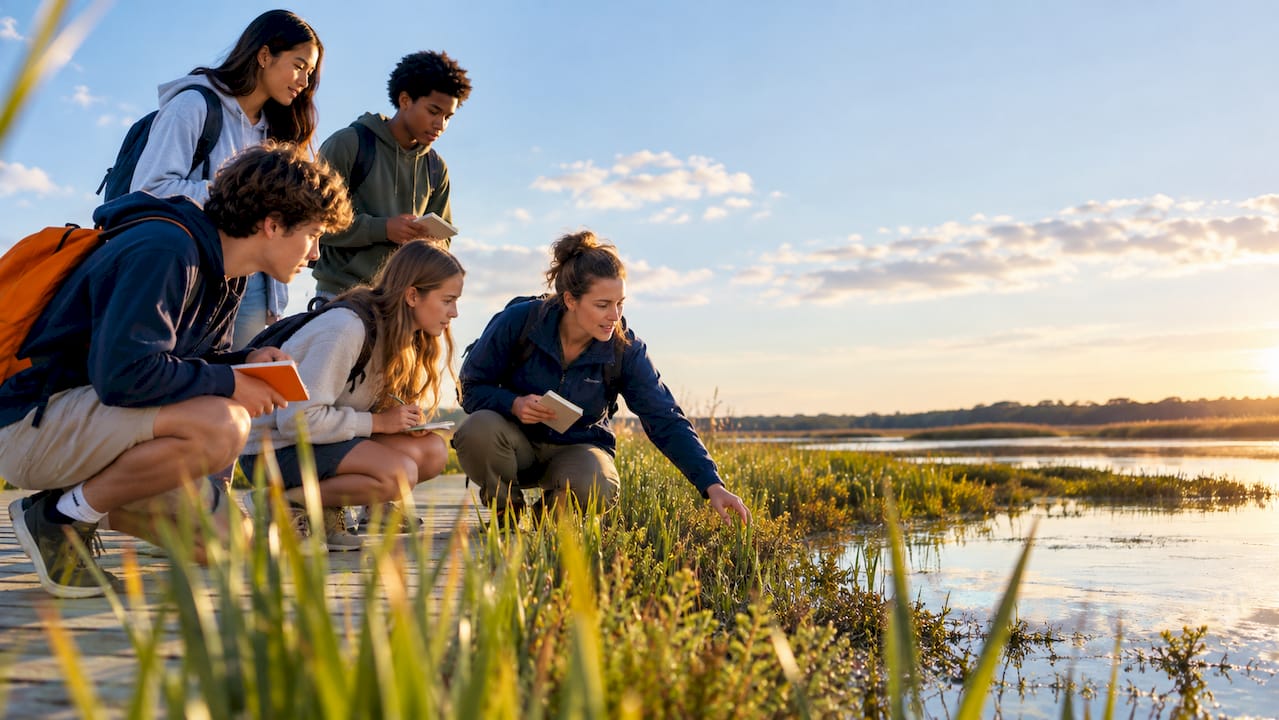
The best eco-friendly school excursions do not travel far to find something worth studying. A wetland twenty minutes from campus can teach more measurable science than a six-hour bus ride to a famous landmark, and it costs a fraction as much. Rank ideas by what students actually learn against how far the bus has to go, not by how impressive the destination sounds on a permission slip.
- Local biodiversity survey. Students catalog species in a nearby park or preserve using a simple transect line, count and identify organisms, then compare findings to a prior year’s data. Works for grades 3 through 12 with adjusted identification tools.
- Farm-to-food-systems visit. A working farm tour paired with a composting demonstration teaches soil science and food supply chains in one trip. Many farms run a hands-on workshop for under two hours, ideal for a half-day itinerary.
- Watershed or wetland water-quality check. Students run pH, turbidity, and dissolved-oxygen tests with a basic field kit and log results against regional water-health benchmarks.
- Renewable energy or utility tour. A wind farm or solar installation visit lets students compare output, land use, and cost per kilowatt-hour across energy types.
- Waste audit at a resource-recovery center. Sorting a sample of real municipal waste teaches contamination rates and recycling economics better than any classroom poster.
- Urban green infrastructure walk. Green roofs, bioswales, and permeable pavement demonstrations show stormwater management in action, usually within city limits.
- Restoration volunteer day. Native planting or trail maintenance with a local land trust gives students physical work with a measurable ecological outcome.
- Regional overnight outdoor classroom. A one- or two-night stay at a nearby nature center replaces a distant trip with the same immersive feel and a much smaller transport footprint.
Every one of these sits within a reasonable drive for most districts, which is the point. Choosing destinations for nature-based educational trips (opens in a new tab) close to home is consistently the single easiest way to shrink a trip’s footprint while keeping the learning dense.
Planning Logistics That Actually Reduce a Trip’s Footprint
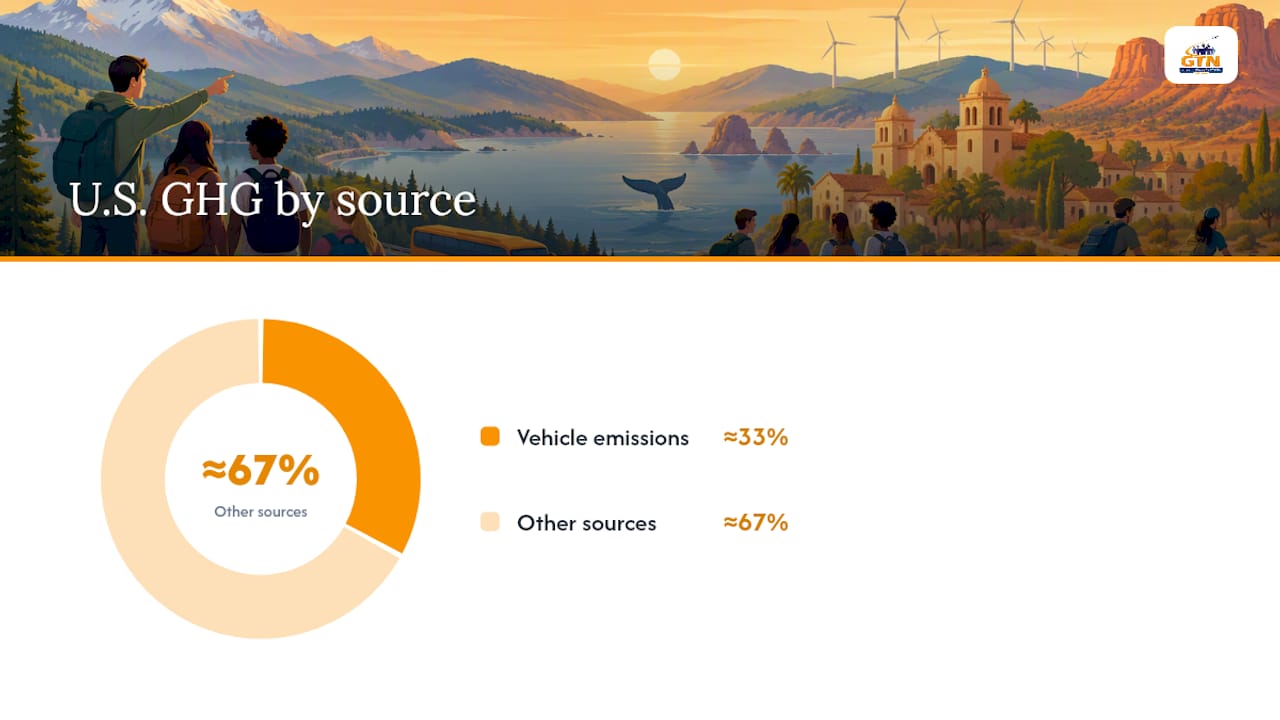
Transport is where most of the environmental impact hides. The EPA notes that vehicle emissions account for roughly one-third of U.S. greenhouse gas output (opens in a new tab), which makes routing decisions the single biggest lever a planner controls. Skip flights whenever a bus or rail option covers the distance in a reasonable time, consolidate stops into one efficient route instead of scattered pickups, and ask your bus vendor about idling policies. The EPA’s Clean School Bus Program (opens in a new tab) has funded low- and zero-emission bus replacements since 2022, and asking a vendor whether their fleet includes newer, cleaner buses is a fair question to put on any request for proposal.
Budgeting for sustainability works best as a total-trip calculation, not a single line item. A step-by-step budgeting guide (opens in a new tab) can help you build that math correctly the first time.
- Ask providers about group minimums and cancellation terms before booking.
- Request specifics when a vendor claims to be “sustainable” or “carbon neutral.”
- Confirm accessibility accommodations for mobility, dietary, and sensory needs.
- Prioritize local food vendors and plant-forward menu options over packaged catering.
- Avoid single-use disposables for meals and water service where a refill station is available.
Pro Tip: Call your bus or coach vendor and ask directly whether idling time is limited at pickup and drop off. A five-minute policy change across a full day of stops adds up fast, and most vendors will confirm it in writing if you ask.
Aligning Trips With NGSS and UN SDGs for Real Learning Outcomes
A trip earns its footprint by tying activities directly to standards administrators already track. Greening curriculum guidance from UNESCO (opens in a new tab) recommends mapping outcomes by age band and partnering with local institutions to deliver action oriented results rather than passive observation.
Set a pre-trip learning goal, collect real data on site, then assess with a post-trip project instead of a worksheet.
- Elementary: Students sort waste samples and graph recycling rates against a class prediction, satisfying NGSS performance expectations around patterns and cause-effect relationships.
- Middle school: Water-quality testing at a local stream feeds a lab report comparing results to regional health standards, tying directly to NGSS Earth systems standards and SDG 6 on clean water.
- High school: A biodiversity transect survey generates a dataset students analyze for population trends, supporting NGSS ecosystems standards and SDG 15 on life on land.
Hands-On Activities That Reinforce the Lesson After the Bus Leaves
Activities work best when they scale by grade and produce something concrete students can revisit.
- Waste audit. Sort a sample bag of school waste by category, weigh each pile, and graph the results against last semester’s numbers. Works for any grade with adjusted category counts.
- Water testing. Use a basic field kit to log pH and turbidity at two points along a stream, then compare upstream to downstream readings.
- Transect survey. Lay a 50-foot line through a natural area and record every species crossing it, building a simple biodiversity index.
- Composting demonstration. Layer materials in a bin, measure temperature over several days, and chart decomposition rate.
Document learning with photo logs, simple data sheets, and a short written reflection rather than a formal exam.
Pro Tip: Have students photograph their own data sheet before leaving the site. It creates a built-in backup if a page gets lost on the bus ride home, and it gives you ready-made material for a post-trip slideshow.
Keeping Low-Impact Trips Accessible and Safe for Every Student
A sustainable itinerary should never quietly exclude the students who need it most.
- Offer an alternate, lower-mobility route or activity station for students who cannot manage a walking-heavy itinerary.
- Check accessible transport and restroom facilities at every stop before the trip, not the morning of.
- Set up flexible payment plans so cost never determines who gets to participate.
- Brief chaperones on wildlife-disturbance rules, biosecurity basics, and the emergency plan before departure.
Measuring Impact Without Overpromising
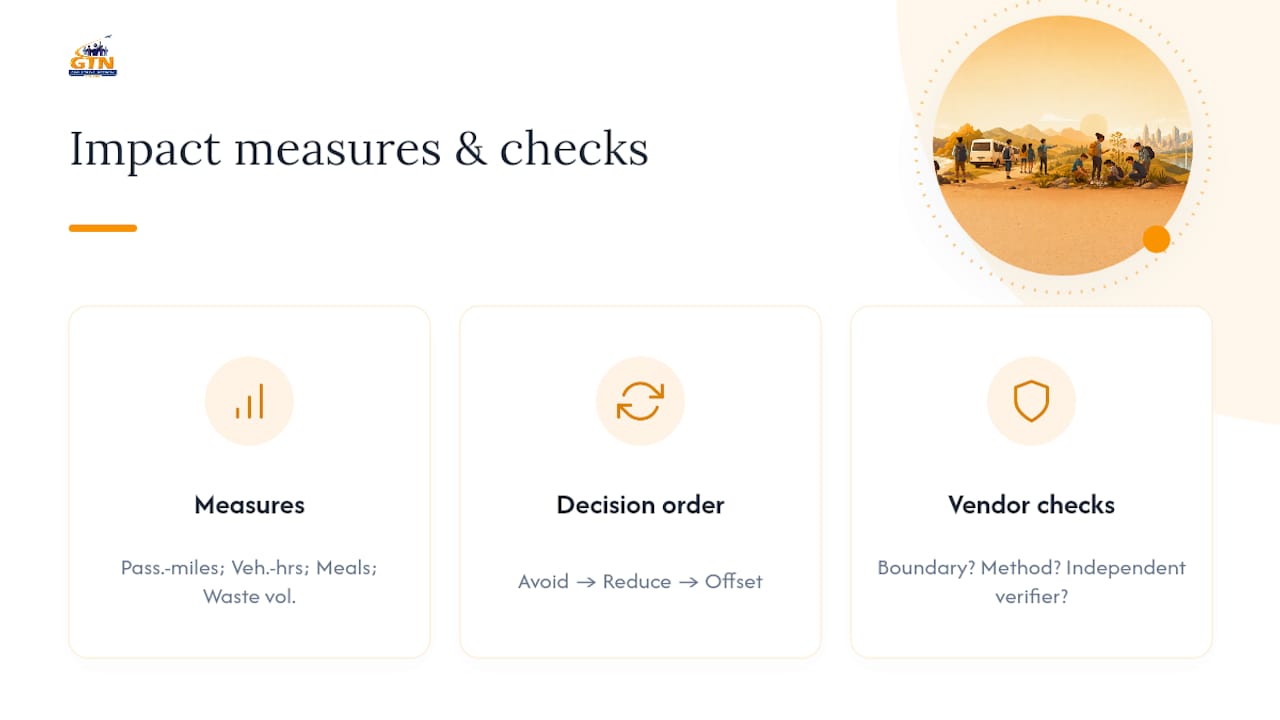
Track passenger-miles, vehicle hours, meal types served, and waste volume generated. These four numbers give you a defensible before-and-after comparison without needing a full carbon audit. Follow an avoid, reduce, offset order: cut unnecessary travel first, shrink what remains through routing and clean buses, and only consider verified offsets for what’s left. Before accepting any vendor’s “carbon neutral” or “zero waste” claim, ask what boundary it covers, what method calculated it, and who verified it independently, following guidance from field-trip environmental assessments (opens in a new tab).
How Group Travel Network Supports Sustainable Trip Planning
A dedicated trip coordinator, online registration, and flexible payment plans make it easier to route efficiently, negotiate with local vendors, and add sustainability terms into contracts without extra staff hours on your end.
What Sustainable School Trips Get Wrong Today
Most sustainability advice for school trips focuses on the wrong metric. Planners get told to hunt for a farm with solar panels or a hotel with a recycling bin, when the number that actually moves the needle is passenger-miles. A trip forty minutes away with a rigorous water-testing protocol beats a “green certified” destination three hours out almost every time, because the bus ride is where most of the footprint and most of the budget disappears.
The conventional advice also treats sustainability and rigor as separate checkboxes. They are not. A well-designed local trip that produces real data, a graded assessment, and a defensible NGSS or SDG alignment does more for a district’s mission than a distant trip with a green label and a worksheet. If you take one thing from this: audit your shortlist by distance and learning density before you audit it by amenities. Everything else, including the offset conversation, is secondary to that first filter.
— Donovan
Ready to Plan a Trip That’s Both Sustainable and Stress-Free?
A dedicated trip coordinator can provide schools a direct path to sustainable travel without the guesswork of vetting vendors and routes alone. A trip coordinator can handle vendor sourcing, transport routing, and payment logistics, helping staff focus on the curriculum instead of logistics spreadsheets. Explore Educational Endeavors (opens in a new tab) to see how a curriculum-linked, low-impact itinerary comes together, or check out the school group travel planning guide (opens in a new tab) for the full process. A sustainability-focused consultation reviews your draft itinerary, checks transport and lodging choices against lower-impact alternatives, and reconciles your budget line by line. Request a consultation today to get your next trip mapped out.
Sources
Reference the EPA’s transportation guidance and Clean School Bus Program report for transport data, UNESCO’s greening curriculum guidance for standards alignment, the University of Minnesota Landscape Arboretum (opens in a new tab) for program pricing examples, and The Ecology Center’s field-trip guidance for vetting provider claims. For general trip-planning templates, the mission trip planning guide (opens in a new tab) offers useful budgeting frameworks that translate well to school group travel.
- Travel Green | A Student’s Guide to Global Climate Change | US EPA (opens in a new tab)
- EPA Clean School Bus Program: Fourth Report to Congress, Fiscal Year 2024 (EPA-420-R-25-004, January 2025) (opens in a new tab)
- Visits and the environment / Field-trip guidance — The Ecology Center (opens in a new tab)
- Greening curriculum guidance — UNESCO (opens in a new tab)
FAQ
What are the three types of sustainable travel?
Sustainable travel generally breaks into environmental, social, and economic sustainability: minimizing emissions and waste, respecting host communities and wildlife, and supporting local businesses financially. For school trips specifically, this means low-emission transport, respectful behavior at natural sites, and spending on local vendors rather than large chains.
How can our school make trips more sustainable?
Start by choosing destinations closer to campus to cut passenger-miles, since transportation drives a major share of a trip’s footprint. Pair that with hands-on activities like water testing or waste audits, plant-forward meal options, and a coordinator who vets vendors’ environmental practices, such as through Educational Endeavors.
Where is the best place for a school trip?
The best destination is the one that delivers the most learning value for the least travel distance, not necessarily the most famous site. A local farm, wetland, or resource-recovery center often teaches more measurable science than a distant landmark, at a lower cost and a smaller footprint.
What are the downsides of school field trips?
Field trips carry real costs: staff time, transportation expenses, liability and safety planning, and the risk of unequal access when families cannot cover fees. Outdoor visits can also disturb wildlife or natural sites if group behavior isn’t planned as carefully as the curriculum content itself, which is why briefing chaperones and students beforehand matters as much as picking the destination.
How much do sustainable school programs typically cost?
Costs vary widely by program and group size. As one benchmark, the University of Minnesota Landscape Arboretum lists a K–3 Green Grocery Field Trip at $235 per class, a useful reminder to budget the full trip rather than judging by admission price alone.
Recommended
- Class Trips: Creating Inspiring Educational Adventures (opens in a new tab)
- 10 Outdoor Learning Trip Ideas For Educators In 2026 (opens in a new tab)
- Educational Group Trip Guide: Expert Planning For Schools (opens in a new tab)
- Educational Group Travel: Making Classroom Lessons Real (opens in a new tab)