

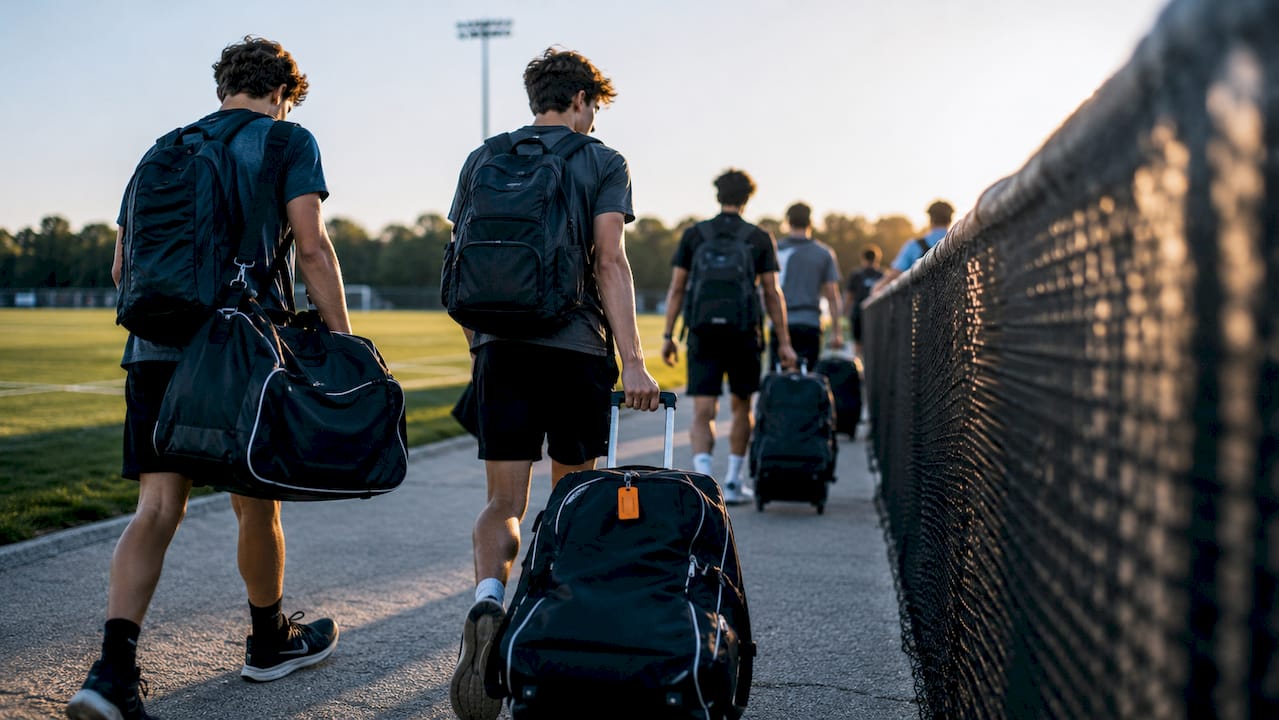
The fastest way to stop tournament weekend chaos is simple: name one travel lead and build a single one-page checklist before anyone books a room. This guide covers the packing lists, hotel hacks, budgeting math, and on-site playbook that make sports tournament travel manageable, drawing on organizer practices used across NCAA-style team travel, resources from groups like the American Bus Association, and planning frameworks from Group Travel Network.
TL;DR:
- A single designated travel leader should own all logistics and distribute a concise checklist taped inside the equipment bin to prevent paperwork chaos.
- For trips over 500 miles, flying or chartering is faster but requires checking baggage policies and arrival times to avoid missing the first game.
- Hotels near the venue with flexible cancellation policies and included amenities like breakfast and laundry save time and reduce on-site stress.
- Organizing a clear arrival routine, designated base camp, and one communication channel minimizes late arrivals and lost kids during tournament days.
- Early booking of transportation, hotel rooms, and group meals helps control costs and ensures flexible cancellation options, with deposits protected by reliable providers.
Table of Contents
- Sports Tournament Travel Checklist: Packing and Pre-Trip Admin
- How Should a Team Choose Between Driving, Flying, and Chartering?
- Where Should Teams Stay, and What Hotel Hacks Actually Save Money?
- How Do You Manage Tournament Day Logistics On-Site?
- Food, Hydration, and Basic Medical Prep for Tournament Days
- What Does Sports Tournament Travel Actually Cost?
- How to Organize Group Travel: Permissions, Supervision, and Roles
- Pre-Travel Health and Safety Precautions Every Team Should Check
- Getting Around at the Tournament: Shuttles, Transit, and Parking
- Emergency Procedures and Contacts at the Tournament Venue
- An Organizer’s Perspective on What Actually Prevents Tournament Chaos
- Group Travel Network: What to Ask Before You Book a Managed Trip
- Sources
- FAQ
Sports Tournament Travel Checklist: Packing and Pre-Trip Admin
Every tournament trip starts falling apart in the same place: nobody owns the paperwork. Fix that first, then handle gear.
Pack for weather swings and long days, not just the game. Experienced tournament parents consistently point to a short list of items that save weekends: wagons, canopy chairs, layered clothing, and a spare pair of shoes (opens in a new tab) handle both a sudden downpour and a surprise 8 a.m. heat wave.
- Uniforms (home and away) plus a backup jersey or shorts
- Rain gear, layers, and one extra pair of shoes per athlete
- Phone chargers, a portable battery, and a laundry bag for the ride home
- Signed medical release forms and a printed emergency contact sheet
- Medication notes, including anything requiring a parent signature for administration
Before departure day, distribute the itinerary to every family, confirm hotel and transport reservations in writing, and collect final payments so nobody is scrambling at check-in.
Pro Tip: Print the one-page checklist and tape it inside the equipment bin lid. It becomes the thing every parent checks instead of texting the coach at 11 p.m.
How Should a Team Choose Between Driving, Flying, and Chartering?
Transport choice usually comes down to distance, group size, and how much gear you’re hauling. There’s no universal right answer, but there is a wrong one: picking the option that’s cheapest on paper without checking arrival timing against the first game.
- Driving (carpool or family vans): Best for trips under four hours. Gives families control over schedules, but coordination gets messy past 15 people.
- Charter bus: Ideal for larger squads and longer hauls. Keeps the team together, simplifies gear transport, and removes the risk of a carpool running late. Groups like the American Bus Association (opens in a new tab) maintain directories of vetted charter operators for exactly this kind of booking.
- Flying: Fastest for trips over 500 miles, but airlines apply group booking rules and baggage limits that change your cost math fast. Check group travel and baggage policies (opens in a new tab) before locking in fares, especially if you’re checking team equipment.
- Rental vans: Flexible for mid-size squads, but factor in driver eligibility rules and insurance costs.
Build in a buffer. Plan to arrive at least 90 minutes before the first scheduled game, and add an extra hour of slack for any drive over three hours to absorb traffic or weather. If families are traveling separately from the team bus, set one shared check-in time rather than a scattered arrival window.
Where Should Teams Stay, and What Hotel Hacks Actually Save Money?
Hotel choice affects more than comfort. It affects your morning schedule, your food budget, and how many angry texts you get about noise complaints.
Prioritize hotels close to the venue, and confirm they offer free breakfast, on-site laundry, and a cancellation policy that provides schedule flexibility. Ask specifically about flexible or refundable group blocks, since tournament brackets shift constantly.
- Cap room occupancy per adult chaperone and document assignments in a shared spreadsheet before check-in
- Group athletes by age and gender per your organization’s supervision policy
- Reserve a hotel conference or meeting room for team dinners instead of herding a group through a restaurant
- Locate the ice machine and vending area on arrival, not at 10 p.m. when someone needs it
Reserving a conference room is one of the more underused hotel hacks in youth sports travel. It’s often cheaper and far less chaotic than a sit-down group dinner (opens in a new tab), and it doubles as a spot for a pre-game team meeting.
Pro Tip: Ask the front desk if breakfast service can open 30 minutes early for large groups. Most hotels will accommodate this if you ask at booking, not on arrival night.
How Do You Manage Tournament Day Logistics On-Site?
Tournament day runs on rhythm, not luck. A base camp and a clear arrival routine prevent the two most common failure points: late arrivals and lost kids.
- Set up base camp early. Bring a canopy, folding chairs, a cooler, a compact first-aid kit, and a charging station. Claim a shaded spot near the field entrance if one exists.
- Set arrival windows, not just game times. Have players arrive 60 to 90 minutes before kickoff for warmups, equipment checks, and lineup confirmation. Build a separate plan for late arrivals caused by traffic or weather delays.
- Assign one communication channel. Pick a single group chat app for the whole trip. Naming one travel lead and using one channel prevents the mixed messaging that causes missed warmups.
- Name a coach liaison. This person handles schedule changes with tournament officials so the head coach stays focused on the team, not the bracket board.
The base camp setup sounds minor until game three of the day, when it’s the only shade for 40 feet.
Food, Hydration, and Basic Medical Prep for Tournament Days

Fueling and minor injury prep don’t need to be complicated, just consistent. Electrolyte drinks matter more on tournament days than regular practice days, since kids are often playing two or three games under sun with limited downtime.
A well-worn trick from experienced tournament families: freeze water bottles the night before. They work as ice packs early in the day and become cold drinking water by the afternoon.
- Pack electrolyte packets, not just water, for games longer than 60 minutes
- Keep a compact medical kit with tape, ice packs, blister care, and basic wound supplies
- Name one adult as the medical point person so injuries don’t get handled by committee
- Between games, prioritize light stretching and shade over intense activity
A designated medical lead and a concise kit reduce response delays for the scrapes and rolled ankles that make up most tournament injuries. Save the emergency room trip mentality for actual emergencies. Most minor injuries need rest, ice, and five minutes, not a hospital visit.
What Does Sports Tournament Travel Actually Cost?
Costs break into five predictable buckets: registration, transport, lodging, food, and extras like team gear or photos. A rough per-player framework helps families budget before the season starts rather than getting surprised trip by trip.
- Registration fees vary widely by sport and tournament tier, and travel ball programs are often the priciest category
- Transport is usually the second-largest line item, especially for fly-in tournaments
- Lodging, split across a room, is often the most negotiable cost through group hotel rates
- Food drops significantly when teams pool money for group meals instead of individual restaurant stops
- Extras (uniforms, team photos, tournament programs) should be budgeted separately so they don’t blur with core travel costs
Cut costs without cutting corners by negotiating a group hotel rate, booking early for discounted tournament entry, and building flexible cancellation terms into every reservation. For collecting money, an online payment portal with a payment plan option beats chasing checks, and transparent reporting to families (who paid, what’s outstanding) heads off disputes before they start.
How to Organize Group Travel: Permissions, Supervision, and Roles
Every well-run tournament trip has the same operational skeleton, no matter the sport.
- Lock down paperwork first. Permission slips, medical release forms, and insurance verification should be collected before travel, not during check-in. Confirm your school or league’s specific supervision rules, since these vary by district.
- Assign chaperone ratios and named roles. A travel lead, medical lead, coach liaison, and equipment manager (opens in a new tab) cover the four jobs that actually need a dedicated person.
- Use online registration for payments and communication. It tracks who’s paid, flags refunds, and pushes itinerary updates automatically instead of relying on a group text.
- Document rooming assignments in one shared file. Pairing athletes by age and capping occupancy per chaperone (opens in a new tab) avoids confusion at hotel check-in.
Clear role assignment is what separates a smooth trip from a coach fielding fifteen separate questions at once. Leadership roles matter here just as much as they do on the field, and the same principles that guide effective team leadership (opens in a new tab) apply directly to who runs logistics on a tournament weekend.
Pre-Travel Health and Safety Precautions Every Team Should Check
Before the bus leaves, run through health prep the same way you’d check tires on a van. It takes twenty minutes and prevents the worst kind of tournament weekend.
Confirm every athlete’s routine vaccinations are current, particularly for teams traveling across state lines or internationally, since some tournament venues and host families request proof. Collect an updated medical form for each player that lists allergies, current medications, and any chronic conditions a first responder would need to know immediately.
Injury prevention starts before the first game, not during warmups. Build a short pre-tournament routine into the week leading up to travel: dynamic stretching, hydration reminders, and a reduced practice load in the final 48 hours so players arrive fresh instead of fatigued. Fatigue is a bigger injury risk factor at tournaments than most parents realize, since kids are often playing more games in one weekend than they would in three weeks of a regular season.
Pack any prescribed medications in their original labeled containers, along with written parent authorization for administering over-the-counter medication like ibuprofen or antihistamines. Some districts require this in writing before a coach or chaperone can hand a player anything, even a children’s pain reliever.
If your tournament involves travel to a different climate or altitude, build in an extra rest day where possible. Athletes arriving from sea level to a high-altitude tournament site, for example, often need 24 to 48 hours to adjust before performing at their usual level. Pack accordingly for temperature swings, since a tournament that starts in cool morning air can hit significant heat by early afternoon.
Getting Around at the Tournament: Shuttles, Transit, and Parking
Local transportation planning at the destination matters as much as getting there in the first place. Many multi-field tournament complexes are spread across several venues, sometimes miles apart, and a team stuck without a plan loses warmup time fast.
Check whether the tournament host provides a shuttle between the team hotel and the venue. Larger tournaments, especially showcase events with dozens of teams, often run shuttle loops on a fixed schedule. If no shuttle exists, confirm parking capacity at the venue directly. Some complexes fill their lots by mid-morning during peak tournament weekends, which means families arriving for a noon game may need to park off-site and walk.
Public transit is worth checking in cities with strong rail or bus networks, particularly for families managing multiple games at different locations across a weekend. Destination marketing organizations and convention bureaus often publish venue guides (opens in a new tab) that list field locations, parking guidance, and nearby hotel neighborhoods, which can save real time during initial planning.
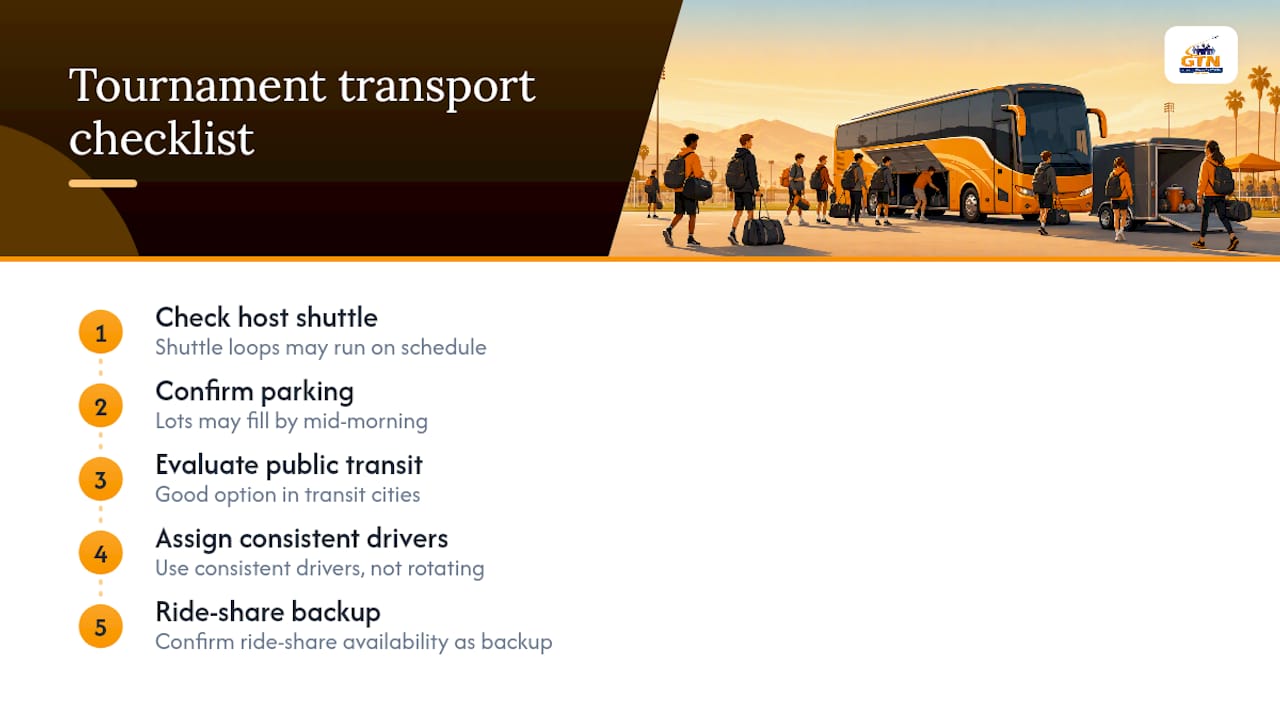
If your team is renting vans or relying on carpools for local movement, assign a consistent group of drivers rather than rotating each day. It’s also worth noting that carpooling with the coach often reduces coordination overhead entirely, since the coach usually needs to be on-site early anyway and already knows the venue layout. Confirm ride-share availability at your destination as a backup option, especially for last-minute changes between hotel and field.
Emergency Procedures and Contacts at the Tournament Venue
Every base camp setup should include an emergency plan, not just a first-aid kit. Know it before game one, not during game three when something actually happens.
Identify the nearest urgent care or emergency room to the venue before the tournament starts, not after an injury. Most tournament directors post venue maps with athletic trainer locations and first-aid stations; find these during check-in, not during a crisis. Confirm whether the tournament provides an on-site athletic trainer or medical staff, which many larger tournaments do for at least the primary fields.
Build a simple emergency contact card for each player that includes a parent’s phone number, a secondary emergency contact, insurance information, and any known allergies or conditions. Keep this in the medical kit, not scattered across individual parent phones. Assign your named medical lead as the single point of contact for any injury, so responders and parents are getting information from one consistent source rather than three different accounts.
Share the venue’s exact address, not just the tournament complex name, with every family before departure. GPS apps sometimes route to the wrong entrance at sprawling multi-field complexes, which matters if a parent needs to reach a specific field quickly during an emergency. Post the local emergency number and the nearest hospital address in your team group chat as a pinned message, so it’s visible without digging.
An Organizer’s Perspective on What Actually Prevents Tournament Chaos
The teams that run smoothly on tournament weekends almost never have the most experienced coach or the biggest budget. They have one adult who owns the checklist and refuses to let logistics become a group decision made by committee in a parking lot. A named travel lead with a printed one-page plan consistently produces fewer late arrivals, calmer parents, and far less on-field scrambling than any amount of last-minute group texting ever will.
— Donovan
Group Travel Network: What to Ask Before You Book a Managed Trip
Running tournament logistics solo works for a lot of teams, but at a certain size, the paperwork alone becomes a part-time job. That’s where a managed partner earns its keep. Some travel agencies offer services to coaches, team managers, and school administrators to handle the parts of tournament travel that eat the most time: dedicated trip coordinators, online registration, flexible payment plans, and travel protection options that cover the unpredictable stuff a group text can’t fix.

Whatever partner you consider, ask three questions before signing anything: what are their safety and supervision protocols, can they provide references from other teams or schools they’ve traveled with, and what exactly happens to your deposit if the tournament schedule changes. A legitimate provider answers all three without hesitation.
If your team’s next trip is getting complicated enough to need real support, start with Group Travel Network’s step-by-step planning guide for school and team tours (opens in a new tab) to see how a coordinated itinerary actually comes together.
Sources
- Groups360 — Hotel booking for sports team travel: tips to help you plan like a pro (opens in a new tab)
- Youth Inc. — The Ultimate Youth Sports Tournament Travel Guide (opens in a new tab)
- Buses (opens in a new tab)
- American Airlines — group travel and baggage policy pages (opens in a new tab)
FAQ
Who Pays for NCAA Tournament Travel?
At the college level, NCAA member institutions typically cover team travel costs for their athletic programs, though funding varies by division and conference. Youth and amateur tournament travel works differently. Families, schools, or club programs cover those costs directly, which is why budgeting and cost-sharing strategies matter so much more at that level.
How Much Does It Cost to Enter a Travel Ball Tournament?
Tournament entry fees vary significantly by sport, region, and competition tier, with travel ball programs often ranking among the pricier options due to registration, field rental, and officiating costs. Check with your specific league or tournament organizer for current entry pricing, since fees shift year to year.
What Is Sports Event Tourism?
Sports event tourism refers to travel undertaken specifically to attend or participate in a sporting event, whether as a competitor, coach, or spectator. It covers everything from youth tournament weekends to major championship travel, and it’s a significant driver of hotel and local business revenue in host cities during tournament season.
What Should a Travel Lead Do Differently From a Coach?
A travel lead handles logistics: hotel confirmations, itinerary distribution, payment tracking, and communication, freeing the coach to focus on the team and the game plan. Splitting these roles is one of the clearest ways to reduce chaos on multi-day tournament trips, a principle organizations like Group Travel Network (opens in a new tab) build directly into their team travel management process.
How Far in Advance Should a Team Book Tournament Travel?
Booking hotels and transport as early as possible, ideally as soon as tournament dates are confirmed, secures better group rates and more flexible cancellation terms. Waiting until a few weeks out often means paying peak rates and losing access to blocked hotel rooms near the venue.