


TL;DR:
- Sports travel management involves coordinating all logistics for teams, focusing on performance and compliance. It includes booking flights, hotels, ground transport, managing documentation, and contingency planning to support athlete readiness. Partnering with specialized providers enhances efficiency, compliance, and overall travel success, especially for multi-team programs.
Sports travel management is defined as the specialized coordination of all travel logistics for sports teams, covering flights, accommodations, ground transport, documentation, risk planning, and compliance with governing body regulations. Unlike booking a class field trip or a corporate offsite, sports travel management (opens in a new tab) differs from leisure and corporate travel due to complex group timing requirements and performance-sensitive scheduling. For school administrators, athletic directors, and travel coordinators, this distinction matters enormously. A delayed bus or a mismanaged hotel rooming list does not just cause inconvenience. It directly affects how athletes perform on game day.
What is sports travel management and what does it include?
Sports travel management is the expert coordination of every travel detail a sports team needs to arrive ready to compete. According to ATPI, travel must be treated as part of the overall performance plan because it directly impacts athlete readiness. That framing changes everything about how you approach planning.
The core components of sports travel management for school programs include:
- Group flight booking and charter planning: Coordinating departure times around practice schedules, competition windows, and recovery needs, including charter options when distance or roster size demands it.
- Accommodation management: Securing room blocks at hotels near competition venues, managing rooming lists, and confirming meal and amenity requirements for large groups.
- Ground transportation: Arranging buses, vans, and local transfers that keep the team together and on schedule from arrival to departure.
- Documentation and compliance: Handling permission forms, medical releases, travel insurance, and any visa requirements for international competitions.
- Risk and contingency planning: Building backup options for weather delays, flight cancellations, or sudden roster changes that require same-day rebooking.
- Itinerary management: Maintaining a master schedule that coaches, administrators, and parents can access in real time.
End-to-end sports travel services (opens in a new tab) from specialized providers also include VIP perks, charter planning, visa handling, and 24/7 operational support. For school programs managing multiple teams across a single season, that breadth of service is not a luxury. It is the only way to keep operations from collapsing under their own complexity.
Pro Tip: Build your rooming list and ground transport sequence at the same time. Hotel and transport coordination (opens in a new tab) is the operational backbone of sports travel logistics, and misaligning the two is the most common cause of team cohesion problems on arrival.
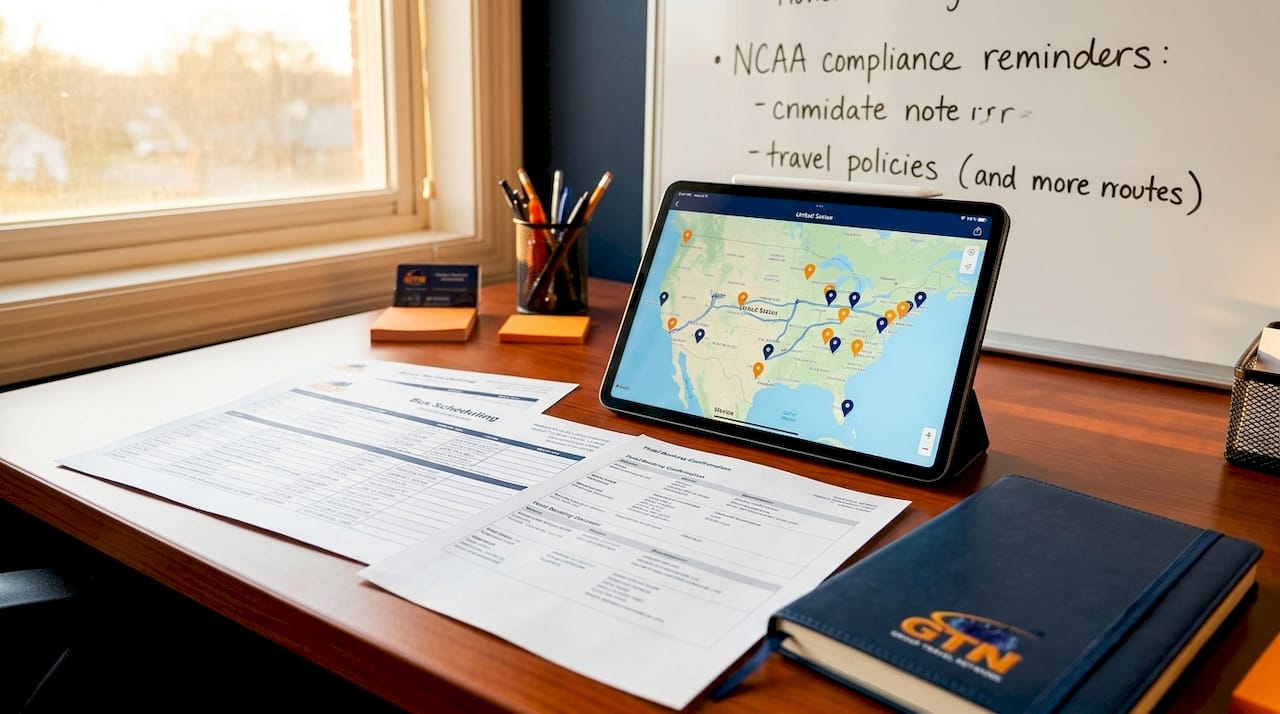
How sports travel management differs from standard travel planning
Standard corporate or leisure travel management optimizes for cost and convenience. Sports travel management optimizes for performance and compliance. That is a fundamentally different objective, and it produces fundamentally different workflows.
| Factor | Standard travel management | Sports travel management |
|---|---|---|
| Scheduling priority | Lowest cost or preferred dates | Competition windows and recovery time |
| Group size | Typically individuals or small teams | Full rosters, coaching staff, support personnel |
| Equipment | Carry-on luggage | Uniforms, gear bags, medical equipment |
| Compliance | Company travel policy | NCAA, state athletic association, or governing body rules |
| Support hours | Business hours | 24/7 operational response |
| Flexibility | Moderate | High, with same-day change capability |
The compliance dimension alone separates sports travel from every other category. NCAA travel guidelines (opens in a new tab) specify charter flight or bus eligibility based on distance thresholds, with defined reimbursement limits for travel parties and gear weight allowances. A school that books travel without understanding those rules risks eligibility violations, not just budget overruns.
Performance-sensitive scheduling adds another layer. Travel impacts readiness and must be planned around competition and recovery cycles, not around airline pricing calendars. A team that arrives six hours before tip-off after a red-eye flight is not the same team that arrives the night before with a full sleep cycle.
Pro Tip: When managing travel for sports teams, always build a 24-hour buffer before major competitions when the schedule allows. 24/7 support and operational responsiveness (opens in a new tab) from your travel provider is critical for weather delays and last-minute roster changes, but a time buffer reduces how often you need to use it.
What digital tools support sports travel management?
The operational complexity of managing travel for multiple school teams simultaneously requires more than spreadsheets and email chains. Modern sports travel management relies on SaaS platforms built specifically for group athletic travel.
Sports travel management platforms (opens in a new tab) provide large-group room block management and real-time itinerary support to college, youth, and tournament teams at scale. That capability matters when you are coordinating three teams traveling to different states on the same weekend.
The most useful platform features for school athletic programs include:
- Instant hotel booking with room block management: Reserve blocks across multiple properties simultaneously, with automatic rooming list generation.
- Real-time dashboards: Track team movements, flight statuses, ground transport schedules, and expense totals from a single interface.
- Policy enforcement automation: Set spending limits, approved vendors, and compliance rules that trigger alerts when bookings fall outside parameters.
- Consolidated manifests and digital reporting: Digital reporting tools (opens in a new tab) are essential for large school districts managing parallel team travel, enabling fast budget tracking and approval workflows.
- Variance reporting: Identify cost overruns or schedule deviations before they become problems, not after the trip ends.
Centralized booking systems with policy controls reduce errors, simplify cost tracking, and improve compliance across the board. For an athletic director managing five or six sports programs, that centralization is the difference between controlled operations and constant firefighting.
How to manage sports travel for school teams: a practical approach
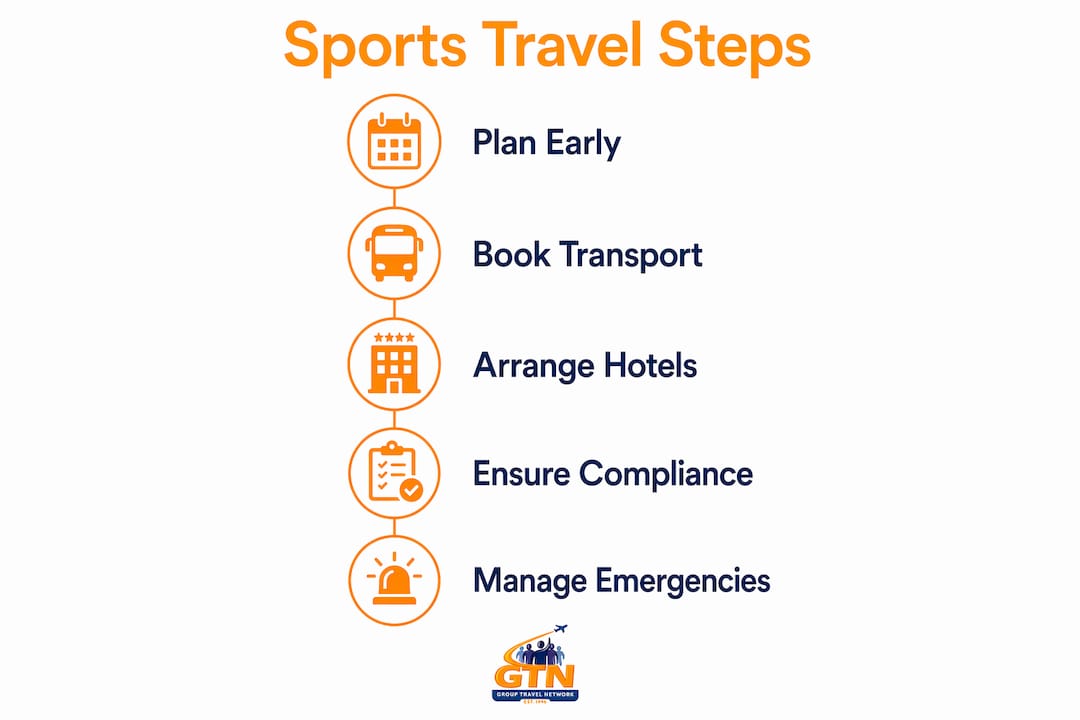
Practical sports travel management for school programs follows a clear sequence. The steps below reflect how experienced athletic directors and travel coordinators approach the process from season planning through post-trip reconciliation.
-
Start planning against the sports calendar. Map every competition, tournament, and away game at the start of the season. Early planning with flexibility is critical because governing body rules and tournament brackets shift frequently, requiring adaptable travel strategies.
-
Identify compliance requirements before booking anything. Review NCAA guidelines, state athletic association rules, or relevant governing body policies. Understand distance thresholds for charter eligibility, travel party composition limits, and reimbursement frameworks before you contact a single vendor.
-
Coordinate with suppliers for group rates. Contact hotels, bus companies, and airlines with your full season calendar. Bulk bookings across multiple trips give you negotiating leverage that single-trip bookings never will.
-
Build contingency options into every itinerary. Identify backup flights, alternative hotels, and secondary transport vendors for every major trip. Successful sports travel management combines proactive planning with round-the-clock operational response to unpredictable changes like weather or roster updates.
-
Manage documentation centrally. Keep permission forms, medical releases, insurance certificates, and travel authorizations in a single digital location accessible to all administrators on the trip.
-
Track budgets and approvals in real time. Use a platform or shared dashboard so that spending is visible to the athletic director and school finance office throughout the trip, not just after it ends.
-
Establish emergency protocols before departure. Every trip needs a written emergency response plan covering medical incidents, natural disasters, and travel disruptions. Assign a point person for each category and share contact lists with all staff traveling.
For safe student group travel (opens in a new tab), the emergency protocol step is non-negotiable. Schools carry legal and ethical responsibility for student welfare during athletic travel, and documented protocols protect both students and institutions.
Pro Tip: Assign a dedicated travel coordinator role for each sport, separate from the coaching staff. Coaches focus on performance. Travel coordinators focus on logistics. Mixing those responsibilities is where school group travel planning (opens in a new tab) breaks down most often.
What are the benefits of partnering with specialized sports travel services?
Managing sports travel in-house is possible for small programs with limited travel schedules. For schools running multiple teams across multiple seasons, the case for partnering with a specialized provider is strong.
The concrete benefits include:
- Negotiated group rates: Specialized agencies carry existing relationships with hotel chains, airlines, and bus companies. Those relationships produce rates and perks that individual schools cannot access through direct booking.
- Centralized booking and invoicing: One invoice per trip, one point of contact, one platform for all documentation. That consolidation alone saves dozens of administrative hours per season.
- Compliance expertise: Providers who specialize in athletic travel understand NCAA rules, state association policies, and international travel requirements. They catch compliance issues before they become eligibility problems.
- Dedicated account management: Dedicated account leads and white-glove service improve responsiveness and problem-solving during rapid schedule changes and complex events. That means a real person answers when a flight cancels at 11 PM before a championship game.
- Performance-focused itinerary design: Experienced providers build travel schedules around recovery and competition timing, not just cost. That directly supports athlete performance on game day.
- Travel protection and insurance: Group travel insurance options protect schools from financial exposure when trips are canceled or disrupted. For student travel safety (opens in a new tab), having the right coverage in place before departure is standard practice.
My take: what most schools get wrong about sports travel
Most school athletic programs treat travel as an administrative afterthought. The budget conversation happens, the trip gets booked, and the logistics get handed to whoever has time. That approach works until it doesn’t, and when it fails, it fails publicly and expensively.
What I’ve seen consistently is that the schools with the smoothest travel operations share one trait: they treat travel planning as part of athletic operations, not separate from it. The athletic director is involved in vendor selection. The travel coordinator attends pre-season planning meetings. The budget for travel technology is treated as an investment in team performance, not a line item to cut.
The compliance dimension is where I see the most avoidable mistakes. Athletic directors who are deeply familiar with NCAA scholarship rules (opens in a new tab) and travel eligibility requirements rarely get caught off guard by a policy violation. Those who treat compliance as someone else’s problem tend to find out about violations at the worst possible moment.
The other pattern I’d flag is underinvestment in contingency planning. Schools that build flexibility into their travel budgets and itineraries recover from disruptions in hours. Schools that don’t recover in days, sometimes at significant cost to both finances and team morale.
The practical fix is straightforward: start earlier, document everything, and build relationships with vendors and providers before you need them urgently. That is not complicated advice. It is just rarely followed with the consistency it requires.
— Donovan
How Grouptravelnetwork helps schools manage team travel
Grouptravelnetwork specializes in organizing group travel for school athletic programs, bands, and student organizations, with dedicated trip coordinators who handle logistics from first booking to final return.

For athletic directors and school administrators who want to move from reactive travel management to a planned, compliant, and performance-focused approach, Grouptravelnetwork provides customized itineraries, vendor partnerships, flexible payment plans, and travel protection options built specifically for educational groups. Their team travel management services (opens in a new tab) cover everything from room block coordination and ground transport sequencing to documentation support and 24/7 coordinator access. If your program is managing multiple teams across a full season, their group travel planning tools (opens in a new tab) give you the structure to do it without the chaos.
FAQ
What is sports travel management in simple terms?
Sports travel management is the specialized planning and coordination of all travel logistics for sports teams, including flights, hotels, ground transport, documentation, and compliance with governing body rules. It differs from standard travel planning because it prioritizes performance-sensitive scheduling and regulatory compliance.
Why do schools need specialized sports travel management?
School athletic programs face compliance requirements from bodies like the NCAA and state athletic associations, manage large groups with equipment, and operate on performance-sensitive timelines that standard travel booking cannot accommodate. Specialized management reduces compliance risk and administrative burden while improving team readiness.
What does sports travel management entail for tournament travel?
Tournament travel management requires early planning, flexible itineraries, and compliance with governing body rules on charter eligibility and travel party composition. NCAA tournament planning highlights the need for adaptive strategies because seeding and transport eligibility rules shift the logistics requirements significantly.
What digital tools help with sports travel logistics?
SaaS platforms designed for sports travel provide room block management, real-time dashboards, policy enforcement, and consolidated reporting. Digital reporting and manifests are particularly valuable for large school districts managing multiple teams traveling simultaneously.
How early should schools start planning sports travel?
Planning should begin at the start of the season, mapped against the full competition calendar. Early planning allows bulk vendor negotiations, compliance review, and contingency building before tournament brackets and governing body rules create last-minute pressure.
Recommended
- Travel Management For Teams: How Schools Plan Smart Group Trips • Group Travel Network (opens in a new tab)
- Top Student Travel Trends In 2026 For School Groups (opens in a new tab)
- Group Travel Services: 8 Ways To Simplify Planning In 2025 (opens in a new tab)
- News • Group Travel Network (opens in a new tab)