


A good parent trip meeting agenda runs about 60 minutes and moves in this order: welcome and purpose, itinerary, costs and deadlines, transportation and lodging, supervision and safety, forms, behavior expectations, packing, communication during the trip, then open questions. Families leave knowing what to sign, what to pay, by when, and whom to call. Below is the full running order with timings, what to hand out, how to invite families and how to document the meeting so nothing is lost afterward.
This guide is written for the person standing at the front of the room: a school administrator, band director, sports team manager, trip coordinator or youth nonprofit leader.
TL;DR
- Hold the meeting after the destination, dates and costs are settled, so you can answer questions with real numbers. The BSA’s own parent meeting guide advises waiting until detailed information is available (opens in a new tab).
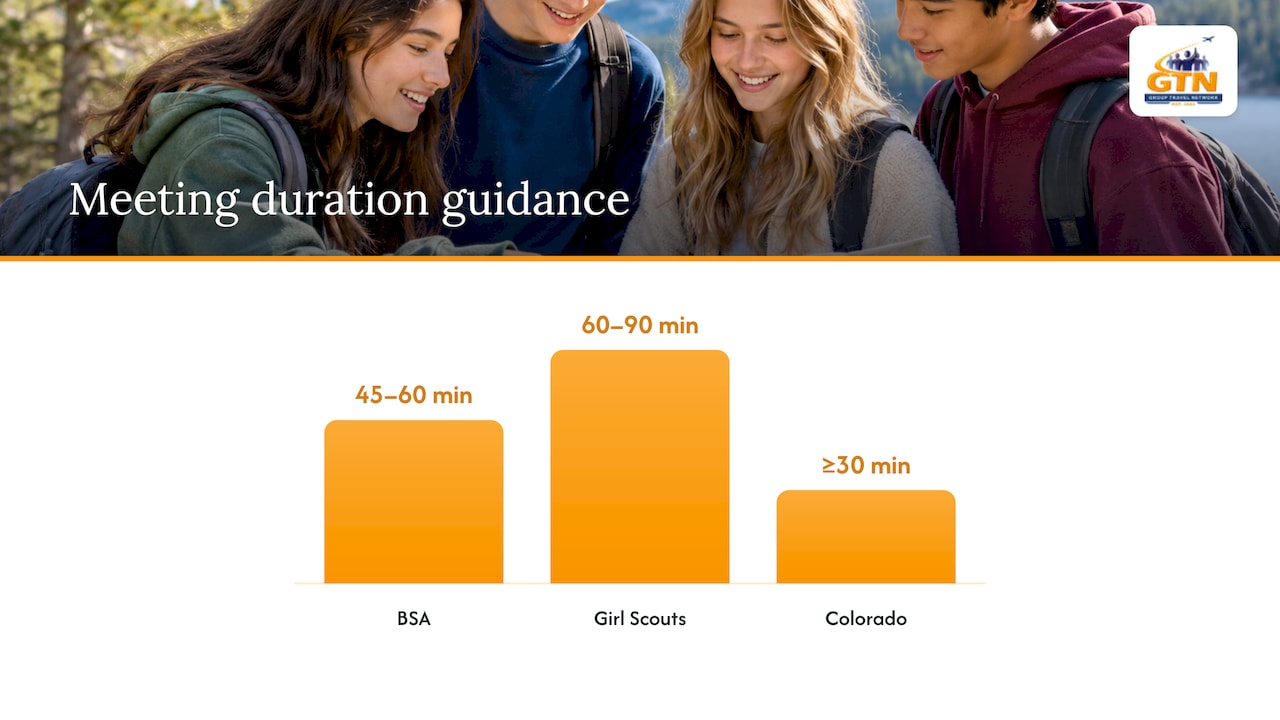
- Plan 45 to 90 minutes. Put the itinerary and money first, forms and deadlines next, and leave at least 15 minutes for questions.
- Every notice, handout and slide should carry a date, an action and a contact person.
- Collect signed forms and deposits at the door where you can, and send a written summary within a few days.
- Assign an owner and a due date to every open item so the follow-up does not depend on memory.
Table of Contents
- What the meeting has to accomplish
- Before the meeting: timing, format and invitations
- The 60-minute agenda
- What to hand out
- After the meeting: minutes and follow-up
- Our perspective
- Plan the trip your parents will say yes to
- FAQ
- Sources
What the meeting has to accomplish
A parent meeting has three jobs. First, it gives families the facts they need to say yes: where the group is going, what it costs and what is included. Second, it gets paperwork and money moving on a schedule. Third, it builds trust, because parents hand over their children to people they may have met only briefly.
Girl Scouts of Colorado’s guide to these meetings says that keeping parents well informed and involved in trip planning builds support and makes expectations clear (opens in a new tab). It also suggests letting the young people themselves explain why they chose the trip and what they hope to learn. For a band or a senior class, a student speaking for two minutes is often more persuasive than any slide.
Who should attend
Invite parents or guardians of every traveling student, plus the adults who will travel with the group. Include the trip leader, the lead chaperones, a school administrator who can speak to policy, and whoever handles payments and forms. If your travel planner assigns a trip coordinator, that person can join to answer logistics questions.
Before the meeting: timing, format and invitations
Pick the right moment
Hold the meeting once the trip is chosen and the itinerary has real dates. The BSA guidance recommends about 45 to 60 minutes and a dedicated session rather than a slot inside a regular unit meeting (opens in a new tab), with required forms on hand. Girl Scouts of Northern California suggests one hour to 90 minutes, after work hours or on a weekend, in a familiar place such as a school or community center (opens in a new tab). For a long trip, the Colorado guide says a short meeting at the end of a regular meeting can work with at least 30 minutes set aside (opens in a new tab), but an overnight or international trip deserves its own evening.
If your district requires a meeting, check the rule. Puyallup School District in Washington, for example, lists an informational meeting for parents on its field trip checklist for overnight or international travel (opens in a new tab).
Write an invitation that gets answered
Send it by email, text and your school’s usual channel, and put the registration link and forms in the same message. The Girl Scouts of Northern California guide recommends invitations by email, text or social media with registration links and key forms included (opens in a new tab). Agenda1’s guide to school communication adds a rule worth copying: send nothing without a date, an expected action and a contact for questions (opens in a new tab). A complete notice states:
- Date, time and location, or the video link if you offer one
- The agenda in three or four lines
- Whether families need to confirm attendance, and by when
- One name, email and phone number for questions
- What to bring, such as a checkbook, a calendar and any questions already in mind
Families who cannot attend are the ones most likely to miss a deadline. Record the meeting if your school policy allows it, or send the handout and slides the same evening.
If you want to show hesitant families what a day of group travel feels like, local ideas for fun family activities (opens in a new tab) can help you build excitement and student participation before the meeting.
The 60-minute agenda
The sequence below combines the checklists from the Girl Scouts of Colorado, the BSA and Girl Scouts of Ohio, which list itinerary, transportation, permission forms, behavior standards, packing, insurance, emergency procedures, payment dates and passports or visas (opens in a new tab) among the topics. Adjust the timings to your group.
| Minutes | Topic | What to cover |
|---|---|---|
| 0 to 5 | Welcome and purpose | Introduce leaders, state the goal of the trip, explain what families will leave with |
| 5 to 15 | Itinerary | Dates, destination, day-by-day plan, performances or learning objectives |
| 15 to 25 | Costs and deadlines | Total price, what is included, payment schedule, fundraising, personal spending money |
| 25 to 32 | Transportation and lodging | How the group travels, who drives or flies, hotel rooming plan |
| 32 to 40 | Supervision and safety | Chaperone ratio, emergency procedures, school contacts |
| 40 to 45 | Forms and health information | Permission, medical, consent, deadlines |
| 45 to 48 | Behavior and packing | Conduct standards, dress, luggage limits |
| 48 to 50 | Communication on the trip | How and when families will hear from you |
| 50 to 60 | Questions and form collection | Open floor, sign-ups, hand-in |
1. Welcome and purpose (5 minutes)
Thank families for coming, introduce everyone who will travel, and say in one sentence why the trip matters: a festival performance, a historical program, a senior celebration. Invite one or two students to speak. Tell parents how the evening is organized and that questions are welcome at the end, which keeps the middle of the meeting from stalling.
2. Itinerary (10 minutes)
Walk through the trip day by day. Parents want departure and return times, where students sleep, what they do each day and which activities carry physical risk. The BSA’s agenda asks organizers to cover date, place, detailed itinerary, age and physical requirements, side trips and minimum and maximum participants (opens in a new tab). Put the full itinerary in a handout so you can summarize aloud rather than read.
For a performance group, add rehearsal and performance times, attire and equipment handling. For an international trip, explain passport timing and entry requirements now, because they take the longest to fix.
3. Costs and deadlines (10 minutes)
This is the section parents remember. State the total per student, what the price includes and excludes, and the payment dates. Show a simple schedule on one slide: deposit, installments and final payment, each with a calendar date. Cover fundraising, scholarships or payment-plan options if you offer them, and personal spending money.
One principle belongs in the room: one district’s field trip manual states that students should never be charged more than the actual cost of the trip (opens in a new tab). Check your own district’s policy on fees and refunds before you present numbers.
For templates, see our guides on a school trip payment policy (opens in a new tab) and a school trip deposit schedule (opens in a new tab). If families ask how to raise money together, what student trip fundraising looks like (opens in a new tab) gives you a starting point, and how to budget for school trips (opens in a new tab) helps you build the figure you present.
4. Transportation and lodging (7 minutes)
Explain how the group gets there and moves around: bus, charter coach, flight, rail. Name the pickup point, the luggage limits and who counts heads at every stop. For lodging, describe how rooms are assigned, who stays on which floor, and how adult chaperones are positioned. Girl Scouts of Ohio’s travel guide includes hotel safety rules (opens in a new tab) you can adapt for your own room policy.
5. Supervision and safety (8 minutes)
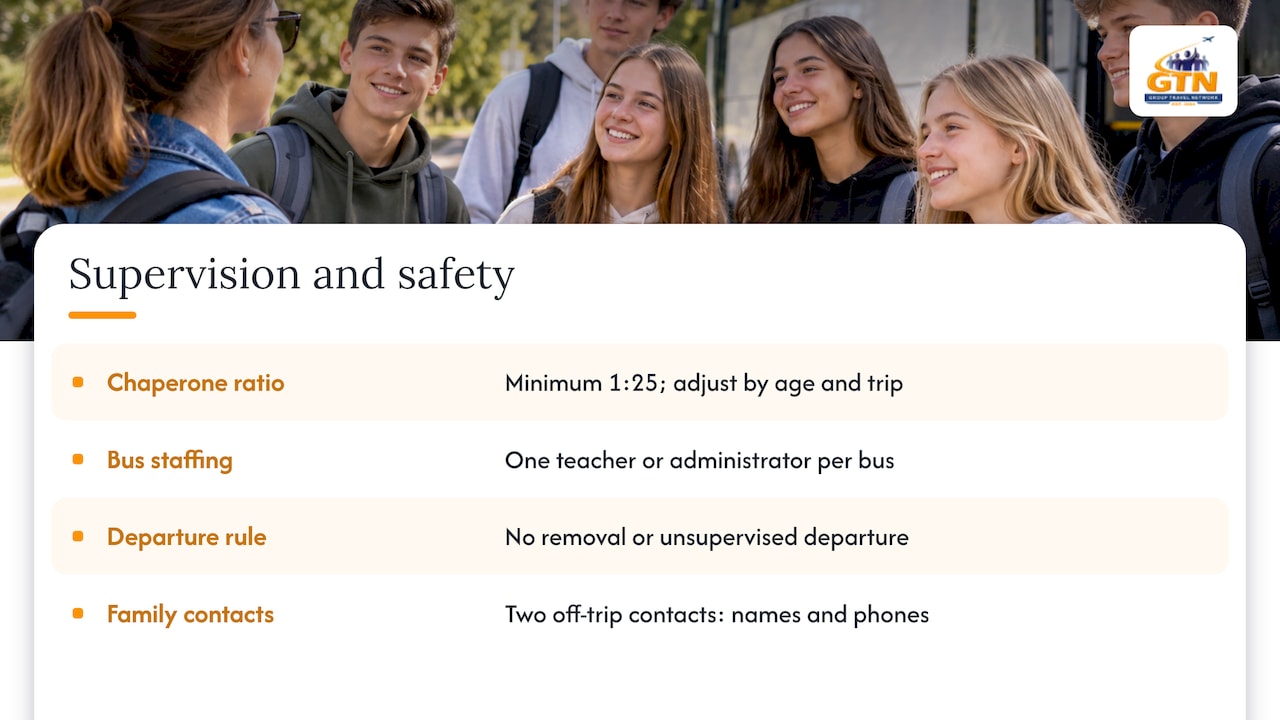
Parents ask who is watching their child. Give a direct answer. One US district’s 2025 to 2026 manual recommends a chaperone-to-student ratio of no less than 1:25, adjusted for age and trip type, with at least one teacher or administrator per bus (opens in a new tab). The same manual says no chaperone or volunteer may remove a student from the trip or let them leave unsupervised. Overnight trips usually need tighter ratios than a day trip, so state the ratio your district or organization actually requires.
Then cover the emergency plan: who is the on-site lead, how families are notified, and where medical care is. St. Lucie County Public Schools in Florida requires that parents receive the names and phone numbers of two school contacts who are not on the trip (opens in a new tab). Giving families a home-base contact is a good practice wherever you are.
6. Forms and health information (5 minutes)
Name every form, its purpose and its due date. Typical sets include permission and informed consent, emergency treatment, medical conditions and, for international trips, a minor travel consent. Puyallup’s checklist describes a parent packet with a letter home, itinerary, consent and emergency treatment forms, and a list of what students may and may not bring (opens in a new tab). For adventure activities with a risk of serious injury, St. Lucie’s guidelines call for a full waiver in addition to approved permission forms (opens in a new tab). Ask your administration or counsel to approve the exact waiver language.
Detailed field guides are here: student medical forms for school trips (opens in a new tab) and the eight fields every minor travel consent form needs (opens in a new tab).
7. Behavior and packing (3 minutes)
State conduct and dress standards, curfew, phone rules and the consequences, including whether a parent must pick up a student sent home. Then give the packing list and luggage limits. Keep this brief and refer to the printed copy.
8. Communication during the trip (2 minutes)
Tell families how they will hear from you: a daily text, a shared album, a call line. Say when they should not expect updates, such as during a performance or overnight travel, so silence does not cause alarm.
9. Questions and collection (10 minutes)
Leave real time here. The Girl Scouts of Northern California guide closes the meeting by collecting forms and leaving time for questions, concerns and getting to know people (opens in a new tab). Set a table at the door with the forms and a sign-in sheet. Note every question you cannot answer on the spot, with the name of the person who will reply.
What to hand out
Give each family one packet so nothing relies on memory:
- A one-page summary: dates, destination, price, and the five key deadlines
- The day-by-day itinerary
- Every form to sign, with due dates highlighted
- Packing list and luggage limits
- Behavior and dress standards
- Emergency and home-base contact numbers
The Girl Scouts of Greater Washington and Maryland travel packet makes the same point: a structured checklist covering itinerary, expenses, transportation, forms, behavior, emergency procedures and due dates (opens in a new tab) keeps the meeting on track.
After the meeting: minutes and follow-up
Send a summary within two or three days. Treat it as a tool for action, not a transcript. Flamingo Education Press suggests a summary with date, purpose, attendees, concerns, information reviewed, input, decisions, actions with owners and dates, and unresolved items (opens in a new tab). For a parent trip meeting you can compress that to:
- Date, attendees and purpose
- Decisions made (price, schedule, ratio, rules)
- Questions raised and the answers given
- Open items, each with an owner and a due date
- Next deadlines and the contact person
The Parent Center Hub’s guide to running meetings recommends appointing a minutes-taker and recording who raised each issue, who is responsible for actions and whether items remain outstanding (opens in a new tab). Ask a co-leader to take notes so you can focus on the room.
Keep a copy of the sign-in sheet, handouts and summary with your trip file. Retention rules vary; Puyallup’s checklist, for one, refers to a six-year district retention schedule (opens in a new tab), so ask your records office how long to keep yours.
Our perspective
Most parent meetings go wrong in the same place: the leader tries to answer money, safety and paperwork questions from memory. Parents hear “I’ll find out” three times and start to doubt the trip.
We build group trips for schools, bands, teams and youth organizations, and our approach is to give the leader a plan that is already complete before the meeting starts: a custom itinerary, dedicated trip coordinators, online registration, flexible payment plans and travel protection options. When those pieces exist, the agenda above is easy to deliver, because every slide has a real answer behind it.
Our advice is to treat the parent meeting as the start of the trip, not an obstacle before it. Families who see a clear schedule, a clear payment calendar and a named person to call tend to register with confidence. That is what stress-free student travel means to us.
Donovan
Plan the trip your parents will say yes to
A parent meeting is only as strong as the plan behind it. Group Travel Network builds custom itineraries for student, school and youth groups, with a dedicated trip coordinator, online registration, flexible payment plans and travel protection options. Whether you are taking a band to perform, a class on an educational program or seniors on a celebration trip, we can help you arrive at the meeting with answers.

Explore Youth Travel (opens in a new tab), Performance Tours (opens in a new tab) or Educational Endeavors (opens in a new tab), or start from our group trip planning guide for schools (opens in a new tab). For a broader checklist, read 10 strategies for stress-free school trips (opens in a new tab).
FAQ
How long should a parent trip meeting be?
Plan 45 to 60 minutes for a standard overnight trip and up to 90 minutes for an international one. The BSA recommends about 45 to 60 minutes, and Girl Scouts of Northern California suggests one hour to 90 minutes. Reserve at least the last 10 to 15 minutes for questions.
When should we hold it?
Hold it after the destination, dates and costs are confirmed but early enough that deposits and forms are not rushed. Choose an evening or a weekend so working parents can attend. Send the invitation with the forms attached so families can start reading before they arrive.
What should we do about parents who cannot attend?
Send the handout, slides and summary the same day, and name one person they can call. You can also offer a short video call. Ask them to confirm they received the materials and to meet the same form and payment deadlines.
What should a meeting notice include?
Include the date, time, location or video format, the agenda, whether families must confirm attendance, and a contact for questions. Agenda1’s guidance says any deadline should be clearly visible and that no message should go out without a date, an action and a contact.
Sources
- Girl Scouts of Colorado: Planning and Holding a Parent Meeting (opens in a new tab)
- BSA TAP Parents Meeting Agenda (opens in a new tab)
- Girl Scouts of Ohio: Troop Travel Guide (opens in a new tab)
- Girl Scouts of Greater Washington and Maryland: Travel Packet (opens in a new tab)
- Girl Scouts of Northern California: Planning the Family Meeting (opens in a new tab)
- Puyallup School District: Field Trip Checklist (opens in a new tab)
- St. Lucie County Public Schools: Field Trips and Extracurricular Activities Guidelines (opens in a new tab)
- Field Trip Manual 2025-2026 (opens in a new tab)
- Agenda1: Guide to communicating with parents (opens in a new tab)
- Parent Center Hub: Strategies for Running an Effective Meeting (opens in a new tab)
- Flamingo Education Press: How to Document Parent Meetings (opens in a new tab)
- Fun Family Activities Near Me: 10 Best Local Picks (opens in a new tab)
Recommended
- Parent Trip Communication: Your 2026 Guide For Schools (opens in a new tab)
- Student Pre-Trip Orientation Guide For Schools 2026 (opens in a new tab)
- Overnight Field Trip Policy: What To Include In 2026 (opens in a new tab)
- School Trip Payment Policy: 2026 Templates And Timelines (opens in a new tab)