

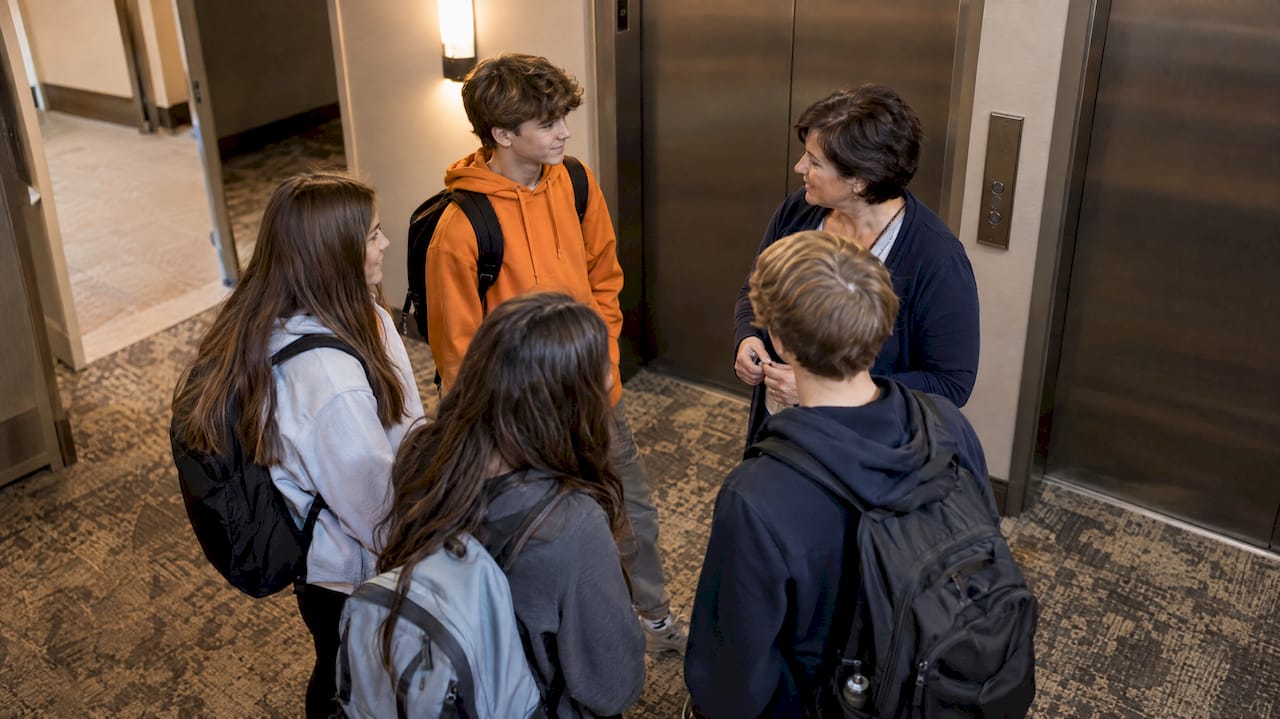
The single most important move you can make is this: book a hotel with 24/7 staffed access control, assign trained adult supervisors to every floor, and run a short arrival safety drill before anyone unpacks. Teach three rules immediately: never use elevators in a fire, place a wet towel under the door if trapped, and call the front desk the moment anything feels wrong. The checklist below turns that verdict into a repeatable process.
TL;DR:
- Verify student IDs against the rooming list before issuing keys, and keep printed and electronic copies with the lead chaperone and front desk.
- If a room has a faulty lock, jammed window, or dead smoke detector, move students and obtain written confirmation of the reassignment.
- Match adult coverage to group size, age, and trip risk rather than a fixed ratio; schedule overnight shifts and record each room check.
- For lost key cards, verify the student’s identity, deactivate the old card immediately, and check that replacements cannot open neighboring rooms.
Table of Contents
- Practical hotel safety checklist organizers can follow for group arrivals and overnight stays
- Arrival and room-safety checks: step-by-step arrival workflow
- Overnight supervision: roles, staffing models, and operational best practices
- Emergency procedures and fire safety: what to rehearse and the exact instructions to give students
- Selecting hotels and negotiating group terms that affect safety
- How Group Travel Network operationalizes hotel safety for organizers
- Handling lost or misplaced room keys and access cards
- Screening and training criteria for chaperones and overnight monitors
- Protocols for managing visitors and outsiders in hotel areas
- Strategies for addressing health emergencies (first aid availability, nearby medical facilities)
- Transportation safety between hotel and event/venue locations
- Organizer perspective: priority checklist and realistic trade-offs
- How Group Travel Network can support your safe hotel stay
- FAQ
- Sources
Practical hotel safety checklist organizers can follow for group arrivals and overnight stays
A clear sequence keeps safety from becoming an afterthought once buses start unloading and room keys get handed out.
- Confirm the hotel has a 24-hour staffed front desk, secure luggage storage, and a rooming list format the hotel can match against reservations.
- Verify student IDs against your rooming list at check-in and confirm room assignments with the front desk before handing out keys.
- Walk sample rooms to check locks, windows, connecting doors, and smoke detectors, reporting any defects right away.
- Set overnight rules with students before lights-out.
- Store documentation where chaperones can reach it fast.
Overnight rules worth repeating out loud:
- No propping doors open for any reason, even briefly.
- Use the buddy system for hallway movement after curfew.
- Save the lead chaperone’s and front desk’s numbers in every student’s phone.
Keep a printed and electronic rooming list with emergency contacts, one copy with the lead chaperone and one at the front desk, so responders can get an accurate headcount fast if needed.
Pro Tip: Print the rooming list on waterproof paper or laminate it. It survives rain, spilled drinks, and the chaos of a 6 a.m. lobby call far better than a phone screen someone forgot to charge.
Arrival and room-safety checks: step-by-step arrival workflow
Run the safety pass while logistics are still fresh, before students scatter to unpack or explore.
- The lead chaperone meets the hotel’s group contact at the desk to confirm staffing, access control, and the final rooming list.
- Floor chaperones walk two or three sample rooms per floor, checking door and window locks, connecting-room latches, and smoke detector function. University hotel-safety guidance (opens in a new tab) instructs travelers to check locks immediately on arrival and report any that fail to the front desk.
- Each floor chaperone identifies the nearest two exits and the ground-floor meeting point, then shares that with their students before bags are unpacked.
If a room fails a check, move students to another room and get the swap confirmed in writing with the front desk. A room with a broken lock, a jammed window, or a dead smoke detector should not be occupied until the hotel fixes it or reassigns the group.
Pro Tip: Assign one chaperone per floor as the “room captain” responsible only for safety checks and key issues that night. One clear owner prevents the “I thought someone else handled it” gap.
Overnight supervision: roles, staffing models, and operational best practices
Deciding who watches the halls at 2 a.m. matters as much as which hotel you book.
- The lead chaperone owns overall coordination, communication with hotel staff, and incident escalation.
- Floor chaperones handle hourly or scheduled room checks, curfew enforcement, and immediate response on their assigned floor.
- Hired night monitors, when budget allows, add dedicated coverage for larger groups or trips with higher-risk itineraries, freeing chaperones to rest in shifts.
- Hotel security or front-desk staff support access control, visitor screening, and corridor monitoring during the overnight window.
Coverage should scale with group size and the specific risks of the trip: a 40-student band tour staying one night needs less structure than a week-long international program with younger students. For a deeper breakdown of supervision ratios, see our guide on the role of travel chaperones (opens in a new tab).
- Set a shift schedule so no chaperone covers more than a few consecutive hours overnight.
- Use a simple log template: time, room checked, chaperone initials, and any issues noted.
- Keep one shared communication channel (group text or radio) for real-time updates between floors.
- Coordinate directly with hotel security on visitor control and how late arrivals will be handled after the desk is quiet.
Emergency procedures and fire safety: what to rehearse and the exact instructions to give students
Teach these rules the moment students arrive, not after an alarm sounds.
- Never use elevators during a fire. Know where the stairwells are on your floor before unpacking.
- If you’re trapped and can’t exit, place a wet towel at the bottom of the door and signal for help from the window, then call the front desk or emergency services. Tufts University’s emergency guidance (opens in a new tab) outlines this exact sequence for fire emergencies.
- Walk the exit route from your room to the ground-floor meeting point as a group within the first hour of arrival.
- Report anything unusual (a left bag, a stranger near student rooms) to hotel staff immediately rather than investigating it yourselves.
A short, practiced walk-through of exit routes on arrival day gives chaperones a quick read on which students need extra supervision and cuts confusion if a real evacuation happens.
Have your rooming list, a current headcount, and any known medical needs ready to hand to hotel staff or first responders the moment they ask. For suspicious items or a bomb threat, keep students away from the object, notify hotel security and local police right away, and follow their instructions rather than trying to resolve it internally. Lodging security guidance from CISA’s lodging annex (opens in a new tab) recommends training staff to recognize unattended items and tightening access control during elevated threat periods, which is why looping in hotel security fast matters more than handling it alone.
Selecting hotels and negotiating group terms that affect safety
The booking stage is where most safety gaps get created or closed, long before any student checks in.
- Confirm a 24-hour staffed front desk, visible CCTV coverage, keyed or fob-based access to guest floors, secure luggage storage, and well-lit hallways and parking areas. Princeton’s accommodation guidance (opens in a new tab) recommends checking for exactly these features before booking group lodging.
- Request rooms on mid-level floors when the property allows it. The same guidance notes mid-floors balance accessibility for emergency responders against exposure to street-level risks.
- Ask for a written incident-reporting process, the hotel’s overnight staffing level, and a named emergency contact person before you sign the contract.
- Request photos or floor plans of the block rooms, or confirm them on a site visit, and get every safety commitment in writing rather than a verbal assurance.
Our roundup of student-friendly hotels (opens in a new tab) walks through properties vetted for exactly these features if you want a starting shortlist rather than building one from scratch.
How Group Travel Network operationalizes hotel safety for organizers
We assign a dedicated trip coordinator to every group, and that person vets hotel partners against the same checklist above before a contract is signed: 24-hour staffing, secure storage, and sensible room adjacency for your group’s age range. That coordinator also manages rooming logistics and stays reachable for on-trip support if an issue comes up overnight. We built our safe travel planning resources (opens in a new tab) around the same arrival and supervision steps outlined here, so organizers aren’t reinventing the process trip after trip.
Handling lost or misplaced room keys and access cards
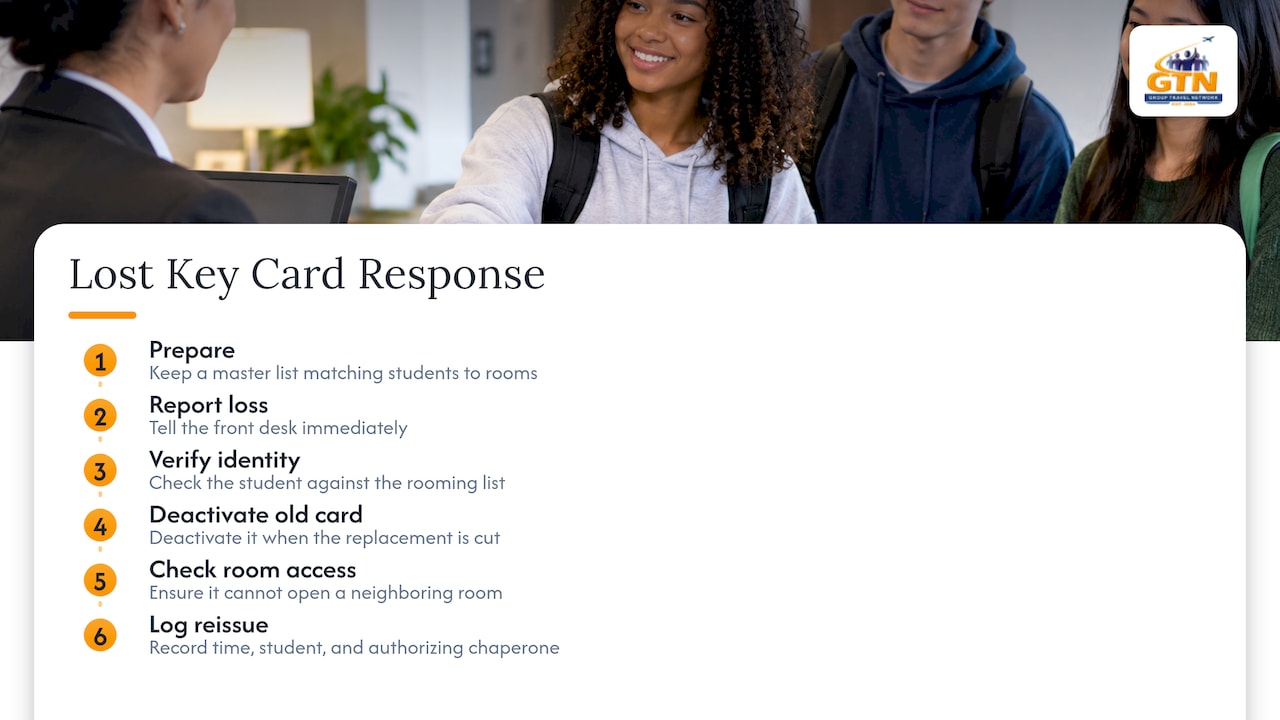
A lost key card is routine, but how you handle it affects whether it stays routine. Have one chaperone per floor keep a master list matching students to room numbers so the front desk can verify identity fast when a card goes missing. Students should report a lost key immediately rather than waiting until bedtime, since an unreported missing card leaves a room exposed to anyone who finds it.
At the desk, confirm the student’s identity against your rooming list before a replacement is issued, and ask the hotel to deactivate the old card the moment the new one is cut. For groups with interconnecting rooms, check that reissued cards don’t accidentally open a neighboring room that wasn’t part of the original booking. Keep a small float of spare blank cards or a backup key policy agreed with the hotel in advance so a 1 a.m. lockout doesn’t turn into a long wait in the hallway. Logging every reissue (time, student, chaperone who authorized it) gives you a paper trail if a card later turns up somewhere it shouldn’t.
Students should never lend their key to another student, even a roommate, and should call the front desk to confirm identity before opening the door to anyone claiming to need entry.
Screening and training criteria for chaperones and overnight monitors
Supervision only works if the people doing it are vetted and briefed before the trip starts, not during it. Every chaperone and any hired night monitor should pass a background check well ahead of departure. Our guide on chaperone background checks (opens in a new tab) covers timing and compliance requirements schools typically need to meet.
Beyond the background check, brief chaperones on the specific hotel’s layout, the overnight schedule, and their individual floor assignments before arrival day. Training should cover the fire and evacuation rules above, the room-check process, how to log incidents, and the escalation chain if something requires calling hotel security or a trip leader. Hired night monitors should receive the same briefing as chaperones, plus clear instructions on where their authority starts and stops relative to hotel security staff.
Match the number of trained adults to group size and age: younger students and larger groups generally need a tighter ratio and more floor coverage than an older, smaller group on a short trip. Build in a short pre-trip session where chaperones practice the room-check walk-through and review the incident log template, so the first time they use it isn’t during an actual overnight shift.
Protocols for managing visitors and outsiders in hotel areas
Guest floors should stay restricted to the group and hotel staff, and that boundary needs to be explicit from the first night. Brief students that they should never open their door to anyone they haven’t verified by calling the front desk first, including someone claiming to be hotel staff or a parent.
Ask the hotel in advance how they handle non-guests attempting to access guest floors, including whether elevators or stairwells require a key card and whether front-desk staff challenge unfamiliar adults in the lobby. For groups with a public-facing event, like a performance or competition, confirm with hotel security how they’ll manage spectators, media, or family members who might show up at the hotel itself rather than just the venue.
Set a clear rule that no outside visitors, including other students’ family members, enter guest rooms, and designate the lobby or a specified common area for any legitimate visits. Floor chaperones should treat an unfamiliar adult on a guest floor as worth a direct, polite question, and loop in hotel security immediately if the answer doesn’t check out.
Strategies for addressing health emergencies (first aid availability, nearby medical facilities)
Know your medical resources before you need them, not after. Confirm during booking whether the hotel has a basic first aid kit at the front desk and ask what their protocol is for guest medical issues overnight.
Identify the nearest urgent care clinic and hospital emergency room before departure, and share that information with every chaperone, not just the trip lead. At least one chaperone per trip should carry a basic first aid kit and know which students have relevant allergies, medications, or conditions, pulled from forms collected before travel.
For anything beyond minor scrapes or a headache, call 911 rather than attempting to manage it internally, and have the rooming list and any known medical details ready to hand to responders. Keep a copy of parental consent and emergency contact forms with the lead chaperone at all times during the trip, not just at the hotel, since medical situations can happen on buses or at venues too.
Transportation safety between hotel and event/venue locations
The stretch between hotel and venue is often less supervised than either endpoint, which makes it worth planning as carefully as the overnight stay. Use a single, confirmed roster for every departure and return, with a chaperone physically counting heads on and off the bus rather than relying on a verbal count.
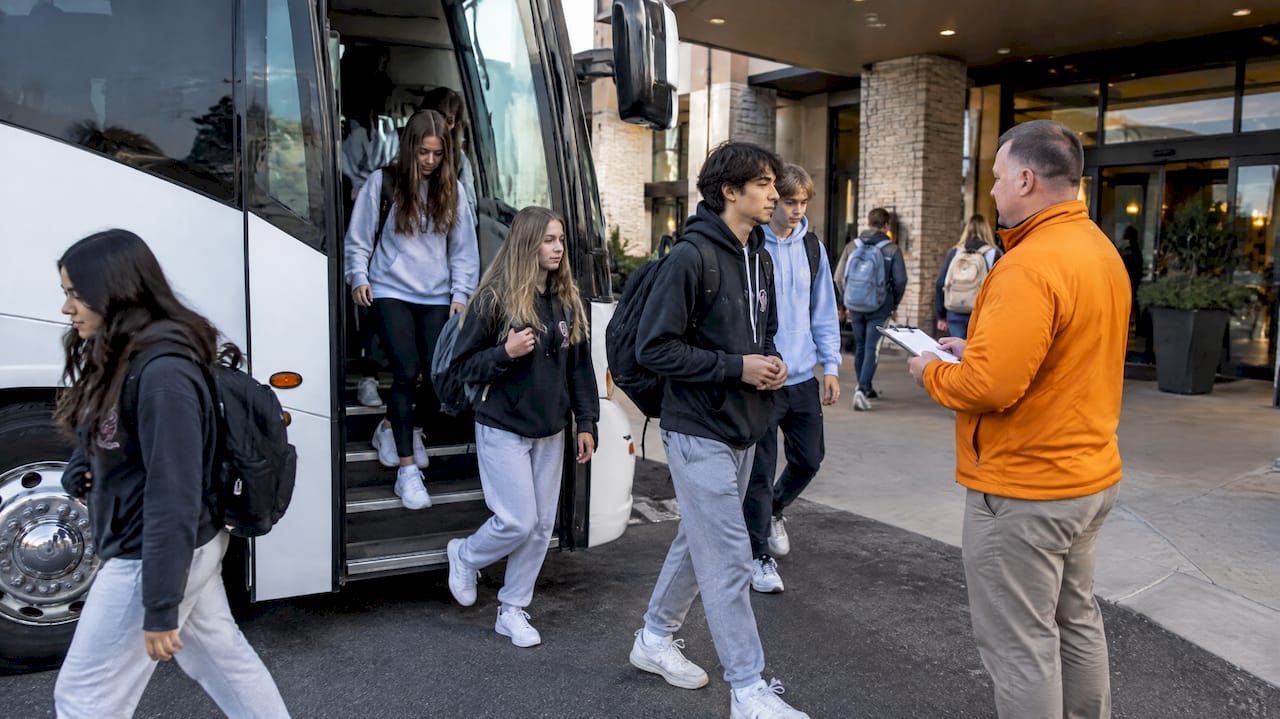
Share pickup and drop-off times with the full group in writing, including a buffer for delays, and designate one chaperone as the point of contact for any student who gets separated. If the group splits across multiple vehicles, assign a chaperone to each vehicle and confirm everyone knows which bus or van they’re on before boarding.
At night, prefer well-lit, direct routes and confirm your transportation provider’s driver is the one you booked, not an unannounced substitute, by checking ID or confirmation details before departure. Build a small cushion into the schedule so a late bus doesn’t turn into students waiting unsupervised outside the hotel or venue.
Organizer perspective: priority checklist and realistic trade-offs
Most hotel safety failures aren’t dramatic. They’re a propped door, a chaperone who didn’t know the stairwell location, or a key reissued without checking ID. The fix isn’t more paperwork, it’s three things confirmed before anyone leaves the lobby on arrival day: staff coverage assigned by floor, the hotel’s access control and locks verified in person, and a five-minute walk of the exit route with students.
Late arrivals and room mix-ups will happen regardless of how well you plan. Keep a short buffer in your schedule and a backup room list so a swap takes minutes, not an hour of lobby standing.
— Donovan
How Group Travel Network can support your safe hotel stay
Planning every hotel safety detail on top of buses, meals, and a packed itinerary is a lot for one coordinator to carry alone. We pair every group with a dedicated trip coordinator who vets hotel partners for 24-hour staffing and secure access, builds the rooming logistics around supervision plans, and stays available for support during the trip.

A safety-focused quote covers hotel vetting, room-block arrangements, and travel protection options tailored to group size and itinerary.
- Dedicated trip coordinators who vet hotel partners before booking.
- Rooming logistics matched to supervision plans and group size.
- On-trip support available if needed.
- Travel protection options for added peace of mind.
If budget planning for added security measures is part of your decision, Vala’s group trip budgeting checklist (opens in a new tab) is a useful companion resource for working those costs into your overall trip budget.
Request a quote through our performance tours (opens in a new tab) page or reach out directly through Group Travel Network (opens in a new tab) to start planning a trip with safety built into the itinerary from day one.
FAQ
What are the three types of hotel security?
Hotel security generally breaks down into physical measures (locks, access control, CCTV), personnel (front-desk staff, security guards, night staff), and procedural measures (incident reporting, visitor screening, emergency protocols). A well-run property combines all three rather than relying on just one.
Why should you always put a towel under your hotel door?
A wet towel placed at the bottom of a door helps block smoke from entering a room if you’re trapped during a fire and can’t safely exit. Tufts University’s fire safety guidance recommends this step alongside signaling from a window and calling the front desk or emergency services.
What are the 5 C’s of security guards?
Definitions vary by industry, but security guard training commonly emphasizes concepts like control, communication, consistency, and visible presence as core duties. There’s no single universal list, so it’s worth asking any hired security provider directly which framework they train to.
What are some ideas for school security on an overnight trip?
Strong overnight security combines verified hotel access control, trained and background-checked chaperones, a clear curfew and buddy-system policy, and a rehearsed arrival evacuation drill. Pairing those with written incident logs and a named hotel emergency contact gives organizers a repeatable process rather than relying on judgment calls in the moment.
How many chaperones should supervise students overnight in a hotel?
Coverage should scale with group size, student age, and trip risk factors rather than a fixed number, with larger or younger groups typically needing tighter floor coverage. Our chaperone guide breaks down how to think through ratios for your specific trip.
Sources
- Tufts University Emergency Management — Fire safety (opens in a new tab)
- Guide to Selecting Suitable Accommodation — Princeton Global Safety & Security (Apr 2024) (opens in a new tab)
- Security and Resiliency Guide — Lodging Annex (CISA, 2026) (opens in a new tab)
- Hotels — International Safety and Security — University of Illinois (opens in a new tab)
Recommended
- Student-Friendly Hotels: Top 10 Picks For School Groups 2026 (opens in a new tab)
- Hotel Youth Group Policies Every Organizer Must Enforce (opens in a new tab)
- U.S. Schools: Run Chaperone Checks Weeks Before Trips And Meet FCRA (opens in a new tab)
- The Role Of Travel Chaperones: 2026 Guide For Schools (opens in a new tab)