

August 10, 2026
Student-Friendly Hotels: Top 10 Picks for School Groups 2026

For organized school groups, a student-friendly hotel means a property with confirmed group blocks, dedicated chaperone rooms, meeting or performance space, bus parking, documented group rates, and written safety policies. It does not mean a budget hostel with a student discount. Here is a six-point screen you can run on any property in under five minutes:
- Group block confirmed in writing with a cut-off date and attrition clause
- Comp chaperone rooms at a stated ratio (typically one complimentary room per about twenty paid rooms)
- Meeting or performance space with dimensions, AV specs, and access hours confirmed
- Bus parking on-site or within walking distance, with overnight permission in writing
- Group rate and deposit schedule documented before any verbal commitment
- Safety and fire-code compliance statement available from the property
Institutional compliance is not optional. Overnight student trips frequently trigger Clery Act reporting obligations, and your travel or risk office needs to sign off before you finalize any hotel arrangement.
Key Takeaways
Student-group hotels that deliver on group blocks, comp chaperone rooms, bus parking, performance space, and written safety policies reduce both per-student cost and institutional risk.
| Point | Details |
|---|---|
| Six-point property screen | Confirm group block, comp rooms, meeting space, bus parking, group rate, and safety compliance before any verbal commitment. |
| Start outreach 120 days out | Send RFPs to 3–5 properties at 120–90 days; sign contracts by 75–60 days to protect block availability. |
| Clery and travel registration | Multi-night stays and university-paid trips often trigger Clery reporting; submit participant lists and lodging details to your risk office at least five business days before travel. |
| Negotiate non-rate items | Comp breakfast, bus parking, and chaperone rooms reduce net per-student cost more than a small rate cut. |
| Grouptravelnetwork | Handles RFP sourcing, contract negotiation, vendor paperwork, and performance logistics for school groups. |
Table of Contents
- What makes a hotel truly student-group-friendly?
- How to book a student group hotel: timeline and steps
- Institutional compliance: Clery, travel registration, and liability
- Rooming assignments, occupancy rules, and chaperone placement
- What safety checks to run before and during the stay
- Bus parking, performance space, and equipment logistics
- Questions to ask hotels and contract clauses to request
- How group hotel pricing works and how to protect your budget
- Staying in sync with hotel staff during the trip
- Supervision and curfew policies for student groups
- Cancellation and refund policies for student groups
- Wi-Fi, A/V, and connectivity for student group activities
- Grouptravelnetwork handles the hotel search so you can focus on the trip
- What experienced trip coordinators know that first-timers learn the hard way
- Sources
- FAQ
What makes a hotel truly student-group-friendly?
Beyond the six-point screen above, a property earns the label when it can deliver on all of the following without you having to fight for each one:
- Block availability with a realistic release date commonly about three months before arrival
- Comp or discounted chaperone rooms, ratio stated in the contract
- Meeting or performance space: minimum square footage, AV hookups, and secure storage
- Bus parking with load/unload zone and overnight permission
- Secure group floors or a dedicated wing with controlled corridor access
- Breakfast or catering options that can handle dietary restrictions at scale
- ADA-compliant rooms and a process for handling medical accommodation requests
- A written group policy or group-sales packet on file
A hotel that hands you a written group-sales packet is signaling something important: it has done this before. Treat the absence of one as a red flag.
One-line RFP opener you can paste into your first email:
“We are requesting a group block for [X] rooms, [dates], including [Y] double/double rooms, [Z] single chaperone rooms, bus parking for [N] coaches, and [meeting/performance space] for [headcount]; please confirm availability and send your group-rate proposal and group-policy packet.”
Hotels that push back hard on this number early rarely get more flexible at signing.
How to book a student group hotel: timeline and steps
The single biggest mistake organizers make is starting too late. For a spring performance trip, your hotel outreach should begin in September.
| Timeframe | Action |
|---|---|
| 120–90 days out | Send RFPs to 3–5 properties; request group-policy packets and W-9/vendor forms |
| 75–60 days out | Compare proposals; negotiate attrition, comp rooms, and deposit schedule; sign contract |
| 30–21 days out | Submit preliminary rooming list; confirm bus parking logistics and performance space setup |
| 7 days out | Deliver final rooming list; confirm front-desk escalation contact and quiet-hours agreement |
At contract stage, request these deliverables in writing from the hotel:
- Signed group contract with attrition percentage, cut-off date, and deposit refund terms
- W-9 or vendor packet for your accounts-payable office
- Named front-desk escalation contact with a 24/7 backup number
- Written quiet-hours agreement and curfew acknowledgment
Institutional compliance: Clery, travel registration, and liability
This is where most organizers underestimate the paperwork. Texas Tech’s OP 34.06 spells out four conditions that pull an overnight stay into Clery reporting: the university pays for the trip, there is a written agreement to stay, it is a repeated-use overnight location, or the trip runs longer than one night. If any of those apply to your group, your institution’s public safety or risk office needs to know before you sign a hotel contract.
Idaho State University’s ISUPP-2380 requires travel information be submitted to campus public safety for stays of two or more nights. Mississippi State’s Policy 91305 mandates pre-trip travel registration for any trip exceeding 25 miles, with participant names, emergency contacts, and lodging details. UT Austin’s Appendix L requires all of that plus insurance evidence, submitted at least five business days before departure.
Documents to collect and submit to your travel or risk office:
- Full participant list with emergency contacts
- Lodging confirmation with address and front-desk number
- Certificate of insurance (hotel’s general liability) and your group’s travel insurance policy
- Hotel W-9 or vendor packet
- Signed participant medical release forms
- Risk assessment and safety plan
Pro Tip: Pull your institution’s exact policy language and match your hotel contract wording to it. A gap between “university-sponsored” in your policy and “school-affiliated” in the hotel contract can create a reporting hole that surfaces only after an incident.
For a deeper look at student travel liability exposures, Grouptravelnetwork’s guide covers the insurance and indemnification questions your risk office will ask.
Rooming assignments, occupancy rules, and chaperone placement
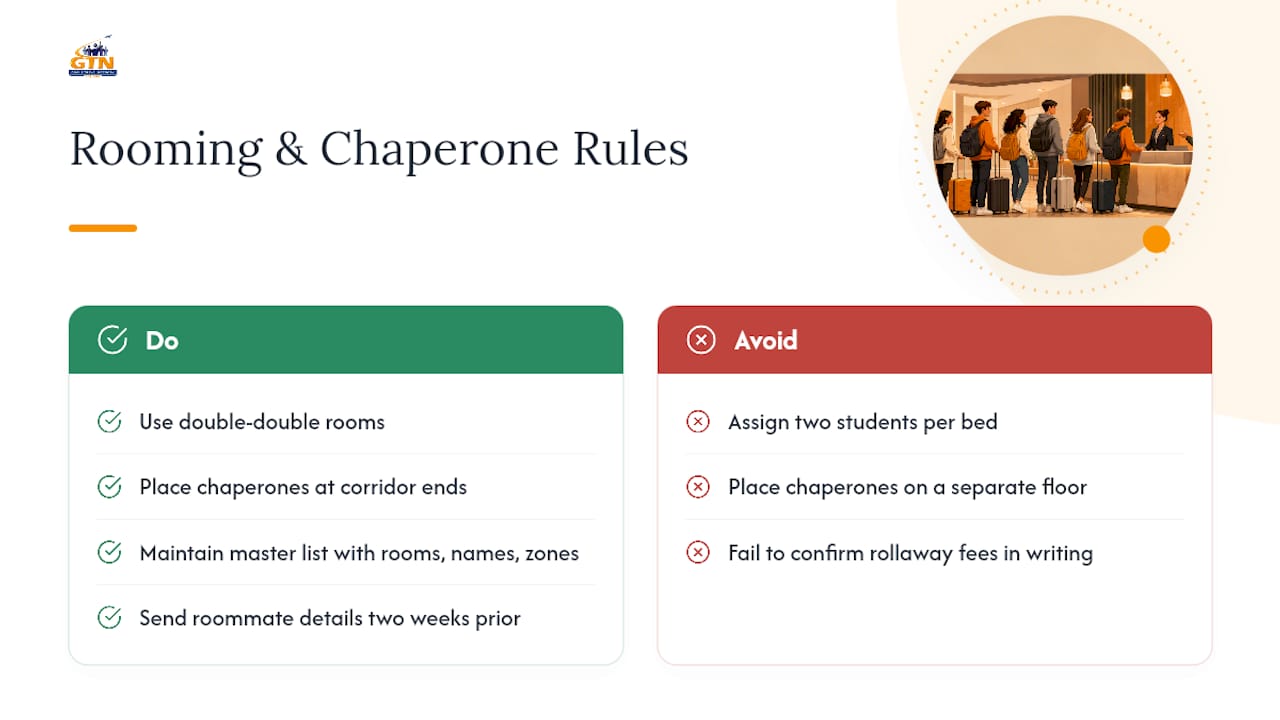
Standard practice for supervised student groups is double-double rooms (two double or queen beds, two students per bed is not acceptable — two students per room with separate beds is the norm). Rollaways are useful for odd-numbered groups but confirm the hotel’s rollaway fee and availability in writing.
Single rooms for medical or health reasons are a separate category. Document every such request with a brief written note from a parent or guardian, and flag it in your rooming list so the hotel does not reassign that room.
For chaperone placement, the most defensible pattern is adults at the ends of each corridor or pod, with student rooms between them. Never assign chaperones to a separate floor from their students. Document every room assignment in a master rooming list that includes room number, occupant names, and chaperone coverage zone. Share that list with the front desk and keep a copy with your on-site lead.
Communicate roommate assignments to families at least two weeks before departure. A short email with room number, roommate name, and chaperone contact eliminates most parent calls during the trip.
For accommodation standards and rooming-list templates, Grouptravelnetwork’s resource covers the format in detail.
What safety checks to run before and during the stay
Before arrival, confirm these with the property directly:
- Fire-exit maps posted in every room and corridor
- Named duty manager with a 24/7 direct line
- On-site security staffing hours and coverage area
- Pool supervision rules or after-hours pool closure for student groups
- Whether group floors have controlled access (key-card corridors preferred)
Carry a physical emergency-contact card with: local 9-1-1, hotel duty manager, school emergency line, and the nearest hospital’s address and phone number. Every chaperone gets a copy.
For the three scenarios that come up most often: a medical emergency means one chaperone stays with the student while another calls 9-1-1 and notifies the duty manager simultaneously. A lost student triggers an immediate floor-by-floor sweep by chaperones before calling the front desk. A fire alarm means everyone exits to the pre-designated assembly point, and you do a headcount before re-entering.
Pro Tip: Run a five-minute on-site orientation at check-in: show students the fire exits, the assembly point, and the curfew floor rule. It takes less time than one incident report.
Safety-focused hotel selection best practices also recommend verifying front-desk staff training and whether rooms connect to public corridors.
Bus parking, performance space, and equipment logistics
Bus logistics fail silently until the day of arrival. Confirm all of the following in writing:
- On-site parking dimensions (length and clearance for full-size coaches)
- Overnight parking permission and any associated fee
- Designated load/unload zone with access times
- Local idling restrictions (many city ordinances cap idling at 3–5 minutes)
For performance and rehearsal space, performance travel guides recommend confirming stage access, ramp or loading-dock availability, and AV hookups in writing before arrival. Add to your RFP:
- Room dimensions and ceiling height (minimum 14 feet for most choral or band setups)
- AV inventory: PA system, microphone inputs, projector or screen
- Secure instrument storage with a lockable room or cage
- Loading-dock or freight elevator dimensions for large cases
Questions to ask hotels and contract clauses to request
RFP question checklist:
- What is the group rate per room type, and what is the cut-off date?
- What is the comp-room ratio, and how is it calculated (paid rooms, not total rooms)?
- What attrition percentage do you require, and what is the penalty for falling short?
- What is the deposit schedule, and under what conditions is the deposit refundable?
- Are taxes and resort fees included in the group rate, or added on top?
- Is direct billing available for the master account?
- How are incidentals handled for student rooms?
- What ADA-accessible rooms are available, and can they be blocked within the group?
Sample contract clauses to request:
- Attrition: “Group shall be responsible for [80%] of the contracted room block; rooms released above that threshold shall carry no penalty.”
- Cut-off date: “Unreleased rooms revert to general inventory on [date]; group rate is honored for rooms booked before that date.”
- Comp rooms: “One complimentary room per [20] paid rooms, calculated on total rooms consumed.”
- Force majeure: “Either party may cancel without penalty in the event of government-declared emergency, natural disaster, or school-board directive.”
- Escalation contact: “Hotel designates [name/title] as the primary group contact with a 24/7 reachable number.”
We will countersign the contract upon receipt of these terms.
How group hotel pricing works and how to protect your budget
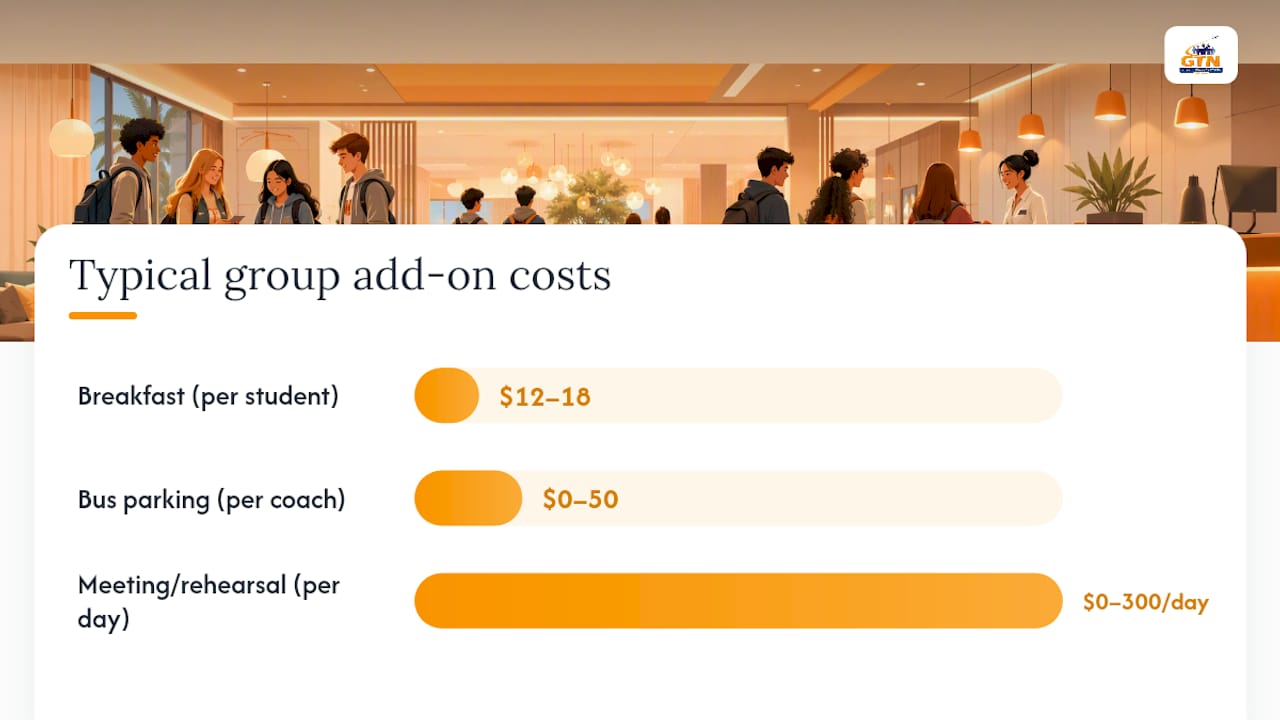
Hotels price group blocks on three levers: the room rate, the comp-room ratio, and package inclusions. Negotiation wins often come from non-rate items — complimentary breakfast, meeting room time, bus parking, and comp chaperone rooms can reduce the net per-student cost more than a small rate cut.
| Budget line | Typical range | Negotiation lever |
|---|---|---|
| Group room rate | Varies by market and season | Shoulder dates, multi-night commitment |
| Comp rooms | 1 per 20–25 paid rooms | Increase block size to improve ratio |
| Breakfast | Included or $12–$18/person add-on | Bundle into rate for groups over 30 |
| Bus parking | $0–$50/night per coach | Waive as part of group package |
| Meeting/rehearsal space | $0–$300/day | Waive for multi-night blocks |
Aim for attrition protection around 80 percent, ask for direct billing on the master account, and confirm which taxes and fees are bundled. Incidentals for student rooms should be set to zero or held on a chaperone card, not individual student cards.
Staying in sync with hotel staff during the trip
Designate one organizer as the single point of contact with the hotel’s group coordinator or duty manager. That person handles all room changes, complaints, and service requests. Splitting hotel communication across multiple chaperones creates conflicting instructions and delays.
At check-in, exchange direct cell numbers with the duty manager and confirm the overnight escalation contact. A brief daily check-in at the front desk, morning and evening, catches billing errors and room issues before they compound. For multi-day trips, request a preliminary folio review on day two so you are not reconciling surprises at checkout.
Supervision and curfew policies for student groups
Set curfew in writing before the trip and share it with families. A standard framework: students in rooms by 10:00 PM, lights-out at 11:00 PM, no room changes after curfew. Chaperones do a corridor walk at curfew and log it.
Ask the hotel to note the group’s curfew in the front-desk file so staff can redirect students found in lobbies or common areas after hours. Some properties will agree to restrict elevator access to group floors after a set time; it is worth asking. Document the supervision schedule so every hour of the overnight stay has a named chaperone on duty.
Cancellation and refund policies for student groups
Standard group contracts include a tiered cancellation penalty: full deposit forfeiture if canceled within 30 days, partial penalty at 60 days, and no penalty beyond 90 days. Push for a force majeure clause that covers school-board cancellations and government travel advisories, not just natural disasters.
Ask specifically: what triggers a full refund versus a credit? Many hotels offer a credit toward a future stay rather than a cash refund. For school groups, a credit is often unusable. Get the refund terms in plain language before signing, and confirm whether your travel insurance for school groups covers non-refundable deposits if the trip is canceled for a covered reason.
Wi-Fi, A/V, and connectivity for student group activities
Group Wi-Fi is a logistics issue, not a perk. Confirm the property’s bandwidth can handle your full group simultaneously, and ask whether group Wi-Fi is included in the room rate or billed separately. Many hotels charge a per-device or per-room fee that adds up fast for a 50-student group.
For A/V, confirm in writing: HDMI and XLR inputs, PA system wattage, microphone count, and whether a hotel technician is on call during your performance window. Bring your own adapters and a backup Bluetooth speaker. Never assume the hotel’s “meeting room AV” matches what a band or choir actually needs.
Grouptravelnetwork handles the hotel search so you can focus on the trip
Sourcing student-group-ready hotels, negotiating attrition clauses, and chasing vendor paperwork takes weeks of back-and-forth that most administrators and band directors do not have. Grouptravelnetwork does that work for you.

Working with Grouptravelnetwork on your school group travel planning means a dedicated trip coordinator handles RFP outreach, contract review, and rooming-list management from day one. Concrete deliverables include:
- RFP sourcing and hotel negotiation across properties with documented student-group experience
- Vendor paperwork coordination (W-9s, insurance certificates, direct-billing setup)
- Performance logistics support (rehearsal space specs, bus parking confirmation, AV pre-checks)
- Flexible payment plans and travel protection options built for school budgets
Ready to hand off the hotel search? Start your group trip planning with Grouptravelnetwork and get a dedicated coordinator on your side before the RFP deadline.
What experienced trip coordinators know that first-timers learn the hard way
The contracts and checklists in this guide cover the mechanics. What they cannot fully convey is the compounding effect of small logistical wins. Securing bus parking and comp chaperone rooms in the same negotiation, for example, can shave $15–$20 per student off the net trip cost while also solving two of the most common day-of headaches. The lesson: go into every hotel negotiation knowing your non-rate asks as clearly as your rate target.
If there is one thing to do earlier next time, it is this: loop in your institution’s travel or risk office at the RFP stage, not after the contract is drafted. Their requirements shape the contract language, and retrofitting compliance terms into a signed agreement is a painful conversation.
Sources
- UConn Off-Campus Advising — Lodging & overnight travel
- Texas Tech OP 34.06 — Student group travel and Clery guidance
- ISU — ISUPP-2380 Student Group Travel
- Mississippi State University — Student domestic travel policy (Policy 91305)
- University of Texas at Austin — Registered student organization travel policy (Appendix L)
FAQ
What qualifies a hotel as student-group-friendly?
A student-group-friendly hotel offers confirmed group blocks, comp chaperone rooms, bus parking, meeting or performance space, and a written group policy. Properties without a documented group-sales packet rarely have the operational experience to support supervised school trips.
When should I start booking hotels for a student group trip?
Send RFPs at 120–90 days before travel and sign contracts by 75–60 days out. Starting later compresses your negotiating position and risks losing block availability at properties with documented student-group experience.
What Clery Act obligations apply to overnight student trips?
Overnight stays trigger Clery reporting when the institution pays for the trip, there is a written agreement to stay, the location is used repeatedly, or the trip runs more than one night, per Texas Tech’s OP 34.06. Consult your institution’s risk or legal office before finalizing hotel arrangements.
What attrition clause should I ask for in a student group hotel contract?
Penalties for rooms released above that threshold should be waived.
Can Grouptravelnetwork handle hotel sourcing and contract negotiation for school groups?
Yes. Grouptravelnetwork assigns a dedicated trip coordinator who manages RFP outreach, hotel contract review, vendor paperwork, and performance logistics, so organizers can focus on the educational program rather than the procurement process.
Recommended

Relax with our Student Travel Expertise .
We deliver stress-free student trips backed by an exceptional array of services you won’t find anywhere else:
- Stress-free, creative planning of customized itineraries
- Dedicated GTN Service host on every trip
- Extensive travel protection plan options
- Online, individual registration system
- Flexible payment plans and online payment options
- Bulk buyer discounts for great trips that cost less
Inclusion into #MyGTNFamily for life! (you don’t even have to remember our birthday!)
Spain
There is no place like Spain to offer a student performance opportunity or cultural student trip.
Myrtle Beach
All students love the beach! Especially a beach known for its 60 miles of pristine coastline.
Boston
Have your students experience colonial charm in the city that is considered the hub of New England.
London
Provide your student group with the “Royal” treatment! One of the world’s most recognized cities.
See What People Are Saying
“It has been my privilege to use Group Travel Network as the exclusive travel coordinator for my band for over 10 years. I can say, without doubt or hesitation, that GTN is, by far, the best travel company for student groups currently in existence. I have often said that I wouldn’t take my band across the street without GTN and that’s not far from the truth!”
“What wonderful trip we had to NYC! Our group of 51 never missed a beat because of Group Travel Network and our wonderful guide, Tim. It was truly a theatre trip to remember! If you are looking for a travel company who really cares about the details, Group Travel Network is for you!”
“This was my first time using a company to plan our band trip. It was so easy working with Justin and Group Travel Network. We had to make several changes along the way, but they were accommodating changes and worked everything out for us. I would highly recommend using Group Travel Network.”