


Start the approval process at least three to four months before departure for international trips, and confirm your itinerary and suppliers before you open registration to participants, never after. Domestic trips move faster, but most institutions still expect paperwork 10 working days to 30 days ahead. Miss these windows and you risk denied approvals, lost group fares, or vendor penalty fees.
TL;DR:
- International trips require at least three to four months of planning, with supplier contracts and safety reviews needing specific deadlines well before departure.
- Confirmed supplier agreements must be signed and deposits paid three to six months in advance to secure group rates and avoid booking cancellations.
- Participant registration should only open 30 to 60 days before departure, after itinerary approval and safety review are finalized to prevent delays.
- Submitting incomplete safety or medical documentation can delay approval and increase the risk of last-minute issues or plan rejection.
- Assigning clear ownership of each planning phase helps prevent common mistakes like early registration or unmet vendor deadlines that threaten trip execution.
Table of Contents
- Timelines at a glance for group trip registration
- Step-by-step registration workflow from proposal to departure
- Documents and information you need before you can register
- How safety and health review gates control your timeline
- A time-phased checklist coordinators can copy into their plan
- Common registration mistakes and how to fix them
- Where Group Travel Network fits into the registration process
- What the timelines actually tell coordinators
- Get help staying ahead of every registration deadline
- Sources
- FAQ
Timelines at a glance for group trip registration
Coordinators juggling school trips, performance tours, or club travel often ask the same question first: how far out do I need to plan? The honest answer depends on destination and institution, but the patterns across university travel offices are consistent enough to build a working calendar around.
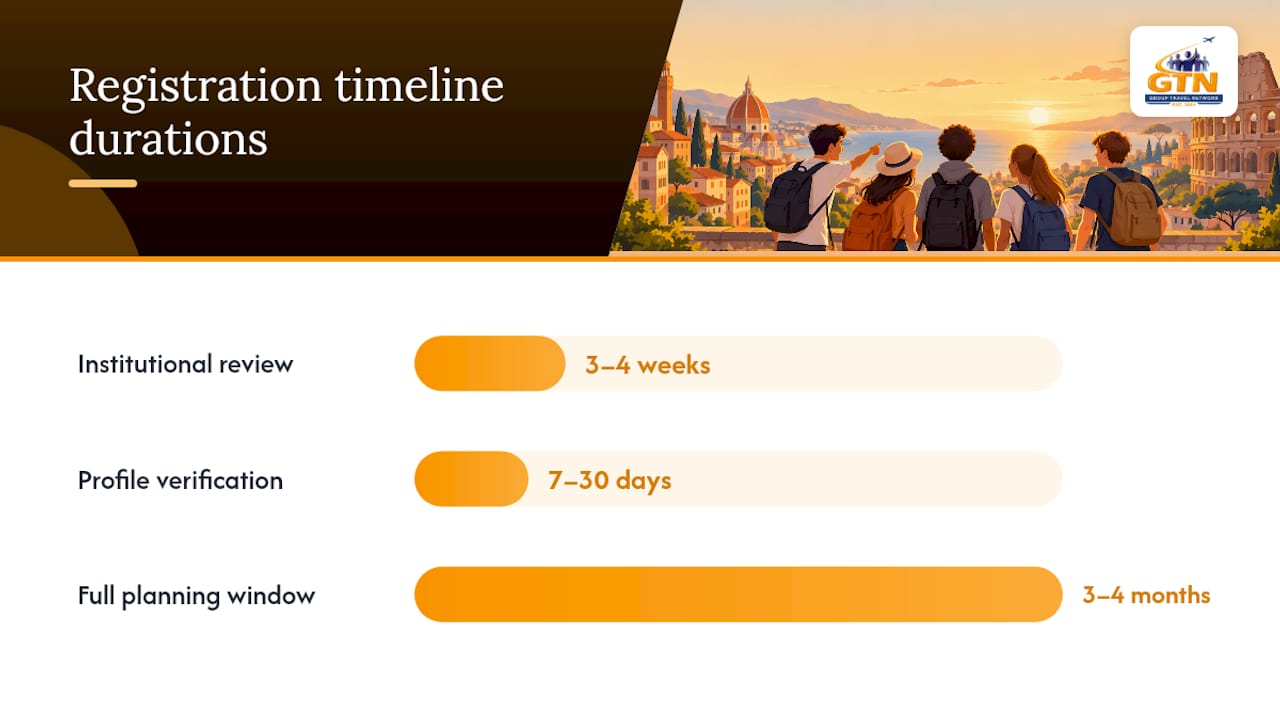
International trips need the longest runway. Some institutions allow proposals up to 12 months ahead, but the practical minimum for international departures clusters around three to four months, driven largely by supplier contracts and safety-review cycles. Domestic trips compress this considerably, with some processes needing as little as 10 working days for form submission.
Supplier deadlines run on their own clock, separate from institutional paperwork. Airlines and hotels often require signed group contracts three to six months out, with deposits due 60 to 90 days before arrival depending on the vendor. Miss a deposit date and you can lose your negotiated group rate entirely.
Participant-level paperwork, meanwhile, typically closes 30 to 60 days before departure, though some domestic forms are due in as few as 10 working days. Institutional safety and health reviews commonly take three to four weeks to complete once submitted, which means the submission itself needs to land at least 30 days before departure to leave room for that review.
| Milestone | Typical window before departure |
|---|---|
| International proposal submission | 3 to 4 months minimum |
| Domestic form submission | 10 working days minimum |
| Supplier contract (air, hotel) | 3 to 6 months |
| Vendor deposit deadline | 60 to 90 days |
| Safety plan submission | At least 30 days |
| Institutional review turnaround | 3 to 4 weeks |
| Participant paperwork due | 30 to 60 days |
These aren’t arbitrary buffers. Washington University’s safety plan form (opens in a new tab) requires submission at least 30 days before departure, with complete trip dates, locations, leader information, and health-and-safety planning included at the time of filing. Skip the buffer and you push your review into the departure window itself, which is exactly when you have no room left to fix a rejected plan.
Step-by-step registration workflow from proposal to departure
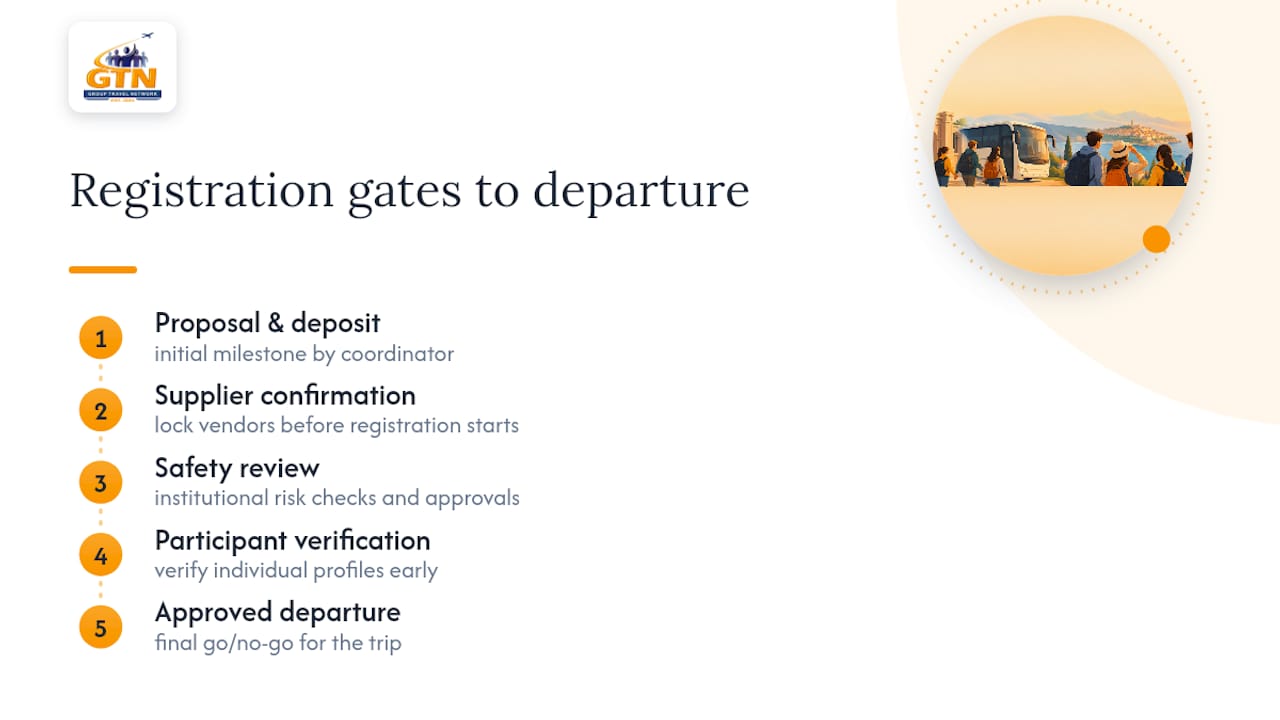
Group travel registration isn’t one form. It’s a sequence, and the order matters more than most coordinators expect. Opening participant registration before your itinerary is locked is one of the most common ways trips get delayed or repriced.
- Lock the itinerary and suppliers first. Secure air and hotel arrangements under signed contract before you ask a single participant to register. Princeton’s group travel checklist (opens in a new tab) specifically requires confirmed air, confirmed hotels, and a confirmed itinerary before the group can be registered in Concur, the institutional travel registry many universities use.
- Submit the group proposal or safety plan. This packet needs trip dates, destinations, leader contact information, and a preliminary roster, at minimum.
- Wait through the institutional review window. Reviewers typically check risk rating for the destination, insurance coverage, and leader qualifications, and this step commonly takes three to four weeks.
- Open participant registration. Once the plan is approved, collect individual profiles, consent forms, and medical information against a clear internal deadline you set for your group, not the institution’s outer limit.
- Collect deposits and send rooming lists. These follow the vendor’s payment schedule, not your internal calendar, so mark them separately.
- Verify every traveler’s profile. Do this seven to 30 days before travel, checking that individual registrations actually matched the group submission.
That last step catches a mistake that trips up even experienced coordinators. Princeton’s checklist flags this directly: submitting the group to the registry does not mean every traveler has completed their individual profile. Someone has to verify completion, one name at a time, rather than assume the group submission covered everyone on the roster.
Pro Tip: Build your registration data packet, meaning your confirmed itinerary, supplier contracts, roster with participant details, medical forms, and insurance proof, before you submit anything to the travel office. A complete packet moves through review faster than a partial one that gets sent back for missing pieces.
The sequencing matters because each step gates the next. You cannot meaningfully collect deposits before suppliers confirm rates. You cannot finalize a roster before individual registrations close. And you cannot open registration credibly before the group itself is approved, because participants asked to pay deposits on an unapproved trip create a mess if the plan later gets rejected or changed. For a fuller walkthrough of this sequence built specifically for school trip leaders, see this step-by-step group travel planning guide (opens in a new tab).
Documents and information you need before you can register
Most late scrambles trace back to one missing document that nobody assigned an owner to collect. Building the full list early, and assigning who gathers what, prevents the week-before panic.
- Participant roster: full legal names, dates of birth, passport numbers for international travel, and emergency contact details for every traveler.
- Itinerary and supplier confirmations: flight confirmation numbers, signed hotel contracts, and vendor agreements with their deposit dates clearly noted.
- Medical and consent forms: signed parental or participant consent, proof of insurance enrollment, and notes on any special medication needs.
- Risk assessment and contingency plans: a day-by-day itinerary, local emergency contacts, and an evacuation plan for higher-risk destinations.
- Financial documentation: deposit receipts, the full payment schedule, and a written refund policy participants can reference.
Medical forms deserve particular attention because they tend to arrive late and incomplete. A checklist and template set for student medical forms (opens in a new tab) can shorten the back-and-forth with families who aren’t sure what’s actually required.
Risk assessments matter just as much, especially for international destinations. Washington University’s safety plan directs planners toward the U.S. Department of State (opens in a new tab), the CDC, and International SOS (opens in a new tab) for destination-specific risk information, and expects that research reflected in the submitted plan rather than assumed. These aren’t optional add-ons to a safety plan. They’re the evidence base a reviewer expects to see cited when judging whether your destination and itinerary are appropriate for the group.
Financial documentation is the piece coordinators most often treat as an afterthought, and it shouldn’t be. A payment schedule that participants can see in writing, alongside a clear refund policy, heads off disputes later if a trip changes or a family needs to cancel.
How safety and health review gates control your timeline
Institutional approval isn’t a formality you check off. It’s a decision gate, and it behaves like one: incomplete submissions get sent back, and every round trip costs you calendar time you likely don’t have.
- Safety plan review requires a destination risk analysis, confirmation of medical coverage for the group, and a named responsible leader for the trip.
- Washington University’s form sets a 30-day minimum submission window before departure and requires trip dates, locations, leader information, and participant registration confirmation at the time of filing.
- Leader training or orientation is often a separate mandatory requirement with its own scheduling window, distinct from the safety plan itself.
- Complete documentation on the first submission is the single biggest factor in how quickly a review clears, since reviewers send incomplete packets back rather than approving them with gaps.
A completed, well-documented safety plan submitted at least 30 days before departure gives reviewers room to check destination risk, insurance, and leader qualifications without pushing your trip against the calendar, according to Washington University’s group travel guidance. That 30-day figure is a minimum, not a target. Build in a buffer of three to four weeks beyond that minimum wherever your own institution’s stated turnaround allows it, because review timelines vary and a plan submitted right at the deadline leaves no room for a second round if reviewers request changes.
The practical fix for slow reviews is almost always the same: submit a complete packet the first time. A trip leader who has already gathered supplier confirmations, a day-by-day itinerary, insurance proof, and destination risk notes before submitting will typically clear review faster than one who submits a partial plan expecting to fill gaps later. For more detail on what that complete packet looks like in practice, this guide to safe travel planning steps for student groups (opens in a new tab) walks through the review criteria in depth.
A time-phased checklist coordinators can copy into their plan
Turning all of this into a working calendar is easier when you assign a phase, an owner, and a deliverable to each stretch of the timeline. Here’s a structure that holds up whether you’re running a domestic weekend trip or an international performance tour.
- 12 months out: Draft the initial concept, a rough budget estimate, and secure any preliminary institutional approvals your policy requires before you go further.
- 6 to 4 months out: Confirm suppliers under contract and submit your formal proposal. International groups commonly submit three to four months before departure at the latest.
- 3 months out: Open participant registration only after supplier confirmation is in hand, start collecting deposits, and begin scheduling any required leader orientation.
- 30 to 60 days out: Audit every traveler’s profile against the roster, chase outstanding paperwork, and confirm insurance enrollment for the whole group.
- 7 to 14 days out: Lock the final roster, send the rooming list, distribute an emergency contact sheet, and hold your final briefing with packing and logistics notes.
Pro Tip: Assign one owner per phase, even on a small trip. A safety plan that’s “everyone’s responsibility” usually becomes nobody’s responsibility until the deadline is already gone.
This structure mirrors what shows up across institutional policy, even though the exact numbers shift slightly from one school to the next. The pattern holds regardless: proposal and supplier work happens early, participant-facing registration opens only after the trip itself is confirmed and approved, and the final two weeks are reserved for verification, not for filling in gaps that should have closed a month earlier.
Coordinators managing performance tours face an added layer here, since venue confirmations and performance scheduling often move on a separate timeline from travel logistics. If that’s your situation, a detailed planning walkthrough for school trips breaks down how those two tracks fit together without one holding up the other.
Common registration mistakes and how to fix them
The failures that derail group trip registration are predictable, and they repeat across schools, districts, and youth organizations. Recognizing them early is most of the fix.
- Opening registration before the itinerary is locked: this leads to repriced fares or canceled hotel blocks once suppliers finalize terms. Fix it by treating supplier confirmation as a hard milestone that gates registration, not a parallel task.
- Assuming the group submission finished individual registration: Princeton’s checklist calls this out directly as a coordination failure. Fix it by assigning someone to verify every traveler’s profile against the roster, not just the group record.
- Missing a vendor deposit or rooming-list deadline: this can mean losing a negotiated group rate entirely. Fix it by mapping every vendor deadline into your planning calendar the moment the contract is signed, not weeks later.
- Failing to meet orientation or leader training deadlines: this can stall final approval even after the safety plan itself is accepted. Fix it by registering leaders for required sessions as soon as the trip receives initial approval, rather than waiting until closer to departure.
Each of these mistakes shares a root cause: treating registration as one event instead of a sequence with its own internal deadlines. Once you separate the steps and assign an owner to each, most of these errors simply stop happening.
Where Group Travel Network fits into the registration process
Coordinators running school, band, or performance trips are usually doing this work alongside a full-time job that has nothing to do with travel logistics. That’s the gap Group Travel Network is built to close for student, school, and youth performance travel.
In practice, that means sequencing supplier confirmation, contract deadlines, and registration opening the same way this guide describes, but with a dedicated trip coordinator managing the calendar rather than a teacher or band director doing it between classes. Online registration tools handle the participant data collection step directly, and flexible payment plans take the deposit and rooming-list deadlines off a coordinator’s personal tracking spreadsheet.
None of that changes the fundamentals covered here. Suppliers still need to be locked before registration opens. Safety documentation still needs to be complete on first submission. What changes is who is tracking each date and chasing each missing form, which is often the difference between a trip that runs smoothly and one that hits a deadline nobody saw coming.
What the timelines actually tell coordinators
The conventional advice on this topic treats registration deadlines as a single date to circle on a calendar. That’s the wrong mental model. What the institutional policies actually show is a chain of gates, supplier confirmation, safety review, participant verification, each with its own lead time, and missing any single link stalls the whole trip regardless of how early you started.
The most underrated step is verification. Coordinators plan carefully for the big milestones, the proposal, the deposit, the safety plan, and then assume the group submission covers every traveler. It doesn’t. Princeton’s own checklist flags this as a real, recurring failure, which tells you it happens often enough that a major research university felt the need to write it down.
If you take one thing from this guide, prioritize locking suppliers before you touch registration, and build in a verification pass on individual profiles well before the final week. Everything else on the timeline bends around those two decisions.
— Donovan
Get help staying ahead of every registration deadline
Group Travel Network works specifically with schools, band and choir directors, and youth organizations planning student trips, and the services map directly onto the deadline pressure points covered above.

- Online registration handles participant data collection and verification without a coordinator manually chasing every family.
- Flexible payment plans align with supplier deposit schedules so deadlines don’t depend on one person’s memory.
- Dedicated trip coordinators manage supplier negotiations and contract timelines from the proposal stage through departure.
- Travel protection options give families and administrators a documented safety net that supports the institutional review process.
Whether you’re organizing a performance tour (opens in a new tab), an educational trip (opens in a new tab), or an international student journey (opens in a new tab), the same sequencing rules apply, and a coordinator familiar with them can save weeks of back-and-forth. Reach out through Group Travel Network (opens in a new tab) to start a planning conversation and get a realistic deadline calendar built for your specific trip.
Sources
The deadlines and requirements in this guide come from published university travel office policies. Every institution sets its own exact submission windows and required fields, so check your own travel office’s current policy before finalizing your calendar.
- Safety Plan for Group Travel (Washington University) (opens in a new tab)
- Group Travel Planning Checklist (Princeton University) (opens in a new tab)
FAQ
How far in advance should I register a group trip?
International trips generally need three to four months of lead time at minimum, driven by supplier contracts and safety review cycles, while some domestic forms are due in as little as 10 working days. Washington University’s policy sets a 30-day minimum for safety plan submission specifically, which should be treated as a floor rather than a target.
What happens if I miss a group travel registration deadline?
Missing a registration or safety plan deadline can mean a denied or delayed institutional approval, since reviewers need time to check destination risk, insurance, and leader qualifications before a trip can proceed. Missing a supplier deposit deadline separately risks losing a negotiated group rate or the booking itself.
Does submitting the group registration cover every traveler automatically?
No. Princeton’s group travel checklist specifically notes that a group submission does not complete individual traveler profiles, so someone needs to verify each participant’s registration separately before departure.
What documents do I need before opening group registration?
You need a confirmed itinerary with suppliers under contract, a participant roster with names and emergency contacts, medical and consent forms, and a destination risk assessment for international trips. Financial documentation, including a payment schedule and refund policy, should also be ready before you ask participants to register.
Can a travel coordinator help manage these deadlines for me?
Yes. Services like Group Travel Network’s dedicated trip coordinators and online registration tools are built to track supplier deadlines, participant paperwork, and payment schedules on behalf of school and youth group leaders throughout the planning process.
Recommended
- Student Travel Planning Guide: A Timeline For Successful Educational Trips (opens in a new tab)
- School Trip Payment Policy: 2026 Templates And Timelines (opens in a new tab)
- What Is Online Trip Registration? A Guide For Schools (opens in a new tab)
- Student Educational Travel: Ultimate 2025 Guide For Schools (opens in a new tab)