


TL;DR:
- Effective group travel management involves controlling schedules, budgets, transportation, and communication to ensure trip success. Well-planned logistics keep participants focused on goals and prevent delays, miscommunications, or budget issues. Using early planning and centralized tools helps organizers coordinate date selection, budgets, travel, and communication efficiently.
Group travel logistics is the system of coordinated decisions that determines whether a school trip or performance tour succeeds or falls apart. For school trip organizers and team managers, mastering the importance of group travel logistics means controlling schedules, budgets, transportation, and communication before problems have a chance to compound. The industry term for this discipline is group travel management, and it covers every moving part from the first date poll to the final headcount at the airport gate. Tools like Doodle, Google Forms, and Google Docs have become standard in this field. Early planning (opens in a new tab) is the single most reliable predictor of a trip that runs on time and within budget.
Why does the importance of group travel logistics matter for schools?
Group travel logistics complexity multiplies with every additional participant. Each new group member (opens in a new tab) adds a new variable to scheduling, payments, dietary needs, and emergency contacts. That compounding effect is why a 40-student band trip requires a fundamentally different planning approach than a family vacation for four.

When logistics work, participants never notice them. Well-planned logistics (opens in a new tab) allow students and performers to focus entirely on the educational or performance goals of the trip, not on missed buses or missing room keys. That invisibility is the real measure of success for any organizer.
The risks of poor planning are concrete. A single missed vendor confirmation can delay an entire group’s hotel check-in. A budget miscalculation can exclude students mid-trip. A communication breakdown can leave chaperones at the wrong terminal. These are not edge cases. They are the predictable results of skipping structured group travel management.
How do you coordinate travel dates for large groups?
Date coordination is the first logistical challenge, and it is where most group trips stall. Trying to find a date that works for every participant causes planning paralysis. Polling for 80% consensus (opens in a new tab) using tools like Doodle or Google Forms is the proven fix. Aiming for full agreement almost always results in a trip that never gets booked.
The timeline for date-setting depends on trip type. International trips need (opens in a new tab) at least 3–4 months of lead time. Domestic trips require 6–8 weeks minimum. Starting earlier than those windows gives you pricing leverage and more venue availability.
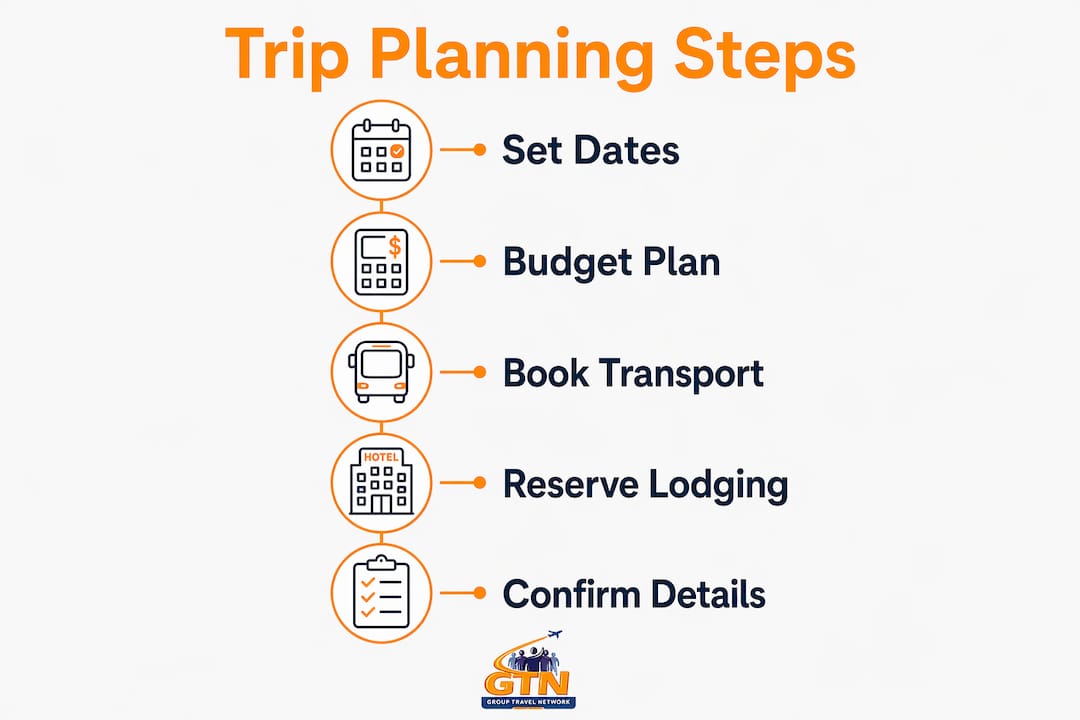
Effective scheduling for school groups also means accounting for academic calendars, sports seasons, and performance schedules simultaneously. A band director coordinating a spring performance tour needs to check state competition dates, spring break windows, and teacher availability before sending a single poll.
Key scheduling steps for group trip organizers:
- Send a date poll via Doodle or Google Forms within the first week of planning
- Set a firm decision deadline, typically two weeks after the poll opens
- Confirm the date with 80% participation, not 100%
- Notify non-participating members immediately so they can make alternative arrangements
- Lock venue and vendor holds within 48 hours of date confirmation
Pro Tip: Set the poll deadline in the same message as the poll link. Groups that receive open-ended polls take three times longer to respond than groups with a stated cutoff date.
How should you plan the budget for a group trip?
Budget planning is where equity and feasibility intersect. The goal is a trip cost that the widest possible range of participants can afford without financial strain. Collect anonymous maximum comfortable budget figures from all participants before setting any prices. Set the trip cost at the lowest comfortable budget figure in the group, not the average.
The 30% rule is a practical filter for destination selection. If more than 30% of your group cannot afford a destination at its realistic cost, that destination should be removed from consideration. Keeping it creates a two-tier group dynamic that undermines the educational and social goals of the trip.
Payment tracking is its own logistical challenge. Manual spreadsheets create errors and delays. Platforms like Grouptravelnetwork offer online registration and flexible payment plans that reduce the administrative load on organizers and give families a clear payment schedule from day one.
Steps for equitable budget planning:
- Send an anonymous budget survey before any destination research
- Identify the lowest comfortable figure and set that as your cost ceiling
- Apply the 30% rule to eliminate destinations that exceed group capacity
- Build a payment schedule with at least three installment options
- Use a centralized tracker, not email threads, to monitor payment status
- Send automated reminders two weeks and one week before each payment deadline
Pro Tip: Always build a 10% contingency buffer into the total trip budget. Unexpected costs like last-minute transportation changes or venue fee increases are standard in group travel, not exceptions.
Transportation and accommodation: what actually works for groups?
Transportation logistics break down most often at two points: airport arrivals and ground transfers. Booking one group fare sounds efficient, but individual flight bookings are typically cheaper and far easier to manage when changes occur. Coordinate arrival windows instead. Ask all participants to book flights that land within a two-hour window, then arrange ground transport to meet that window.
Ground transport requires accurate data. You need confirmed headcounts, luggage counts, and any accessibility requirements before you can book the right vehicle size. A 45-person group with instrument cases needs a fundamentally different transport solution than a 45-person group with standard carry-on bags.
Accommodation selection follows a similar logic. Choose properties that keep the group on the same floor or in adjacent rooms where possible. This reduces supervision complexity for chaperones and speeds up morning departures significantly.
| Logistics area | Common mistake | Better approach |
|---|---|---|
| Flights | Single group booking | Individual bookings within a coordinated arrival window |
| Ground transport | Estimating vehicle size | Confirm headcount and luggage data before booking |
| Accommodation | Scattered room assignments | Request same-floor or adjacent room blocks |
| Itinerary structure | Over-scheduling every hour | Plan 70% structured, leave 30% flexible |
The 70/30 planning rule is one of the most underused tools in group travel management. Structured logistics cover 70% of the trip, and the remaining 30% stays open for rest, spontaneous activities, or schedule recovery. This balance prevents travel fatigue and keeps group energy high through the final day.
Accommodation checklist for school group organizers:
- Confirm group rate and room block at least 8 weeks out for domestic trips
- Request a rooming list template from the property and complete it early
- Verify accessibility features if any participant requires them
- Confirm meal options, especially for dietary restrictions, before arrival
What communication tools reduce organizer burnout?
Communication is where group travel management either holds together or collapses. Centralized platforms like Google Docs, Notion, or TripIt consolidate itineraries, budgets, and contact lists in one place that every stakeholder can access. Information silos, where one person holds all the details, are the leading cause of organizer burnout and trip-day chaos.
Group chat apps like WhatsApp or Telegram work well for real-time alerts. They work poorly for decisions. Group travel disruptions (opens in a new tab) create domino effects when decisions get made through chat threads where half the group misses the key message. Reserve chat for announcements. Use polls or direct calls for decisions.
Sharing responsibilities is as important as choosing the right tools. A single organizer managing all logistics is a single point of failure. DIY group travel fails most often because one person holds all the vendor contacts, all the payment records, and all the emergency protocols. Distribute those responsibilities across at least two people.
Communication tools that work for school group organizers:
- Google Docs or Notion for shared itineraries and budget tracking
- TripIt for real-time itinerary management and flight updates
- WhatsApp or Telegram for time-sensitive announcements only
- Doodle or Google Forms for scheduling polls and preference surveys
- Grouptravelnetwork’s dedicated trip coordinators (opens in a new tab) for full-service logistics support
Pro Tip: Create a single shared document labeled “Trip Bible” that contains every vendor contact, booking confirmation, emergency number, and payment record. Share it with two backup organizers before departure. If your phone dies on day one, the trip continues.
Key takeaways
Effective group travel management is the difference between a trip that achieves its educational or performance goals and one that spends its energy recovering from preventable problems.
| Point | Details |
|---|---|
| Start planning early | International trips need 3–4 months lead time; domestic trips need 6–8 weeks minimum. |
| Use the 80% consensus rule | Poll dates with Doodle or Google Forms and confirm at 80% participation to avoid paralysis. |
| Set budgets from the bottom up | Base trip cost on the lowest comfortable budget figure and apply the 30% exclusion rule. |
| Coordinate arrivals, not group fares | Individual flight bookings within a shared arrival window outperform bulk group bookings. |
| Centralize all information | One shared document with all vendor contacts, confirmations, and records prevents single-point failures. |
What I’ve learned about logistics that most guides won’t tell you
The best group trips I have seen share one trait: the participants have no idea how much work went into them. Good logistics are invisible. Students on a well-run performance tour are thinking about their concert, not about whether the bus will show up. That invisibility is the goal, and it only happens through deliberate, early, and distributed planning.
The advice I give every school trip organizer who comes to me frustrated is this: stop trying to manage everything yourself. The moment you become the only person who knows the hotel confirmation number, you have created a crisis waiting to happen. Distribute your knowledge before you leave home.
I am also skeptical of the instinct to over-schedule. I have seen groups arrive at a destination with 14-hour itinerary days and leave exhausted and resentful. The 70/30 structure is not a compromise. It is the reason groups come home wanting to travel again. Fatigue is the enemy of educational engagement.
The most underrated skill in group travel management is knowing when to call a professional. Organizers who try to handle vendor negotiations, payment tracking, and crisis management alone are taking on risk that a specialist can absorb far more efficiently. That is not a weakness. It is good judgment.
— Donovan
How Grouptravelnetwork supports school trip organizers
School trip organizers carry a significant planning load, and the details that fall through the cracks are rarely small ones. Grouptravelnetwork was built specifically to reduce that load for educational institutions, band directors, and team managers planning group trips.

The school group travel planning guide (opens in a new tab) on Grouptravelnetwork walks organizers through every phase of trip preparation, from initial date polling to post-trip reporting. Dedicated trip coordinators handle vendor negotiations, payment tracking, and real-time coordination so organizers can focus on their students. Flexible payment plans, online registration, and travel protection options are built into every package. For performance tours specifically, Grouptravelnetwork’s performance tour services (opens in a new tab) cover destination selection, venue booking, and itinerary design for bands, choirs, and athletic teams.
FAQ
What is group travel logistics?
Group travel logistics is the coordinated management of schedules, transportation, accommodation, budgets, and communication for trips involving multiple participants. It is also called group travel management in the travel industry.
How far in advance should you plan a school group trip?
International school trips require at least 3–4 months of planning lead time. Domestic trips need a minimum of 6–8 weeks to secure pricing, venues, and participation confirmations.
What is the 80% consensus rule for group travel dates?
The 80% consensus rule means confirming travel dates once 80% of participants agree, rather than waiting for full agreement. Waiting for 100% consensus typically causes trips to stall and never get booked.
How do you manage the budget for a group trip fairly?
Collect anonymous maximum budget figures from all participants, then set the trip cost at the lowest figure in the group. If more than 30% of participants cannot afford a destination, remove it from consideration.
Why do DIY group trips fail more often than professionally managed ones?
DIY group trips frequently fail because one organizer holds all vendor contacts, payment records, and emergency protocols. When that person is unavailable, the entire trip is at risk. Professional coordinators distribute those responsibilities and provide proactive crisis management.
Recommended
- Why School Group Travel Ignites Engagement And Learning • Group Travel Network (opens in a new tab)
- School Group Travel Planning: A Step-by-step Guide • Group Travel Network (opens in a new tab)
- Travel Management For Teams: How Schools Plan Smart Group Trips • Group Travel Network (opens in a new tab)
- How Travel Networks Transform School Group Trip Planning • Group Travel Network (opens in a new tab)