

For a school or youth group, the best currency plan is simple: order a small amount of local cash through your bank before departure, pull the rest from bank-affiliated ATMs after you land, and give every student a spending limit and a safe place to keep the money. Airport kiosks and street exchangers cost more or carry more risk. This guide walks through each step, with the numbers and the points where group trips go wrong.
A group trip adds problems a solo traveler never has. Thirty teenagers means thirty wallets, a chaperone who is suddenly a bank, and a parent group asking how much cash is enough. The decisions below are the ones band directors, teachers and trip coordinators face before an international trip.
TL;DR
- Exchange only a small amount before you leave, enough for the first few days. Get the rest from ATMs after arrival.
- Plan roughly $50 to $100 in local currency per student per week for incidentals, and more for cash-only markets or shops.
- Card and ATM fees add up: typically 1% to 3% for foreign transactions, plus $2 to $5 per foreign ATM use.
- Never trade money with strangers on the street. Keep emergency cash in a separate place from each student’s wallet.
- Spend or exchange leftover bills quickly, because U.S. banks generally won’t take foreign coins.
Table of Contents
- Decide how much cash the group really needs
- Exchange before you leave, or after you land?
- Cards and ATMs: what they cost
- Keep cash safe in a group setting
- The $10,000 rule on the way home
- What to do with leftover currency
- A step-by-step currency plan for your group
- How we help groups keep money simple
- Our perspective
- FAQ
- Sources
Decide how much cash the group really needs
Start with the spending that cash must cover. Group packages usually prepay lodging, transportation, admissions and many meals, so cash is for incidentals: snacks, souvenirs, small tips, a drink between rehearsals or tours. That keeps the number low.
Indiana University’s student handbook says an average of $50 to $100 per week (opens in a new tab) provides sufficient spending money, and it recommends exchanging $50 to $100 into the host country’s currency before departure. That is a useful baseline for a short school trip, where students are not buying groceries or paying transit fares.
Raise or lower it using three questions:
- How many meals are free-choice? If lunch is on the student’s own dime, budget for it per day.
- Where are you going? Markets, small village shops and some rural stops are cash-only.
- How long is the trip? A four-day festival trip needs far less than a ten-day cultural program.
Put the number in writing. Parents want a clear recommendation, such as “$75 in local currency for the week,” not “bring what you think you’ll need.” If you set a suggested amount, you also reduce the odds that one student carries a large wad of cash while another has none.
Our guide to budgeting for school trips (opens in a new tab) shows where spending money fits next to the fixed costs, so the cash figure you give families matches the total trip price.
Exchange before you leave, or after you land?
The two pieces of advice that appear across university travel offices agree on a middle path. Haverford College advises exchanging a small amount of the host country’s currency before leaving the U.S. (opens in a new tab) for the first few days, then waiting until you arrive to get most of the foreign currency. Duke’s Office of Global Health and Safety also recommends that participants exchange a small amount before departure (opens in a new tab).
The reasons are practical:
- Arrival day is chaotic. A group landing after an overnight flight does not want to hunt for an ATM with 30 students and instruments in tow. A little cash in hand pays for water, a snack or a luggage cart.
- Rates are better away from kiosks. Harvard’s Graduate Student Support notes that airport currency kiosks rarely offer favorable rates (opens in a new tab).
- Ordering ahead takes time. UW–Madison’s study abroad handbook warns that ordering foreign currency can take a week or two (opens in a new tab), so start the process at least a month before departure.
The same UW–Madison handbook notes that withdrawals from ATMs and debit cards use an exchange rate typically better than exchanging U.S. dollars at a counter. Indiana University goes further and tells students not to carry U.S. dollars to exchange at banks abroad, since the process can be costly and difficult to coordinate (opens in a new tab).
Ordering currency from your U.S. bank
If your school’s bank or a family’s bank offers foreign currency, ordering is straightforward but has rules. Chase notes that you often need to hold an account with the bank (opens in a new tab), that there may be minimum and maximum amounts, and that the bank typically adds a markup to the current exchange rate. SoFi adds that many institutions require an account and that scheduling an appointment (opens in a new tab) helps make sure the branch can handle the transaction.
Bank of America’s 2026 international travel flyer gives a good picture of the logistics. Standard delivery takes one to three business days and costs $7.50, with next-business-day delivery at $20 (opens in a new tab). Orders of $1,000 or more, or orders from customers whose account or address is new within 30 days, are shipped to a financial center rather than to the home address.
For a group, that suggests a practical rule: families order their own small amounts individually, and the trip leader does not collect and order cash for everyone from one personal account. Pooling hundreds or thousands of dollars in a staff member’s name creates record-keeping and liability problems that have nothing to do with the trip itself.
Cards and ATMs: what they cost
Cards are convenient, but fees decide whether they are the cheap option. Several sources agree on the ranges:
| Fee | Typical amount | Source |
|---|---|---|
| Foreign transaction fee on cards | 1% to 3% of the purchase | Haverford College (opens in a new tab) |
| Foreign transaction fee, per the issuer | Typically 3%, so $1,000 becomes $1,030 | Capital One (opens in a new tab) |
| International ATM fee | Typically $2 to $5 per use | Harvard GSS (opens in a new tab) |
| Bank of America International Transaction Fee | 3% when converting currency | Bank of America flyer (opens in a new tab) |
The lesson for a group is that the flat ATM fee punishes small, frequent withdrawals. Haverford recommends withdrawing larger amounts of local currency less frequently (opens in a new tab) from a local ATM rather than relying on cards for everyday use. Indiana University suggests using a debit card at an ATM perhaps once or twice a week and keeping the credit card for emergencies.
A quick worked example
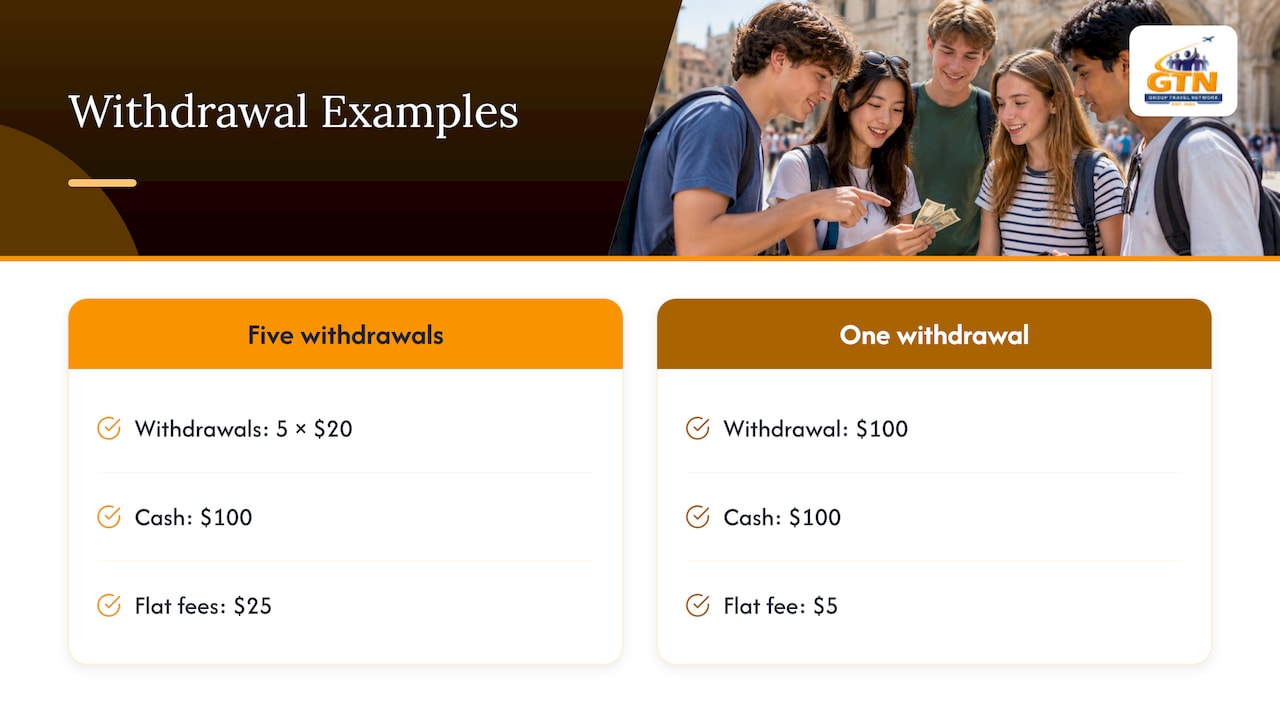
Imagine a student who takes out $20 at an ATM five times in a week with a $5 flat fee each time. That is $25 in fees on $100 of cash, before any percentage fee. Take out $100 once, and the flat fee is $5. The same logic applies to a chaperone fund, so fewer, larger withdrawals are cheaper. (This is an illustration, and your own bank’s fee schedule decides the real amount.)
Fee-proofing the group
Before departure, have students and chaperones work through a short list drawn from Duke’s guidance for program directors:
- Bring at least one credit card and one ATM or debit card.
- Notify the bank of travel dates and destinations.
- Confirm the international transaction fees.
- Make sure the ATM PIN is four digits.
- Activate the card for international use.
- Check that the card will not expire during the trip.
Harvard also points out that for frequent travelers, a travel credit card typically doesn’t charge foreign transaction fees (opens in a new tab). That is relevant to the adults on the trip, who may handle shared expenses. Students under 18 generally will not hold their own credit cards, so plan their money around cash and, where a parent agrees, a debit card.
Keep cash safe in a group setting
Exchange rates are only half the problem. Lost or stolen cash costs a student their week, and a missing wallet can pull a chaperone away from the group. Duke’s guidance gives a solid routine:
- Carry only the cash needed for a few days at a time.
- Use a money belt or neck pouch.
- Divide resources so backup cards or emergency cash stay at the hotel.
- Use ATMs inside banks or in well-lit public places, and shield PIN entry.
- Avoid exchanging with individuals on the street, because of scams and counterfeit bills.
Indiana University adds a tip that works especially well for teens: keep the equivalent of $50 in bedrooms or suitcases at all times (opens in a new tab) in case a backpack or wallet is lost or stolen. With roommates, that means every room has a small reserve and no one is stranded.
Set rules before you leave
Duke also stresses that directors should include financial prep in pre-departure meetings (opens in a new tab) and tailor recommendations to the destination. Use your parent meeting for exactly that. A one-page handout covering the suggested cash amount, the daily carrying limit, what to do if a card is lost, and who to call is more useful than a long email.
A few group-specific rules that save headaches:
- One shared-expense owner. If the group pays for anything collectively, such as a tip for a guide, one adult tracks it with receipts.
- No lending between students. It starts arguments and confuses the end-of-trip budget.
- Daily check-in on spending. A two-minute check on the bus at the end of the day is enough.
- Photocopies of card details stored apart from the cards, kept with the trip leader.
If you are paying shared costs in several currencies, keep one record of what was paid, in what currency and at what rate. Our guide on managing group travel payments (opens in a new tab) covers how to keep the money side organized before and during the trip, and the school trip payment guide (opens in a new tab) breaks down the costs and fees families should expect.
The $10,000 rule on the way home
Most school groups are nowhere near this figure, but it matters for tours with large shared funds. U.S. Customs and Border Protection says travelers entering the United States with more than $10,000, or the foreign equivalent, in currency or monetary instruments must file FinCEN Form 105 (opens in a new tab). The threshold applies to the total carried by an individual or by groups traveling together. If your group is carrying a combined pot near that amount, report it, and speak to a customs officer at the port of entry if you are unsure.
What to do with leftover currency
Leftover cash is where small group budgets quietly leak. Three rules apply:
- Coins are the problem. The University of Kentucky’s education abroad office notes that U.S. banks generally won’t exchange foreign coins (opens in a new tab), so students should use up local coins before flying home. Plan a final-day snack stop.
- Bills may be accepted, with conditions. SoFi explains that banks generally won’t accept foreign coins or old currency no longer in use (opens in a new tab), and may require a minimum value, for example $20 in U.S. dollars.
- Check if your bank buys back. Bank of America says excess foreign bills, but no coins, can be exchanged for U.S. dollars at a full-service financial center (opens in a new tab).
The easiest fix is to plan the last day around spending. Tell students on the second-to-last day that cash left over after the final meal is theirs to keep as souvenirs, or can be spent at the airport shop before departure. Keep small bills, which are easier to use up, as a share of what you order in the first place.
A step-by-step currency plan for your group
- Six weeks out: Tell families the suggested cash amount, using the $50 to $100 per week range as a starting point, and adjust for your destination.
- Four weeks out: Families order a small amount of local currency from their bank or credit union, remembering that ordering can take a week or two.
- Two weeks out: Everyone notifies their bank, confirms fees, activates cards and checks PINs and expiration dates.
- Departure week: Hold the pre-departure meeting on money, with the handout and reserve-cash rule.
- Arrival: Use the small pre-ordered cash for the first days, then withdraw larger amounts less often from bank-affiliated ATMs.
- During the trip: Daily check-ins, money belts, reserve cash in each room.
- Last day: Spend coins, then exchange leftover bills if your bank allows it.
How we help groups keep money simple
Your group’s international trip does not have to turn into a spreadsheet exercise. Through International Adventures (opens in a new tab), we plan custom itineraries for student and youth groups abroad, with dedicated trip coordinators, online registration, flexible payment plans and travel protection options. When lodging, transport and activities are arranged and paid through the plan, the cash your students carry is for small purchases only, and the number you give parents stays low.

If you are building a trip around concerts or festivals, see our Performance Tours (opens in a new tab). For broader educational programs, take a look at Educational Endeavors (opens in a new tab). For ideas on destinations and planning, our international student travel programs guide (opens in a new tab) is a good next read.
Our perspective
Most currency problems on school trips are planning problems. A group that knows what is prepaid, what is spent in cash and who is responsible for what rarely has a currency crisis.
That is why we build trips so the large costs are settled before departure through flexible payment plans, and why families get a clear picture of the trip’s price up front. When the big expenses are handled, spending money becomes a modest, predictable amount that parents can set with confidence.
Our dedicated trip coordinators exist so that a band director or teacher is not also a travel bank. We think an international trip should leave the adults free to teach, rehearse and supervise, with money a small part of the day.
Donovan
FAQ
How much foreign currency should each student carry?
A common university recommendation is to exchange $50 to $100 before departure, and the same handbook says an average of $50 to $100 per week gives sufficient spending money. Increase it if your itinerary includes cash-only markets or small shops, and ask your trip coordinator which meals and activities are prepaid so you do not overestimate.
Can I walk into a bank and exchange foreign currency?
Often yes, but not always. Many banks require you to hold an account, and some set minimum and maximum amounts. Call ahead, ask about the fee or markup, and allow a week or two for the order to arrive.
Is it cheaper to use cards or cash abroad?
It depends on the fees. Cards commonly add 1% to 3% per transaction, and foreign ATMs often add $2 to $5 per use, so frequent small withdrawals get expensive. Haverford advises that cash is usually less expensive for daily use, withdrawn in larger amounts less often.
What should we do with leftover foreign money?
Spend the coins before you leave, because U.S. banks generally won’t exchange them. For bills, check whether your bank accepts foreign currency and whether it has a minimum value, such as $20 in U.S. dollars at some institutions.
Should the trip leader exchange money for the whole group?
It is better for families to handle their own students’ currency and for the leader to track only shared expenses. That keeps records clean and keeps one adult from holding a large pool of other people’s cash.
Sources
- Managing Money Abroad, Student-Guardian Handbook (Indiana University) (opens in a new tab)
- Finances, Travel Resources (Haverford College) (opens in a new tab)
- Handbook: Managing Money on Your Program (UW–Madison Study Abroad) (opens in a new tab)
- Accessing and Managing Cash Abroad (Duke Office of Global Health and Safety) (opens in a new tab)
- Money and Banking Options Abroad (Harvard GSS) (opens in a new tab)
- Where To Exchange Foreign Currency To Reduce Fees (Chase) (opens in a new tab)
- Can You Deposit Foreign Currency Into Your Bank Account? (SoFi) (opens in a new tab)
- International Travel flyer (Bank of America) (opens in a new tab)
- The Cheapest Ways to Access Cash While Traveling Abroad (Capital One) (opens in a new tab)
- Know Before You Go: Traveling Abroad (U.S. Customs and Border Protection) (opens in a new tab)
- Money Abroad (University of Kentucky Education Abroad) (opens in a new tab)
Recommended
- How To Budget For School Trips: A Step-by-Step Guide (opens in a new tab)
- School Group Travel Planning: A Step-by-step Guide (opens in a new tab)
- Top Student Travel Trends In 2026 For School Groups (opens in a new tab)
- Student Travel Accommodation Standards: 2026 Guide For Schools (opens in a new tab)