


Yes, student charter trips can be safe, but only when planners complete three non-negotiable checks before signing a contract. Run the carrier’s USDOT number through the FMCSA Bus Safety Search (opens in a new tab), obtain a current Certificate of Insurance (COI) confirming at least $5 million in coverage for vehicles carrying 16 or more passengers, and get written confirmation of driver Hours-of-Service (HOS) compliance and seatbelt availability. Skip any one of these and you are booking blind.
A carrier rated “Unsatisfactory” by FMCSA is barred from interstate passenger operation. If a bus company can’t produce a clean safety snapshot, a current COI, or answers about seatbelts, that’s your answer: do not hire them, no matter how good the price looks.
Here’s what to request today, before you request anything else:
- A screenshot or PDF of the carrier’s FMCSA/SAFER snapshot showing USDOT number and safety rating
- A COI listing at least $5 million in commercial liability coverage for the vehicle class you’re chartering
- Written confirmation of HOS/ELD compliance and seatbelt equipment on the specific bus assigned to your trip
Key Takeaways
Charter bus safety for students depends on verifying carrier rating, insurance, driver compliance, and seatbelt equipment before any contract is signed.
| Point | Details |
|---|---|
| Check FMCSA rating first | Search the carrier’s USDOT number, not company name, and reject Unsatisfactory-rated operators. |
| Confirm $5M insurance | Require a current COI showing at least $5 million in coverage for 16+ passenger vehicles. |
| Verify driver compliance | Confirm CDL passenger endorsement, HOS/ELD adherence, and a rest plan for overnight trips. |
| Require a pre-trip briefing | Get written confirmation the driver delivers a live safety briefing before departure. |
| Put it all in the contract | Lock seatbelt, briefing, and insurance requirements into RFP language before you sign. |
Table of Contents
- Charter Bus Safety Verification: How to Read an FMCSA Report
- What to Verify About the Bus Itself
- Driver Qualifications and Operational Controls
- Day-of Safety Procedures Every Trip Needs
- Building Safety Into Your Charter Contract
- How Group Travel Network Handles This in Practice
- Where to Verify Charter Bus Safety Information
- What Administrators Get Wrong About Bus Safety
- Sources
- FAQ
Charter Bus Safety Verification: How to Read an FMCSA Report
Charter bus safety for students starts with one search box. Type the carrier’s USDOT number, not just its company name, into the FMCSA Bus Safety Search. Company names change, get resold, or overlap with unrelated businesses; the USDOT number is permanent and tied to a specific operating authority. If a sales rep can’t give you that number within a day, treat it as a warning sign.
Once you’re in the system, look for three statuses: Satisfactory, Conditional, or Unsatisfactory. A Satisfactory rating means the carrier meets minimum federal safety standards. Conditional means deficiencies exist but the carrier remains authorized, so dig deeper into recent inspection and crash records before proceeding. Unsatisfactory means the carrier cannot legally operate in interstate passenger service, full stop.
Below the rating, you’ll find BASIC categories (Behavior Analysis and Safety Improvement Categories) covering things like unsafe driving, hours-of-service compliance, and vehicle maintenance. A yellow triangle next to any category signals the carrier exceeds federal intervention thresholds there. That’s not automatically disqualifying, but it’s your cue to ask for recent inspection reports and crash history before moving forward.
- Pull the USDOT number from the quote or contract.
- Search it directly on FMCSA’s site rather than trusting a linked screenshot.
- Check the overall rating and scan every BASIC category for warning symbols.
- Request supporting documents (inspections, crash reports) for any flagged category.
- Escalate to a district transportation director or legal counsel if the carrier resists sharing this information.
Pro Tip: Bookmark the carrier’s SAFER snapshot page and re-check it about a week before departure. Safety ratings can change, and a company that was clean during your RFP process might not be clean by trip day.
What to Verify About the Bus Itself
A clean FMCSA rating tells you about the company. It doesn’t tell you whether the specific bus rolling into your parking lot has seatbelts, current tires, or a working fire extinguisher. Those are separate questions, and you need to ask them separately.
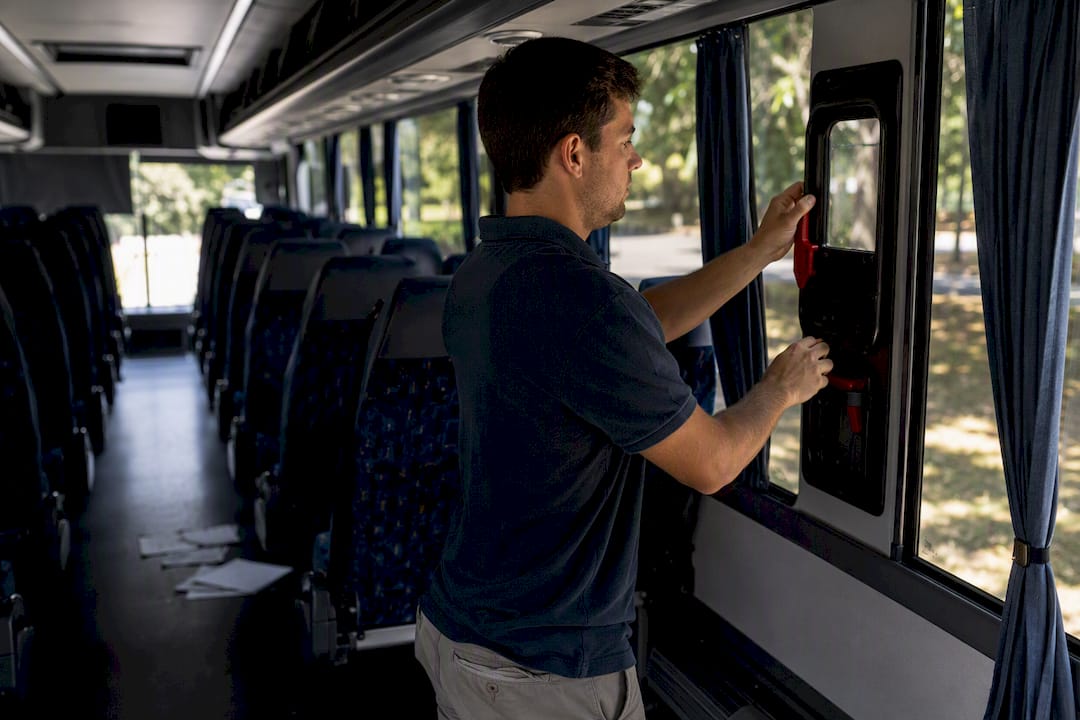
NHTSA’s 2016 final rule (opens in a new tab) requires lap and shoulder belts on newly manufactured large motorcoaches, but older vehicles built before the rule took effect may have no belts at all. Model year matters more than most planners realize. Ask for the vehicle’s build year or VIN and confirm seatbelt presence in writing rather than assuming every motorcoach in a fleet is equipped the same way.
Gross vehicle weight rating (GVWR) and vehicle class also affect which safety features apply and how insurance minimums are calculated, so it’s worth confirming the vehicle type matches what you were quoted. Before the trip, request:
- Recent vehicle inspection logs and any open recall notices tied to the VIN
- Tire maintenance and replacement history
- Confirmation of onboard emergency equipment: marked exits, a fire extinguisher, first-aid kit, and a driver reminder system such as Child Check-Mate for buses that also run daily school routes
NTSB safety alerts (opens in a new tab) tied to real crash investigations repeatedly point back to the same preventable failures: worn tires, skipped inspections, and missing seatbelts. None of those are hidden information. They’re all things you can ask for in a single email.
Driver Qualifications and Operational Controls
The bus matters, but the person behind the wheel matters more. Confirm the assigned driver holds a Commercial Driver’s License (CDL) with passenger endorsement and meets current DOT medical certification requirements before the trip.
Fatigue is one of the most underestimated risks in charter transportation. Federal Hours-of-Service rules (opens in a new tab) cap how long a driver can operate without rest, and Electronic Logging Devices (ELDs) track compliance automatically. For long trips or overnight travel, ask whether the carrier plans a second driver or builds in mandatory rest stops. A single driver pushing through an eight-hour overnight run on minimal sleep is exactly the scenario HOS rules exist to prevent.
- Request the CDL and passenger endorsement status for the driver assigned to your trip.
- Ask for evidence of ELD compliance or a documented rest plan for multi-day trips.
- Confirm the carrier runs pre-employment background checks and ongoing drug and alcohol testing.
- Request a copy of the driver’s training certification summary.
- Get a direct contact for the carrier’s safety supervisor, not just a booking agent.
Pro Tip: Ask for the driver roster at least a week before departure, not the morning of. Last-minute driver swaps are common, and you want time to confirm the replacement meets the same standard.
Day-of Safety Procedures Every Trip Needs
The paperwork matters, but so does what happens the morning students board. Require the driver to deliver a live pre-trip safety briefing covering seatbelt use, emergency exit locations, and evacuation steps, and have a chaperone document that it happened. FMCSA guidance on pre-trip briefings is explicit that this step shouldn’t be assumed. It has to be requested and verified.
Beyond the briefing, lock in these day-of basics:
- Assign chaperones throughout the bus, not clustered at the front, so no section goes unsupervised
- Set a no-standing policy and assigned seating, especially for younger groups
- Confirm the driver carries a working phone and knows the district’s emergency contact chain
- Establish a backup transportation plan in case of a breakdown, plus a clear reporting procedure for any incident
Pro Tip: Put your chaperone-to-student ratio and seating rules in writing and share them with parents before departure. It sets expectations and gives chaperones something concrete to enforce instead of improvising on the fly. Review chaperone roles and placement guidance (opens in a new tab) before finalizing your trip roster.
Building Safety Into Your Charter Contract
The best time to enforce every standard above is before you sign anything. Build these requirements into your RFP and contract language so they’re not negotiable after the fact.
Pre-award, collect: the carrier’s USDOT number, current FMCSA snapshot, a COI showing the $5 million minimum, a list of vehicles that could be assigned to your trip, the driver roster, and recent maintenance logs. The UMA Student Motorcoach Travel Best Practices guide (opens in a new tab) recommends going a step further and maintaining a district-approved carrier list vetted by a qualified safety examiner, rather than re-vetting from scratch every time a trip comes up.
Contract clauses worth including:
- Mandatory seatbelts on the assigned vehicle, confirmed in writing
- A required, documented pre-trip safety briefing with a signed roster
- Adherence to HOS and ELD requirements for the driver assigned
- Clear substitution and cancellation terms if the original vehicle or driver changes
- Insurance indemnity language tied to the $5 million COI minimum
- Reject any vendor with an Unsatisfactory rating or no visible operating authority, regardless of price
- Track compliance documents in a single folder through both the bidding and pre-trip phases so nothing gets lost in email threads
Districts managing facility and equipment compliance on a larger scale often use structured audit frameworks; the same logic behind audit-ready compliance documentation (opens in a new tab) applies just as well to transportation vendor files. Insurance documentation specifically deserves its own review; see this breakdown of liability protection for group travel (opens in a new tab) for what COI language should actually say.
How Group Travel Network Handles This in Practice
Most districts don’t have a full-time compliance officer dedicated to bus vetting, which is exactly why this process breaks down. Grouptravelnetwork built its trip coordination process around closing that gap. Dedicated trip coordinators collect USDOT snapshots, current COIs, and driver and vehicle documentation as a standard part of booking, rather than something a school administrator has to chase down separately.
That documentation feeds directly into the Safe Travel Planning Steps for Student Groups (opens in a new tab) framework, which extends verification through day-of procedures like pre-trip briefings and chaperone coordination.
Managed providers that centralize COI collection, vendor vetting, and day-of oversight reduce administrative risk for school districts by standardizing documentation and enforcing contract clauses consistently, rather than leaving each trip’s paperwork to chance.
For districts planning performance tours or educational group trips (opens in a new tab), that centralization means one team tracking safety compliance across every vendor, every trip, all season.
Where to Verify Charter Bus Safety Information
Bookmark these before your next RFP goes out:
- FMCSA Bus Safety Search (opens in a new tab) for carrier ratings and BASIC scores
- NHTSA and NTSB guidance on seatbelt requirements and pre-trip briefings
- The UMA student motorcoach travel guide (opens in a new tab) for district policy templates
What Administrators Get Wrong About Bus Safety
Most districts still shop for charter buses the way they shop for copier paper: lowest bid wins, safety assumed. That’s backward. The research is consistent that price-driven selection is one of the most common and preventable mistakes in student transportation procurement, and it’s usually the districts that skip the FMCSA check who end up explaining a preventable incident to parents later.
The conventional advice, “ask if the company is safe,” is nearly useless. Every sales rep says yes. What actually works is demanding specific, checkable documents: the USDOT number, the COI, the driver roster. If a carrier hesitates on any of those three, that hesitation is the most honest answer you’ll get.
Prioritize the FMCSA rating first, above everything else. It’s free, it takes minutes, and it filters out the operators who shouldn’t be in the conversation at all. Insurance and driver documentation matter too, but they’re worth verifying only after a carrier clears that first bar. Skip the sequence and you’re just collecting paperwork from a company you never should have contacted.
Sources
- Understand your bus safety search results (opens in a new tab)
- School District Checklist: Selecting a Safe Passenger Carrier (NTSB safety alert SA-106) (opens in a new tab)
- NHTSA announces final rule requiring seat belts on motorcoaches (opens in a new tab)
- Look Before You Book (FMCSA) (opens in a new tab)
FAQ
How do I check a charter bus company’s safety rating?
Search the carrier’s USDOT number in the FMCSA Bus Safety Search and confirm the rating is Satisfactory or Conditional, never Unsatisfactory.
Do all charter buses have seatbelts?
Not necessarily. NHTSA’s 2016 rule requires lap and shoulder belts on newly manufactured large motorcoaches, but older vehicles may lack them, so confirm belt availability for the specific bus assigned to your trip.
What insurance should a charter bus company carry?
For-hire carriers transporting 16 or more passengers must carry at least $5 million in commercial liability insurance; always request a current Certificate of Insurance before booking.
Who is responsible for the pre-trip safety briefing?
The driver is responsible for delivering it, but planners should require it contractually and have a chaperone document that it occurred, since federal guidance notes this step is not automatic.
What should I do if a carrier has an Unsatisfactory rating?
Do not book them. An Unsatisfactory rating bars the carrier from interstate passenger operation, and districts should move to the next vendor on their pre-qualified list.
Recommended
- Student Bus Tours: Safe Educational Transportation Guide (opens in a new tab)
- Student Travel Safety: Protecting Students And Schools • Group Travel Network (opens in a new tab)
- Student Travel Accommodation Standards: 2026 Guide For Schools • Group Travel Network (opens in a new tab)
- Safe Travel Planning Steps For Student Groups In 2026 • Group Travel Network (opens in a new tab)