


A school or youth group can get a tax exempt hotel stay in some states, but not automatically and not everywhere. Eligibility depends on the state, the type of organization, the type of tax and how the room is paid for. Nonprofit status alone often does not qualify. In most cases you need a state-specific certificate or verification letter, and you must hand it over before or at check-in, with the group paying directly.
This guide is for school administrators, band directors, team managers and youth nonprofit leaders who book rooms for groups. It uses state tax agency rules from Texas, New York, Idaho and Massachusetts as worked examples, because they show the patterns you will meet elsewhere. Always confirm your own state and your destination state before you sign a hotel contract.
TL;DR
- Hotel tax exemptions are set by each state (and sometimes each city), so the rules at your destination apply, not the rules where your school is located.
- Being a 501©(3) or a school does not make a stay exempt by itself. In Texas, for example, an organization exempt solely on federal tax status is not exempt from hotel tax (opens in a new tab).
- Give the hotel the right certificate and proof of exemption at booking or check-in, and pay with an organization card or check, not a personal card.
- State exemptions often do not cover local hotel taxes. Ask the hotel which taxes are removed, in writing.
- Budget as if you will pay the tax, then treat any exemption as a saving you have confirmed.
Table of Contents
- Who actually qualifies for a hotel tax exemption
- Which hotel taxes can be exempt
- The forms and documents hotels ask for
- How to pay so the exemption sticks
- Confirm the hotel applied it
- What happens if the paperwork does not qualify
- Budget the tax first, then count the savings
- Let us handle the hotel paperwork with you
- A pre-trip checklist
- FAQ
- Sources
Who actually qualifies for a hotel tax exemption
Three broad groups tend to qualify in the US: federal government travelers on official business, certain state and local government employees, and qualifying nonprofit, religious, charitable or educational organizations. Foreign diplomatic personnel can also claim relief with a valid card, and the State Department notes that prepaid online bookings cannot guarantee relief (opens in a new tab).
Schools and youth groups fall into the third category, and that is where most confusion starts. A few examples show how narrow the definitions can be.
Texas. Employees and representatives of qualifying nonprofit religious, charitable or educational organizations are exempt from state hotel tax on official business (opens in a new tab). But the organization must qualify and apply, and the Comptroller sends instructions for getting a verification letter. The Comptroller’s FAQ adds that school groups are not exempt by law and must apply (opens in a new tab). Booster clubs and similar groups do not count as educational organizations, though a qualifying 501©(3) or 501©(4) may qualify for sales tax and, where applicable, franchise tax exemptions.
Idaho. The state’s lodging form limits the exemption to listed qualified organizations and qualifying public or nonprofit schools. Auxiliary groups such as parent-teacher associations, booster clubs and alumni groups do not qualify under that rule (opens in a new tab).
Massachusetts and New York. Both treat dormitory-type lodging at educational institutions differently from hotel rooms. Massachusetts exempts lodging, including dormitories, at educational institutions, but not accommodations at an institution-operated hotel or motel open to the public (opens in a new tab). New York’s sales tax guide describes a similar line, noting that the exemption for college lodging often disappears when the institution runs a hotel open to the public with 100 or more rooms (opens in a new tab).
The practical lesson: the word “school” on your letterhead is the start of the conversation, not the end of it.
Groups that usually do not qualify
These are the groups that most often assume they do and then get a surprise on the folio:
- Booster clubs, parent-teacher organizations and alumni associations (excluded in both Texas and Idaho, as above)
- Individual students, parents and chaperones paying personally
- A nonprofit whose only basis for exemption is its federal tax-exempt letter
- Private teams or clubs with no qualifying educational or charitable status in the destination state
If your trip is funded through a booster club, ask your school business office whether the school itself can be the contracting and paying party. That single decision can change the answer.
Which hotel taxes can be exempt
Your hotel bill can carry several different charges:
- State sales tax or state hotel occupancy tax
- County or city occupancy tax (often called a bed tax or transient occupancy tax)
- Tourism, convention or special district assessments
- Resort or destination fees, which are usually the hotel’s own fees, not taxes
An exemption for one does not mean an exemption for all. Texas says a hotel may ask for the organization’s exemption letter or verification, and that local hotel taxes still must be paid even when the state exemption is accepted (opens in a new tab). New York makes a related point: qualifying for sales tax exemption does not automatically exempt the occupant from hotel occupancy taxes unless specific procedures, such as providing a completed exemption certificate (opens in a new tab), are followed.
That is why a quote that says “tax exempt” is not enough. Your contract should state which taxes are being waived.
Rooms, meeting rooms and banquet space
Texas applies state hotel occupancy tax to charges of $15 or more per day for sleeping rooms, meeting rooms and banquet rooms, as the Comptroller’s exemption publication (opens in a new tab) shows in its coverage of what the tax applies to. If your band needs a rehearsal room or you host an awards banquet at the hotel, ask whether those charges are exempt too. Do not assume they follow the sleeping rooms.
Long stays, rentals and dorms
Many states treat stays of 30 days or more differently, but a school trip rarely lasts that long, so do not count on it. Dorm lodging at colleges can be exempt where renting the same space to the general public may be taxable, according to New York’s guide for hotels (opens in a new tab). Short-term rentals such as apartments and houses follow their own licensing and tax rules, and a tourist rental licenses guide (opens in a new tab) shows how much the documentation changes with the type of property. For school groups, a standard hotel contract is usually the simplest route to an exemption the hotel will honor.
The forms and documents hotels ask for
There is no single national hotel tax exempt form. Each state publishes its own, and some do not have one at all. When searching for the right paperwork, look for your destination state’s department of revenue or comptroller page.
| State | Document | What to know |
|---|---|---|
| Texas | Form 12-302 plus proof of exemption | Each claimant except a permanent resident gives it to the hotel (opens in a new tab); organizations apply for a verification letter first |
| New York | Exemption certificate such as Form ST-129 for government occupancy | Documentation must reach the hotel no later than 90 days after the last day of the first period of occupancy (opens in a new tab) |
| Idaho | Form ST-104HM | Limited to listed qualified organizations and qualifying schools (opens in a new tab) |
| Massachusetts | Guidance in Technical Information Release 19-3 | Dormitory-style lodging at educational institutions is treated differently from public-facing hotels (opens in a new tab) |
Texas also tells hotels not to send certificates to the state. The hotel keeps them. Hotel operators must generally keep copies of exemption certificates for a set period, four years in Texas (opens in a new tab), so expect the front desk to keep your form and ask for it complete.
What a complete submission looks like
- The correct state form, filled out with the organization’s legal name, not a teacher’s name.
- Proof of exemption, such as a verification letter where the state issues one.
- A letter on school letterhead naming the trip, dates and the number of rooms.
- A copy of the organization’s payment method (card or check details) in the organization’s name.
- A photo ID or business card for the traveler, if the hotel requests it. Texas’s certificate notes that the operator may ask for identification (opens in a new tab).
How to pay so the exemption sticks
Payment method is the most common reason a valid exemption is refused. Idaho is explicit: lodging furnished to a qualified organization is exempt only when the charge is billed directly to and paid directly by the organization (opens in a new tab), and employees must use a qualifying card paid by the organization, not personal funds or personal cards.
For a group, that means:
- Have the school or organization pay the master bill, not individual chaperones.
- Use an organization card, purchase order or check, and make sure the name on it matches the exemption paperwork.
- Avoid reimbursing a teacher who paid personally. That can undo the exemption.
- If students pay per room, ask the hotel in advance how it will handle taxes, since individual payments often lose the exemption.
Our school trip payment policy guide (opens in a new tab) covers how to set up deposits and timelines so the organization, not families, is the payer of record on hotel charges.
Confirm the hotel applied it
Do not wait for the final bill.
- Before booking: ask the sales manager which taxes the hotel will remove and which forms it needs. Get the answer in an email.
- In the contract: put the exemption language in writing. Our guide to hotel contracts for schools (opens in a new tab) lists the clauses worth requiring before you sign.
- At check-in: hand the certificate to the front desk, not a bellhop, and ask for a receipt or a note on the master folio.
- At checkout: read the folio line by line. Compare the tax lines with what was promised.
- After the trip: file the paperwork copy with your trip records for your auditor.
What happens if the paperwork does not qualify
You pay the tax. It is that simple, and it should be in your budget from the start. Texas is direct that an organization exempt only on its federal tax status is not exempt from hotel tax (opens in a new tab).
Even a qualifying group can run into delays. A Texas city’s hotel training document explains that a claimant may need to pay tax until exemption status is verified, after which the hotel may give a refund or credit (opens in a new tab). Refund procedures are the hotel’s, so ask about timing before arrival and set a date in writing.
If a hotel refuses a valid certificate, stay calm at the desk, pay the bill under protest with the organization’s payment method, and send the documents to the hotel’s accounting office the same week. Then ask your state tax agency or your school’s business office how to proceed. Do not argue it out in a lobby with 40 students waiting.
Budget the tax first, then count the savings
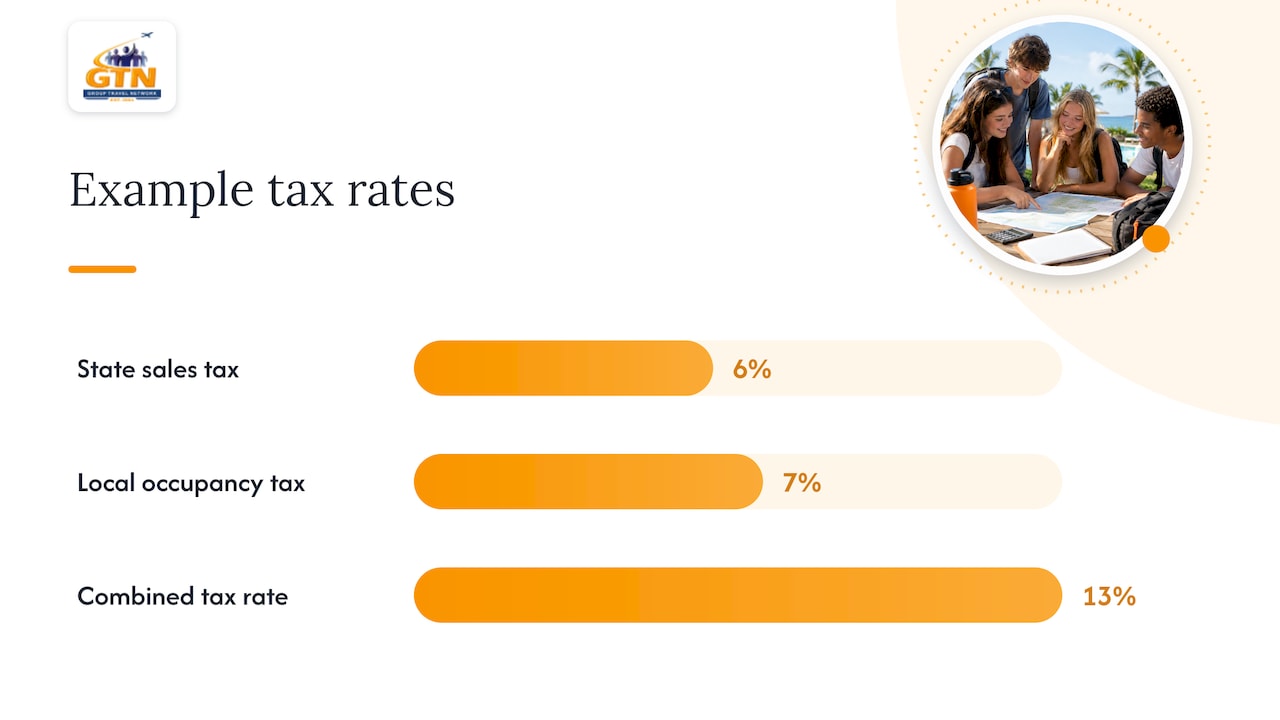
A typical hotel bill can carry both a state sales tax and a local occupancy tax. One industry article gives the example of 6% state sales tax plus 7% local occupancy tax, 13% in total. Your destination’s rates will differ. On a trip with 25 rooms for three nights at a $150 room rate, the room charge before tax is $11,250. At 13%, the tax would be $1,462.50, so it is worth pursuing, but only if the paperwork is realistic for your group.
Build the budget with taxes included, and treat any exemption as a confirmed saving only after the hotel has agreed to it in writing. Our step-by-step guide to budgeting school trips (opens in a new tab) shows where lodging fits in the total cost per student.
Perspective
We plan group trips for schools, bands and youth organizations, and hotel tax is one of the details that causes the most late-stage stress. The usual story: a director hears that schools are tax exempt, budgets accordingly, and finds out at checkout that the hotel wants a form that was never filed.
Our view is that the exemption should be handled as part of trip design, not as an afterthought. A dedicated trip coordinator can ask each hotel up front which taxes it will waive, which form it needs and who must pay, then build that into the contract and the payment schedule. That is the kind of detail we aim to take off an administrator’s plate.
We also tell groups to plan conservatively. Budget with taxes in, collect the paperwork early, and let any savings be a pleasant surprise rather than a hole in the budget.
Donovan
Let us handle the hotel paperwork with you
If you would rather not chase certificates state by state, our coordinators build tax questions into the planning of your performance tours (opens in a new tab) and educational trips (opens in a new tab). We work from your destination, your organization type and your payment plan, so the hotel knows what to expect before anyone arrives.

To talk through your next trip, start at Group Travel Network (opens in a new tab).
A pre-trip checklist
- Identify the destination state and city, and look up its lodging tax exemption page.
- Decide which entity will contract and pay: the school, the district or a nonprofit.
- Confirm that entity qualifies in the destination state, not only in your home state.
- Request the state verification letter early if one is required.
- Complete the form in the organization’s legal name.
- Ask the hotel which taxes it will waive and get it in writing.
- Pay with an organization payment method.
- Review the folio at checkout and keep copies.
If your hotel list is not final, our student-friendly hotels roundup (opens in a new tab) and guide to hotel youth group policies (opens in a new tab) can help you narrow down properties that are set up for groups.
FAQ
Can a school get a tax exempt hotel stay?
Sometimes. It depends on the state where the hotel is located and on the school’s status there. In Texas, for example, school groups are not exempt by law and must apply, so check your destination state’s tax agency before you book.
Are hotels tax exempt in New York State?
New York has exemptions for certain occupants, but they require procedures such as a completed exemption certificate. The state guide says that sales tax exemption for an organization does not automatically remove hotel occupancy taxes. Ask the hotel which forms it needs.
What form do I give the hotel?
It differs by state. Texas uses Form 12-302 with proof of exemption, and Idaho uses Form ST-104HM. Look for your destination state’s lodging exemption form on its tax agency website and bring it with the organization’s proof of status.
Does a booster club qualify for hotel tax exemption?
Usually not. Both Texas and Idaho state that booster clubs do not qualify as educational organizations under their rules. If a school is the contracting and paying party, the answer may be different, so ask the school business office.
What if the hotel charges tax anyway?
Pay with the organization’s payment method, keep the folio and send your exemption documents to the hotel’s accounting office. Some hotels refund or credit tax once the exemption is verified, so ask about their process before you travel.
Sources
- Hotel Occupancy Tax Exemptions, Texas Comptroller (opens in a new tab)
- Frequently Asked Questions About Exemptions, Texas Comptroller (opens in a new tab)
- Form ST-104HM Tax Exemption on Lodging Accommodations, Idaho State Tax Commission (opens in a new tab)
- Publication 848: A Guide to Sales Tax for Hotels, New York State (opens in a new tab)
- TIR 19-3: Room Occupancy Excise changes, Massachusetts (opens in a new tab)
- Hotel Tax Exemption, U.S. Department of State (opens in a new tab)
- Information for Lodging Providers Hotel Training Packet (opens in a new tab)
- Tourist rental licenses guide (opens in a new tab)
Recommended
- Student-Friendly Hotels: Top 10 Picks For School Groups 2026 (opens in a new tab)
- Student Travel Accommodation Standards: 2026 Guide For Schools (opens in a new tab)
- Hotel Youth Group Policies Every Organizer Must Enforce (opens in a new tab)
- Hotel Contracts For Schools: What To Require Before You Sign (opens in a new tab)