

September 17, 2026
Practical School Trip Risk Assessment Template, Before, During, After
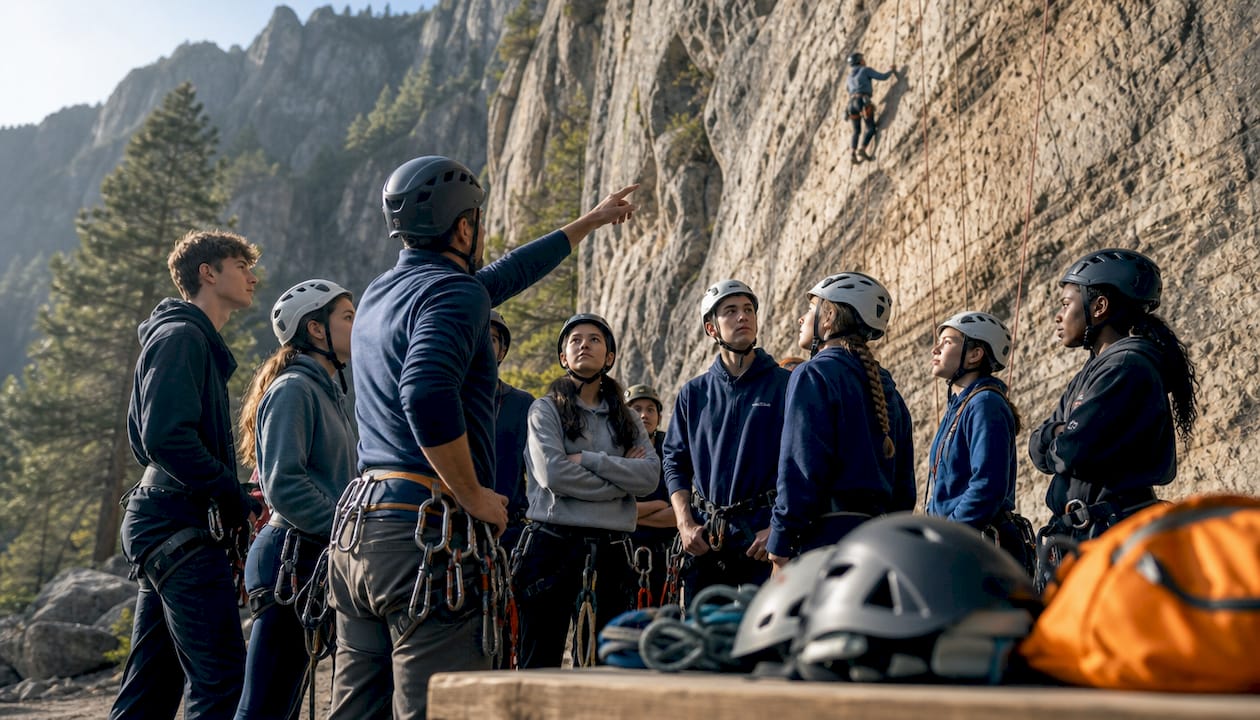
A valid school trip risk assessment identifies every foreseeable hazard, pairs each one with a specific, verifiable control, names who is responsible for what, and lays out an emergency and approval plan before anyone boards a bus. It is not a form you fill out and file. It is a working document. Skip ahead to the template and checklist below, adapt it to your trip, and you have the foundation of a plan an approver will actually sign off on.
TL;DR:
- Risk assessments must be specific, detailing exact controls like assigned staff, schedules, and clear actions, not vague instructions.
- Approval requires demonstrating due diligence, including a signed review by trained personnel and comprehensive recordkeeping of safety measures.
- Transport and activity controls need to address contingency plans for breakdowns, delays, or emergencies, with documented supervision on boarding and travel.
- All students’ medical information must be collected, securely stored, and accessible to designated adults, with regular updates right before departure.
- Ongoing use of the risk assessment during the trip, with live records, role cards, and debriefs, ensures safety procedures remain active and effective.
Table of Contents
- What Is a School Trip Risk Assessment and When Do You Need One?
- Legal, Policy and Approval Requirements: What Approvers Want to See
- Common Hazards and the Controls That Actually Hold Up
- Supervision, Roles, and Adult to Student Ratios
- Transport and Travel Risks: Coach, Minibus, and Public Transit
- SEND, Medical Needs, Privacy, and Documentation
- Emergency Response and Communication Plan
- How to Write a Risk Assessment (Plus a Template You Can Copy)
- How Experienced Trip Coordinators Keep Assessments Alive
- Making Risk Assessments Practical, Not Just Paperwork
- How Group Travel Network Takes the Load Off Trip Leaders
- Sources
- FAQ
What Is a School Trip Risk Assessment and When Do You Need One?
Not every outing needs the same level of paperwork. A walk to the local library differs enormously from a five-day trip to a national park with a rock-climbing component, and treating them identically wastes time on the easy trip and shortchanges the risky one.
Government guidance on educational visits draws a clear line between routine, low-risk visits covered by standing school policy and trips that need a detailed, trip-specific risk assessment and higher-level approval. The factors that push a trip into that second category include distance from school, the type of activity (water, height, wilderness), how remote the location is, and whether specialist instructor skills are required.
The trip leader typically drafts the assessment. Approval sits with someone else, usually an Educational Visits Coordinator, outdoor education adviser, or the head or a governing body member, depending on your district’s policy. A complete assessment covers five things at minimum: the destination itself, transportation to and from it, every planned activity, the participants involved (age, ability, medical needs), and the full duration of the trip, including overnight stays if applicable.
Legal, Policy and Approval Requirements: What Approvers Want to See
Approvers are not reading your document for style. They are checking whether it proves due diligence, and that means specific things need to be visible on the page.
First, the policy check. Does the trip connect to curriculum or a stated educational purpose? Does it require sign-off from a head or governing body under your school or district’s own procedures? Districts often set rules here: some require advance lead times for international travel, plus blackout periods when trips cannot be scheduled at all, as outlined in Broward County’s field trip manual. Build those windows into your planning calendar early, not after you’ve already booked transportation.
Second, the competent-person review. An EVC or outdoor adviser signing off is not a formality. Their approval means someone with training has actually checked your hazard list against the activity and found the controls adequate.
Third, recordkeeping. Legal analysis of school trip liability recommends a formal approval process that reviews crisis management plans, supervision ratios, medical planning, and communication protocols before a trip proposal gets a green light, according to Venable LLP’s overview of school trip risk management. Attach consent forms, provider certifications, and staff training records to the assessment itself, not to a separate folder nobody checks.
Common Hazards and the Controls That Actually Hold Up
The difference between a real risk assessment and a box-ticking exercise comes down to specificity. “Supervise students near water” is not a control. “Named group leader Ms. Torres stations herself at the pool’s shallow end from 1:00 to 2:30 PM and performs a headcount every 15 minutes” is a control, according to guidance on writing effective school trip risk assessments. An approver can verify that. A vague instruction, they can’t.
Here are the hazard categories that show up on nearly every trip, with the kind of control detail that passes review:
- Roads and traffic: Assign a designated crossing point, station a staff member at it, and require hand-holding or paired walking for younger groups.
- Slips, trips, and falls: Identify uneven surfaces or stairs in advance and brief students on footwear requirements before departure.
- Water hazards: Require certified lifeguard supervision at any pool, lake, or beach activity, and set a clear no-swim zone with visible signage.
- Weather: Set a temperature or precipitation threshold that triggers a shift to an indoor backup activity, decided by the trip leader on-site.
- Public spaces: Establish a buddy system, a fixed meeting point, and a check-in time for any unsupervised browsing period, such as at a museum or mall.
- Animals: Brief students on approach distance for any wildlife encounter and confirm the venue’s own animal-handling protocols in advance.
Tailor every one of these to the group in front of you. A control that works for a group of 17-year-old seniors on a college tour is inadequate for a group of third graders at a petting zoo, and an activity-heavy outdoor trip needs tighter physical controls than a museum visit regardless of age.
Supervision, Roles, and Adult to Student Ratios
An assessment without named roles is just a hazard list. Assign these positions before you finalize anything else:
- Trip leader — holds overall responsibility and final call on schedule changes or activity cancellations.
- Deputy leader — takes over if the trip leader is unavailable or dealing with an incident.
- First-aid lead — carries the medical kit and is the first responder for any injury.
- Group leaders — each supervises a fixed subgroup and takes attendance at every transition point.
- Backmarker — walks at the rear of any moving group to catch stragglers.
- Family liaison — the single point of contact for parents if something goes wrong.
There’s no single mandated ratio that fits every trip. Age, activity risk, remoteness, and the number of students with additional support needs all push the number of adults up or down. A day trip to a science center might run fine at one adult per 12 students; an overnight wilderness trip with SEND students in the group often needs closer to one adult per four or five. Brief every chaperone on their specific role in writing, and have them sign off that they’ve read it. Vetted, written expectations for chaperone conduct also reduce behavioral and liability problems on the trip itself, a point Venable LLP’s risk management guidance makes directly.
Transport and Travel Risks: Coach, Minibus, and Public Transit
The journey is often riskier than the destination, and it’s the part of the assessment schools rush through most.
For coach or minibus travel, document boarding supervision (who counts heads on and off), a fixed seating plan, seatbelt checks before departure, and who is authorized to carry and administer medication en route. For trips using public transit, controls look different: platform supervision at boarding, a fixed grouping system so no student travels alone, a pre-departure briefing on what to do if separated, and a designated meeting point if the group gets split across train cars.
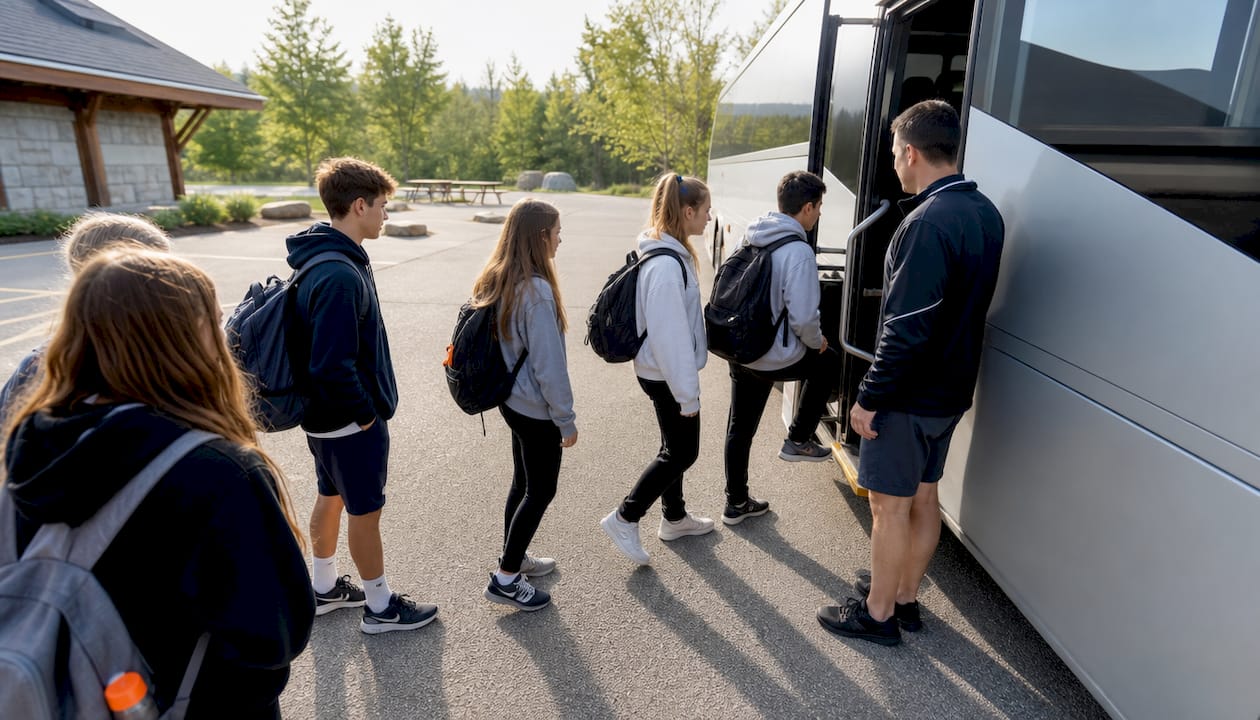
Build in contingency actions before you leave, not after something happens. What’s the plan if the bus breaks down? If a train is delayed by two hours? If a substitute driver shows up who wasn’t part of the pre-trip briefing? Background reading on the aftermath of transport incidents, such as this overview of bus accident claims processes, makes a strong case for documenting exactly who supervised boarding and seating, since that documentation is often the first thing scrutinized after an incident.
SEND, Medical Needs, Privacy, and Documentation
Every student with a medical condition, allergy, or additional support need should have that information collected before the trip and made available to the right adults on it. That means noting medication schedules, emergency action plans for conditions like asthma or severe allergies, and who has informed consent to administer medication if needed.
Handle this information the way you’d want your own child’s data handled. Keep a dedicated sensitive-documents folder in both hard copy and encrypted digital form, since a paper backup keeps working when a phone dies or a signal drops, according to Wellesley College’s guide for academic field trips. Destroy or securely archive that folder immediately once the trip ends, per your district’s data policy.
Pro Tip: Print the sensitive-documents folder the morning of departure, not three days before. Medication changes and last-minute allergy updates happen constantly, and a stale folder is worse than no folder at all.
Specify exactly who carries the folder, who’s authorized to administer medication, and how consent was documented. A medical forms checklist and template can speed up this part of the process considerably.
Emergency Response and Communication Plan
Every trip needs a plan for the moment something goes wrong, and that plan has to name people, not just describe procedures.
Define an on-call team back at school who can be reached at any hour, and designate a family liaison whose only job during an incident is communicating with parents. Decide in advance who talks to media, if it ever comes to that, and who has authority to make legal or district-level calls.
Specific scenarios need specific answers written into the plan:
- Missing student: Who searches, who calls it in, and how long before local authorities are contacted?
- Serious injury: Who provides first aid, who calls emergency services, and who notifies the family?
- Vehicle accident: Who accounts for all students, and who contacts the district office?
- Severe weather: Who makes the call to shelter in place versus evacuate, and by what deadline?
An effective emergency plan needs assigned roles and immediate access to contacts and medical records built in from the start, not assembled during the crisis, per Wellesley College’s field trip guide. After any incident, no matter how minor, write it down and hold a debrief within a day or two while details are fresh.
How to Write a Risk Assessment (Plus a Template You Can Copy)
Building the document is a sequence, not a single sitting. Work through it in this order:
- Gather venue information. Contact the destination directly and ask about known hazards, staffing, and emergency procedures on-site.
- Do a pre-visit if you can. Nothing replaces walking the route or checking the pool depth yourself.
- List every hazard specific to the destination, activity, transport, and group.
- Write controls for each hazard, naming a person, a time, and an action.
- Assign roles using the supervision structure covered above.
- Build the emergency plan with on-call contacts and scenario steps.
- Submit for approval to your EVC or district-designated approver.
- Distribute the final version to every chaperone before departure day.
A workable template needs these fields, which mirror what education-focused templates commonly require:
- Trip name, date, and destination
- Trip leader and full attendee list
- Hazard, who might be harmed, existing controls, additional controls needed
- Named responsibilities for each control
- Emergency contacts and nearest urgent care or hospital
- Approval signature and review date
Before departure, run a quick checklist so nothing slips through:
- Final headcount matches the approved attendee list
- Medication and medical folder are packed and assigned to a named adult
- Chaperones have been briefed on their specific roles
- Emergency contact protocols have been confirmed with every adult on the trip
For a broader framework that ties this checklist into full trip logistics, this step-by-step group travel planning guide walks through the surrounding planning calendar.
How Experienced Trip Coordinators Keep Assessments Alive
A risk assessment that sits in a binder after approval is worthless the moment something unexpected happens. The most effective ones stay in active use: a quick briefing the morning of departure, a working reference during the trip itself, and a real debrief afterward, not just a form marked complete.
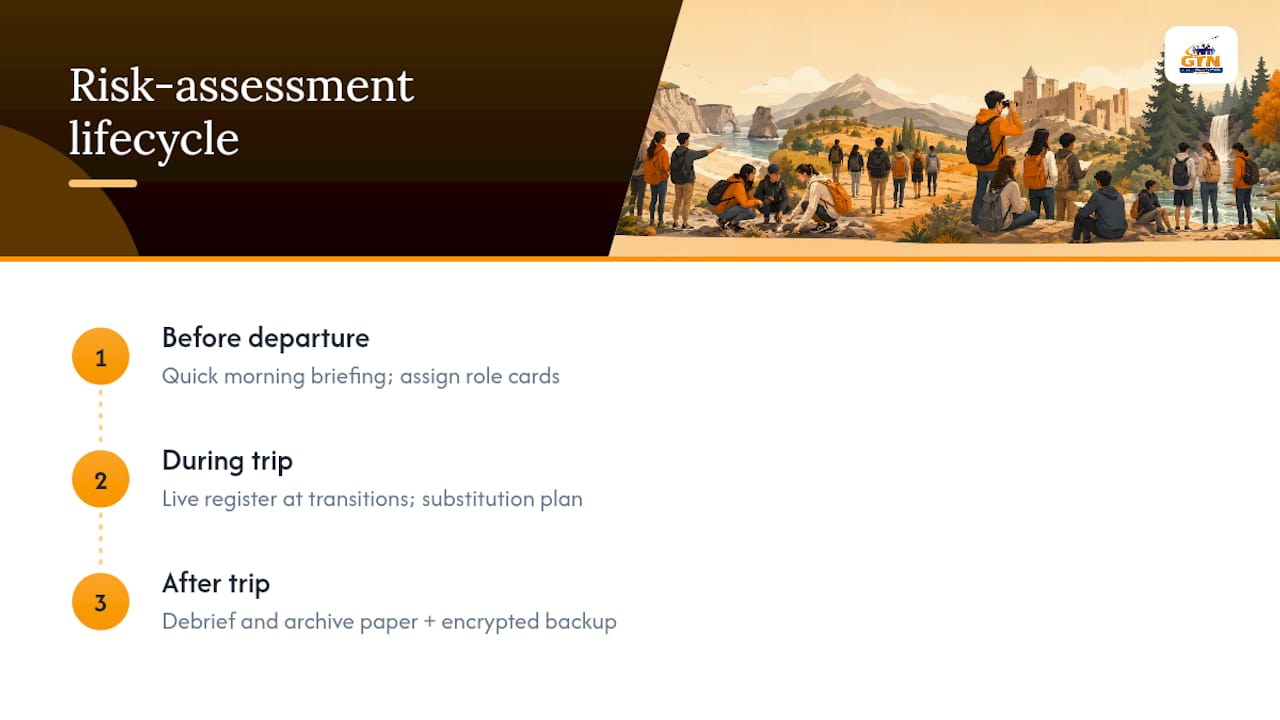
Coordinators who run trips regularly rely on a few concrete habits: printed role cards each adult keeps on them, a sensitive-documents folder that travels as both paper and encrypted digital backup, and a live register checked at every transition point, with a clear substitution procedure if a chaperone has to step out.
Pro Tip: Assign one adult the sole job of the register at every headcount. Splitting that responsibility across multiple people is how students get missed.
This is where dedicated trip coordinators earn their keep. Groups working with a managed travel partner get support built around exactly this kind of operational discipline, from vendor vetting to on-trip coordination, which is part of how travel experts make student trips safer.
Making Risk Assessments Practical, Not Just Paperwork
The worst risk assessments I’ve seen aren’t the ones missing information. They’re the ones written to satisfy an approver and then never opened again. A document only protects students if the trip leader can flip to it mid-trip and find an actual answer.
Treat the assessment as an operational tool, not a compliance artifact, and it improves the trip itself, not just the safety record.
— Donovan
How Group Travel Network Takes the Load Off Trip Leaders
Writing a strong risk assessment is one job. Running the logistics behind it, coordinating vendors, transportation, and on-site contacts, is another entirely, and most trip leaders are doing both on top of a full teaching or coaching load. Group Travel Network exists for that second half: dedicated trip coordinators who handle vendor vetting, transportation logistics, and on-trip coordination so your risk plan has fewer moving pieces to track alone.

For schools planning curriculum-linked travel, Educational Endeavors pairs planning support with safety-focused coordination from booking through return. Performance groups get a similar setup through Performance Tours, built around itineraries with a dedicated coordinator managing the pieces that usually eat up a trip leader’s evenings. Online registration and flexible payment plans round out the support, so the operational side of your next trip doesn’t fall entirely on one person’s desk. Reach out through the Group Travel Network homepage to talk through your destination and get a coordinator assigned to your trip.
Sources
Keep these on hand when drafting or reviewing an assessment:
- Guide for academic field trips (Wellesley College)
- Gov
- How to Write a School Trip Risk Assessment – AllSchools
Always check your own district’s field trip manual first. Local lead times and blackout periods override any general guidance.
FAQ
What Are the 5 Things a Risk Assessment Should Include?
A complete school trip risk assessment includes a hazard list, specific controls for each hazard, named roles and responsibilities, an emergency communication plan, and a documented approval sign-off from a competent person like an EVC.
How Do You Do a Travel Risk Assessment for a School Trip?
Gather venue and transport details, list every foreseeable hazard tied to the destination and activities, write a specific control for each one, assign supervision roles, build an emergency plan, and submit the finished document for approval before booking is final.
What Is a School Risk Assessment?
A school risk assessment is a written document that identifies foreseeable hazards on a trip or activity, sets out the controls used to reduce each one, and records who is responsible for supervision and emergency response.
What Are Some Examples of Risk Assessment Hazards?
Common examples include road crossings on the way to a venue, water hazards at a pool or beach, slip and fall risks on uneven terrain, severe weather during outdoor activities, and separation risk in crowded public spaces.
Does Group Travel Network Help With Risk Planning for School Trips?
Group Travel Network provides dedicated trip coordinators, vendor vetting, and travel protection options that support a school’s own risk assessment and reduce the operational burden of coordinating transport, activities, and on-trip logistics.
Recommended

Relax with our Student Travel Expertise .
We deliver stress-free student trips backed by an exceptional array of services you won’t find anywhere else:
- Stress-free, creative planning of customized itineraries
- Dedicated GTN Service host on every trip
- Extensive travel protection plan options
- Online, individual registration system
- Flexible payment plans and online payment options
- Bulk buyer discounts for great trips that cost less
Inclusion into #MyGTNFamily for life! (you don’t even have to remember our birthday!)
Spain
There is no place like Spain to offer a student performance opportunity or cultural student trip.
Myrtle Beach
All students love the beach! Especially a beach known for its 60 miles of pristine coastline.
Boston
Have your students experience colonial charm in the city that is considered the hub of New England.
London
Provide your student group with the “Royal” treatment! One of the world’s most recognized cities.
See What People Are Saying
“It has been my privilege to use Group Travel Network as the exclusive travel coordinator for my band for over 10 years. I can say, without doubt or hesitation, that GTN is, by far, the best travel company for student groups currently in existence. I have often said that I wouldn’t take my band across the street without GTN and that’s not far from the truth!”
“This was my first time using a company to plan our band trip. It was so easy working with Justin and Group Travel Network. We had to make several changes along the way, but they were accommodating changes and worked everything out for us. I would highly recommend using Group Travel Network.”
“What wonderful trip we had to NYC! Our group of 51 never missed a beat because of Group Travel Network and our wonderful guide, Tim. It was truly a theatre trip to remember! If you are looking for a travel company who really cares about the details, Group Travel Network is for you!”