


Start with a clear trip purpose and locked dates. Everything else in orchestra tour planning, from venue contracts to instrument freight, builds off those two decisions. If you’re staring down a blank calendar and a director’s meeting next week, here’s what to do in the next 10 days:
- Inform administration and finance office that you’re pursuing a tour, and ask about approval timelines.
- Lock a destination and travel window (even tentatively) so vendors can quote real dates.
- Collect a rough headcount and instrument list, since oversized instruments (cello, bass, harp, percussion) affect every transport quote you’ll get.
Pro Tip: Ask your school’s finance office how far in advance they need a signed contract before you promise parents a firm departure date.
Key Takeaways
Orchestra tour planning succeeds when directors lock trip purpose and dates 12 to 18 months out, then build budget, itinerary, and staffing decisions around that fixed foundation.
| Point | Details |
|---|---|
| Start early | Begin planning 12 to 18 months before departure, longer for international tours. |
| Define purpose first | Performance, cultural immersion, and competition tours each demand different venues and budgets. |
| Budget with contingency | Add 15% to every estimate; expect $800-$1,500 per student domestic, $2,500-$4,000 international. |
| Assign a Home Contact | Keep one non-traveling staff member holding all emergency documents and numbers. |
| Consider a travel partner | Grouptravelnetwork offers dedicated coordinators, online registration, and flexible payment plans for school orchestra tours. |
Table of Contents
- When to Start: A 9 to 18 Month Orchestra Tour Timeline
- Defining Your Tour’s Purpose and Choosing the Right Trip Type
- What Does Orchestra Tour Planning Actually Cost?
- Building an Itinerary That Actually Serves the Music
- Getting There: Flights, Instruments, Passports, and Visas
- Who Needs to Be on Staff: Roles, Ratios, and Emergency Planning
- Should You Hire a Travel Partner or Plan It Yourself?
- Your 12-Month Orchestra Tour Planning Checklist
- Running the Tour: A Day-of Operations Playbook
- Wrapping Up: What Happens After the Final Bow
- Why a Coordinator Changes What’s Possible on Tour
- How Group Travel Network Makes This Easier
- Sources
- FAQ
When to Start: A 9 to 18 Month Orchestra Tour Timeline
Most successful tours begin planning 12 to 18 months before departure, with international trips needing the longer runway. That window isn’t arbitrary. Venue lead times, visa processing, and instrument freight all move slower than school administrators expect, and a rushed timeline is the single most common reason tours fall apart before they start.
A realistic milestone sequence looks like this, and it comes from practitioners who’ve run these tours repeatedly: lock your destination and dates around month 18 (opens in a new tab), confirm venue contracts by month 14, finalize instrument transport arrangements at month 12, and collect the first round of student deposits by month 10.
| Months Before Departure | Milestone |
|---|---|
| 18 | Lock destination, dates, tour purpose |
| 14 | Confirm venue and performance contracts |
| 12 | Arrange instrument transport plan |
| 10 | Collect first student deposits |
| 6 | Finalize rooming lists and chaperone roster |
| 2 | Confirm final headcount, distribute itinerary |
Common pitfalls worth avoiding:
- Booking flights before confirming venue availability, which forces expensive date changes later.
- Underestimating passport processing time for students who’ve never traveled internationally.
- Skipping a contingency buffer between travel days and performance days.
Defining Your Tour’s Purpose and Choosing the Right Trip Type
Every downstream decision, budget, repertoire, venue tier, and itinerary pacing traces back to one question: why are you touring? A performance tour built around a competitive festival demands different venues than a cultural immersion trip centered on community exchanges, and both look nothing like a competition-focused tour where adjudication schedules dictate everything else. Defining that purpose early keeps repertoire, budget, and venue choice pointed in the same direction instead of pulling against each other.
A quick way to sort it:
- Performance tour → prioritize concert halls or festival stages with strong acoustics and audience draw.
- Cultural immersion → prioritize school residencies, exchange concerts, and community venues over marquee halls.
- Competition tour → prioritize adjudicated festival slots and rehearsal access near the competition venue.
The most common planning error is picking flights and hotels before nailing down this purpose, which leaves directors misaligning budget with the actual performance opportunities (opens in a new tab) available at the destination.
Pro Tip: Match your ensemble’s skill level honestly to the venue’s expectations. A strong high school orchestra sounds impressive in a 300-seat community hall and overwhelmed in a 2,000-seat concert house with a demanding acoustic.
What Does Orchestra Tour Planning Actually Cost?
Budget conversations go sideways when directors quote a single number without context. Domestic tours running 5 to 7 days typically land between $800 and $1,500 per student, while international tours commonly run $2,500 to $4,000 per student, depending on destination, flight costs, and performance venue fees.
| Line Item | Typical Share of Budget |
|---|---|
| Airfare or ground transport | 40% |
| Lodging | 20-25% |
| Instrument freight/handling | 5-10% |
| Venue and performance fees | 5-15% |
| Meals and per diems | 10-15% |
| Insurance | 3-5% |
| Contingency | 15% |
A worked example: for a 60-student domestic tour at $1,200 per student, you’re looking at roughly $72,000 total. If ticket sales, a school-district grant, and a modest fundraiser cover $15,000 combined, families are responsible for the remaining balance, ideally split across a payment plan rather than one lump sum.
Fundraising levers worth stacking, not choosing between:
- Ticket sales from a pre-tour benefit concert.
- Local arts grants and district enrichment funds.
- Business sponsorships tied to program acknowledgment at the concert.
- Group payment plans that spread parent costs over several months.
Building an Itinerary That Actually Serves the Music
A good orchestra tour itinerary balances rehearsal time, travel days, performance obligations, and enough cultural breathing room that students don’t arrive at the concert hall exhausted. A typical 5-day tour might run: Day 1 travel and check-in, Day 2 rehearsal plus a cultural site visit, Day 3 performance day, Day 4 a second performance or exchange concert plus free time, Day 5 travel home.
Venue selection deserves its own checklist, since acoustics and load-in logistics can quietly wreck an otherwise well-planned tour — and making live events more accessible is a vital part of that process to ensure all performers and audience members feel included:
- Acoustic suitability for your ensemble size and repertoire.
- Load-in access wide enough for basses, percussion, and harp cases.
- Seating capacity that matches realistic audience turnout.
- Availability of local stage crew or whether your group handles setup.
- Existing relationships for audience development (opens in a new tab) at that venue.
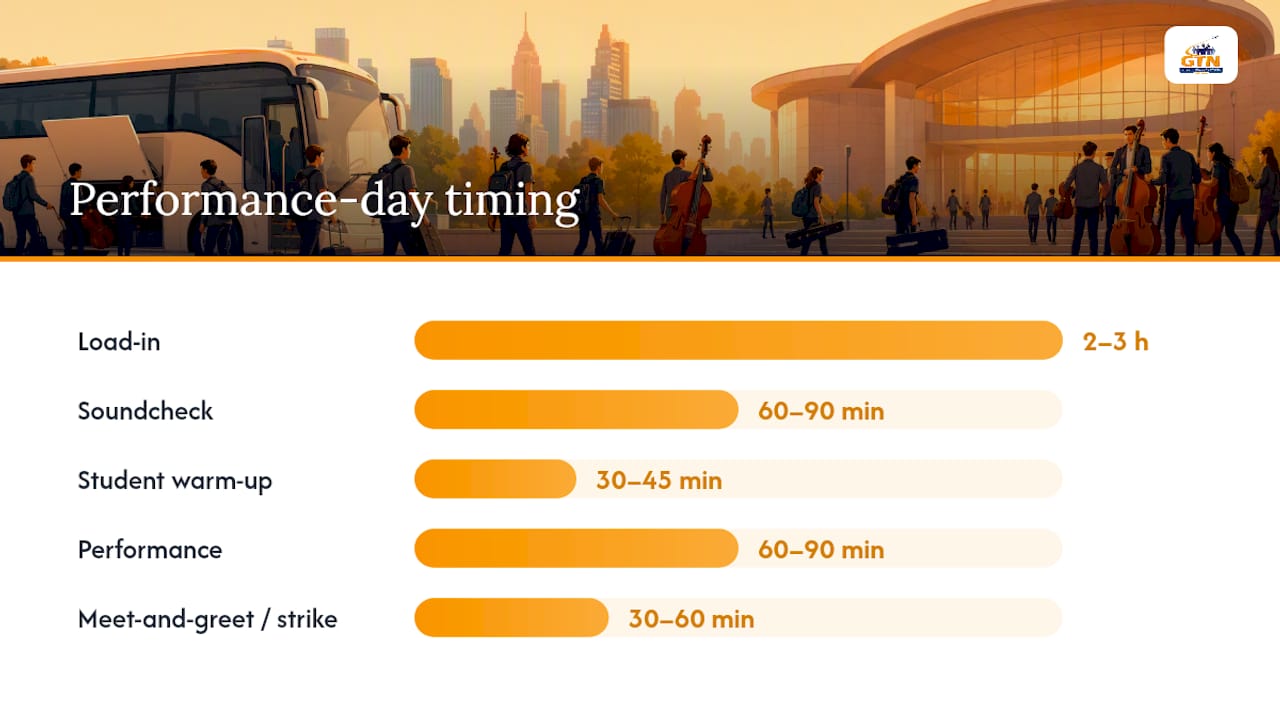
| Performance-Day Phase | Typical Timing |
|---|---|
| Load-in | 2-3 hours before soundcheck |
| Soundcheck | 60-90 minutes |
| Student warm-up | 30-45 minutes |
| Performance | 60-90 minutes |
| Meet-and-greet/strike | 30-60 minutes |
Route and venue compatibility matter more than most directors expect. Prioritizing venues whose stage size and dock access match your ensemble (opens in a new tab) prevents the scramble of discovering, an hour before soundcheck, that the loading dock can’t fit your percussion cart. Academic research on large touring operations backs this up: tours that build in planned operational overcapacity (opens in a new tab), extra time, extra hands, extra flexibility, avoid the cascading failures that ripple from one bad venue match into a ruined afternoon.
Getting There: Flights, Instruments, Passports, and Visas
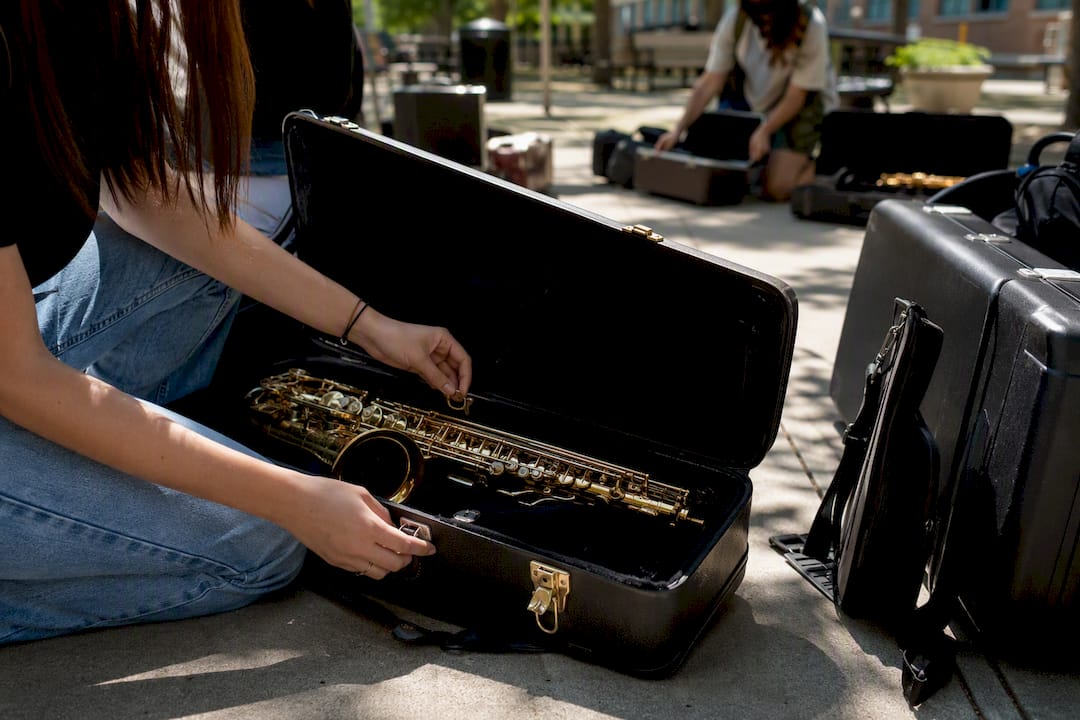
Instrument transport is where orchestra tours diverge sharply from a typical school field trip. You have three real options: rent instruments at the destination, ship instruments ahead via specialized freight, or bring them as oversized cargo or extra seats on the plane. Each carries tradeoffs. Renting locally reduces freight risk but raises cost and creates availability uncertainty (opens in a new tab) for less common instruments, while shipping ahead costs more upfront but sidesteps the nightmare of a gate agent refusing to check a cello.
For groups with unusual routing needs, oversized instruments, tight timelines, or multiple stops in one trip, chartering an aircraft (opens in a new tab) can simplify logistics that commercial airlines make painfully complicated.
Documentation is non-negotiable and always takes longer than directors budget for:
- Collect passport details for every traveling musician well before booking flights.
- Use an online form to export data directly into a spreadsheet, and make sure however you store that data complies with student data protection rules.
- Check visa requirements for the destination country based on each student’s citizenship, not just the group’s home country.
- Build in a buffer for passport renewals, since processing delays are common during peak travel seasons.
| Instrument Transport Option | Best For |
|---|---|
| Rent at destination | Common instruments (violin, flute, clarinet) |
| Ship ahead via freight | Cellos, basses, harps, large percussion |
| Oversized cargo/extra seat | Groups avoiding freight lead times |
| Charter aircraft | Complex multi-stop or large-group itineraries |
Pro Tip: Ask your travel partner or airline directly about their oversized-instrument policy in writing. Verbal assurances from a call center rarely match what happens at the gate.
Who Needs to Be on Staff: Roles, Ratios, and Emergency Planning
Every tour needs three roles filled, regardless of group size: an orchestra manager handling rehearsal and performance logistics, a tour manager handling travel and vendor coordination, and a Home Contact, someone who stays behind and holds every travel document and emergency number in case something goes wrong at the airport or on-site. For orchestras larger than roughly 45 players, consider assigning two touring managers rather than stretching one person across load-in, rehearsals, and vendor calls simultaneously.
Communication works best on a predictable rhythm. Releasing the next day’s schedule at the same time every evening, via a shared messaging platform, cuts down on the “wait, where are we supposed to be” chaos that eats into rehearsal time.
- Confirm chaperone-to-student ratios with your school district before finalizing headcount.
- Carry both group travel insurance and instrument insurance, and know exactly what each covers.
- Distribute a printed emergency contact card to every chaperone, not just a digital copy.
- Designate one Home Contact who does not travel and can act fast if a problem hits mid-tour.
Pro Tip: Test your group messaging platform with the full chaperone team before departure. A tool nobody knows how to use is worse than no tool at all.
Should You Hire a Travel Partner or Plan It Yourself?
A dedicated trip coordinator handles the parts of orchestra tour planning that eat the most director time: vendor contracts, venue negotiations, instrument freight coordination, and payment collection from dozens of families. That’s the value proposition, less because directors can’t do it themselves, and more because most directors are already teaching full-time and don’t have forty extra hours a month for contract negotiation.
Large touring operations succeed on coordinated vendor relationships (opens in a new tab), booking agents, ground transport, cargo specialists, working together instead of independently. When evaluating a potential travel partner, ask directly:
- What’s your experience with school orchestra groups specifically, versus general student travel?
- What insurance coverage is included, and what requires an add-on?
- Can you provide references from other band or orchestra directors you’ve worked with?
- How do you handle instrument-specific logistics, freight, oversized seating, customs?
- What’s your emergency response protocol if something goes wrong overseas?
Pro Tip: Ask for two references specifically from performance-based tours, not general class trips. The logistics are different enough that generic references won’t tell you much.
The decision usually comes down to group size and complexity. A small domestic tour with 20 students might work fine as a DIY effort. An international tour with 60 musicians, oversized instruments, and a festival performance slot is where a full-service travel partner (opens in a new tab) earns its cost many times over in avoided mistakes.
Your 12-Month Orchestra Tour Planning Checklist
Copy this into a shared spreadsheet or planning doc and adjust dates based on your specific departure.
- 12 months out: Define tour purpose, get administrative approval, request initial vendor quotes.
- 11 months out: Present the plan and preliminary budget to parents; open registration.
- 10 months out: Collect first-round student deposits and finalize instrument transport plan.
- 9 months out: Confirm passport status for every student; flag anyone needing renewal.
- 8 months out: Lock venue contracts and performance time slots.
- 7 months out: Begin visa applications if the destination requires them.
- 6 months out: Finalize chaperone roster and confirm staffing ratios with the district.
- 5 months out: Book ground transportation and confirm hotel room blocks.
- 4 months out: Distribute detailed itinerary drafts to families.
- 3 months out: Collect final payments and confirm dietary or medical needs.
- 2 months out: Finalize rehearsal schedule leading up to departure.
- 1 month out: Hold a pre-tour parent meeting; distribute emergency contact cards.
| Deadline | Critical Task |
|---|---|
| Month 18 | Destination and dates locked |
| Month 14 | Venue contracts confirmed |
| Month 12 | Instrument transport arranged |
| Month 10 | Student deposits collected |
| Month 1 | Emergency documents distributed |
A parent letter template line worth borrowing: “Our orchestra has been selected to perform at [venue], and we’re finalizing travel plans for [dates]. A deposit of $[amount] is due by [date] to secure your student’s spot.”
Running the Tour: A Day-of Operations Playbook
Concert logistics break into four working phases, pre-tour planning, advancing the venue, show-day operations, and post-show wrap-up, and each phase needs its own checklist rather than one master document trying to cover everything.
On departure day: confirm every student has checked in with a chaperone before airport arrival, verify instrument check-in separately from luggage, and build a 90-minute buffer before boarding closes.
- Release the next day’s schedule at the same time every evening so nobody’s guessing.
- Have a backup plan for a missed flight, including which chaperone stays with delayed students.
- Photograph instrument condition at check-in and pickup to document any damage claims.
- Keep a printed copy of the itinerary in case phones die or signal drops.
Pro Tip: Build a 30-minute staging buffer into every load-in. Buses run late more often than they run early.
Wrapping Up: What Happens After the Final Bow
The tour isn’t finished when the plane lands. Confirm all instruments cleared customs undamaged, settle any outstanding vendor payments, and track down lost-and-found items before chaperones scatter for the weekend. Send thank-you notes to venue staff and host families, since you’ll likely want that relationship again next year.
- Send a short feedback survey to students, chaperones, and venue contacts within a week.
- Document actual costs against your original budget for next year’s planning baseline.
- Archive vendor contacts and contract terms so next year’s search starts from data, not memory.
| Point | Details |
|---|---|
| Post-tour tasks | Confirm customs clearance, settle final payments, locate lost items. |
| Feedback loop | Survey students, chaperones, and venues while the trip is still fresh. |
| Documentation | Record actual vs. budgeted costs to sharpen next year’s estimates. |
Why a Coordinator Changes What’s Possible on Tour
A coordinator earns their keep in the moments nobody plans for: a cello case damaged in cargo, a venue that moves the load-in time three hours with no warning, a bus that breaks down two hours from soundcheck. The difference between a tour that recovers smoothly and one that spirals is usually whether someone on the ground has already solved a version of that exact problem before.
The operational habit worth stealing is the pre-built escalation path. Every issue gets triaged fast: can the tour manager handle it on-site, or does it need the Home Contact, the insurer, or the school back home? Waiting to figure that out mid-crisis wastes the exact minutes you need most. A coordinator who’s run a dozen tours already knows which problems are minor and which ones need an immediate phone call.
What conventional planning advice underestimates is how much of tour success comes down to redundancy, backup instruments, backup drivers, a second person who knows the emergency contacts, rather than perfect planning that assumes nothing goes wrong. Nothing ever goes exactly as planned. The tours that feel effortless to families are the ones where problems got solved before anyone noticed there was one.
How Group Travel Network Makes This Easier
Grouptravelnetwork is the alternative to piecing together vendors on your own for orchestra tour planning. Instead of separately negotiating with a bus company, a venue, an instrument freight service, and a hotel, you work with one dedicated trip coordinator who handles those relationships and keeps them accountable to your dates.

Services built specifically for school music tours include a dedicated trip coordinator from first quote through final payment, online registration so parents can pay and submit forms without a paper trail, flexible payment plans that spread costs across months instead of one deposit shock, and established relationships with instrument-handling partners who understand what a cello case actually needs at check-in.
Before requesting a quote, gather three things: your estimated student count, a list of instruments requiring special handling, and your desired travel window. With that in hand, Group Travel Network’s planning guide (opens in a new tab) walks through what happens next, and most schools receive an initial proposal within a few business days of submitting their details. If you’re ready to see what a coordinated itinerary looks like for your ensemble, request a quote for a performance tour (opens in a new tab) and get real numbers instead of guesswork.
Sources
- How To Tour An Orchestra Overseas – London Musical Theatre Orchestra (opens in a new tab)
- How to Organize a School Orchestra or Choir Tour: A Complete Guide | Tour DC With Us (opens in a new tab)
- Managing Rock/Pop Tours: An Exploration of Logistical Dimensions (journal article) (opens in a new tab)
- Planning for a European tour comes down to the details — SLSO (opens in a new tab)
FAQ
How Far in Advance Should You Plan an Orchestra Tour?
Most directors should start 12 to 18 months before departure, with international tours needing the longer end of that window to handle visa processing and venue booking.
What Is the Hardest Orchestra to Get Into?
Difficulty depends on which ensemble and audition pool you mean, but at the professional level, major international orchestras with global reputations tend to have the most competitive auditions; for student tours, “hardest to get into” usually refers to selective festival or competition slots rather than the orchestra itself.
What Is the Basic Layout of an Orchestra for Touring Purposes?
Standard seating places strings in front (violins, violas, cellos, basses), woodwinds and brass in the middle rows, and percussion at the back, a layout venues need in advance to confirm stage size and load-in access.
How Do You Organize a Tour Step by Step?
Define the tour’s purpose, lock dates and destination, confirm venues, arrange instrument transport, collect student deposits, and build a communication plan, ideally with a dedicated trip coordinator like Grouptravelnetwork managing vendor relationships along the way.
Who Should Be the Home Contact on a Tour?
The Home Contact should be a staff member who isn’t traveling and can hold every passport copy, emergency number, and insurance document in case a problem arises while the group is on the road.