


TL;DR:
- Choosing the right educational music tour can enhance musical skills, cultural awareness, and academic growth for students. Proper planning involves establishing clear objectives, safety protocols, logistics, and curriculum connections to ensure a meaningful and safe experience. Thoughtful preparation and outcome-focused strategies elevate tours from fun trips to transformative educational milestones.
Choosing the right educational music tour for your students is one of the most consequential decisions you will make as a school administrator or trip coordinator. The stakes are real: a well-chosen tour can sharpen musical skills, expand cultural awareness, and genuinely shift a student’s academic trajectory. A poorly planned one can drain resources, frustrate parents, and leave students with little more than jetlag. The challenge is that dozens of options exist, each making bold promises about enrichment and impact. This guide gives you a clear, evidence-based framework for evaluating your options, comparing outcomes, and ultimately selecting the tour that serves your students best.
Table of Contents
- Establishing criteria: Building the foundation for a successful music tour
- Top educational music tour options: Destinations and experiences
- Comparing tour benefits: Academic, social, and personal outcomes
- Making the decision: Practical packing, preparation, and safety protocols
- Our perspective: Why thoughtful planning transforms music tours from trips to transformative experiences
- Connect with expert group travel planners
- Frequently asked questions
Key Takeaways
| Point | Details |
|---|---|
| Holistic planning is essential | Careful preparation across logistics, objectives, and safety yields lasting educational benefits. |
| Tour selection drives outcomes | The destination and design of a music tour directly affect student growth and achievement. |
| Academic gains from music travel | Instrumental music and tour participation support higher academic performance and student engagement. |
| Preparation ensures safety | Packing, health, and behavior protocols are vital for a smooth and enriching trip. |
| Professional resources aid success | Expert guidance and planning tools streamline organizing impactful music tours. |
Establishing criteria: Building the foundation for a successful music tour
Now that the challenge is clear, let’s lay out the foundational criteria that guide effective music tour planning. Before you look at a single brochure or destination website, you need to know exactly what you are trying to achieve. Without defined criteria, every option looks equally appealing or equally overwhelming.
Start by answering three core questions: What musical skills should students develop? What cultural experiences do we want them to have? And what academic goals align with this trip? Your answers will filter out tours that look exciting on the surface but do not serve your school’s specific curriculum or student population.
Key planning criteria to define early:
- Educational objectives. Document specific musical growth targets, such as improving ensemble precision, exposure to historical performance venues, or preparation for competitive festival adjudication.
- Timeline and scheduling. Identify the ideal trip window around the academic calendar, factoring in exam seasons, sports events, and fundraising lead time.
- Transportation and accommodations. Evaluate bus vs. air travel based on group size, distance, and budget. Confirm that accommodations are age-appropriate, safe, and logistically practical for an ensemble (think instrument storage, rehearsal space access, and proximity to performance venues).
- Health and safety protocols. Prepare for medication management, dietary restrictions, emergency contacts, and destination-specific health risks. This step is non-negotiable.
- Behavior expectations. A written behavior code shared with students and parents before departure sets clear accountability and protects the group’s reputation at every venue.
- Crisis management plan. Define escalation procedures for medical emergencies, missing students, or travel disruptions. Assign staff roles clearly.
- Measurable engagement goals. Decide how you will track student confidence and participation before, during, and after the tour. Simple reflection journals or pre/post surveys work well.
- Parent communication protocols. Plan regular check-in updates via group messaging apps or dedicated tour portals so families feel informed without overwhelming the coordination team.
Planning mechanics (opens in a new tab) include setting objectives, timeline creation, transportation selection, accommodations, packing guidelines, health preparedness, behavior codes, and crisis plans — and addressing all of them before you book anything will save significant stress later.
One of the smartest moves you can make is to turn travel into classrooms by integrating curriculum connections into every part of the itinerary, from pre-trip history lessons to post-tour performance reflections. Our band trip planning guide walks through each of these steps in detail if you want a deeper framework to share with your planning committee.
Pro Tip: Build your evaluation criteria before contacting any tour vendor. This prevents vendor enthusiasm from steering your decision and keeps your school’s objectives at the center of every conversation.
Top educational music tour options: Destinations and experiences
With strong criteria in mind, let’s explore the best educational music tours available for student groups. The market offers a wide range of formats, from highly selective national honor ensembles to custom curriculum-integrated tours designed around your school’s specific repertoire.
Major tour types and what sets them apart:
- National honor ensemble tours. These are audition-based tours where students from across the country are selected to perform together. A standout example is the National Honor Ensemble European Tour (opens in a new tab), a 12-day experience traveling through Munich, Vienna, and Prague. Students must audition for placement, making this an elite opportunity for high school bands and ensembles seeking rigorous musical challenge alongside historic European cultural immersion.
- U.S. festival performance tours. These tours center on registered adjudicated festivals where student groups perform for judges and receive structured feedback. Cities like Nashville, New York, and New Orleans offer rich musical heritage alongside strong festival infrastructure.
- European music and cultural tours. Beyond honor ensembles, schools can book custom tours through cities like London, Salzburg, Barcelona, or Rome, combining performance workshops with visits to major concert halls, opera houses, and cultural landmarks.
- Custom curriculum-integrated music travel. These tours are designed around your ensemble’s current repertoire and learning goals. For example, a jazz band studying American music history might tour New Orleans and Chicago, visiting historically significant venues and meeting working professional musicians.
- Theme park and entertainment performance programs. Several major entertainment destinations offer performance programs where student ensembles perform in iconic public spaces, which is great for building stage confidence in a lower-stakes environment.
| Tour type | Typical duration | Audition required | Primary benefit |
|---|---|---|---|
| National honor ensemble (Europe) | 10 to 14 days | Yes | Elite performance + cultural immersion |
| U.S. festival performance | 3 to 5 days | No | Adjudication + feedback |
| Custom curriculum-integrated | 5 to 10 days | No | Curriculum alignment + flexibility |
| European cultural music tour | 7 to 12 days | No | History + international performance |
| Theme park performance program | 2 to 4 days | No | Confidence + entertainment experience |
Explore curated music tour destinations that match different ensemble types and academic goals. You can also review a broader overview of performance and educational opportunities to compare formats side by side.
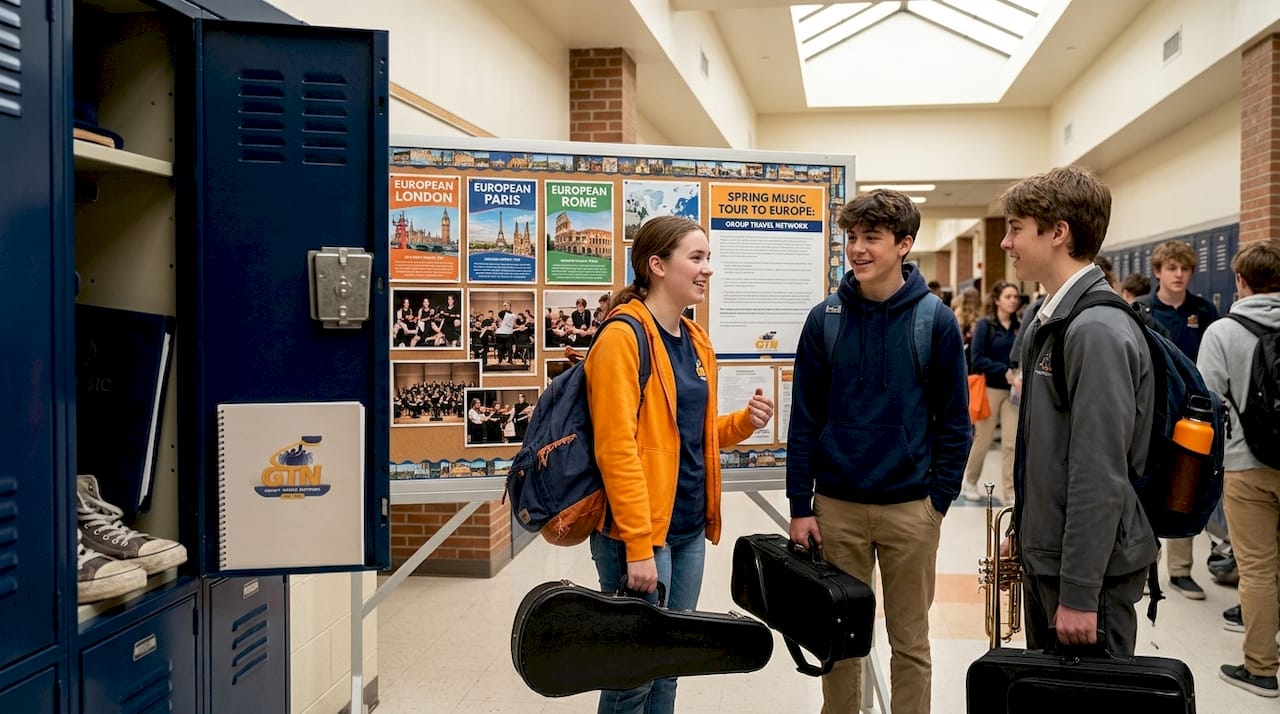
Pro Tip: If your group is performing internationally for the first time, choose a destination with strong English-speaking support infrastructure. Cities like London or Amsterdam offer deep musical history with logistical familiarity that reduces stress for first-time international coordinators.
Comparing tour benefits: Academic, social, and personal outcomes
Having explored tour options, it’s essential to compare the real-world benefits for students and schools. Administrators frequently focus on logistics and costs during the planning phase, but the strongest case for educational music tours is built on measurable student outcomes.
The academic evidence is compelling. Music participation (opens in a new tab) is linked to higher test scores in science, math, and English, with the effect being especially pronounced for students playing instruments. When you combine that baseline academic advantage with the experiential learning of a well-designed tour, you get a learning environment that a classroom simply cannot replicate.
“Students who participate in music education, particularly instrumental programs, consistently outperform peers in core academic subjects, and travel-based performance experiences amplify those gains by building resilience and self-confidence in high-pressure situations.”
Side-by-side benefit comparison:
| Benefit area | Honor ensemble tour | U.S. festival tour | Custom curriculum tour |
|---|---|---|---|
| Academic reinforcement | High (intensive practice) | Medium (focused rehearsal) | High (curriculum-aligned) |
| Social cohesion | Very high (new ensemble peers) | Medium (known group) | High (shared project) |
| Personal confidence | Very high (audition + performance) | Medium to high | Medium to high |
| Cultural exposure | Very high (international) | Medium (regional) | High (destination-specific) |
| Parent engagement | High (major milestone) | Medium | High (clear outcomes) |
| Cost accessibility | Lower (more competitive) | Higher (more accessible) | Variable |
Beyond the table, consider the harder-to-measure outcomes. Students who travel together and perform under pressure develop a specific kind of group cohesion that carries back into the classroom and into future rehearsals. Directors consistently report that a well-executed tour elevates the ensemble’s discipline and collective motivation for the entire following school year.
Tours also create visible community moments. When students return and perform for their school or town, the shared achievement of the trip becomes a rallying point that strengthens school culture. Read more about showcasing student talent through performance tours and explore the types of performance tours that best fit your ensemble’s development stage.
Making the decision: Practical packing, preparation, and safety protocols
To finalize your tour selection, focus on thorough preparation and safety, ensuring a smooth educational experience. Once your destination and tour type are selected, the quality of your preparation will determine whether the trip delivers its full potential or falls short in frustrating ways.
Here is a practical pre-tour preparation sequence:
- Finalize packing lists by role. Students need instrument cases (with hard-sided cases strongly recommended for air travel), uniforms in garment bags, any required sheet music or folders, travel documents, and a small personal first aid kit. Directors need master rosters, emergency contacts, insurance documents, and all vendor confirmation numbers.
- Conduct a pre-tour health check. Collect and review student medical forms two weeks before departure. Confirm which staff members are certified in first aid and designate a health officer for the trip. Pack group supplies including basic over-the-counter medications where permitted by school policy.
- Hold a behavior expectations meeting. A formal meeting with students and parents, separate from the general trip orientation, signals that behavior standards are serious. Cover phone use, curfews, venue dress codes, and the specific consequences of violations.
- Rehearse crisis protocols with staff. Walk through your emergency contact chain, student accounting procedures for headcounts, and the process for contacting parents during an incident. Every chaperone should have a printed copy of the crisis plan.
- Set up a communication platform. Choose one dedicated tool for parent updates during the trip and test it before departure. Daily brief updates reduce anxiety and build trust with your school community.
- Debrief planning with vendor partners. Confirm all logistics with your tour operator one week before departure: bus schedules, meal times, venue access windows, and any required dress code for each performance space.
Planning mechanics such as health preparedness, behavior codes, and crisis plans are often treated as administrative formalities, but experienced coordinators know they are what separates a smooth tour from a chaotic one.
Download our performance trip checklist to share with your planning team, and review our educational travel tips for coordinators managing a school music trip for the first time.
Pro Tip: Label every instrument case with a laminated card inside and outside the case. Lost instrument cases at airports are more common than coordinators expect, and internal identification cards dramatically speed up recovery when a case ends up on the wrong baggage carousel.
Our perspective: Why thoughtful planning transforms music tours from trips to transformative experiences
Looking beyond logistics and comparisons, let’s reflect on the broader impact that thoughtful educational music tours deliver. Here is something worth saying plainly: most schools underestimate what a music tour can actually do for students. They frame it as a reward, a fun bonus at the end of a hard year. That framing costs students something real.
When a music tour is treated as a curricular milestone with defined learning goals and measurable outcomes, it does not just entertain students. It changes them. We have seen students arrive at a rehearsal in Prague unable to sit still, and by the final night’s performance, they are holding concentration through an entire movement with a kind of focus their directors had never seen in a domestic setting. That is not magic. That is what happens when young people are placed in high-stakes, high-meaning environments with the right support around them.
The administrators who get the most out of these trips are the ones who plan with the end in mind. They are asking, six months before departure, how will we measure whether this experience achieved its educational goals? They are connecting the cultural stops to classroom content before the trip even begins. They are building in reflection time during the tour, not just fun activities.
There is also a harder truth here: the schools that view tours as extras tend to cut them first when budgets tighten. The schools that document outcomes, share student stories with school boards, and tie tour results to academic and social development goals tend to protect those programs even in lean years. Planning with purpose is not just about student experience. It is about institutional survival of a program that matters.
Explore resources on planning tours to Europe that include frameworks for connecting itinerary choices to learning outcomes your board and parents will actually value.
Connect with expert group travel planners
If you’re ready to elevate your school music tour, the next step is connecting with professionals who can turn your plan into reality. Planning a high-quality educational music tour involves dozens of moving parts, from audition logistics and venue booking to travel protection and dietary accommodation for 80 students.
Group Travel Network specializes in exactly this kind of work. Our team brings hands-on experience in school group travel planning from the earliest goal-setting conversations through to post-trip debriefs. Whether you are organizing your first domestic festival tour or leading students on an international performance experience, our range of student performance tours gives you a proven starting point. Discover the concrete advantages of student tours and see why hundreds of school administrators trust us to make their students’ travel experiences both safe and genuinely transformative.
Frequently asked questions
How do educational music tours improve student academic performance?
Music participation, especially instrumental, is linked to higher scores in science, math, and English, and tours reinforce those gains through experiential, real-world learning that classroom settings cannot provide.
What are the key planning steps for organizing a student music tour?
Essential steps include setting educational objectives, building a detailed timeline, arranging transportation and accommodations, and preparing health and behavior protocols alongside a clearly documented crisis management plan.
Does participating in a national honor ensemble tour require auditions?
Yes, the National Honor Ensemble European Tour and similar programs require auditions, as these tours select students from across the country to form a high-caliber performing ensemble.
Are parent engagement and community connections a significant part of music tours?
Music tours noticeably boost parent involvement and create lasting community pride around student musical achievements, particularly when schools share tour outcomes publicly after returning.
How are health and safety addressed during music tours?
Health and safety are integrated into the full planning process through pre-departure health screenings, written behavior codes, designated health officers, and staff-trained crisis response procedures established well before departure day.