


TL;DR:
- A successful student pre-trip requires multiple meetings, activated insurance, complete forms, and assigned chaperones before departure.
- Focusing on four core pillars—administrative/legal, health and safety, finance and insurance, and cultural/group dynamics—minimizes risks.
A well-run student pre-trip orientation requires at least three pre-departure meetings, completed forms, activated insurance, and assigned chaperones before anyone boards a plane or bus. Get those four things right and the trip runs. Miss one and you’re managing a crisis instead of an itinerary.
Start here — your immediate action checklist:
- Assign a named trip coordinator with defined authority and a backup
- Confirm travel insurance coverage and locate the policy number and assistance hotline
- Schedule three pre-departure meetings spread reasonably before departure
- Collect and centralize all required forms: permission slip, emergency contact, medical release, photo/release, code of conduct
- Run a digital sync at the final meeting so every student saves emergency numbers on their phone
- Send a parent communication package with payment schedule, insurance summary, and conduct expectations
- Register U.S. travelers with the Smart Traveler Enrollment Program (STEP) for international trips
- Confirm district-level approvals and file all documents in a secure, role-access folder
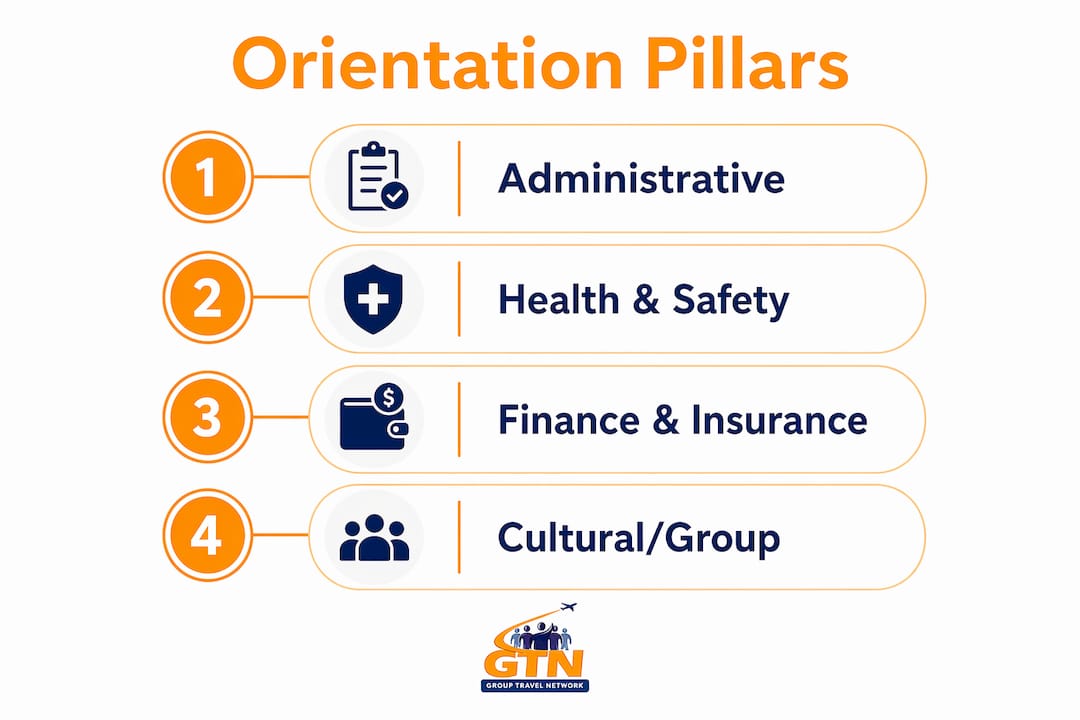
This plan maps to four core pillars: administrative/legal, health and safety, finance and insurance, and cultural/group dynamics.
Pro Tip: Print this checklist and tape it inside the lead coordinator’s binder. Every item should have a name and a deadline next to it before the first of the three required pre-departure meetings.
Table of Contents
- What are the four orientation pillars every coordinator needs?
- How should you schedule pre-trip meetings and what goes in each one?
- What administrative forms and approvals do you need before departure?
- What health and safety protocols does every trip coordinator need?
- How do you select, train, and assign chaperones?
- What should your code of conduct cover?
- How do you build a logistics and communications plan?
- What do families need to know about payments and insurance?
- What goes on the day-of departure checklist?
- Ready-to-use templates for your orientation pack
- How Grouptravelnetwork makes orientation planning faster
- Key Takeaways
- What coordinators who’ve run these trips actually know
- Useful sources for trip coordinators
- FAQ
What are the four orientation pillars every coordinator needs?
A student pre-trip orientation guide (opens in a new tab) built on four pillars gives you a framework that’s easy to delegate and audit. Each pillar addresses a distinct category of risk.
- Administrative/legal: Missing permission slips or unsigned liability waivers can ground a trip at the last minute. This pillar covers forms, district approvals, data handling, and legal compliance.
- Health and safety: A student with an unmanaged medical condition or a group that hasn’t rehearsed emergency procedures is a liability. This pillar covers medical forms, insurance activation, and emergency drills.
- Finance and insurance: Surprise costs and families who don’t understand refund policies generate conflict. This pillar covers payment schedules, contingency budgets, and insurance education.
- Cultural/group dynamics: Groups that haven’t discussed conduct expectations, cultural norms, or downtime rules tend to fracture. This pillar covers the code of conduct, cultural briefings, and group cohesion.
For high-risk international destinations, front-load health and safety. For domestic trips, administrative/legal is usually the first bottleneck.
Pro Tip: Assign one chaperone as the “pillar owner” for health and safety. That person owns the medication log, the insurance binder, and the emergency contact list — not the lead coordinator alone.
How should you schedule pre-trip meetings and what goes in each one?
Experts recommend (opens in a new tab) a minimum of three pre-departure meetings to normalize group dynamics and troubleshoot concerns before departure. Schedule three pre-departure meetings: a planning meeting 8–12 weeks out, logistics and documents 4–6 weeks out, and a final orientation 1–2 weeks before departure. Add a day-of checkpoint for headcount and document staging on departure morning.
Sample final orientation agenda (30–45 minutes):
- Attendance and passport/ID verification by staff (5 min)
- Emergency roles review: lead chaperone, medical lead, communications lead (5 min)
- Digital sync: students enter insurance hotline, embassy number, and coordinator cell into their phones while staff verify (10 min)
- Medication handoff and log confirmation (5 min)
- Code of conduct pledge signing (5 min)
- Q&A and parent acknowledgment collection (10 min)
For international trips, start planning several months ahead to secure visas and avoid passport-related cancellations.
What administrative forms and approvals do you need before departure?

University predeparture checklists (opens in a new tab) typically require students to complete mandatory online orientation modules and register travel with government resources 4–6 weeks before departure. Your school’s requirements will overlap significantly.
Required forms checklist:
- Signed permission slip with trip dates, destination, and parent/guardian signature
- Emergency contact form with at least two contacts and their cell numbers
- Medical release authorizing treatment if a parent is unreachable
- Photo/media release covering trip documentation
- Code of conduct agreement signed by student and parent
- District field-trip authorization signed by the principal or designee
- Any destination-specific forms (visa support letters, immunization records)
Store all documents in a central secure folder with role-based access. Health data should be visible only to the medical lead and lead coordinator. Retain records for the period your district requires, typically three years minimum.
Pro Tip: Run a data audit at the logistics meeting. Pull up your roster, go name by name, and mark every missing document in red. Give families a 48-hour deadline to submit before the form is escalated to the principal.
Organizing physical copies in labeled document folders (opens in a new tab) keeps participant packets audit-ready and easy to hand off to chaperones on departure day.
What health and safety protocols does every trip coordinator need?
The CDC recommends a pre-travel medical consultation (opens in a new tab) 4–6 weeks before departure to cover vaccines, prophylaxis, and destination-specific risks. Some vaccines require multiple doses spread over weeks, so scheduling early is not optional.
Pre-travel health checklist:
- Student medical forms collected and reviewed by medical lead
- Immunization status confirmed against CDC destination recommendations
- Prescriptions reviewed: 30-day supply minimum, translated medication letter for international borders
- Travel health appointment scheduled 4–6 weeks out
- Allergy and chronic condition flags documented in the medication log
Emergency roles chart:
| Role | Person Assigned | Primary Responsibility |
|---|---|---|
| Lead chaperone | [Name] | Overall decision authority, parent notification |
| Medical lead | [Name] | Medication log, first aid, hospital liaison |
| Communications lead | [Name] | Group app updates, embassy contact, school admin |
| Parent contact | [Name] | Single point of contact for all family calls |
Insurance activation steps (numbered for students and parents):
- Locate the policy number on the insurance card distributed at the final orientation
- Download or open the assistance app and confirm it loads before departure
- Save the 24-hour emergency hotline in your phone contacts labeled “Trip Insurance”
- In an emergency, call the hotline first, then notify the lead chaperone
- Document the incident: date, time, symptoms, and actions taken
Treating travel insurance (opens in a new tab) as a check-the-box item is a documented failure point. Run a simulated call to the assistance line during the final orientation so families know exactly what to say.
Coordinate with a travel clinic to assemble a trip-specific medication and evacuation plan. One staff member should carry a physical copy of all prescription names, dosages, and a translated medication letter if the destination requires it at the border.
How do you select, train, and assign chaperones?
Selection criteria:
- Cleared background check (required; no exceptions)
- Prior experience supervising youth in unstructured settings
- Calm under pressure: ask directly in the selection conversation
- Clear understanding that their role is supervisory, not participatory
Suggested supervision ratios by group type:
- Middle school students: 1 chaperone per 8–10 students for standard activities; 1 per 5–6 for high-risk or water activities
- High school students: 1 chaperone per 10–12 students for standard activities; 1 per 8 for overnight or international travel
- Students with documented medical or behavioral needs: additional dedicated staff as required by the IEP or 504 plan
Chaperone training checklist (cover at the logistics meeting):
- Review the emergency roles chart and confirm each person’s assignment
- Walk through the medication log and storage protocol
- Confirm the communication tool (group app, managed SMS) and daily check-in times
- Review conduct enforcement: what to document, when to escalate, and how to notify parents
- Confirm room-check procedures and curfew enforcement steps
Day-of duties include morning headcount, medication distribution, activity lead coverage, and a nightly room check logged in the chaperone binder.
What should your code of conduct cover?
Sample code of conduct pledge: “I understand that I represent my school and my community on this trip. I agree to follow all curfew and rooming rules, refrain from alcohol, tobacco, and illegal substances, treat fellow travelers and local residents with respect, and comply with all instructions from chaperones and trip staff. I understand that violations may result in removal from the trip at my family’s expense.”
Downtime vs. personal time — define both explicitly. Downtime is scheduled free time within a supervised area where students may move independently but must remain visible to a chaperone. Personal time is rare, destination-dependent, and requires prior coordinator approval with a buddy system in place. Defining these boundaries is the single most effective way to manage liability and accountability.
Consequence flow:
- Minor incident: documented verbal warning, logged in chaperone binder
- Repeat or moderate incident: parent phone call within two hours, written record
- Serious incident: lead coordinator notified immediately, parent notified, removal escalation begins
Sample parent notification script: “Hello, this is [Name] calling from [School] regarding [Student]. I’m calling to let you know that [brief factual description of incident]. We have [action taken]. Please call me back at [number] within [timeframe].”
Pro Tip: Have students sign the conduct pledge at the final orientation in front of a parent or guardian, not at home. It changes the weight of the commitment.
How do you build a logistics and communications plan?
A structured document checklist prevents the most common day-of failures: invalid passports, missing itineraries, and students who don’t know where they’re going.
Document checklist for every traveler:
- Passport valid beyond return date (international trips)
- Visa or entry authorization if required
- Printed and digital copies of the full itinerary
- Hotel name, address, and phone number
- Insurance card and hotline number
- Emergency contact sheet
Rooming plan template:
| Room | Students | Chaperone Assigned | Room Number |
|---|---|---|---|
| Room A | [Names] | [Chaperone] | TBD at check-in |
| Room B | [Names] | [Chaperone] | TBD at check-in |
Rooms are assigned by gender unless a documented exception applies. Staff rooms are placed adjacent to student rooms. Room assignments are distributed at the final orientation, not on departure day.
Daily communication cadence:
- Morning check-in: attendance confirmed by 8:00 AM, logged in group app
- Midday status: chaperones report to lead coordinator by noon
- Evening check-in: all students confirmed in rooms by curfew, logged
If a student is unreachable after two contact attempts, the lead chaperone escalates to the communications lead and the parent contact simultaneously. Register all U.S. travelers with STEP before departure so the embassy can locate the group in an emergency.
What do families need to know about payments and insurance?
Payment schedule template:
Payments generally require a deposit at registration, followed by further installments before departure, with a contingency buffer above projected costs to cover unexpected expenses.
Refund policy checklist:
Cancellation policies typically include forfeiture of deposit with refunds adjusted for non-recoverable costs depending on timing, no refund for late cancellations except through insurance, and no refund if removed for behavioral reasons with family responsible for return travel.
Insurance activation for families (step-by-step):
- Receive the insurance card at the final orientation meeting
- Download the assistance app and test it before departure
- Save the emergency hotline under “Trip Insurance” in your phone
- In a medical emergency, call the hotline before calling the school
- Keep a photo of the insurance card in your phone’s camera roll
Pro Tip: Send a one-page insurance summary to families two weeks before departure. Include the policy number, hotline, and a plain-English description of what medical evacuation coverage means. Families who understand their coverage don’t panic when something goes wrong.
What goes on the day-of departure checklist?
Day-of checklist for coordinators:
- Confirm arrival time communicated to all families (minimum 90 minutes before departure)
- Stage all travel documents in the lead coordinator’s go-bag
- Complete medication handoff from parents to medical lead; log each item
- Run final headcount against the roster before boarding
- Confirm transport: driver contact, vehicle capacity, and departure time
- Distribute printed itineraries and emergency contact sheets
Emergency quick reference (keep in go-bag and on phone):
- Lead coordinator cell: [Number]
- Insurance hotline: [Number from policy card]
- Nearest U.S. embassy/consulate: [Address and phone]
- Delegated parent contact person: [Name and cell]
- School main office: [Number]
Go-bag contents for lead coordinator:
- Copies of all student passports and IDs
- Medication log and all prescription copies
- Insurance policy documents
- $200–$300 in local currency or emergency cash
- Portable charger and charging cables
- First-aid kit
- Printed rooming list and emergency contact sheet
Ready-to-use templates for your orientation pack
Pre-departure participant packs should include health, safety, behavioral, and practical details to mentally prepare participants. The templates below are copy-ready starting points.
Permission slip — required fields:
- Student full name, date of birth, grade
- Trip name, destination, dates
- Parent/guardian name, relationship, signature, date
- Emergency contact (different from parent if possible)
- Medical release authorization language
- Photo/media release (opt-in or opt-out)
- District liability waiver language (confirm exact wording with legal counsel)
Medication log template:
| Student Name | Medication | Dosage | Frequency | Storage Location | Administered By | Notes |
|---|---|---|---|---|---|---|
| [Name] | [Med] | [Dose] | [Schedule] | Locked bag | Medical lead | [Allergies] |
Sample parent emails:
- Initial invite: Subject: “[Trip Name] — Registration Now Open.” Include dates, destination, cost overview, and registration link.
- Payment reminder: Subject: “[Trip Name] — Payment Due [Date].” State amount due, payment method, and late-payment policy.
- Health deadline warning: Subject: “Action Required: Medical Forms Due [Date].” List missing items by student name.
- Emergency contact confirmation: Subject: “Confirm Your Emergency Contact for [Trip Name].” Ask parents to reply with updated cell numbers.
Pro Tip: Add a district-specific clause placeholder at the bottom of every template: “This document is subject to [District Name] Policy [Number]. Confirm current policy language with your district legal counsel before distribution.”
Use a well-organized document presentation folder for each participant packet so chaperones can locate forms instantly during an emergency.
How Grouptravelnetwork makes orientation planning faster
Running a full student pre-trip orientation from scratch takes weeks of coordinator time. Grouptravelnetwork cuts that workload significantly by providing dedicated trip coordinators, online registration, flexible payment plans, and built-in travel protection for school and performance groups.

Every Grouptravelnetwork booking includes coordinator support from initial planning through departure day, which means your staff isn’t building permission slip templates at 11 PM or chasing insurance policy numbers the morning of departure. The school group travel planning (opens in a new tab) process is structured around the same four-pillar framework this guide covers, so nothing falls through the cracks.
Administrators who want a turnkey orientation pack, a step-by-step planning timeline, and a dedicated coordinator can request a consultation (opens in a new tab) directly through Grouptravelnetwork’s site.
Key Takeaways
A complete student pre-trip orientation requires three pre-departure meetings, activated insurance, collected forms, and assigned chaperones — all confirmed before departure day.
| Three meetings minimum | Schedule at 8–12 weeks, 4–6 weeks, and 1–2 weeks before departure to cover all four pillars and add a day-of checkpoint on departure morning.
| Insurance activation | Students and parents must save the hotline, download the app, and understand evacuation coverage before departure. |
| Forms and approvals | Collect permission slip, medical release, emergency contact, code of conduct, and district authorization for every traveler. |
| Chaperone assignment | Assign named roles (lead, medical lead, communications lead) with clear day-of duties before the logistics meeting. |
| Grouptravelnetwork support | Grouptravelnetwork provides dedicated coordinators, online registration, and travel protection to reduce administrator workload. |
What coordinators who’ve run these trips actually know
The part no checklist tells you: the problems that derail student trips almost never come from the big stuff. Passports get forgotten. A student’s medication wasn’t packed because the parent assumed the school had it. Two students who had a conflict at school end up in the same room because no one flagged it during rooming assignments.
The fix for all three is the same: separate checkpoints. Don’t combine the document audit with the medical verification with the rooming assignment into one chaotic final meeting. Run them as distinct steps, each with a named person responsible. When something is missing, you know exactly who owns it.
On emergency response: the groups that stay calm during an incident are the ones that practiced. A five-minute “what-if” exercise at the final orientation, where you walk through a lost passport scenario or a student with a high fever, does more than any written procedure. Students who’ve heard the script once don’t freeze when it’s real.
Post-trip debriefs are where most coordinators leave value on the table. A 20-minute debrief with chaperones within a week of return, focused on what the next orientation should change, compounds across every future trip. Write it down. File it with the trip documents. The coordinator who runs the next trip will thank you.
Useful sources for trip coordinators
- CDC Yellow Book — Study Abroad and International Student Travel: The primary reference for destination health risks, vaccine requirements, and pre-travel medical consultation timing. Save this link and share it with your medical lead.
- U.S. Department of State — Smart Traveler Enrollment Program (STEP): Free registration for U.S. travelers abroad. Required for all international student trips; takes five minutes and gives the embassy a way to reach your group.
- University of Washington — Before Departure Health & Safety Handbook: Detailed predeparture guidance including digital sync protocols and emergency normalization exercises. Useful as a model for your own handbook.
- Cornell University — Student Pre-Departure Checklist: A practical checklist model covering online orientation modules, STEP registration, and document requirements.
- Grouptravelnetwork — Travel Risk Management for School Groups (opens in a new tab): Coordinator-focused guidance on minimizing risk and building a pre-departure safety framework.
| Source | Best Used For |
|---|---|
| CDC Yellow Book | Vaccine and health planning, destination risk |
| STEP (State Department) | Embassy registration for international trips |
| UW Before Departure Handbook | Digital sync protocol, emergency drills |
| Cornell Pre-Departure Checklist | Administrative form and module checklist |
| Grouptravelnetwork Risk Management | School-specific risk framework and coordinator tools |
Save these in your program binder and share the CDC and STEP links directly with parents at the final orientation. Check your district’s own policy documents alongside these — district rules always take precedence over general guidance.
FAQ
How many pre-trip meetings should a coordinator schedule?
Experts recommend at least three pre-departure meetings: an initial planning session 8–12 weeks out, a logistics and documents meeting 4–6 weeks out, and a final orientation 1–2 weeks before departure, with a day-of checkpoint for headcount and document staging.
When should students see a doctor before an international trip?
The CDC recommends a pre-travel medical consultation 4–6 weeks before departure, since some vaccines require multiple doses spread over several weeks.
What forms are required for every student traveler?
At minimum: a signed permission slip, emergency contact form, medical release, photo/media release, code of conduct agreement, and district field-trip authorization. International trips add visa support letters and immunization records.
How does a student activate travel insurance in an emergency?
Students should call the 24-hour assistance hotline printed on their insurance card, then notify the lead chaperone. The hotline number should be saved in every student’s phone contacts before departure, confirmed during the final orientation’s digital sync.
What should go in a coordinator’s go-bag on departure day?
Copies of all student passports and IDs, the medication log, insurance policy documents, emergency cash, a portable charger, a first-aid kit, and a printed rooming list with emergency contacts.
Recommended
- How To Organize School Tours: 2026 Planning Guide • Group Travel Network (opens in a new tab)
- Student Educational Travel: Ultimate 2025 Guide For Schools (opens in a new tab)
- Safe Travel Planning Steps For Student Groups In 2026 • Group Travel Network (opens in a new tab)
- Parent Trip Communication: Your 2026 Guide For Schools (opens in a new tab)