


TL;DR:
- Before confirming student lodging, ensure you have a valid certificate of insurance, verified carrier authority, documented driver background checks, a written emergency plan, and an on-site manager’s contact details to avoid undue risk. Meeting these standards protects students and guarantees safety, while thorough vendor vetting prevents issues during trips. Proper preparation, documentation, and responsive vendor relationships are vital for a safe and compliant student travel experience.
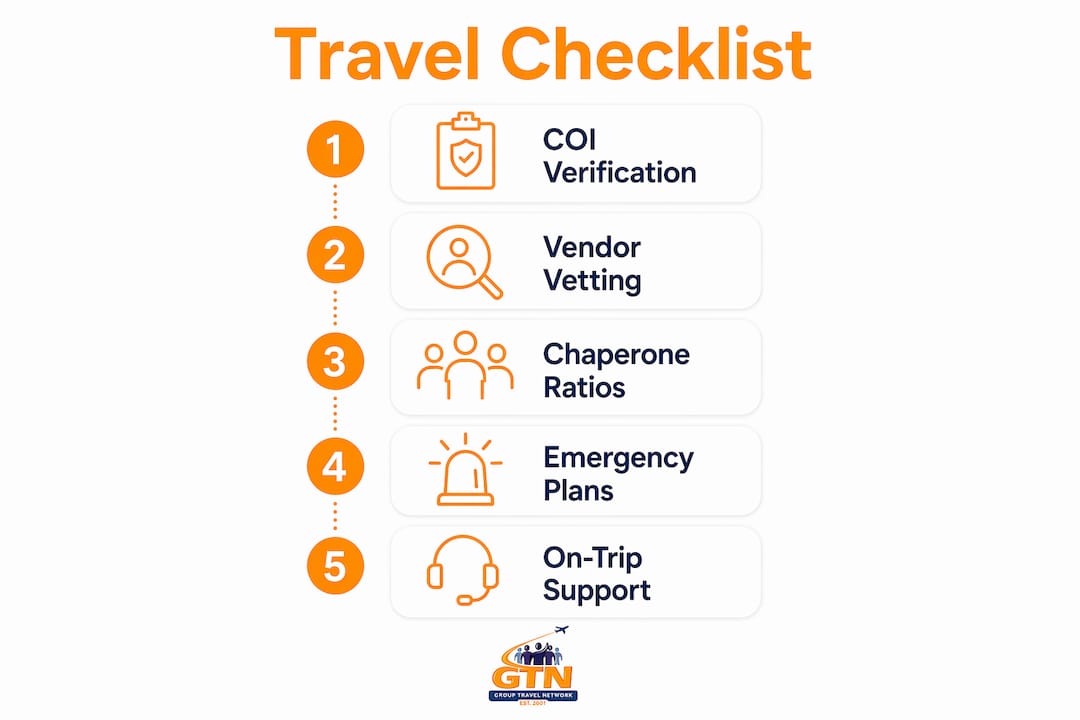
Before you confirm any student lodging, you need five things in hand: a certificate of insurance (COI) naming your school or district as an additional insured, verified FMCSA carrier authority and an acceptable safety rating for any motor coach, documented driver background checks, a written emergency and evacuation plan from the property, and a confirmed on-call on-site manager with 24/7 contact information. Without all five, you are accepting risk your district almost certainly cannot absorb.
Each item closes a specific gap. The COI transfers liability to the vendor. FMCSA verification confirms that the carrier is legally authorized and has passed federal safety scrutiny. Driver background checks protect students from unsupervised contact with unvetted adults. The emergency plan tells you what happens when something goes wrong at 2:00 a.m. The on-site manager means someone can actually act on that plan.
Do not book until these are in hand and verified.
A chaperone supervision plan rounds out the non-negotiable list. Know your ratios before you sign anything.
Table of Contents
- What student travel accommodation standards actually require
- How to vet vendors, vehicles, and the property before you book
- Rooming rules, chaperone ratios, and student behavior standards
- Medical plans, medication handling, and emergency-response expectations
- Contracts, COI requirements, and travel protection you must secure
- How to handle on-trip issues and vendor responsiveness
- U.S. transportation rules every school group organizer must know
- Pre-trip checklist: what to verify and when
- Key Takeaways
- What professional trip planners actually do differently
- Grouptravelnetwork takes the compliance burden off your desk
- Useful sources and further reading
- FAQ
What student travel accommodation standards actually require
Student accommodation quality starts with the physical space but does not end there. A property can have a modern lobby and still fail on the checks that matter most for a school group.
Facility basics:
- Clean, functioning rooms with working locks on every door and window
- Fire safety compliance: posted evacuation maps, working smoke detectors, unobstructed fire exits
- Accessible routes, rooms, and bathrooms for students with disabilities (ADA compliance for U.S. properties)
- Functioning heat and air conditioning
Security features:
- 24/7 on-site staff or manager, not just a phone number
- Controlled entry: swipe-card access or a staffed front desk that screens non-guests
- On-site staff and visible security measures correlate directly with higher perceived safety among student residents
- Neighborhood safety check completed before booking, not after
Staffing credentials:
- Background checks for all staff who interact with students
- ID verification policy at check-in
- Documented first-aid/CPR training for on-site personnel or your lead chaperones
Operational policies:
- Written maintenance-response SLA (time-to-respond window for urgent issues)
- Quiet-hours enforcement policy
- Visitor-control rules: no non-registered guests in student room areas
Food safety and dietary accommodations:
- Food-service sanitation certificates for any on-site dining
- Allergen protocols in writing, not just verbal assurances
Data privacy:
- Student registration data collected through encrypted forms only
- Minimal data retention: vendor should not hold student personal information beyond the trip
- Limited staff access to student records
Comfort amenities matter to students. Survey data shows proximity to activities and functioning room features rank among the top satisfaction drivers. But a designer lobby does not replace a working lock or a trained staff member. Extended-stay properties with kitchens and laundry can work well for school groups, but organizers still need to verify local safety, staff availability, and policies for minors regardless of brand name.
Pro Tip: Ask for recent on-site inspection photos or a short live video tour of the actual rooms and hallways your group will use. Marketing photos are staged; a five-minute video call with the property manager is not.
How to vet vendors, vehicles, and the property before you book
A reliable vetting process combines document verification, a virtual or live property tour, and a local spot-check for distant or international destinations. Here is the workflow.
Documents to request and verify:
| Document | Verification Step | Who Verifies | Pass/Fail Cue |
|---|---|---|---|
| COI (with policy period and limits) | Confirm school/district named as additional insured; check policy dates cover trip | School admin or district risk manager | Fail: school not named; policy expires before trip end |
| — | Confirm active registration in state of operation | Organizer | Fail: expired or unregistered |
| Staff background check confirmation | Request written attestation or third-party screening report | Organizer | Fail: verbal only, no documentation |
| Motor-coach USDOT number | Search FMCSA SAFER system (opens in a new tab) for carrier authority and safety rating | Organizer or trip coordinator | Fail: conditional or unsatisfactory rating |
| Emergency and evacuation plan | Review written plan; confirm local medical facility listed | Organizer | Fail: no written plan, no medical contact |
For motor coaches specifically, look up the carrier’s USDOT number in the FMCSA SAFER database. A “satisfactory” rating is the floor. Conditional or unsatisfactory ratings are a hard stop, not a negotiating point.
For distant or international destinations, pre-departure guidance (opens in a new tab) from the University of Washington’s Office of Global Affairs recommends deploying an in-country partner or local coordinator to verify neighborhood safety, transit reliability, and proximity to emergency facilities. Vendor descriptions alone are not sufficient.
On-site inspection checklist (common failure points):
- Fire exits blocked by furniture or propped open
- Poor exterior lighting around entrances and parking areas
- Easy non-resident access to room corridors
- Broken or missing window locks
- No posted emergency contact or evacuation map
Pro Tip: Take timestamped photos during any inspection and require a written conditional acceptance letter from the vendor before final approval. If fixes are promised, get a completion deadline in writing.
Rooming rules, chaperone ratios, and student behavior standards
Chaperone ratios depend on age and activity type. For overnight trips, a conservative starting point is one adult chaperone per eight students for middle school and one per ten for high school. Mixed-gender groups require at least one chaperone of each gender. For students with significant medical or behavioral needs, lower ratios apply.
Room assignments follow a clear rule: no non-student adults share rooms with students, ever. Same-gender rooming is the default. Parent-approved exceptions for gender-nonconforming students should be documented in writing before departure.
Access control:
- Key distribution logged at check-in with student name and room number
- Master keys held only by the on-site property manager and the lead chaperone
- Custodial and housekeeping staff keys tracked separately; no unannounced room entry during student occupancy
Sample behavior contract language (adapt for your school’s policy):
Chaperone responsibilities during lights-out include a brief hallway check every 30–45 minutes. This is not a room search; it is a presence check. Document the time of each check in a written log.
For students with disabilities, rooming plans must account for accessible room features and proximity to accessible bathrooms. Reasonable accommodations should be confirmed with the property in writing before arrival. See Grouptravelnetwork’s team travel supervision guide (opens in a new tab) for ratio templates by group type.
Pro Tip: Collect signed behavior contracts and parental consent forms at least two weeks before departure. Last-minute paperwork creates gaps in your documentation and puts you in a difficult position if an incident occurs.
Medical plans, medication handling, and emergency-response expectations
Every trip needs a documented emergency and evacuation plan from the lodging property, plus a written list of the nearest urgent care clinic and emergency room with addresses and phone numbers.
Medication handling:
- Collect a complete medication list from parents at registration, stored securely and accessible only to the lead chaperone and school nurse if traveling
- Prescription medications stored in a locked container held by the lead chaperone, not in student rooms
- Parental consent forms required for any medication administration, including over-the-counter items
- Student data privacy best practices apply to medication records: limit access, use encrypted forms, and retain only as long as legally required
Chaperone training minimums:
- At least one chaperone per group certified in first aid and CPR, with current certification records on file
- All chaperones briefed on the emergency plan before departure
Serious incident protocol:
- Medical evacuation insurance included in trip protection coverage (confirm supplier insolvency and repatriation wording)
- Parental notification within one hour of any medical incident requiring outside care
- Written incident log with timestamps and witness notes preserved for post-trip review
Pro Tip: Prepare a sealed, labeled medication kit for the lead chaperone containing each student’s medications, dosage instructions, and the signed parental consent form. Keep a digital backup of the medication list in an encrypted folder accessible to the school administrator at home.
Contracts, COI requirements, and travel protection you must secure
The COI is your first line of financial protection. Request a certificate that names your school or district as an additional insured, covers the full trip period, and lists general liability limits. Your district’s risk manager can advise on minimum acceptable limits, but $1 million per occurrence is a common floor for school-group vendors.
Required contract clauses to request:
- Indemnification and hold-harmless language protecting the school from vendor negligence
- Cancellation penalty schedule with specific dates and percentages
- Maintenance-response SLA with defined response windows (e.g., urgent safety issues addressed within two hours)
- Explicit guest-access controls: non-registered individuals prohibited from student areas
- Proof-of-staff-screening clause: vendor certifies background checks are current for all staff with student contact
Travel protection:
- Trip-cancellation coverage for weather, illness, and supplier insolvency
- Medical evacuation and repatriation coverage
- Confirm the policy covers minors and group bookings
Document retention: Keep COIs, signed contracts, background-check confirmations, and incident reports for a minimum of three years, or per your district’s records-retention policy, whichever is longer.
District-level approvals often require final sign-off at least 30 days before travel. Build that deadline into your contract timeline so vendor paperwork is complete before the board meeting. For a deeper look at liability transfer, Grouptravelnetwork’s liability protection guide (opens in a new tab) covers COI language and risk-transfer clauses in detail.
Pro Tip: Paste the hold-harmless clause and the proof-of-staff-screening clause directly into your initial vendor inquiry email. Vendors who push back on standard language are telling you something.
How to handle on-trip issues and vendor responsiveness
Require a named on-call manager with a direct phone number before you check in. Not a front desk number. A person.
Issue-reporting process:
- Photo plus timestamp plus written description for every maintenance or safety issue
- One designated organizer owns escalation; students and other chaperones report to that person only
Three-step escalation ladder:
- On-site manager: contact within 15 minutes of identifying the issue
- Vendor’s regional director or corporate office: escalate if no response within one hour
- School district emergency line or trip coordinator: escalate if issue remains unresolved or poses immediate student safety risk
Vendor responsiveness and clear reporting channels are among the strongest predictors of positive student accommodation experiences. A property with a slow maintenance response is a liability, not just an inconvenience.
If a serious safety hazard goes unresolved after escalation, relocate the group. Document the decision in writing: the issue, the time reported, the response received, and the decision to move. That paper trail protects you.
Pro Tip: Within the first hour after check-in, call the on-call manager’s number to confirm it works and the person answers. Do it while you still have time to escalate before anything goes wrong.
U.S. transportation rules every school group organizer must know
Many U.S. school district policies prohibit private vans and personal vehicles for overnight student travel. Commercial motor coaches with verified FMCSA authority are the required standard, not a preference.
What to check in FMCSA SAFER:
- Active operating authority (not revoked or suspended)
- Safety rating: satisfactory only
- Insurance filings current and on file
Avoid scheduling arrivals or departures between midnight and 6:00 a.m. Accident risk rises sharply in those hours, and many district policies explicitly prohibit overnight travel in that window. Build itineraries that respect driver hours-of-service rules as well.
District approval timelines matter here. Many school committees require final approval at least 30 days before the trip, with initial approval before fundraising begins. Confirm your district’s specific timeline and work backward from the departure date. For motor-coach-specific guidance, Grouptravelnetwork’s student bus tours resource (opens in a new tab) covers carrier verification steps in detail.
Pro Tip: Request the carrier’s USDOT number in writing before any verbal agreement. Run the SAFER check yourself — do not rely on the vendor’s self-reported rating.
Pre-trip checklist: what to verify and when
Use this timed checklist for every school group trip. Store digital copies in an encrypted folder accessible to the lead chaperone and the school administrator at home.
30+ days before departure:
- COI received, school/district named as additional insured, dates confirmed
- Motor-coach carrier USDOT verified in FMCSA SAFER (satisfactory rating)
- Driver background checks confirmed in writing
- Signed contracts with cancellation terms, SLA, and hold-harmless clause
- District or school-committee final approval obtained
- Travel protection policy in place (trip cancellation, medical evacuation)
14 days before:
- Rooming plan finalized and distributed to chaperones
- Chaperone first-aid/CPR certifications confirmed and copies on file
- Student behavior contracts and parental consent forms collected
- Medication list collected and medication kits assembled
7 days before:
- Emergency and evacuation plan reviewed with all chaperones
- Local urgent care and emergency room addresses confirmed
- On-site manager name and direct phone number confirmed
- Neighborhood safety check completed (local partner or coordinator for distant destinations)
48–24 hours before departure:
- Test call to on-site manager’s direct line
- Digital document folder confirmed accessible
- Final headcount and room assignments confirmed with property
- Departure time confirmed: no arrivals or departures between midnight and 6:00 a.m.
For a full planning framework, Grouptravelnetwork’s educational group trip guide (opens in a new tab) includes sample templates and checklists organizers can adapt.
Key Takeaways
Meeting student travel accommodation standards requires verified vendor credentials, a written emergency plan, confirmed chaperone ratios, and tested vendor responsiveness before any group departs.
| Point | Details |
|---|---|
| COI is non-negotiable | Require the school or district named as additional insured, covering the full trip period. |
| FMCSA verification protects students | Check every motor-coach carrier’s USDOT number in FMCSA SAFER; satisfactory rating only. |
| Chaperone ratios and training | One certified first-aid/CPR chaperone per group minimum; one adult per 8–10 students overnight. |
| Test vendor responsiveness on arrival | Call the on-call manager within the first hour of check-in to confirm contact details work. |
| Grouptravelnetwork handles vetting | Grouptravelnetwork’s dedicated coordinators collect COIs, verify carriers, and manage emergency support so organizers focus on students. |
What professional trip planners actually do differently
The single most common failure organizers face is discovering, on arrival, that the “on-call manager” is a voicemail box. Professional planners run a responsiveness test within the first hour of check-in: call the direct line, confirm a real person answers, and log the time. If no one picks up, escalation starts immediately, before any student issue arises.
The second pattern worth noting: organizers who skip the neighborhood safety check because the property looked fine in photos. Marketing images are shot in the best light. A local coordinator or in-country partner who physically walks the block, checks the nearest transit stop, and confirms the emergency room location catches what photos miss. That check has prevented group relocations more than once.
Working with a dedicated trip coordinator reduces the administrative burden significantly. The coordinator tracks document deadlines, follows up on outstanding COIs, and maintains the escalation contacts so the band director or school administrator can focus on the students rather than the paperwork.
Grouptravelnetwork takes the compliance burden off your desk
Collecting COIs, running FMCSA carrier checks, assembling chaperone documentation, and managing vendor escalation during a trip is a full-time job on top of your actual job. Grouptravelnetwork’s dedicated trip coordinators handle that entire layer for school administrators, band directors, and youth-group organizers.

Specifically, Grouptravelnetwork provides pre-trip vendor vetting (including COI collection and motor-coach FMCSA verification), sample contracts with hold-harmless and SLA clauses, on-trip emergency support with a direct coordinator line, and printable checklists and templates your district can use for approval documentation. Every vendor in the network is screened against the standards this article covers.
Ready to hand off the compliance checklist and focus on the trip itself? Start planning your school group trip (opens in a new tab) with Grouptravelnetwork’s coordinator team, or explore the full youth group travel planning guide (opens in a new tab) to see how the process works from first inquiry to departure day.
Useful sources and further reading
- MASC Student Travel Regulations — motor-coach requirements, district approval timelines, and overnight travel rules
- FMCSA SAFER System (opens in a new tab) — carrier USDOT lookup, safety ratings, and insurance filings
- University of Washington Before-Departure Health & Safety Handbook — pre-departure checks, local partner verification, and transit safety
- Office for Students / IFF Research: Student Experiences of Accommodation — satisfaction drivers and maintenance responsiveness data
- gov.scot PBSA Student Housing Research — on-site staffing and security measures data
- Grouptravelnetwork Pre-Trip Checklist and Sample COI Wording (opens in a new tab) — printable templates available on site
- Grouptravelnetwork Student Travel Safety Guide (opens in a new tab) — incident handling and emergency protocols
Pro Tip: Bookmark the FMCSA SAFER lookup page now and add it to your trip-planning folder. Running a carrier check takes under two minutes and is the single fastest compliance verification you can do.
FAQ
What documents must a lodging vendor provide for a school group?
At minimum: a certificate of insurance naming the school or district as an additional insured, a written emergency and evacuation plan, proof of staff background checks, and a maintenance-response SLA. Motor-coach carriers must also provide FMCSA USDOT verification with a satisfactory safety rating.
What chaperone ratio is required for overnight student trips?
No single federal standard applies, but best practice for overnight trips is one adult chaperone per eight middle-school students or per ten high-school students, with at least one chaperone of each gender for mixed groups. Your district policy may set stricter ratios.
Can a school group use private vans for overnight travel?
Many U.S. school district policies prohibit private vans and personal vehicles for overnight student travel, requiring commercial motor coaches with verified FMCSA authority instead. Check your district’s written travel policy before booking any transportation.
How does Grouptravelnetwork help schools meet these standards?
Grouptravelnetwork’s dedicated trip coordinators collect COIs, verify motor-coach carriers against FMCSA records, provide sample contracts with hold-harmless clauses, and offer on-trip emergency support, reducing the compliance workload for school administrators and band directors.
When should district approval be secured before a student trip?
Many school committees require final approval at least 30 days before the trip, with initial approval before fundraising begins. Build that deadline into your planning timeline and confirm your district’s specific requirements early in the process.
Recommended
- Student Educational Travel: Ultimate 2025 Guide For Schools (opens in a new tab)
- Student Behavior Contract For Travel: 2026 Best Practices • Group Travel Network (opens in a new tab)
- Top Student Travel Trends In 2026 For School Groups (opens in a new tab)
- Safe Travel Planning Steps For Student Groups In 2026 • Group Travel Network (opens in a new tab)