


TL;DR:
- Group transportation logistics involve planning and managing safe, on-time group travel for students, including vehicle allocation, scheduling, and communication. A dedicated coordinator ensures real-time adjustments, precise manifests, and contingency plans, preventing trip disruptions. Proper planning with buffers and early booking enhances reliability, while expert support simplifies complex itineraries for school groups.
What is group transportation logistics for school trips?
Group transportation logistics is the coordinated planning and management of moving a group of travelers safely, on schedule, and without chaos. For school administrators and group leaders, it goes well beyond booking a few charter buses. It means orchestrating vehicle capacity, passenger manifests, luggage handling, driver communication, safety compliance, and contingency protocols across every leg of a trip.
Think of it as the operational backbone of any educational group travel (opens in a new tab) experience. When it works, students arrive on time, instruments are loaded correctly, and no one is left at a rest stop. When it fails, the entire trip unravels fast.
The core elements of group transportation logistics include:
- Passenger manifests: Accurate headcounts and rosters for every vehicle and transit segment
- Vehicle allocation: Matching the right vehicle type and capacity to each group size and cargo need
- Scheduling and routing: Coordinating departure times, stops, and arrival windows across multiple transport providers
- Luggage and equipment management: Planning dedicated cargo space, especially for groups carrying instruments or athletic gear
- Safety and compliance: Meeting federal and state regulations for student transport, including driver certification and vehicle inspection standards
- Communication systems: Keeping group leaders, drivers, and administrators connected in real time
- Contingency planning: Building backup protocols for delays, vehicle breakdowns, or last-minute itinerary changes
Grouptravelnetwork specializes in managing all of these elements for student and performance groups, providing dedicated trip coordinators and vendor partnerships that take the burden off school administrators.
Table of Contents
- Key components and challenges in planning group transportation
- Best practices and expert strategies for effective group transportation
- How dedicated coordinators make group transportation actually work
- Key Takeaways
- Grouptravelnetwork takes the logistics off your plate
- FAQ
Key components and challenges in planning group transportation
Planning group transport for students is genuinely harder than it looks. Group transportation involves far more than vehicle bookings. Underestimating passenger manifests, luggage volume, and the need for flexible scheduling are among the most common pitfalls administrators face.
The core planning components:
- Accurate manifests: A manifest that is off by even a few students can create vehicle shortages or compliance issues at the last minute
- Vehicle capacity matching: Oversized vehicles waste budget; undersized ones create safety violations
- Luggage volume: Band groups and sports teams often carry far more than standard storage allows, requiring dedicated cargo vehicles or trailers
- Scheduling buffers: Loading and unloading typically adds 20–30 minutes per stop, a factor most first-time planners ignore entirely
- Multi-provider coordination: Trips involving flights, charter buses, and local shuttles require synchronized handoffs between vendors who may not communicate with each other by default
- Regulatory compliance: Student transport must meet specific federal and state safety standards, including driver background checks and vehicle inspection records
The challenges compound quickly. Staggered flight arrivals mean some students land an hour before others, leaving buses idle or forcing multiple vehicle runs. Traffic delays cascade through a tight schedule. A communication breakdown between a bus driver and a chaperone can leave 40 students waiting outside a venue in the rain.
Pro Tip: Use a group messaging app or platform that connects all stakeholders, including drivers, chaperones, and administrators, in a single thread. When a flight is delayed, everyone knows within seconds, and the vehicle staging plan adjusts before confusion sets in.

Centralized oversight prevents most of these breakdowns. When one person holds the full picture of all vehicle assignments, schedules, and contact information, decisions happen faster and errors get caught before they become crises.
Best practices and expert strategies for effective group transportation
The most experienced group travel planners share one consistent habit: they design for disruption, not just for the ideal scenario. Travel environments are dynamic and prone to change, so flexible plans consistently outperform rigid ones.
Proven strategies that work:
- Build buffer time into every segment: Add buffer time around each loading and unloading stop, not as padding but as a realistic acknowledgment of how long student groups actually take to move
- Group arrivals strategically: Consolidate flight bookings so students arrive in waves that match vehicle capacity, rather than trickling in across four hours
- Assign a single transportation point of contact: One coordinator who owns all vehicle communication eliminates the “I thought you called the driver” problem
- Use real-time tracking tools: Apps that show vehicle location and estimated arrival let group leaders make decisions before a delay becomes a crisis
- Confirm all vendors 48 hours out: Driver names, vehicle plate numbers, and cell contacts should be in hand before departure day, not the morning of
- Create a written contingency protocol: What happens if a bus breaks down? Who calls the backup provider? Who notifies parents? Write it down before the trip, not during it
- Book early, especially for peak seasons: Securing the right vehicles for spring performance tours or fall educational trips requires early booking to avoid last-minute shortages
Planning insight: Group transportation success is often invisible when done well. The entire trip’s impression is shaped by logistics that avoid visible problems. A flawless transfer from airport to hotel goes unnoticed; a missed bus is remembered for years.
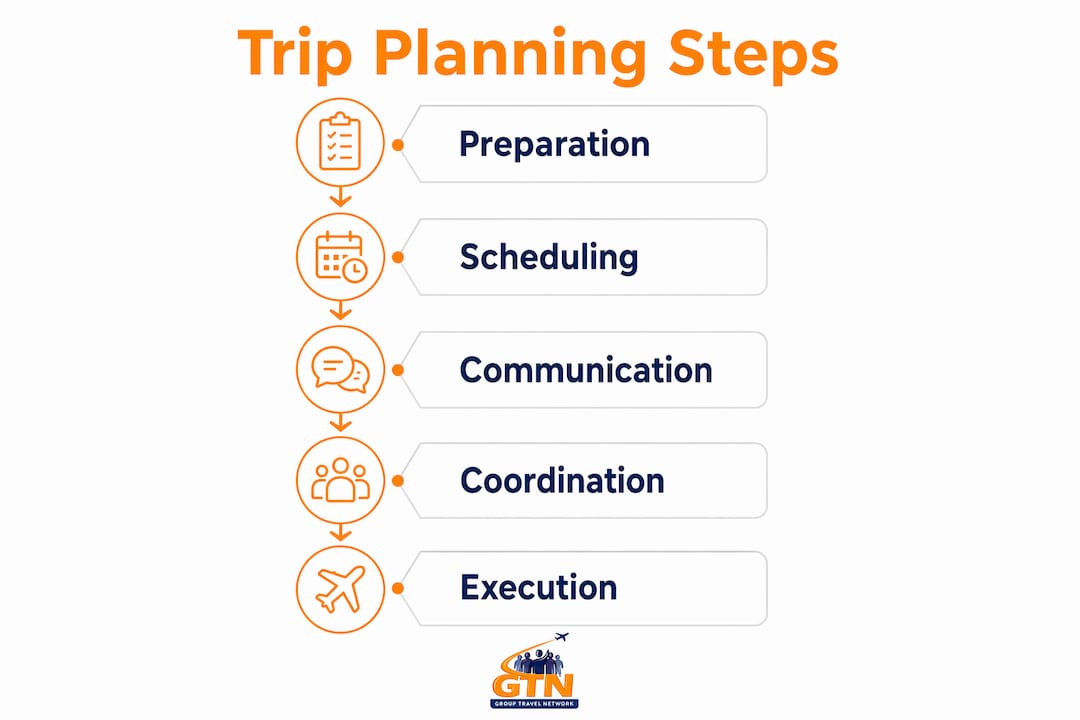
For administrators managing complex itineraries, the step-by-step school trip planning guide (opens in a new tab) from Grouptravelnetwork offers a structured framework that covers each of these strategies in detail.
Good planning also connects to broader project coordination skills. The project coordinator role (opens in a new tab) shares significant overlap with group travel logistics management, particularly in managing timelines, stakeholder communication, and contingency protocols.
How dedicated coordinators make group transportation actually work
There is a meaningful difference between a school administrator who also handles transportation and a dedicated logistics coordinator whose only job is to make the group move smoothly. The latter changes the entire experience.
A dedicated coordinator manages:
- Real-time schedule adjustments: When a flight is delayed, they reroute vehicles and notify all parties simultaneously
- Student flow at pick-up and drop-off: They physically stage students into the right vehicles, preventing the chaos of 60 teenagers trying to self-organize
- Live manifest updates: If a student misses a connection, the manifest updates immediately so no vehicle waits unnecessarily
- Vendor communication: They maintain direct lines to every driver and provider, not just a general booking number
- On-the-ground problem solving: Flat tire, wrong venue entrance, unexpected road closure. A coordinator handles it without pulling the group leader away from the students
The role of a travel coordinator (opens in a new tab) in educational group travel is not administrative overhead. It is the difference between a trip that runs and a trip that derails. Grouptravelnetwork assigns dedicated trip coordinators to every group, which means the band director can focus on the students while someone else is on the phone with the charter company.
For administrators who want to understand how group assignments and coordination translate into practical logistics management, the overlap between project planning and travel coordination is worth exploring.
Key Takeaways
Group transportation logistics for educational trips requires centralized coordination, flexible scheduling, and dedicated communication systems to prevent the cascading delays that derail student travel.
| Point | Details |
|---|---|
| Buffer time is non-negotiable | Loading and unloading typically adds 20–30 minutes per stop; build this into every schedule segment. |
| Manifests and cargo need precision | Accurate headcounts and dedicated luggage planning, especially for instruments, prevent day-of vehicle shortages. |
| One point of contact prevents chaos | A single coordinator managing all vehicle communication eliminates miscommunication between drivers, chaperones, and administrators. |
| Flexibility beats rigid scheduling | Contingency protocols for delays, breakdowns, and flight changes must be written before departure, not improvised during the trip. |
| Grouptravelnetwork handles it end-to-end | Dedicated trip coordinators, vendor partnerships, and real-time support make Grouptravelnetwork a practical choice for school and performance group travel. |
Grouptravelnetwork takes the logistics off your plate
Planning a student performance tour or educational trip means managing dozens of moving parts simultaneously. Grouptravelnetwork was built specifically for this: school administrators, band directors, and group leaders who need expert logistics support without becoming transportation specialists themselves.

Where most agencies hand you a booking confirmation and step back, Grouptravelnetwork assigns a dedicated trip coordinator who manages vehicle staging, vendor communication, and real-time adjustments from departure to return. Flexible payment plans, online registration, and travel protection options are built into every package, so the administrative load on your end stays manageable.
Whether you are organizing a first-time field trip or a multi-city performance tour (opens in a new tab) for your school’s music program, the planning process starts with a clear, structured framework. Use Grouptravelnetwork’s school group travel planning guide (opens in a new tab) to map out your trip logistics step by step, or contact the team directly to get a customized itinerary built around your group’s specific needs.
FAQ
What is group transportation logistics in simple terms?
Group transportation logistics is the coordinated planning of vehicles, schedules, manifests, and communication systems needed to move a group of travelers safely and on time. For student trips, it includes safety compliance, luggage management, and contingency planning.
How much buffer time should I add for student group transportation?
Experienced planners add 20–30 minutes of buffer time per stop to account for loading and unloading delays, a common factor underestimated when moving large student groups.
Why does a dedicated coordinator matter for group travel logistics?
A single coordinator managing all vehicle communication and real-time adjustments prevents the miscommunication that turns minor delays into trip-wide disruptions, particularly when flights or road conditions change unexpectedly.
When should I book transportation for a school group trip?
Book as early as possible, especially for peak seasons like spring performance tours and fall educational trips. Early booking secures the right vehicle types and avoids last-minute shortages that force costly compromises.
How does Grouptravelnetwork support group transportation logistics?
Grouptravelnetwork assigns dedicated trip coordinators to manage vehicle staging, vendor communication, and schedule adjustments, handling the logistics so school administrators and group leaders can focus on the students.
Recommended
- Travel Logistics For Schools: A 2026 Planning Guide • Group Travel Network (opens in a new tab)
- Group Travel Logistics: Why It Matters For School Trips • Group Travel Network (opens in a new tab)
- Team Travel Coordination Tips For Schools In 2026 • Group Travel Network (opens in a new tab)
- Group Travel Agencies: Complete 2025 Guide For Excellence (opens in a new tab)