


TL;DR:
- Travel logistics for schools involves managing transportation, scheduling, permissions, budgeting, and safety protocols for student trips. Schools that treat logistics as a comprehensive project with a dedicated plan improve safety and educational value. Using digital systems and early planning helps prevent last-minute issues and streamlines the entire trip process.
Travel logistics for schools is defined as the coordinated management of all transportation, scheduling, permissions, budgeting, and safety protocols required to move students safely from campus to a destination and back. The industry term for this practice is “educational trip logistics,” and it covers far more than booking a bus. School administrators who treat logistics as the foundation of a trip, rather than a final checklist, consistently produce safer and more educationally effective experiences. Grouptravelnetwork specializes in exactly this kind of end-to-end coordination, helping school staff turn complex planning into a manageable process.
What is travel logistics for schools?
Travel logistics for schools is the systematic organization of every moving part that makes a student trip possible. That includes transport arrangements, staff assignments, vendor contracts, permission workflows, emergency protocols, and budget tracking. Each element connects to the others. A change in transportation, for example, can affect supervision ratios, departure times, and overall cost.

The scope of educational trip logistics has grown significantly as schools face higher expectations from parents, insurers, and district administrators. Schools must now document medical information, maintain privacy compliance, and provide real-time communication to families. Treating these requirements as separate tasks creates gaps. Treating them as one integrated system is what group travel logistics (opens in a new tab) professionals recommend.
Understanding the full scope of school travel management also helps administrators allocate staff time correctly. Most schools underestimate how many hours go into a single trip when processes are manual. Digital workflows and centralized planning tools have changed that calculation significantly.
What are the essential components of school travel logistics?
School travel logistics breaks down into five core components. Each one requires deliberate planning and clear ownership.
-
Transportation arrangements. Motor coaches are the preferred option for regional trips because they keep the group together and simplify supervision. Securing transportation early (opens in a new tab) directly affects budget, group energy, and the full planning timeline. Air travel adds complexity through ticketing, baggage policies, and airport coordination.
-
Permission forms and approvals. Digital permission forms reduce the back-and-forth that paper processes create. They also create an auditable record, which matters when insurance providers or district offices request documentation.
-
Scheduling and contingency planning. A solid schedule accounts for travel delays, meal stops, venue wait times, and rest periods. Every schedule needs at least one contingency block built in for unexpected changes.
-
Budget management. Integrated cost reporting (opens in a new tab) allows administrators to track invoices, funding sources, and expenditures in one place. Exportable reports make budget reviews faster and more accurate.
-
Safety protocols and emergency planning. Every trip needs a written emergency response plan that covers medical incidents, missing students, and weather events. Staff must review this plan before departure, not on the bus.
Pro Tip: Assign one staff member as the logistics lead for each trip. That person owns the master schedule, the emergency contacts, and the vendor communication. Distributed ownership creates gaps; single-point accountability closes them.
How do schools manage travel logistics to enhance safety and efficiency?
Effective school travel management depends on replacing manual processes with systems that centralize data and automate routine tasks. Here is how the best-run school trips handle it.
-
Adopt field trip management software. Digital management platforms (opens in a new tab) centralize trip requests, automate approvals, and keep all stakeholders in sync. They save hours of administrative time per trip and reduce the miscommunication that paper processes create.
-
Automate driver and vehicle scheduling. Driver assignment tools match qualified drivers to vehicles based on availability and district criteria, then send automated notifications by text or email. This removes the manual coordination that often causes last-minute scrambles.
-
Use GPS tracking and real-time updates. Advanced logistics platforms include GPS tracking so transportation staff and administrators can monitor vehicle locations throughout the trip. That visibility reduces anxiety and speeds up response when something goes wrong.
-
Communicate with parents through apps. Real-time parent alerts notify families when students board and disembark buses, or when delays occur. Transparent communication builds trust and reduces the volume of calls administrators receive during a trip.
-
Centralize medical and emergency information. All student medical records, allergy alerts, and emergency contacts should live in one secure digital location that every chaperone can access. Protecting that data under applicable privacy standards is non-negotiable.
Pro Tip: Run a pre-trip digital check 48 hours before departure. Confirm that all permission forms are submitted, driver assignments are confirmed, and emergency contacts are current. Catching gaps two days out is manageable. Catching them two hours out is not.
What challenges do schools face in travel logistics?
Planning school travel surfaces predictable problems. Knowing them in advance lets you build solutions into your process before they become crises.
-
Last-minute roster changes. Rooming lists and supervision ratios must account for student compatibility, medical needs, and staffing coverage. When a student withdraws close to departure, the ripple effects touch pricing, room assignments, and chaperone ratios all at once.
-
Manual processes causing bottlenecks. Paper-based tracking creates administrative delays and increases the risk of data loss. Schools that switch to digital workflows report faster approvals and more accurate records.
-
Communication breakdowns. When administrators, teachers, transportation staff, and parents each operate from different information sources, errors multiply. A single communication platform eliminates version conflicts and keeps everyone working from the same facts.
-
Cost versus safety trade-offs. Choosing cheaper transportation to save budget can increase supervision difficulty and reduce safety margins. The correct approach is to set a safety baseline first, then find the most cost-effective option that meets it.
-
Inadequate contingency planning. Trips without written backup plans for delays, medical emergencies, or venue closures force staff to improvise under pressure. Early and thorough planning that integrates all logistics elements is the most reliable way to avoid that situation.
How to implement an effective travel logistics plan for school trips
A structured approach to planning school travel removes guesswork and gives every stakeholder a clear role. Follow these steps to build a plan that holds up under real conditions.
-
Lock in destination and dates first. Every other logistical decision flows from where you are going and when. Destination determines transportation mode, lodging options, and required permits or chaperone ratios.
-
Secure transportation and lodging early. Early booking decisions affect the entire budget and supervision structure. Motor coaches for regional trips and block hotel bookings for overnight travel should be confirmed months in advance.
-
Digitize all requests and approvals. Replace paper permission forms with digital workflows. This creates a complete audit trail, speeds up the approval process, and makes it easy to identify who has not yet submitted required documents.
-
Assign staff and chaperones with safety ratios in mind. Most districts publish required adult-to-student ratios for off-campus travel. Assign chaperones based on those ratios first, then factor in individual staff strengths and student needs.
-
Build a communication and emergency response plan. Define who contacts parents, who contacts emergency services, and who manages the group if an incident occurs. Write it down and share it with every staff member before the trip.
-
Use software for scheduling, tracking, and reporting. Advanced logistics features like automated trip requests, multi-level approvals, and GPS tracking reduce paperwork and give teachers, transportation staff, and parents clear visibility into the trip’s status.
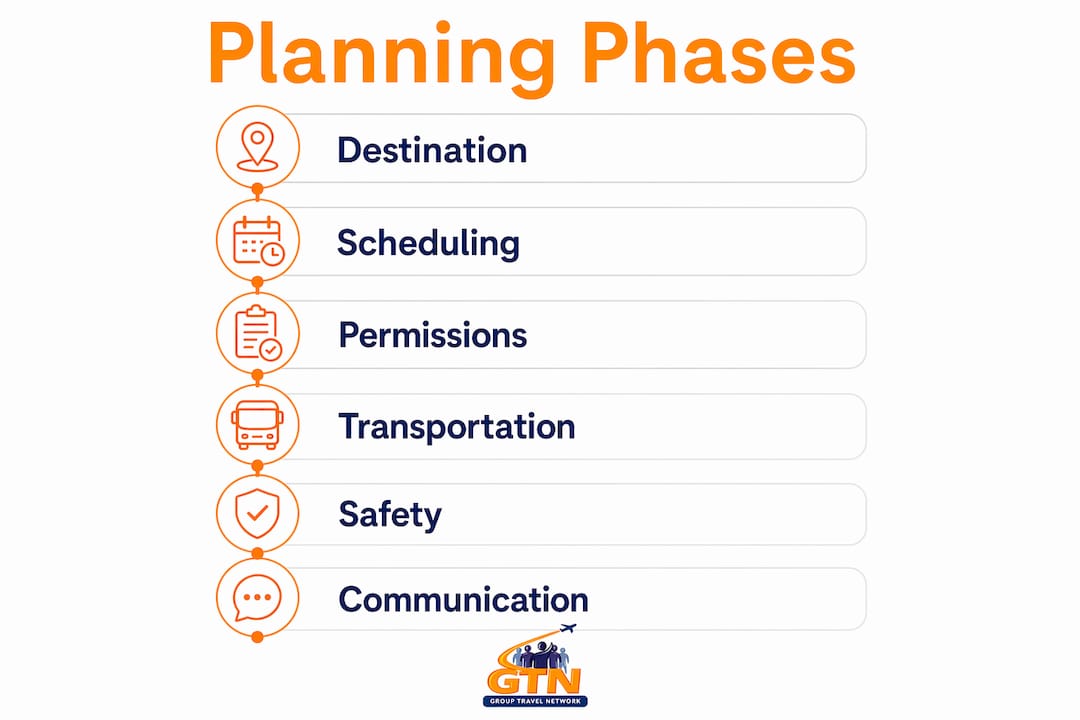
The table below shows how each planning phase maps to its primary logistics function.
| Planning phase | Primary logistics function |
|---|---|
| Destination and dates | Sets scope for all other decisions |
| Transportation and lodging | Determines budget, supervision, and group structure |
| Digital permissions | Creates audit trail and speeds approvals |
| Staff and chaperone assignment | Meets safety ratios and covers student needs |
| Communication plan | Keeps all stakeholders informed before and during the trip |
| Software and tracking | Provides real-time visibility and post-trip reporting |
Coordination among administrators, teachers, transportation staff, and parents is the factor that ties all six phases together. Successful trips are built on that collaboration, not on any single tool or checklist.
For schools planning international or performance-based travel, resources like the school tour planning tips (opens in a new tab) from Astor International School offer useful benchmarks for logistics coordination across different contexts.
Key Takeaways
Effective school travel logistics requires integrating transportation, permissions, budgeting, safety protocols, and communication into one coordinated plan managed from the start of the planning process.
| Point | Details |
|---|---|
| Define logistics early | Treat travel logistics as the foundation of the trip, not a final checklist. |
| Digitize permissions and approvals | Digital workflows reduce bottlenecks, improve accuracy, and create audit trails. |
| Secure transport and lodging first | Early booking decisions shape the entire budget and supervision structure. |
| Assign a logistics lead | Single-point accountability prevents gaps in communication and execution. |
| Build contingency plans | Written emergency and delay protocols protect students and reduce staff stress. |
Why logistics is the part of school trips most administrators underestimate
I have watched well-intentioned school trips fall apart not because of bad destinations or poor teaching, but because the logistics were treated as an afterthought. A teacher books the venue, someone else handles the bus, and a third person manages permissions. Nobody owns the full picture. By the time departure day arrives, there are three different versions of the roster and a driver who was never officially confirmed.
The shift I have seen make the biggest difference is treating educational trip logistics (opens in a new tab) as a project with a single owner, a written plan, and a digital system that everyone can access. Schools that do this stop firefighting and start actually preparing. The educational value of the trip goes up because staff are not distracted by logistics problems on the day.
My honest advice: stop waiting until you have a problem to invest in better systems. The schools that handle travel well are not the ones with the biggest budgets. They are the ones that decided logistics matters and built their process accordingly. Parents notice. Students notice. And the trips are genuinely better for it.
— Donovan
How Grouptravelnetwork helps schools plan smarter trips
School administrators who want expert support for planning school travel have a direct resource in Grouptravelnetwork. The platform provides customized itineraries, dedicated trip coordinators, online registration, flexible payment plans, and travel protection options designed specifically for educational groups.

Whether you are planning a domestic field trip or an international performance tour, the expert planning guide for schools on Grouptravelnetwork covers logistics from first booking to final debrief. For administrators who want a broader view of what student travel can achieve, the student educational travel guide (opens in a new tab) provides destination ideas, safety frameworks, and step-by-step planning tools built for school staff. Grouptravelnetwork handles the complexity so your team can focus on the students.
FAQ
What is travel logistics for schools?
Travel logistics for schools is the coordinated management of transportation, scheduling, permissions, budgeting, and safety protocols needed to run a student trip. It covers every operational detail from booking vehicles to communicating with parents during the trip.
How do I start organizing a school trip?
Start by confirming the destination and travel dates, then secure transportation and lodging. All other logistics decisions, including permissions, staffing, and communication plans, follow from those two anchors.
What software helps with school trip management?
Field trip management platforms centralize requests, automate approvals, assign drivers, and send real-time updates to parents and staff. These tools replace paper-based processes and reduce administrative time per trip significantly.
How do schools handle last-minute changes to trip rosters?
Rooming lists and supervision ratios should be reviewed with student compatibility, medical needs, and required adult-to-student ratios as the primary criteria. Digital roster management makes it faster to update assignments and notify affected staff when changes occur.
Why is early planning critical for school travel logistics?
Securing transportation and lodging early shapes the entire budget and supervision structure for the trip. Schools that begin logistics planning months in advance avoid the cost increases and availability problems that come with late bookings.
Recommended
- How To Organize School Tours: 2026 Planning Guide • Group Travel Network (opens in a new tab)
- Student Educational Travel: Ultimate 2025 Guide For Schools (opens in a new tab)
- Team Travel Coordination Tips For Schools In 2026 • Group Travel Network (opens in a new tab)
- Group Travel Logistics: Why It Matters For School Trips • Group Travel Network (opens in a new tab)