

July 23, 2026
Student Behavior Contract for Travel: 2026 Best Practices

A well-written student behavior contract for travel does one thing above all else: it removes ambiguity before the bus leaves the parking lot. Every expectation, every consequence, and every financial obligation is spelled out in writing, signed by the student and their parents, and enforceable the moment the group steps off campus. Without it, you are managing conduct on the fly with no documented baseline to stand on.
What is a student behavior contract for travel, and why does it matter in 2026?
A student travel behavior contract is a formal, signed agreement between a student, their parent or guardian, and the school that governs conduct during an educational trip. It is not a duplicate of the student handbook. It is a trip-specific document with its own authority, its own financial clauses, and its own enforcement teeth.

Here is why that distinction matters. A general student code of conduct may not give you the immediate authority to send a student home mid-trip or to bill parents for the cost of doing so. A separate trip contract closes that gap explicitly. It also extends the school’s disciplinary reach to off-campus settings, meaning violations can still be addressed after the group returns home.
In 2026, the case for a formal travel conduct agreement is stronger than ever. School trips are longer, more international, and more complex than they were a decade ago. The legal and logistical stakes have grown accordingly.
Key reasons every trip needs its own signed contract:
- Aligns trip conduct with the school’s existing code of conduct
- Authorizes immediate dismissal and documents parental financial responsibility
- Creates a clear record for any post-trip disciplinary action
- Signals to students and parents that this is a structured educational activity, not a vacation
- Protects chaperones and staff by establishing documented expectations in advance
Key elements every student travel behavior contract must include
The strongest contracts are specific, not general. Vague language like “students must behave appropriately” gives you nothing to enforce. Here is what belongs in every document.
Essential vs. optional contract elements
| Element | Type | Purpose |
|---|---|---|
| Conduct rules aligned to school code | Essential | Extends institutional policy to off-campus travel |
| Prohibited behaviors list | Essential | Removes ambiguity about what is not allowed |
| Financial responsibility clause | Essential | Makes parents liable for early dismissal costs |
| No-refund policy on early dismissal | Essential | Prevents disputes over unused trip fees |
| Parent and student signatures | Essential | Creates legal acknowledgment and accountability |
| Curfew and lodging rules | Essential | Defines supervision boundaries after hours |
| Substance prohibition | Essential | Explicitly bans alcohol, tobacco, and non-prescribed drugs |
| Cultural sensitivity language | Recommended | Prepares students to represent the school respectfully |
| Emergency contact information | Recommended | Supports chaperone response in urgent situations |
| Social media conduct guidelines | Optional | Addresses online behavior during the trip |
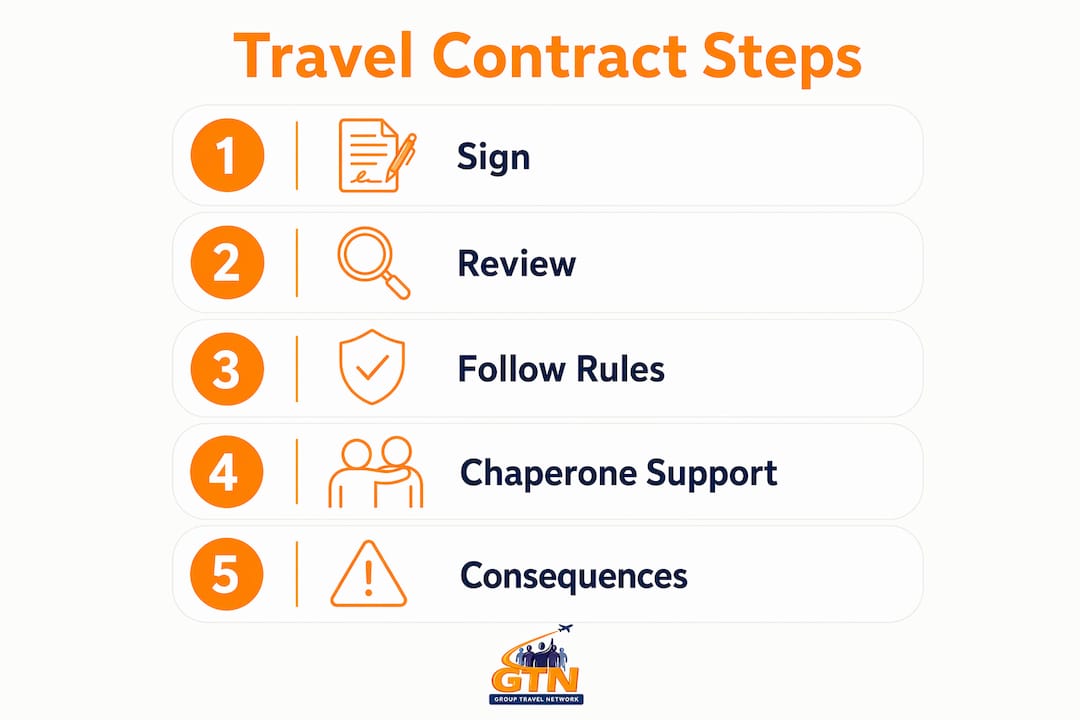
Prohibited behaviors in student travel contracts consistently include drug and alcohol possession, criminal activity, property damage, harassment, and unauthorized independent travel away from the group or assigned lodging. Curfew violations and failure to attend mandatory scheduled events also appear in most well-drafted agreements.
The financial responsibility clause is the clause parents read most carefully, and rightly so. Contracts from districts like Seattle Public Schools and Troy City School District make clear that parents cover early return costs and that no refund applies if a student is sent home early, regardless of the reason, including illness. Spelling this out in plain language before the trip prevents the disputes that tend to surface after one.
Practical checklist for building your contract:
- Reference the school’s official code of conduct by name
- List prohibited behaviors explicitly, not by category alone
- Include a signed parent section with its own financial acknowledgment
- Add a line releasing the school from liability for personal property damage
- Specify curfew times and room-check procedures
- Include language about respecting local customs and cultural sensitivity at each destination
- Require both student and parent signatures with printed names and dates
Best practices for implementing your travel conduct agreement
Getting the contract right on paper is only half the job. How and when you distribute it shapes whether students and parents actually absorb what they are signing.
Timing matters. Collect signed contracts at least 48 hours to one week before departure. That window gives you time to follow up with any family that has not returned the form, and it creates a final accountability conversation before the trip begins. Waiting until the day of departure turns the signing into a formality nobody reads.
The signing process itself is a teaching moment. Research from Vanderbilt University’s behavior contract best practices work notes that signing a contract increases mutual understanding among students and parents that school trips are structured educational activities rather than casual outings. Walk students through the key clauses in a pre-trip meeting rather than just handing them a form to take home. Ask them to explain back what happens if they violate curfew or are caught with alcohol. That conversation sticks.
Practical tips for smooth contract management:
- Hold a dedicated pre-trip meeting with students and parents to review the contract together
- Send a digital copy to parents at least two weeks before departure so they have time to ask questions
- Keep signed originals in a secure folder that travels with the lead chaperone
- Brief all chaperones on the contract’s key clauses before departure, not during the trip
- Post a condensed version of the key rules in each student’s room or on the group’s shared communication channel
- Document any verbal warnings given during the trip in writing, referencing the specific contract clause
Pro Tip: Create a one-page “quick reference” summary of the contract’s five most critical rules and give each chaperone a laminated copy. When a violation occurs, the chaperone can cite the exact clause on the spot rather than trying to recall it from memory.
Expert insights on behavior contracts in educational travel planning
A behavior contract is not just a permission slip with extra rules. As Penn State’s Student Conduct Office makes clear, a properly drafted agreement extends the institution’s conduct jurisdiction to off-campus and international settings, allowing disciplinary action even after the group returns home. That reach matters when a violation surfaces days after the trip ends.
The contract also functions as a communication tool. When students read language stating that they represent their school and community during travel, it reframes the trip in their minds. They are not tourists. They are ambassadors, and the contract makes that explicit. This framing is especially relevant for international student travel, where cultural missteps carry real consequences for the school’s reputation and future access to destinations.
Chaperone training is the piece most organizers underinvest in. Staff need to know not just what the contract says, but how to respond when a student violates it. That means a clear escalation protocol: verbal warning, documented warning, contact with school administration, and if necessary, the early dismissal process. Without that sequence defined in advance, chaperones make inconsistent calls under pressure, which creates fairness disputes later.
Pro Tip: Run a 30-minute pre-trip scenario session with your chaperone team. Present two or three realistic violation situations and walk through the correct response for each. Chaperones who have rehearsed the process enforce it far more consistently than those who read about it in a memo.
Sample student behavior contract template for educational travel (2026 edition)
The template below reflects current best practices and can be adapted for overnight field trips, performance tours, or international educational travel. Customize the bracketed fields for your school and destination.
Student Agreement Section
I, [Student Name], understand and agree to the following rules and expectations during my participation in the [Trip Name] on [Dates] to [Location]:
- I will follow the [School Name] Code of Conduct at all times during this trip and understand that violations may result in disciplinary action upon return.
- I will treat all classmates, chaperones, teachers, and community members with courtesy and respect.
- I will not leave the group or my assigned lodging without explicit chaperone permission.
- I will observe all curfew times set by the trip leadership.
- I will not possess or use alcohol, tobacco, or any non-prescribed medication or illegal substance.
- I will respect public and private property and accept financial responsibility for any damage I cause.
- I understand that failure to comply may result in being sent home early at my parents’ expense.
Parent/Guardian Agreement Section
I/We, [Parent/Guardian Name], have read and accept the student agreement above and additionally agree to:
- Accept financial responsibility for my child’s early return if a chaperone or teacher determines it is necessary.
- Acknowledge that no refund will be issued if my child is sent home early or misses scheduled activities for any reason.
- Release [School Name] from liability for personal property damage occurring during the trip.
- Accept full responsibility if my child is detained or arrested for illegal activity.
Clause-by-clause reference
| Clause | Purpose | Customization note |
|---|---|---|
| Code of conduct reference | Extends school policy to the trip | Name the specific policy document |
| Prohibited behaviors | Removes ambiguity | Add destination-specific rules if needed |
| Financial responsibility | Prevents post-trip disputes | Specify which costs parents cover |
| No-refund policy | Clarifies financial consequences | Confirm with your district’s legal team |
| Property damage | Assigns liability clearly | Reference local laws for international trips |
| Signature lines | Creates legal acknowledgment | Include printed name, signature, and date |
Key features of this template:
- Dual-section structure keeps student and parent obligations clearly separate
- Financial clauses appear in both sections so neither party can claim they missed them
- The code of conduct reference by name gives the contract immediate disciplinary authority
- Signature lines require printed names alongside signatures to prevent disputes over legibility
Plan your next trip with Grouptravelnetwork

A strong behavior contract sets the foundation. The trip itself still needs expert logistics behind it. Grouptravelnetwork specializes in organizing student, school, and performance group travel with dedicated trip coordinators, flexible payment plans, and built-in travel protection. Whether you are planning a domestic field trip or an international performance tour, the school group travel planning resources at Grouptravelnetwork give you a step-by-step framework that covers conduct management alongside every other detail. Start your planning at grouptravelnetwork.com.
Key Takeaways
A trip-specific student behavior contract is the single most effective tool for protecting students, staff, and the school’s legal standing during educational travel.
| Point | Details |
|---|---|
| Use a trip-specific contract | General student handbooks lack the authority to authorize immediate dismissal or bill parents for early return costs. |
| Include a financial responsibility clause | Parents must agree in writing to cover early dismissal expenses, with no refund for unused trip fees. |
| Collect signatures at least 48 hours before departure | Early collection creates a final accountability checkpoint and allows time to follow up with missing forms. |
| Train chaperones on enforcement protocols | Staff who have rehearsed violation responses enforce the contract consistently and reduce fairness disputes. |
| Extend conduct rules to cultural context | Contracts should explicitly remind students they represent their school and must respect local customs at every destination. |
FAQ
What should a student behavior contract for travel include?
Every travel behavior agreement needs conduct rules aligned to the school’s code of conduct, a prohibited behaviors list, a financial responsibility clause, curfew and lodging rules, and signed acknowledgments from both the student and parent or guardian.
Can a school discipline a student for violations that happen during a trip?
Yes. A properly drafted contract extends school conduct jurisdiction to off-campus and travel settings, allowing disciplinary action even after the group returns home.
Who pays if a student is sent home early from a trip?
Parents are financially responsible for all costs associated with early dismissal, including travel and lodging, and no refund applies for any unused portion of the trip.
How far in advance should contracts be distributed and collected?
Best practice is to collect signed contracts well in advance before departure, giving organizers time to follow up and conduct a final pre-trip accountability conversation with students and families.
Do parents need to sign the behavior contract separately from students?
Yes. The parent or guardian section should be a distinct agreement with its own clauses covering financial responsibility and liability, signed and dated separately from the student section.
Recommended

Relax with our Student Travel Expertise .
We deliver stress-free student trips backed by an exceptional array of services you won’t find anywhere else:
- Stress-free, creative planning of customized itineraries
- Dedicated GTN Service host on every trip
- Extensive travel protection plan options
- Online, individual registration system
- Flexible payment plans and online payment options
- Bulk buyer discounts for great trips that cost less
Inclusion into #MyGTNFamily for life! (you don’t even have to remember our birthday!)
Spain
There is no place like Spain to offer a student performance opportunity or cultural student trip.
Myrtle Beach
All students love the beach! Especially a beach known for its 60 miles of pristine coastline.
Boston
Have your students experience colonial charm in the city that is considered the hub of New England.
London
Provide your student group with the “Royal” treatment! One of the world’s most recognized cities.
See What People Are Saying
“What wonderful trip we had to NYC! Our group of 51 never missed a beat because of Group Travel Network and our wonderful guide, Tim. It was truly a theatre trip to remember! If you are looking for a travel company who really cares about the details, Group Travel Network is for you!”
“This was my first time using a company to plan our band trip. It was so easy working with Justin and Group Travel Network. We had to make several changes along the way, but they were accommodating changes and worked everything out for us. I would highly recommend using Group Travel Network.”
“It has been my privilege to use Group Travel Network as the exclusive travel coordinator for my band for over 10 years. I can say, without doubt or hesitation, that GTN is, by far, the best travel company for student groups currently in existence. I have often said that I wouldn’t take my band across the street without GTN and that’s not far from the truth!”