


Music band travel is the organized process of taking student music groups on multi-city performance tours, combining live concerts, educational experiences, and structured travel logistics into a single coordinated program. Unlike a standard field trip, a student music tour (opens in a new tab) is built around scheduled performances at specific venues, with every logistical element, from transportation to accommodation to instrument handling, planned around the needs of performing musicians. The industry term for this is a concert tour, defined as a series of performances) by a group in different cities or locations, often organized into geographic segments called “legs.”
For school band directors, music band travel serves goals that go well beyond the stage. Students develop discipline, teamwork, and cultural awareness while representing their school in front of real audiences. Specialized organizations like Music Travel Consultants, Musicians Abroad, and Grouptravelnetwork exist specifically to help educators manage the complexity of these tours, handling everything from venue booking to chaperone coordination.
Core aspects of student music band travel at a glance:
- Scheduled performances at multiple venues across different cities or regions
- Coordinated transportation for students, chaperones, and instruments
- Accommodation and meal planning tailored to group size and budget
- Educational programming woven into the itinerary alongside performances
- Fundraising and financial planning to make the trip accessible to all students
- Safety protocols, emergency planning, and parental consent processes
- Post-trip evaluation to measure educational and musical outcomes
What is music band travel, and how do you plan it effectively?
Strong planning is what separates a memorable tour from a chaotic one. The first decision every band director needs to make is why the trip is happening. Is the goal to perform at a prestigious festival? Expose students to a specific cultural destination? Raise the program’s profile? The answer shapes every decision that follows, from destination to budget to the length of the trip.

A realistic planning timeline for a student music tour can span over a year from the first conversation to departure day. That window sounds long, but popular performance venues and festival slots fill up fast, and school administration approval, parent communication, and fundraising all take more time than most directors expect.
Essential planning tasks, roughly in order:
- Define the trip’s educational and performance goals with your administration
- Identify target destinations and performance venues or festivals
- Establish a preliminary budget and identify funding sources
- Submit proposals to school administration and the school board
- Begin parent and student communication with an informational meeting
- Secure venue bookings, travel arrangements, and accommodation
- Launch fundraising campaigns
- Collect permission slips, medical forms, and payment installments
- Confirm all logistics and distribute final itineraries
A practical planning timeline:
- More than a year before: Set goals, research destinations, get administrative buy-in
- Several months in advance: Book venues, contact travel specialists, establish budget
- Months ahead: Hold parent information night, open registration, begin fundraising
- Closer to departure: Confirm transportation and accommodation, collect deposits
- Few months out: Finalize itinerary, arrange permits and permissions
- Shortly before trip: Collect all forms, confirm headcount, brief chaperones
- Weeks before departure: Distribute packing lists, run final rehearsals, confirm all vendors
- Just before trip: Send final itinerary to parents, confirm emergency contacts
Engaging stakeholders early prevents the biggest planning failures. Parents who feel informed from the start are far more likely to support fundraising and comply with deadlines. Administration that understands the educational rationale is more likely to approve the trip and allocate school resources.
Pro Tip: Build a shared digital folder accessible to all chaperones containing the full itinerary, emergency contacts, medical forms, insurance documents, and vendor confirmation numbers. When something goes wrong at 11 PM in an unfamiliar city, that folder is what saves the trip.
How to budget and fundraise for a school band tour
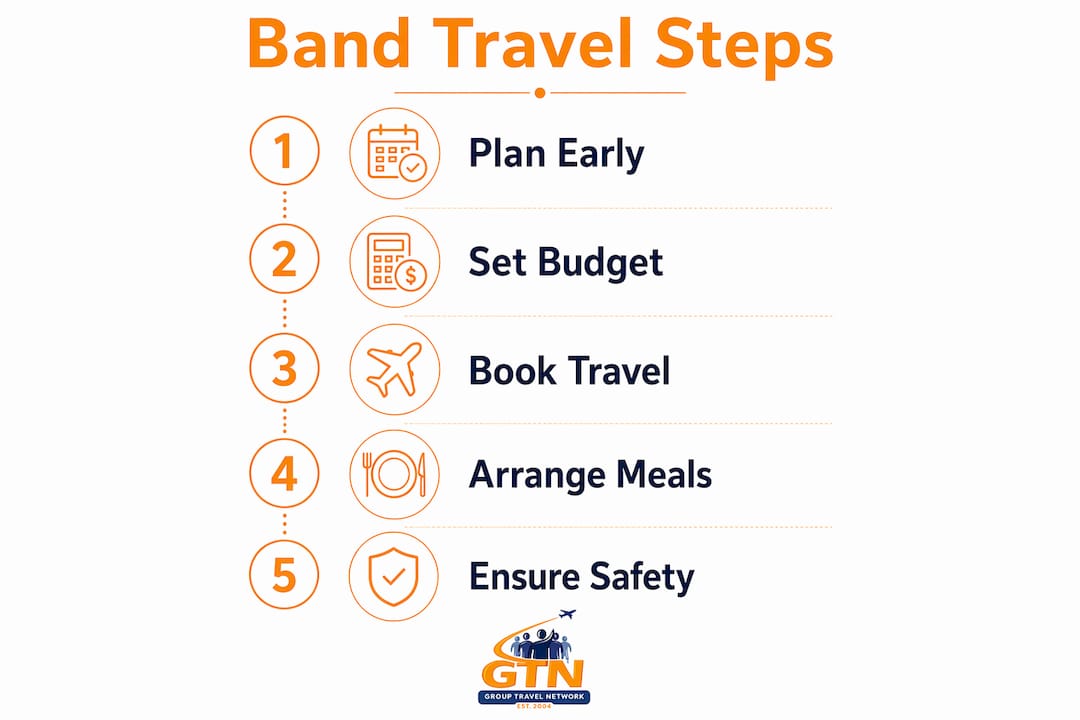
Budgeting for a student music tour requires accounting for every cost category before you announce a per-student price. Underestimating costs early creates a funding gap that is nearly impossible to close once families have committed.
Standard budget categories for a student band tour:
- Transportation (charter buses, flights, or van rentals)
- Accommodation (hotel rooms, typically double or triple occupancy)
- Meals (per diem rates or group meal packages)
- Performance fees, festival registration, and venue costs
- Instrument and equipment transport, including cases and freight
- Travel insurance and emergency fund (a contingency percentage of the total budget)
- Chaperone costs (often covered by the program, not individual families)
- Merchandise, uniforms, or program materials
Once you have a realistic total, divide it by the number of paying students to get your per-student price. Then build your fundraising plan around closing the gap between what families can reasonably pay and what the trip actually costs.
Fundraising options that work for school band programs:
- Community concerts or dinner performances with ticket sales
- Corporate sponsorships from local businesses in exchange for program recognition
- Grant applications through music education foundations and arts councils
- Online crowdfunding campaigns targeting alumni and community supporters
- Product sales (candy, candles, discount cards) run by students
- Restaurant nights where a percentage of sales benefits the band
Pro Tip: Set your fundraising goal somewhat higher than your actual gap to provide a buffer. Campaigns rarely hit 100%, and the buffer protects students from last-minute cost increases without requiring a painful announcement to families.
Transparent financial management builds trust with parents and administration. Use a dedicated account for trip funds, provide regular written updates on fundraising progress, and offer payment plans so cost does not exclude students from participating. The educational benefits of group travel (opens in a new tab) are well documented, and making the trip financially accessible to every student in your program is worth the extra administrative effort.
How to manage transportation, accommodation, meals, and safety
Logistics for band travel (opens in a new tab) are more complex than standard group travel because you are moving both people and instruments, often on a tight schedule tied to performance call times. Getting this wrong does not just cause inconvenience; it can mean arriving at a venue without your instruments or missing a performance slot entirely.
Transportation
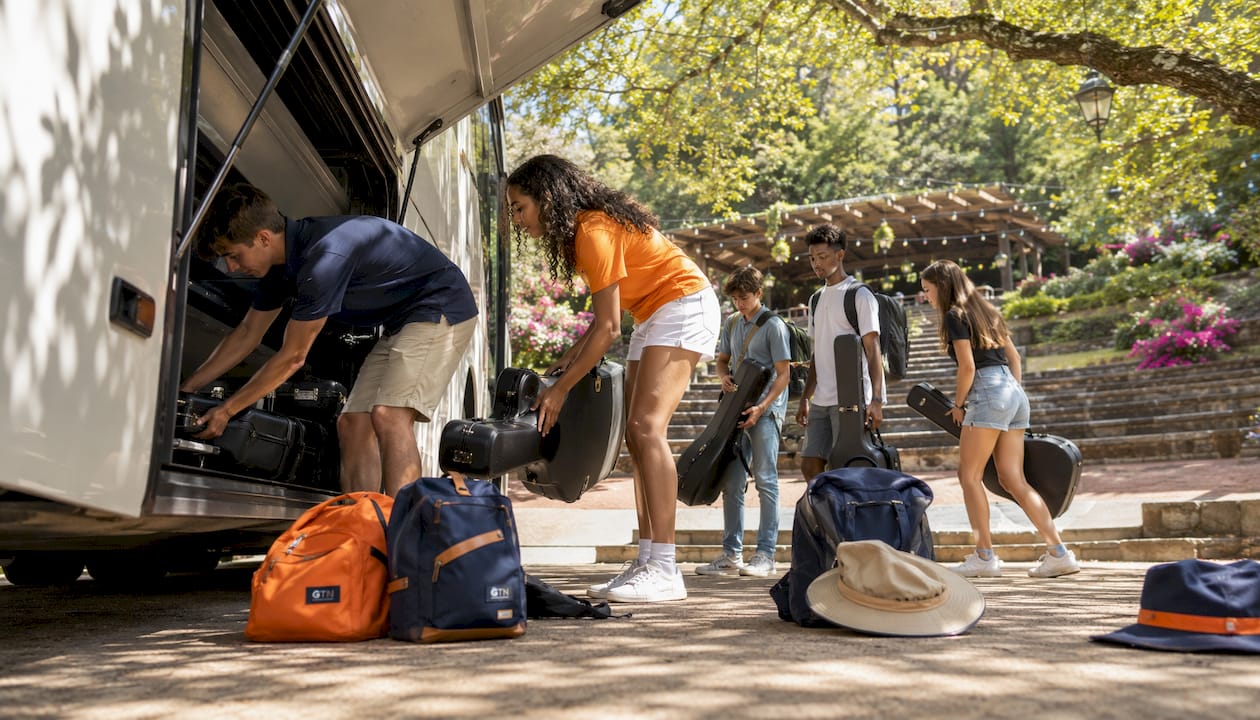
Charter buses are the most practical option for regional tours. They keep the group together, allow instrument storage in the luggage bays, and eliminate the coordination problems that come with splitting students across multiple vehicles. For longer distances, flights become necessary, but airline instrument policies vary widely. Some carriers allow smaller instruments as carry-on; others require gate-checking or purchasing an extra seat for fragile pieces. Always confirm policies in writing before booking, and arrange separate freight for larger instruments and equipment.
Tour buses are worth considering for multi-city tours with back-to-back performance dates. They allow overnight travel between cities, saving accommodation costs on transit nights, and keep the group together throughout the tour. Poor van travel management, including driver fatigue and unsecured gear, is one of the top causes of tour burnout and failed performances. Rotating drivers and building in mandatory rest stops are not optional.
Accommodation
Choose hotels within walking distance of performance venues when possible. Group-friendly properties with block booking rates, accessible loading areas for equipment, and secure storage for instrument cases make a meaningful difference. Aim for properties with at least a three-star rating, and confirm that room configurations match your chaperone-to-student supervision ratios before booking.
Meals
Pre-arranged group meal packages at restaurants near venues save time and reduce the risk of students wandering off schedule. Collect dietary restrictions and allergies from every student before the trip and communicate them to every food vendor in writing. A per diem system works for some groups, but it requires students to manage their own money, which adds a layer of supervision complexity.
Safety planning
Every student music tour needs a written safety plan before departure. That plan should include:
- Chaperone-to-student ratios (typically one adult per several students as required by school districts)
- Emergency contact protocols and a designated communication chain
- Medical forms and prescription medication procedures for every student
- Travel insurance covering medical emergencies, trip cancellation, and lost instruments
- A designated meeting point at every venue in case students become separated
- Clear behavioral expectations and consequences communicated to students and parents
Pro Tip: Assign each chaperone a specific group of students they are responsible for at all times. A general “watch the group” instruction is how students get lost. Named accountability is how they stay safe.
How to build an itinerary that balances performance, learning, and fun
The best student music tour itineraries do three things well: they protect performance quality, they create genuine learning moments, and they leave room for students to actually enjoy the trip. Itineraries that are packed wall-to-wall with scheduled activities produce exhausted, disengaged students who perform below their best.
Best practices for itinerary design:
- Schedule performances for mid-morning or early afternoon when possible, avoiding late-night slots that disrupt sleep
- Build at least one full rest period into every two days of travel
- Pair performance venues with nearby cultural or historical sites for educational context
- Include one or two student-choice free time blocks so the trip feels like an adventure, not a forced march
- Plan rehearsal time on the day before major performances, not the morning of
A sample two-day itinerary for a regional festival tour might look like this:
| Time | Day 1 | Day 2 |
|---|---|---|
| morning | Depart by charter bus | Hotel breakfast, pack out |
| mid-morning | Arrive at destination, check in | Warm-up rehearsal at venue |
| early afternoon | Lunch (pre-arranged group meal) | Festival performance |
| 1:30 PM | Cultural site visit or museum | Awards ceremony |
| afternoon | Free time in supervised groups | Depart for home |
| evening | Group dinner | En route dinner stop |
| evening | Hotel, lights out evening | Arrive home |
The cultural programming is not filler. When students perform in a city they have also explored, the experience sticks. A band that plays in New Orleans after spending an afternoon in the French Quarter absorbs something about the music they are performing that no classroom lesson can replicate. That kind of real-world learning (opens in a new tab) is exactly what makes performance tours worth the planning effort.
Pro Tip: Send students a one-page “destination brief” before departure covering the history of the performance venue, notable musicians connected to the city, and two or three things worth seeing during free time. It takes 20 minutes to write and dramatically increases student engagement with the destination.
Common problems during student band tours and how to handle them
Even the best-planned tours hit unexpected problems. The difference between a trip that recovers well and one that falls apart is almost always preparation and communication.
The most common issues and practical fixes:
- Travel delays: Build buffer time into every transit leg. A 30-minute buffer between arrival and performance call time is the minimum; 90 minutes is better for flights.
- Instrument damage or loss: Require hard-shell cases for all instruments in transit. Document every instrument with photos and serial numbers before departure, and carry copies of insurance policies.
- Student illness: Designate one chaperone as the medical point of contact. Carry a first aid kit, know the location of the nearest urgent care at every stop, and have a protocol for contacting parents.
- Behavioral issues: Address problems immediately and privately. Have a written behavioral contract signed by students and parents before departure so expectations are clear.
- Vendor no-shows or booking errors: Carry printed confirmation numbers for every reservation. Have a backup contact for your transportation provider and know your hotel’s direct line, not just the 800 number.
Detailed itineraries and backup contacts are the foundation of effective crisis management on student music tours. When a problem hits, the director who has a printed itinerary and a list of backup contacts in their bag handles it in 10 minutes. The one who relied on a phone app spends 45 minutes trying to recover information.
Key insight: The tours that recover fastest from problems are the ones where every chaperone knows the plan, not just the director. Brief your entire adult team on the full itinerary, the emergency protocols, and who makes decisions when something goes wrong. Distributed knowledge is your best contingency plan.
A brief example: a band director traveling with 60 students discovers their charter bus has a mechanical failure two hours from the performance venue. Directors who have a backup transportation contact in their planning documents can make one call and solve the problem. Those who don’t spend those two hours on hold with a general customer service line. The preparation gap is that stark.
Why professional support makes student band travel better
Planning a student music tour is a part-time job stacked on top of a full-time one. Most band directors are managing rehearsals, grading, and administrative duties while simultaneously trying to coordinate hotel blocks, charter buses, and festival registrations. Professional travel support does not just save time; it prevents the category of mistakes that come from doing complex logistics without specialized experience.
Specialized music travel agencies operate differently from general travel agencies. They understand artist-first logistics, meaning they build itineraries around performance call times, instrument transport requirements, and the specific needs of traveling musicians, not just standard group travel preferences. They have existing relationships with venues, hotels, and transportation providers that translate into better rates and faster problem resolution.
What professional support typically provides for school band tours:
- Dedicated trip coordinator who manages all vendor relationships
- Pre-negotiated group rates for transportation and accommodation
- Instrument transport coordination, including freight and customs documentation for international tours
- 24/7 emergency support during the trip
- Online registration and payment plan management for families
- Comprehensive travel insurance options
- Post-trip reporting and evaluation support
Organizations like Music Travel Consultants, Musicians Abroad, and Grouptravelnetwork specialize in exactly this kind of work. They bring experience from hundreds of student tours, which means they have already encountered and solved most of the problems a first-time director would not see coming. For directors planning their first major tour, or scaling up from a regional trip to a multi-state or international one, that institutional knowledge is worth more than the coordination fee.
From the field: “The biggest thing a travel specialist gave us was confidence. I knew the logistics were handled, so I could actually focus on my students and the music instead of spending the whole trip on my phone managing vendors.”
Grouptravelnetwork offers dedicated trip coordinators, flexible payment plans, and travel protection options designed specifically for student groups. Their performance tour planning (opens in a new tab) services cover everything from initial itinerary design through post-trip evaluation, making them a practical choice for band directors who want professional support without giving up control of the educational experience.
Student music tours also carry real weight beyond the performance itself. Research on extracurricular activities for college admissions (opens in a new tab) consistently shows that sustained, high-level participation in performing arts, including competitive touring, strengthens a student’s application profile. That context gives band directors another compelling argument when presenting tour proposals to school administration.

Ready to plan your next student music tour without the logistical headache? Grouptravelnetwork’s school group travel planning (opens in a new tab) guide walks you through every step, from setting goals to post-trip evaluation, with dedicated support at every stage.
Key Takeaways
Student music band travel requires 12–18 months of planning, a detailed budget with a contingency fund, and professional logistical support to deliver safe, educationally rich performance tours.
| Point | Details |
|---|---|
| Start planning 12–18 months out | Popular venues and festival slots fill quickly; early booking protects your options. |
| Budget every cost category upfront | Include transportation, accommodation, meals, equipment, and a contingency fund. |
| Assign named chaperone accountability | General supervision fails; each adult should be responsible for a specific group of students. |
| Balance performance with rest | Build rest periods into every two days of travel to protect performance quality. |
| Use professional travel support | Specialists in student music tours reduce risk, negotiate better rates, and provide 24/7 backup. |
FAQ
What is it called when a band travels to perform in multiple cities?
This is called a concert tour, or simply a tour. A concert tour) is a series of scheduled performances by an artist or group in different cities or locations, often divided into geographic segments called “legs.”
What does a music travel consultant do for school bands?
A music travel consultant manages the logistics of a student performance tour, including venue booking, transportation, accommodation, instrument transport, and emergency support, so the band director can focus on the students and the music.
How far in advance should a band director start planning a tour?
Most experienced directors begin planning 12–18 months before the departure date. That window allows time for administrative approval, fundraising, venue booking, and collecting all required permissions and medical forms.
How do bands typically transport instruments during travel?
For regional tours, instruments travel in the luggage bays of charter buses or in a trailer. For flights, policies vary by airline; some allow smaller instruments as carry-on, while others require gate-checking or an extra purchased seat. Hard-shell cases are standard for all instrument transport.
What is the ATA Carnet, and does it apply to student band travel?
The ATA Carnet is a customs document that functions as a passport for professional equipment, allowing duty-free temporary import and export across participating countries. It applies primarily to international tours and is worth arranging for any student group traveling abroad with valuable instruments.
Recommended
- What Is Travel For School Bands: A Director’s Guide • Group Travel Network (opens in a new tab)
- Band Trip Planning Guide: Organize Student Music Travel (opens in a new tab)
- Music Tours: A School Administrator’s Planning Guide • Group Travel Network (opens in a new tab)
- Tips For Organizing Band Tours: 10 Proven Strategies • Group Travel Network (opens in a new tab)