

July 2, 2026
Team Travel Supervision Guide for Coaches in 2026

TL;DR:
- Effective team travel supervision requires strict adherence to legal safety standards, including adequate adult-to-minor ratios and background checks. Proper planning involves assigning clear roles, sharing detailed itineraries, and establishing communication protocols to manage emergencies efficiently. Regular debriefs and documentation improve supervision quality and ensure safer, more organized future trips.
Team travel supervision is the structured process of ensuring safety, compliance, and smooth logistics for groups traveling together, especially minors. Effective group travel supervision blends safeguarding policy compliance, proactive coordination, and real-time problem solving. For school administrators, sports coaches, and trip coordinators, getting this right is not optional. The 2026 safeguarding guidance sets clear legal standards for adult-to-minor ratios, background checks, and transportation compliance. This team travel supervision guide covers every stage, from pre-trip planning through post-trip reporting, so you can lead with confidence.
What are the mandatory supervision requirements for team travel?
The 2026 safeguarding guidance sets firm rules for supervising minors on group trips. Teams with junior players under 18 must have at least two adult supervisors, with one sharing the gender of the children. For athletes aged 8–12, one of those supervisors must be a parent. These are not suggestions. They are minimum legal thresholds that every school administrator and coach must meet before departure.
Background checks are equally non-negotiable. Every supervising adult must hold a current DBS check or equivalent background clearance before traveling with minors. Institutions that skip this step expose themselves to serious legal liability. Many school districts now require documentation of clearance to be filed with the athletic director at least two weeks before travel.
Transportation compliance adds another layer of obligation. Under 49 CFR § 37.189, bus operators require 48-hour advance notice for accessible transportation services. That means coordinators must identify accessibility needs early and communicate them to carriers well before departure day.
Insurance and separate-travel approvals round out the legal picture. Any participant traveling independently to a destination must have written institutional approval on file. Group travel insurance covering medical emergencies, trip cancellations, and liability is standard practice for safe student group travel.
| Supervision requirement | Details |
|---|---|
| Minimum adult supervisors | At least 2 adults for groups with players under 18 |
| Gender matching | One supervisor must share the gender of the children |
| Ages 8–12 | One supervisor must be a parent |
| Background checks | Current DBS or equivalent clearance required for all supervisors |
| Accessible transport notice | 48-hour advance notice required under 49 CFR § 37.189 |
| Separate travel approval | Written institutional approval required for any independent traveler |
Pro Tip: Keep a printed copy of your supervision ratios and background check confirmations in a dedicated travel binder. If a school official or venue security asks for proof, you can produce it in seconds.
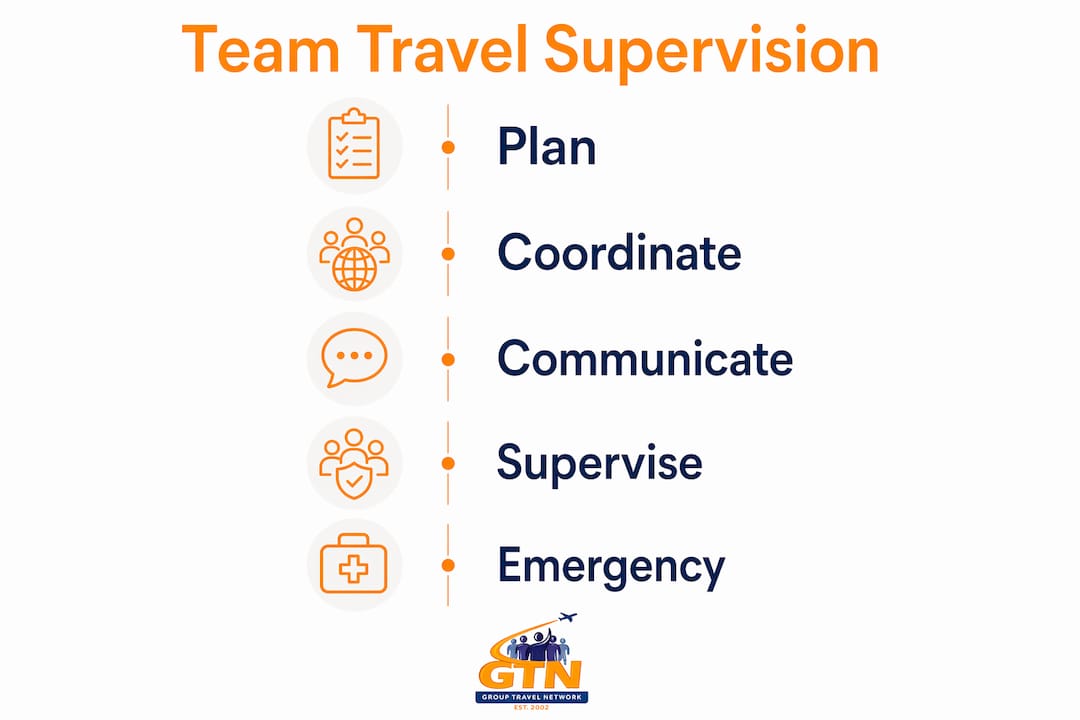
How to plan and coordinate logistics for effective team travel supervision
Strong logistics coordination starts with one person owning the plan. Appoint a primary trip coordinator before any bookings are made. That coordinator then assigns a deputy who handles daily operational details, freeing the primary supervisor to focus on safety and unexpected issues. This role separation is the single most effective structural decision you can make for a group trip.

The master itinerary is your operational backbone. It should include departure times, transportation details, accommodation addresses, venue schedules, meal arrangements, and emergency contact numbers. Share it with all supervisors, parents, and institutional administrators at least one week before departure. A shared digital version, accessible via Google Drive or a similar platform, keeps everyone on the same page in real time.
Accommodation selection follows a clear priority order. Hotels near venues with quiet environments and reliable Wi-Fi outperform higher-rated properties that are farther away or noisier. Athlete recovery and focus depend more on sleep quality and proximity than on amenities. Book rooms in clusters on the same floor to simplify supervision and reduce late-night movement.
- Confirm room assignments and floor plans with the hotel before arrival
- Request a single point of contact at the property for group logistics
- Verify Wi-Fi reliability for real-time itinerary updates and parent communication
- Confirm accessibility features if any participant requires them
- Arrange a quiet common area for team meetings and briefings
Financial management is often the most overlooked part of pre-trip planning. Centralizing group expenses on a single card reduces administrative burden and speeds up reconciliation after the trip. Assign one person to manage the card and track receipts digitally using an expense app that auto-matches transactions.
Pro Tip: Automated pre-trip approval systems can reduce out-of-policy travel spending by 12–18% by screening requests against fare limits and preferred vendors before booking. Many school districts already use these systems for staff travel. Ask your business office if the same tool can be applied to team trips.
What tools and communication strategies improve real-time supervision?
Real-time supervision depends on clear communication channels set up before the trip begins. Assign a single group messaging platform, such as GroupMe or a school-approved equivalent, for all supervisors and chaperones. Establish a check-in schedule, for example, every two hours during activity blocks and at each transition point. Consistency prevents confusion and catches problems early.
Role delegation is the engine of effective on-trip management. Delegating daily logistics to a deputy allows the primary coordinator to stay focused on emergencies rather than bus schedules and meal counts. The deputy handles headcounts, room checks, and vendor coordination. The primary coordinator monitors the overall situation and responds to anything that escalates.
Documentation redundancy protects the whole group. Splitting critical paperwork between the primary and backup supervisor, including medical releases, emergency contacts, and insurance documents, prevents delays if one device is lost or a supervisor becomes unavailable. Keep both digital and printed copies.
- Set up a group messaging channel before departure and confirm all supervisors are active
- Assign a deputy to own headcounts, room checks, and vendor communication
- Distribute copies of medical releases and emergency contacts to at least two supervisors
- Use a shared digital itinerary with real-time edit access for schedule change alerts
- Establish an escalation path for emergencies, including an out-of-hours contact at the school or institution
- Brief all supervisors on the escalation procedure the evening before departure
For school team travel coordination, the escalation path deserves special attention. Identify who gets called first, second, and third if a medical emergency, missing participant, or transportation failure occurs. Write those names and numbers on a card that every supervisor carries physically. Digital-only contact lists fail when phones die or lose signal.
How to troubleshoot common challenges and ensure a safe return
No-shows and last-minute illnesses are the most common disruptions on departure day. Have a written protocol for both scenarios before the trip begins. If a participant cannot travel, confirm whether a replacement is permitted under your institutional policy and whether the participant’s insurance covers cancellation. Never make these decisions on the fly at the departure gate.
Separate travel approvals create accountability gaps if not managed carefully. Any participant who travels independently to a destination must check in with a supervisor upon arrival and be formally logged as present. A simple sign-in sheet at the first team gathering point closes this gap. Coaches who skip this step often discover the problem only when someone is missing at departure.
- Confirm all participants are accounted for at each transition point, not just at the start and end of the trip
- Reconcile expenses within 48 hours of return while receipts and memory are fresh
- Collect feedback from supervisors, participants, and parents within one week of return
- File a post-trip report with the athletic director or school administrator covering incidents, near-misses, and logistics gaps
- Archive all documentation, including medical releases and incident reports, for at least three years
Standardizing emergency protocols and establishing a clear escalation path before departure greatly reduces reactive crises. Teams that debrief after every trip and update their protocols consistently outperform those that treat each trip as a fresh start. Post-trip reporting is not paperwork for its own sake. It is the foundation of a better trip next time.
Pro Tip: Create a one-page emergency reference card for every supervisor. Include the escalation path, local emergency numbers at the destination, the group’s insurance policy number, and the hotel address. Laminate it. Supervisors who can act immediately in a crisis are worth more than any app.
Expense reconciliation is faster when you use a yearbook adviser-style documentation approach, treating every receipt as a record that must be filed and accounted for before the trip closes. The same discipline that keeps school programs financially clean applies directly to group travel budgets.
Key Takeaways
Effective team travel supervision requires structured roles, legal compliance, and pre-defined emergency protocols working together from the first planning meeting through the final post-trip report.
| Point | Details |
|---|---|
| Legal supervision ratios | 2026 guidance requires at least two adult supervisors for groups with players under 18, with gender matching. |
| Role delegation | Assign a deputy to handle daily logistics so the primary coordinator can focus on safety issues. |
| Documentation redundancy | Split medical releases and emergency contacts between two supervisors to prevent trip delays. |
| Accommodation strategy | Prioritize proximity and quietness over star ratings to support athlete recovery and focus. |
| Post-trip reporting | File a formal report within one week of return to capture incidents and improve future trips. |
What I’ve learned after years of watching group trips go sideways
The coordinators who struggle most are the ones who try to control everything personally. I have watched experienced coaches spend an entire travel day managing bus seating and meal orders while missing the fact that two athletes were showing signs of heat exhaustion. Delegation is not a luxury. It is a safety mechanism.
The second pattern I keep seeing is late communication with families. Sending the itinerary three days before departure is not early communication. Parents who receive full details two weeks out ask fewer panicked questions on departure morning and respond faster in a genuine emergency. That calm at the start of a trip carries through the whole experience.
The third thing most guides get wrong is over-engineering the technology side. You do not need a custom app to run a safe group trip. You need a shared document, a group chat, and a laminated emergency card. Complexity creates failure points. Simplicity creates reliability.
What actually separates good supervision from great supervision is the debrief. Teams that sit down after every trip, even for 20 minutes, and ask “what broke and what worked” build institutional knowledge that no checklist can replicate. The travel management strategies that hold up over years are the ones refined by real experience, not borrowed wholesale from a template.
— Donovan
How Grouptravelnetwork supports team travel planning and supervision
School administrators and coaches who want a structured foundation for group travel planning do not need to build everything from scratch.

Grouptravelnetwork offers a step-by-step school group travel planning guide built specifically for educational institutions, sports teams, and performance groups. The platform provides dedicated trip coordinators, customized itineraries, vendor partnerships, and travel protection options that align with 2026 safeguarding standards. Whether you are coordinating a regional sports tournament or a multi-day performance tour, Grouptravelnetwork handles the logistics infrastructure so your supervision team can stay focused on the people, not the paperwork. Explore the team travel coordination resources to see how schools are planning safer, better-organized trips this year.
FAQ
What is the minimum adult-to-minor ratio for team travel in 2026?
The 2026 safeguarding guidance requires at least two adult supervisors for groups with players under 18, with one supervisor sharing the gender of the children. For athletes aged 8–12, one supervisor must be a parent.
How far in advance should accessible transportation be booked?
Under 49 CFR § 37.189, bus operators require 48-hour advance notice for accessible transportation services. Coordinators should identify accessibility needs during the initial planning phase, well before that deadline.
What documents should every supervisor carry during a team trip?
Every supervisor should carry medical releases, emergency contacts, insurance policy details, and the institutional approval forms for any separate travelers. Splitting these documents between the primary and backup supervisor prevents delays if one set is lost.
How do you handle a participant who becomes ill on departure day?
Confirm whether a replacement is permitted under your institutional policy and whether the participant’s travel insurance covers cancellation. Document the situation in writing and notify the school administrator before the group departs.
What is the fastest way to improve supervision on future trips?
File a formal post-trip report within one week of return, covering incidents, near-misses, and logistics gaps. Teams that debrief consistently and update their protocols after each trip build the strongest supervision practices over time.
Recommended

Relax with our Student Travel Expertise .
We deliver stress-free student trips backed by an exceptional array of services you won’t find anywhere else:
- Stress-free, creative planning of customized itineraries
- Dedicated GTN Service host on every trip
- Extensive travel protection plan options
- Online, individual registration system
- Flexible payment plans and online payment options
- Bulk buyer discounts for great trips that cost less
Inclusion into #MyGTNFamily for life! (you don’t even have to remember our birthday!)
Spain
There is no place like Spain to offer a student performance opportunity or cultural student trip.
Myrtle Beach
All students love the beach! Especially a beach known for its 60 miles of pristine coastline.
Boston
Have your students experience colonial charm in the city that is considered the hub of New England.
London
Provide your student group with the “Royal” treatment! One of the world’s most recognized cities.
See What People Are Saying
“This was my first time using a company to plan our band trip. It was so easy working with Justin and Group Travel Network. We had to make several changes along the way, but they were accommodating changes and worked everything out for us. I would highly recommend using Group Travel Network.”
“What wonderful trip we had to NYC! Our group of 51 never missed a beat because of Group Travel Network and our wonderful guide, Tim. It was truly a theatre trip to remember! If you are looking for a travel company who really cares about the details, Group Travel Network is for you!”
“It has been my privilege to use Group Travel Network as the exclusive travel coordinator for my band for over 10 years. I can say, without doubt or hesitation, that GTN is, by far, the best travel company for student groups currently in existence. I have often said that I wouldn’t take my band across the street without GTN and that’s not far from the truth!”