

June 14, 2026
Role of Local Tour Guides: Why They Matter in 2026

TL;DR:
- Local guides act as cultural mediators, offering personalized insights, language support, and safety management that enhance visitors’ understanding. They promote sustainable tourism by supporting local economies and protecting heritage sites through community engagement and proper training. Travelers can ensure quality by verifying certifications, choosing vetted platforms, and prioritizing guides skilled in authentic cultural interpretation.
Local tour guides are defined as trained cultural mediators who interpret a destination’s heritage, traditions, and values for visitors in real time. They do far more than point out landmarks. The role of local tour guides spans language interpretation, safety management, community storytelling, and cultural immersion that no travel app or group bus tour can replicate. Research confirms that guides shape cultural understanding through direct, interpretive contact with travelers, influencing what visitors appreciate, respect, and carry home with them.
How do local tour guides enhance cultural understanding?
Local guides transform a visit from surface observation into genuine participation. A traveler walking through Kyoto’s Gion district with a licensed guide learns not just what the buildings are, but why geisha culture persists, how seasonal festivals connect to Shinto beliefs, and which tea houses are still family owned. That context is impossible to absorb from a signpost.
Fodor’s identifies local insight as the primary defense against surface-level tourism. Guides who know a place intimately redirect travelers away from tourist traps and toward experiences that reflect how residents actually live. This is the core of what local guide experiences deliver: access to the living culture, not just the curated version.
Language barriers are another area where guides prove their value. A certified guide in Marrakech, Morocco, does not just translate Arabic or Darija. They explain the social etiquette of a medina, warn you before you accidentally photograph something sacred, and negotiate prices on your behalf without embarrassing either party. That kind of cultural fluency takes years to develop.
Relevant certifications matter here. Guides trained through national tourism boards, such as those certified by the World Federation of Tourist Guide Associations (WFTGA), demonstrate verified knowledge of history, first aid, and communication. Asking a potential guide about their credentials is not rude. It is smart.
- Ask guides how they handle unscripted questions about local politics or religion. Their answer reveals depth.
- Prioritize guides who speak your language fluently and the local language natively.
- Look for specialization: a guide focused on culinary history delivers more than a generalist.
- Verify certifications through national tourism ministries or platforms like Viator and GetYourGuide.
- Request references from past travelers, especially those from your home country.
Pro Tip: Evaluating cultural depth means asking guides how they interpret living practices, not just which sites they visit. A great guide gives you a different answer every time because the culture is alive.
What is the contribution of local guides to sustainable tourism?
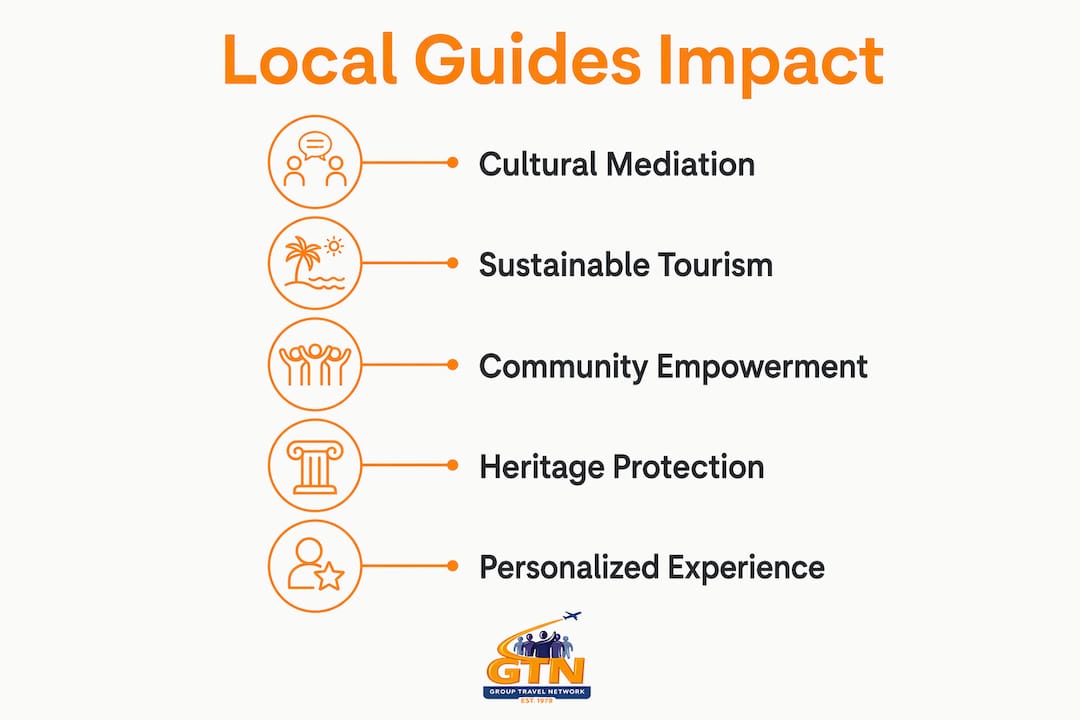
Local guides are one of the most direct tools for sustainable tourism. When travelers hire community members as guides, money stays in the local economy rather than flowing to international tour operators. This is the economic foundation of community-based tourism.
A three-year project on Mt. Manunggal in the Philippines documented how local guides support community empowerment and cultural preservation. Guides in that project actively protected natural trails, educated visitors on local customs, and built community pride around their heritage. The result was measurable: fewer incidents of environmental damage and stronger local ownership of the tourism experience.
UNESCO’s 2026 work in Eswatini reinforces this pattern. The Matsanjeni Cultural Landscape project focused on guide professionalization and governance as the backbone of sustainable tourism. Guides trained in storytelling and community itinerary design became ambassadors for their own heritage, not just service workers for foreign visitors.
UNESCO also ran capacity-building workshops in Mongolia, where 27 community members were trained in heritage interpretation, storytelling, and itinerary design. Participants reported measurable gains in confidence and a stronger sense of ownership over how their culture is presented to the world. Training changes outcomes.
| Guide Type | Sustainability Impact | Community Benefit |
|---|---|---|
| Certified community guide | Protects heritage sites through informed visitor management | Keeps tourism revenue local |
| Untrained freelance guide | Risk of misinformation and site damage | Minimal community reinvestment |
| UNESCO-trained guide | Applies storytelling and conservation frameworks | Builds cultural pride and ownership |
| National board-certified guide | Follows regulated environmental and safety standards | Supports formal tourism infrastructure |
- Hire guides who are members of local cooperatives or community tourism associations.
- Ask whether a portion of your guide fee supports local conservation or education programs.
- Choose destinations where UNESCO or national bodies have invested in guide training.
- Avoid unlicensed guides at major heritage sites, as they often lack conservation awareness.
- Leave reviews that specifically mention guide quality to help future travelers make informed choices.
What challenges do local tour guides face?
Local guides face real structural obstacles that limit their effectiveness. Research using qualitative discourse analysis found that guides show sincere intent toward sustainability but are constrained by poor institutional support, inconsistent training, and limited professional recognition. Good intentions do not overcome bad systems.

Governance is a major factor. In destinations where tourism ministries are underfunded or disorganized, guides operate without standardized training, fair pay structures, or legal protections. A guide in a well-governed destination like New Zealand operates within a framework that includes licensing, insurance, and ongoing education. A guide in an under-resourced region may have none of that, regardless of personal skill.
Training gaps create uneven quality. A traveler who hires a guide in Rome through a verified platform like Airbnb Experiences or Context Travel gets a vetted professional. A traveler who accepts an unsolicited offer outside the Colosseum takes a real risk. The difference is not always visible until the tour is already underway.
Pro Tip: High-quality guides are consistently found through trusted local referrals, verified communication skills, and demonstrated safety focus. Ask your hotel concierge or a local tourism office for names before you search online.
Travelers can actively support guide professionalization by choosing certified guides, paying fair rates, and tipping generously. When travelers reward quality, the market rewards training. That feedback loop matters more than most travelers realize.
- Use platforms that vet guides directly: Viator, GetYourGuide, Context Travel, and Airbnb Experiences all have review systems.
- Confirm your guide holds a current license from the relevant national tourism authority.
- Check that your guide has specific knowledge of your destination, not just general tourism experience.
- Verify safety protocols, especially for outdoor, adventure, or heritage site tours.
Local guides vs. group tours: which delivers more value?
Group tours function as sightseeing conveyor belts. They move large numbers of people through a fixed list of sites on a rigid schedule. Travelers become observers rather than participants. Research confirms that local guides help travelers become active participants rather than passive audiences, which is the defining difference in experience quality.
A student group visiting Washington, D.C. on a standard bus tour sees the Lincoln Memorial. A group with a local guide who specializes in civil rights history hears about the 1963 March on Washington from someone whose family attended. That is not a small upgrade. It is a completely different experience. Grouptravelnetwork builds this distinction into its student guided tours by pairing groups with guides who match the educational objectives of the trip.
Personalization is the other major advantage. A local guide adjusts the route based on your group’s interests, energy level, and questions. A group tour does not. If your students are fascinated by street art in Buenos Aires, a local guide can spend an extra hour in Palermo. A bus tour moves on at 2:15 p.m. regardless.
| Feature | Local Guide | Standard Group Tour |
|---|---|---|
| Itinerary flexibility | High, adjusts in real time | Fixed, no deviation |
| Cultural depth | Deep, interpretive, personal | Surface level, scripted |
| Group size | Small, intimate | Large, impersonal |
| Language support | Native fluency | Often translated or subtitled |
| Traveler role | Active participant | Passive observer |
| Cost per person | Moderate to high | Lower, but less value |
The benefits of local tour guides over group tours come down to one word: depth. You pay more for a local guide, but you leave knowing more, feeling more connected, and with stories worth telling. That return on experience is why international student tours consistently report higher satisfaction when expert local guides lead the itinerary.
Key takeaways
Local tour guides are the single most effective tool for converting a standard trip into a culturally meaningful experience.
| Point | Details |
|---|---|
| Guides are cultural mediators | They interpret heritage and values, not just facts, creating genuine cross-cultural understanding. |
| Sustainability depends on local guides | Community-based guides keep revenue local and protect heritage sites through informed visitor management. |
| Training determines quality | UNESCO and WFTGA-certified guides deliver measurably better experiences than untrained alternatives. |
| Vetting is the traveler’s responsibility | Use platforms like Viator or GetYourGuide and ask for certifications before booking. |
| Local guides outperform group tours | Personalization, flexibility, and cultural depth make guide-led travel the higher-value choice. |
Why i think most travelers still underestimate local guides
I have watched the travel industry shift dramatically over the past decade. Apps replaced paper maps. AI replaced travel agents for basic bookings. But the one thing that has not been replaced, and will not be, is a person who grew up in a place and knows it the way only a local can.
The conventional wisdom says you hire a guide for convenience. I think that is wrong. You hire a guide for transformation. The best guides I have encountered do not recite facts. They ask you questions. They watch what interests you and redirect the experience accordingly. A guide in Oaxaca, Mexico once noticed that a student in our group kept photographing the dye patterns on textiles. She spent the next hour explaining the Zapotec weaving tradition in a way that connected directly to the student’s interest in graphic design. That is not convenience. That is education at its best.
The future of guiding is heading toward deeper professionalization, and that is a good thing. UNESCO’s investments in training programs across Eswatini and Mongolia show that when institutions take guiding seriously, communities benefit and travelers get better experiences. The guides who will define the next decade are not just storytellers. They are conservation advocates, community economists, and cultural educators.
My advice: stop treating a local guide as an optional add-on. Budget for one the same way you budget for flights. The role of guides in student travel is especially significant because young travelers are forming their worldview in real time. A great guide shapes that worldview in ways a textbook never will.
— Donovan
Plan your next guided educational trip with Grouptravelnetwork
Grouptravelnetwork specializes in connecting student and school groups with expert-led travel experiences that go far beyond standard sightseeing. Every itinerary is built around educational objectives, cultural depth, and the kind of local expertise that makes a trip genuinely memorable.
Whether you are planning a class trip to Europe, a performance tour, or a cultural immersion program, Grouptravelnetwork pairs your group with guides who match your curriculum and your students’ curiosity. Explore the full range of options through the student educational travel guide and start building a trip your students will talk about for years.
FAQ
What is the main role of local tour guides?
Local tour guides serve as cultural mediators who interpret a destination’s heritage, traditions, and values for visitors. They provide personalized knowledge, language support, and safety management that standard group tours cannot match.
How do local guides support sustainable tourism?
Local guides contribute to sustainable tourism by keeping revenue within the community, protecting heritage sites, and educating visitors on responsible behavior. UNESCO-supported projects in Eswatini and Mongolia demonstrate that trained guides directly strengthen community ownership and conservation outcomes.
How do i find a trustworthy local guide?
Fodor’s recommends using trusted referrals, verifying certifications from national tourism authorities, and checking communication skills before booking. Platforms like Viator, GetYourGuide, and Context Travel vet guides and provide verified traveler reviews.
Are local guides better than group tours for cultural immersion?
Local guides consistently deliver deeper cultural immersion than group tours because they personalize the experience, adjust routes in real time, and engage travelers as active participants rather than passive observers.
Why does guide training matter for travelers?
Guide effectiveness depends heavily on institutional support and formal training. Certified guides from programs like WFTGA or UNESCO-backed workshops demonstrate verified knowledge of history, storytelling, and safety, which directly improves the quality of your experience.
Recommended

Relax with our Student Travel Expertise .
We deliver stress-free student trips backed by an exceptional array of services you won’t find anywhere else:
- Stress-free, creative planning of customized itineraries
- Dedicated GTN Service host on every trip
- Extensive travel protection plan options
- Online, individual registration system
- Flexible payment plans and online payment options
- Bulk buyer discounts for great trips that cost less
Inclusion into #MyGTNFamily for life! (you don’t even have to remember our birthday!)
Spain
There is no place like Spain to offer a student performance opportunity or cultural student trip.
Myrtle Beach
All students love the beach! Especially a beach known for its 60 miles of pristine coastline.
Boston
Have your students experience colonial charm in the city that is considered the hub of New England.
London
Provide your student group with the “Royal” treatment! One of the world’s most recognized cities.
See What People Are Saying
“This was my first time using a company to plan our band trip. It was so easy working with Justin and Group Travel Network. We had to make several changes along the way, but they were accommodating changes and worked everything out for us. I would highly recommend using Group Travel Network.”
“What wonderful trip we had to NYC! Our group of 51 never missed a beat because of Group Travel Network and our wonderful guide, Tim. It was truly a theatre trip to remember! If you are looking for a travel company who really cares about the details, Group Travel Network is for you!”
“It has been my privilege to use Group Travel Network as the exclusive travel coordinator for my band for over 10 years. I can say, without doubt or hesitation, that GTN is, by far, the best travel company for student groups currently in existence. I have often said that I wouldn’t take my band across the street without GTN and that’s not far from the truth!”