


TL;DR:
- A travel itinerary is a detailed, time-specific schedule encompassing destinations, transportation, accommodations, and activities for group trips. It serves as an essential operational document that reduces miscommunication, facilitates budget management, and supports contingency planning. Creating a comprehensive itinerary involves defining trip goals, confirming bookings, building a detailed schedule, and using digital tools for real-time updates, ensuring a smooth and well-coordinated experience.
A travel itinerary is a detailed schedule of a trip (opens in a new tab) that lists destinations, dates, transportation modes, accommodations, and planned activities. For anyone organizing group or educational travel, it functions as the single source of truth that keeps every participant, chaperone, and vendor aligned. The travel app market reached $629 billion in 2024, a 13% jump from the prior year, reflecting how seriously travelers now treat digital planning. Whether you are a band director coordinating a performance tour or a school administrator managing a class trip, a well-built itinerary is the difference between a smooth experience and a logistical crisis.
What is a travel itinerary and why does it matter for groups?
A travel itinerary is more than a list of places to visit. According to the Cambridge Dictionary (opens in a new tab), it explicitly defines when each journey element happens, including specific dates and times, making it an operational document rather than a wishlist. For group travel, this precision is non-negotiable. When 40 students, 6 chaperones, and a bus driver all need to be at the same location at 7:45 a.m., a vague plan creates chaos.
The travel itinerary definition used by most travel professionals covers six core elements: where you are going, when you are going, how you are getting there, where you are staying, what you are doing each day, and who to contact in an emergency. For educational trips specifically, Grouptravelnetwork treats itineraries as operational planning tools (opens in a new tab) that incorporate participant data, parent permissions, and contingency plans alongside the standard schedule.
The practical value is straightforward. A group of 50 people cannot rely on a thread of text messages or a shared spreadsheet to stay coordinated. A structured itinerary replaces fragmented communication with one authoritative document everyone references.

What are the essential components of a travel itinerary?
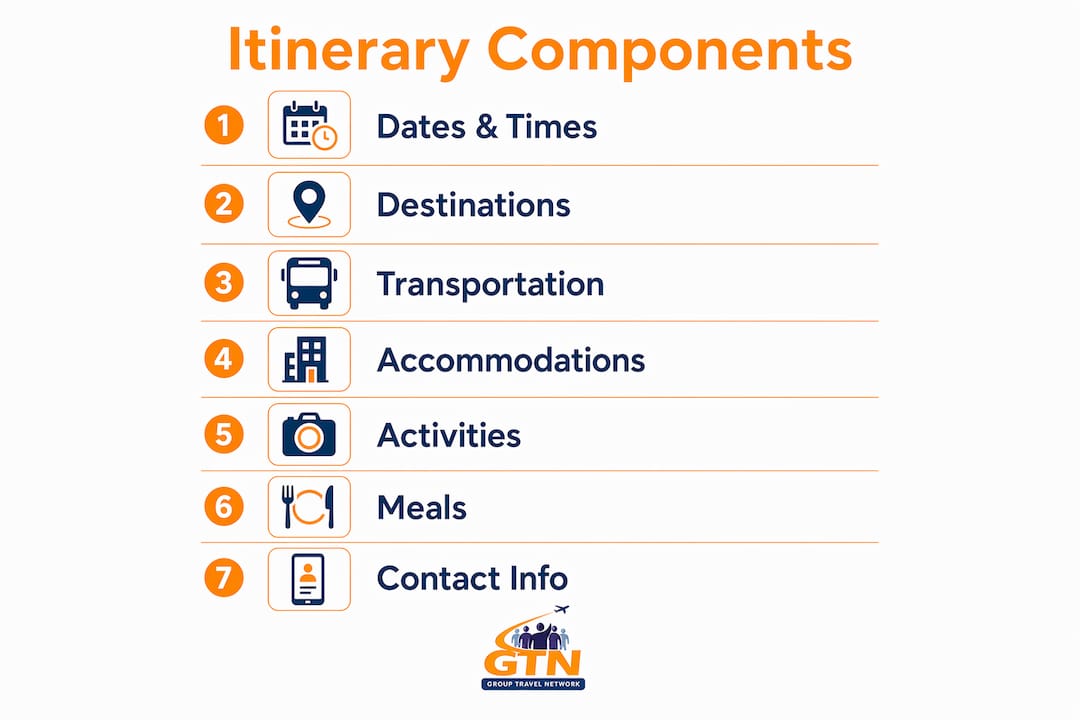
A thorough group travel itinerary covers far more ground than a personal trip plan. The following components are standard for any educational or performance group trip:
- Travel dates and times: Departure and return dates, plus exact times for every leg of the journey, including check-in windows and boarding deadlines.
- Destinations and locations: Full addresses for every venue, school, hotel, and performance hall, not just city names.
- Transportation details: Mode of transport (charter bus, flight, train), carrier names, confirmation numbers, and driver or airline contact information.
- Accommodation bookings: Hotel names, addresses, check-in and check-out times, room assignments, and front desk contact numbers.
- Daily activity schedule: A time-blocked breakdown of each day, including sightseeing, performances, meals, and free time.
- Meals and breaks: Scheduled meal stops, dietary restrictions flagged per participant, and rest break locations on long travel days.
- Emergency contacts: Local emergency services, trip coordinator numbers, school administration contacts, and medical contacts for participants with health needs.
- Special notes: Participant preferences, accessibility requirements, dress codes for performances, and any venue-specific rules.
A comprehensive itinerary (opens in a new tab) reduces confusion by specifying exactly where and when to meet, what to bring, and what happens if plans change. For a school band traveling to a competition in Nashville, for example, the itinerary would include the performance hall address, load-in time for instruments, sound check schedule, and the name of the venue coordinator.
Pro Tip: Always include a one-page “day at a glance” summary at the front of your itinerary. Participants rarely read the full document, but they will check a single-page overview every morning.
How does a travel itinerary benefit group and educational travel planning?
The clearest benefit of a travel itinerary is the elimination of miscommunication. Fragmented plans stored in chats or spreadsheets (opens in a new tab) cause confusion and planning errors. A single shared document removes the guesswork and gives every stakeholder, from parents to bus drivers, the same confirmed information.
For educational trips, the coordination challenge multiplies quickly. A school group might involve a principal, two teachers, a travel coordinator, a charter bus company, three hotels, and a museum education department. Each party has different needs and different questions. A well-structured itinerary answers most of those questions before they are asked, which reduces the volume of back-and-forth emails and last-minute calls.
Budget management is another concrete advantage. When every activity, meal, and transport leg is documented in advance, cost overruns become visible before they happen. A group trip to Washington, D.C. with 60 students requires pre-booked museum entries, restaurant reservations for large parties, and confirmed bus schedules. Without an itinerary tying those bookings together, one missed reservation can cascade into a full afternoon of unplanned downtime and unbudgeted expenses.
Contingency planning is also built into a strong itinerary. If a museum closes unexpectedly or a flight is delayed, a group with a detailed itinerary can identify the downstream impact immediately and activate backup options. Groups without one are left improvising in real time, which is stressful for adults and disorienting for students.
Pro Tip: Use a shared Google Doc or a platform like Sembark to distribute itinerary updates in real time. When you change a departure time or swap a venue, every participant sees the update instantly rather than receiving a confusing chain of correction emails.
What are the differences between simple and comprehensive itineraries?
Not all itineraries are built the same. A simple itinerary suits an individual traveler booking a weekend trip. A comprehensive itinerary is an operational document designed for group travel with multiple participants, vendors, and moving parts.
Itineraries serve as operational assets (opens in a new tab) with defined lifecycle stages, including draft, review, and approved status, to coordinate traveler data and vendor commitments. This lifecycle structure prevents downstream booking failures. For a school trip, an itinerary in “draft” status is not shared with parents. Once it reaches “approved,” it triggers hotel confirmations, bus contracts, and permission slip distribution.
The table below contrasts the two types directly:
| Feature | Simple itinerary | Comprehensive itinerary |
|---|---|---|
| Primary user | Individual traveler | Group or educational trip planner |
| Level of detail | Destination and dates only | Time-blocked schedule with full logistics |
| Booking records | Not typically included | Links to PNRs and vendor confirmations |
| Participant data | Not applicable | Includes traveler names, dietary needs, emergency contacts |
| Version control | Single document | Lifecycle stages: draft, review, approved |
| Contingency plans | Rarely included | Standard component for group safety |
Itineraries often link to Passenger Name Records (PNRs) in airline and booking systems, aligning the human-readable plan with the actual financial and ticketing records. For a group flight booking, this connection is critical. If the itinerary says the group departs at 9:00 a.m. but the PNR reflects an 11:00 a.m. booking, the discrepancy creates real problems at the airport.
Educational trips demand comprehensive itineraries because the stakes are higher. You are responsible for minors, accountable to parents, and operating within institutional policies that require documented plans.
How can you create an effective travel itinerary for a group trip?
Creating a group travel itinerary follows a clear workflow. Skipping steps or working from memory produces the fragmented plans that cause the most common group travel failures. Here is a step-by-step process that works for school trips, performance tours, and sports travel alike:
- Define trip goals and parameters. Identify the purpose of the trip, the travel dates, the number of participants, and the budget ceiling before booking anything.
- Collect participant information. Gather names, emergency contacts, dietary restrictions, medical needs, and any accessibility requirements from every traveler.
- Book transportation and accommodation first. Flights, charter buses, and hotels fill up quickly for group bookings. Confirm these before building the daily schedule around them.
- Build the day-by-day schedule. Assign activities to specific time blocks, including travel time between venues, meal breaks, and buffer time for delays.
- Add operational details. Include venue addresses, confirmation numbers, contact names at each location, and dress code or equipment requirements.
- Review with co-planners. Share the draft with other teachers, administrators, or trip coordinators for accuracy checks before it goes to participants.
- Distribute and update. Share the approved itinerary through a platform that allows real-time edits, and communicate any changes immediately.
Group itinerary planning software can suggest multiple itinerary options based on client preferences, automatically calculate costs, and facilitate sharing with participants. Tools like Sembark handle the calculation and distribution work, which is especially useful when managing 50 or more travelers with different room assignments and activity selections.
The most common mistake in group itinerary creation is building the plan in isolation. When one person holds all the information in a personal spreadsheet or email folder, the group is one sick day away from a planning crisis. A shared, navigable itinerary that reveals confirmed and optional details appropriately is the professional standard.
For school-specific guidance, the Grouptravelnetwork resource on building a school team trip itinerary (opens in a new tab) walks through each stage with examples drawn from real educational group trips.
What does a sample travel itinerary look like for a group trip?
A sample travel itinerary for a group trip typically takes one of three formats: a PDF schedule distributed before departure, a shared Google Doc with edit access for coordinators, or an app-based itinerary through a platform like Sembark or TripIt for Teams. Each format works, but digital documents with real-time update capability are the current standard for groups larger than 20.
The table below shows a sample single-day itinerary structure for an educational group trip:
| Time | Activity | Location | Notes |
|---|---|---|---|
| 7:00 a.m. | Breakfast and hotel checkout | Marriott Downtown | Bag storage available at front desk |
| 8:30 a.m. | Depart for museum | Charter bus, lobby pickup | Attendance check before boarding |
| 9:00 a.m. | Guided museum tour | National History Museum | Group split into 4 cohorts |
| 12:00 p.m. | Lunch break | Museum cafeteria | Vegetarian options confirmed |
| 1:30 p.m. | Free exploration time | Museum grounds | Students stay in buddy pairs |
| 3:00 p.m. | Depart for performance venue | Charter bus | Instruments loaded separately |
| 4:00 p.m. | Sound check and rehearsal | City Concert Hall | Formal dress required |
| 7:00 p.m. | Evening performance | City Concert Hall | Parents and guests admitted |
Templates like this one can be adapted for any trip length or purpose. A three-day sports tournament itinerary would replicate this structure across multiple days, adding game schedules, referee contacts, and equipment logistics. Free templates are available through Google Docs, Canva, and travel planning platforms. Paid options through Grouptravelnetwork include customized formats built specifically for school group travel planning (opens in a new tab) with pre-built sections for participant data and emergency protocols.
The goal of any template is standardization. When every trip your school organizes follows the same itinerary structure, coordinators spend less time building from scratch and more time refining the details that make each trip memorable.
Key takeaways
A travel itinerary is the operational backbone of any group trip, and its effectiveness depends entirely on the level of detail, accuracy, and accessibility built into the document from the start.
| Point | Details |
|---|---|
| Core definition | A travel itinerary is a time-specific schedule covering destinations, transport, accommodation, and activities. |
| Group travel necessity | Comprehensive itineraries reduce miscommunication by giving all stakeholders one confirmed source of information. |
| Simple vs. comprehensive | Educational trips require comprehensive itineraries with participant data, booking records, and lifecycle stages. |
| Creation workflow | Start with goals and participant data, then build the schedule around confirmed bookings, not the other way around. |
| Digital tools | Platforms like Sembark automate cost calculations and real-time sharing, reducing errors in large group planning. |
Why itineraries are the most underrated tool in group travel
I have seen school trips fall apart in the first hour because the only person who knew the full plan was stuck in traffic. No backup document, no shared access, no way for the chaperones on the bus to answer basic questions from students. That experience is more common than most educators admit.
The conventional wisdom is that a good trip planner just “knows what they are doing.” What actually separates effective group travel coordinators from overwhelmed ones is documentation. A detailed itinerary is not bureaucratic overhead. It is the tool that lets you hand off responsibility without losing control.
I have also seen the opposite failure: itineraries so rigid that a 20-minute delay at one venue caused visible anxiety in the entire group because no one had built in buffer time. The best itineraries I have worked with include a 15-minute buffer after every major transition and a clearly labeled “flex block” each afternoon. That structure gives the plan room to breathe without abandoning the schedule entirely.
Digital tools have made the distribution problem largely irrelevant. The real work is still in the thinking: knowing your group, anticipating their needs, and building a document that answers questions before they are asked. If you are planning a trip for students traveling internationally, integrating language preparation into the itinerary, such as noting that learning basic Japanese (opens in a new tab) reduces stress for groups visiting Japan, is the kind of detail that separates a good itinerary from a great one.
The groups that have the best trips are not the ones with the most exciting destinations. They are the ones whose coordinators did the hard planning work before anyone boarded the bus.
— Donovan
Plan your next educational group trip with Grouptravelnetwork
Grouptravelnetwork specializes in building customized itineraries for student and educational group travel, from school band tours to sports competitions and cultural excursions.

Their team of dedicated trip coordinators handles the logistics that consume most of a teacher’s planning time: vendor negotiations, accommodation assignments, real-time itinerary updates, and travel protection options. If you are starting from scratch or refining an existing plan, the Educational Group Trip Guide covers every stage of the planning process with examples built specifically for schools. For student travel at scale, the 2025 student travel guide (opens in a new tab) provides destination-specific frameworks and budget planning tools that take the guesswork out of group trip management.
FAQ
What is the travel itinerary definition used by travel professionals?
A travel itinerary is a detailed schedule that lists a trip’s destinations, dates, transportation, accommodations, and planned activities in time-specific order. Travel professionals treat it as both a human-readable plan and a structured record linked to booking confirmations.
How many components does a complete group travel itinerary include?
A complete group travel itinerary includes at least seven components: travel dates and times, destinations, transportation details, accommodation bookings, a daily activity schedule, meal and break plans, and emergency contacts. Educational trips typically add participant data and contingency plans.
What is the difference between a simple and a comprehensive itinerary?
A simple itinerary covers basic destination and date information for individual travelers. A comprehensive itinerary includes operational details like booking records, participant data, vendor contacts, and lifecycle stages, making it the required standard for group and educational trips.
How do you create a travel itinerary for a school group trip?
Start by defining trip goals, collecting participant information, and confirming transportation and accommodation bookings. Then build a time-blocked daily schedule, add operational details, review with co-planners, and distribute through a shared digital platform that supports real-time updates.
What tools are best for building a group travel itinerary?
Sembark and similar group itinerary planning platforms automate cost calculations, suggest itinerary options based on preferences, and support real-time sharing with participants. Google Docs and Canva offer free templates suitable for smaller groups or first-time planners.
Recommended
- How To Create Group Itineraries That Work For Everyone • Group Travel Network (opens in a new tab)
- How To Design Educational Itineraries That Actually Teach • Group Travel Network (opens in a new tab)
- What Is Travel For School Bands: A Director’s Guide • Group Travel Network (opens in a new tab)
- How To Build A School Team Trip Itinerary That Works • Group Travel Network (opens in a new tab)