


TL;DR:
- School liability during student trips extends beyond permission slips, emphasizing the importance of supervision, documentation, and layered insurance coverage. Effective risk management relies on proactive planning, vendor vetting, staff training, and transparent communication rather than solely on waivers. Cultivating a culture of attentive supervision and utilizing technology enhances student safety and organizational protection in 2026.
Every year, school administrators sign off on field trips and group tours with the genuine belief that a signed permission slip covers them legally. It does not. Understanding what is student travel liability means recognizing that your institution carries a legal duty of care from the moment students board that bus until the moment they return home. The gaps between that assumption and the legal reality are where costly claims, injuries, and institutional damage happen. This guide breaks down the law, the insurance layers, and the practical steps you need to protect your students and your organization in 2026.
Table of Contents
- Key takeaways
- What is student travel liability, and why it matters legally
- Insurance coverage essentials for student travel
- Common risk factors and how to prevent them
- Liability waivers and permission slips: what they actually do
- Putting it all together: building a compliant travel program
- My take on what liability really comes down to
- How Grouptravelnetwork helps you plan with confidence
- FAQ
Key takeaways
| Point | Details |
|---|---|
| Waivers are not full protection | Permission slips acknowledge risk but rarely shield institutions from negligence claims. |
| Duty of care governs all trips | Schools must meet a “reasonably prudent guardian” standard on every student trip, including optional ones. |
| Insurance requires multiple layers | General liability, professional liability, and HNOA coverage work together to close coverage gaps. |
| Supervision quality is the deciding factor | Courts focus on the adequacy and attentiveness of supervision, not just whether adults were present. |
| Documentation is your legal defense | Written risk assessments, incident logs, and vendor contracts are your strongest protection if a claim arises. |
What is student travel liability, and why it matters legally
Student travel liability refers to the legal responsibility your school or organization holds when a student is injured, becomes ill, or causes harm to others during a school-sponsored trip. The legal foundation for this responsibility is the concept of “duty of care.” In educational contexts, this standard requires that staff, administrators, and chaperones act as a reasonably prudent guardian (opens in a new tab) would under similar circumstances.
That standard does not disappear when you leave campus. It actually intensifies. Schools face higher supervision standards (opens in a new tab) on field trips than in classrooms, because unfamiliar environments introduce hazards that require additional planning and attention. A student who trips on a loose stage riser during a performance tour, a child who develops a medical emergency in a foreign city, or a chaperone who misses a student sneaking out of a hotel, all of these scenarios can trigger a liability claim against your organization.
Common situations that create liability exposure include:
- Failing to identify foreseeable hazards before the trip departs
- Deploying unqualified or untrained chaperones in supervisory roles
- Ignoring known medical conditions in student travel documentation
- Using transportation that has not been vetted for safety compliance
Pro Tip: Foreseeability is a core legal test in liability cases. If a hazard was reasonably predictable and you did not plan for it, a court may find you negligent even if no one intended harm.
One critical misconception worth addressing: traveling is “optional” (opens in a new tab) does not remove your duty of care. If grades, team membership, or peer pressure make participation functionally expected, courts will treat the trip as mandatory from a liability standpoint.
Insurance coverage essentials for student travel
Understanding what is student travel liability also means understanding that no single insurance policy covers everything. Effective travel liability coverage for school groups requires layered protections working in parallel.
| Coverage type | What it covers | Common gap to watch for |
|---|---|---|
| General liability | Third-party bodily injury and property damage claims | May not cover professional decisions made by staff |
| Professional liability | Claims arising from staff or volunteer actions and advice | Often excluded from standard general liability policies |
| Hired and non-owned auto (HNOA) | Rented vehicles or personal cars used for the trip | Personal auto policies frequently exclude business use |
| Student travel insurance | Medical costs, trip cancellation, and emergency evacuation | Exclusions can void coverage if safety advisories are ignored |
The HNOA gap is one of the most overlooked risks in youth travel planning. Personal auto insurance typically excludes business use (opens in a new tab), which means if a parent volunteer drives students to a venue in their own car and an accident occurs, your organization could face uninsured liability. HNOA coverage fills that gap directly.
Multiple insurance layers are required (opens in a new tab) because liability claims often involve several parties at once: the school, individual staff members, vendors, transportation companies, and even property owners at the destination. Understanding your travel insurance policy details (opens in a new tab) before departure is not optional. It is how you know whether you are actually covered.
Pro Tip: Always request certificates of insurance from every vendor and transportation provider you hire. Verify that the coverage limits meet or exceed your school district’s minimum requirements before signing any contract.
International trips add another layer of complexity. Medical costs during international emergencies (opens in a new tab) can be devastating without the right student travel insurance in place, and certain policies become void the moment a government travel advisory is ignored. Read every exclusion clause.
Common risk factors and how to prevent them
Travel risk management for students starts with knowing where claims actually come from. The most frequent liability triggers are preventable with good planning.
Here are the top five preventable risk factors in student travel:
- Inadequate adult-to-student ratios. Most states and accrediting bodies recommend ratios based on student age and activity type. Ignoring these recommendations is one of the clearest forms of negligence.
- Unvetted transportation vendors. Simply hiring a charter bus is not enough (opens in a new tab). Contracts should include verified insurance limits and indemnification clauses that shift liability back to the vendor if their negligence causes harm.
- No pre-trip route or venue checks. Visiting a venue in advance or requesting safety inspection records is standard practice for managing the importance of travel liability in off-campus settings.
- Untrained or inattentive chaperones. Supervision quality matters more than presence. A distracted chaperone is legally equivalent to no chaperone at all in many liability cases.
- No emergency protocol training. Staff and volunteers must know exactly what to do in a medical emergency, a missing student situation, or a natural disaster before they leave school grounds.
Proactive measures that actually reduce exposure include:
- Conducting documented risk assessments for every destination and activity
- Running pre-trip driver checks and route safety reviews (opens in a new tab) for all transportation legs
- Requiring all staff to complete emergency procedure training at least two weeks before departure
- Using written vendor agreements that require adequate insurance and place indemnity responsibility on contractors
- Keeping detailed logs of all planning decisions, inspections, and communications
For international trips, staff training should also address local emergency services, language barriers in medical settings, and the protocols for contacting families and consular officials. Resources like guidance on preparing for student exchanges can give your team practical frameworks for exactly these scenarios.
Liability waivers and permission slips: what they actually do

Many administrators operate under the belief that a signed waiver creates a legal force field around the institution. Courts do not see it that way. Waivers and permission slips serve an important informational function, but they rarely provide complete immunity from liability claims.
Here is what waivers genuinely accomplish and where they fall short:
- They document that parents and students were informed of known risks before participation
- They can reduce liability exposure for inherent risks of an activity, such as minor injuries during a hiking trip
- They do not protect against gross negligence, meaning clear failures in supervision or safety protocol
- They cannot cover risks that were not disclosed or hazards that should have been identified in advance
- Their enforceability varies by state, and courts frequently scrutinize whether language was clear and whether consent was truly informed
“Waivers are risk communication tools, not liability shields. An institution that relies solely on a waiver to manage student travel risk has not managed risk at all.”
The best practice is to treat waivers as one component of a broader informed consent process. Parents should receive full trip details including destinations, activities, known hazards, supervision plans, and emergency contacts. That level of transparency demonstrates your commitment to the duty of care standard, and it creates a stronger legal record than a checkbox waiver alone.
Putting it all together: building a compliant travel program
Knowing the legal theory and insurance requirements is one thing. Applying them to an actual trip plan is where responsible leadership shows up.
Start with a written travel policy that covers supervision ratios, chaperone qualifications, behavioral standards, and emergency response procedures. The policy should be reviewed annually and updated to reflect any changes in state law or district requirements. A well-developed school group travel plan (opens in a new tab) addresses all of these elements before a single student registration form is signed.
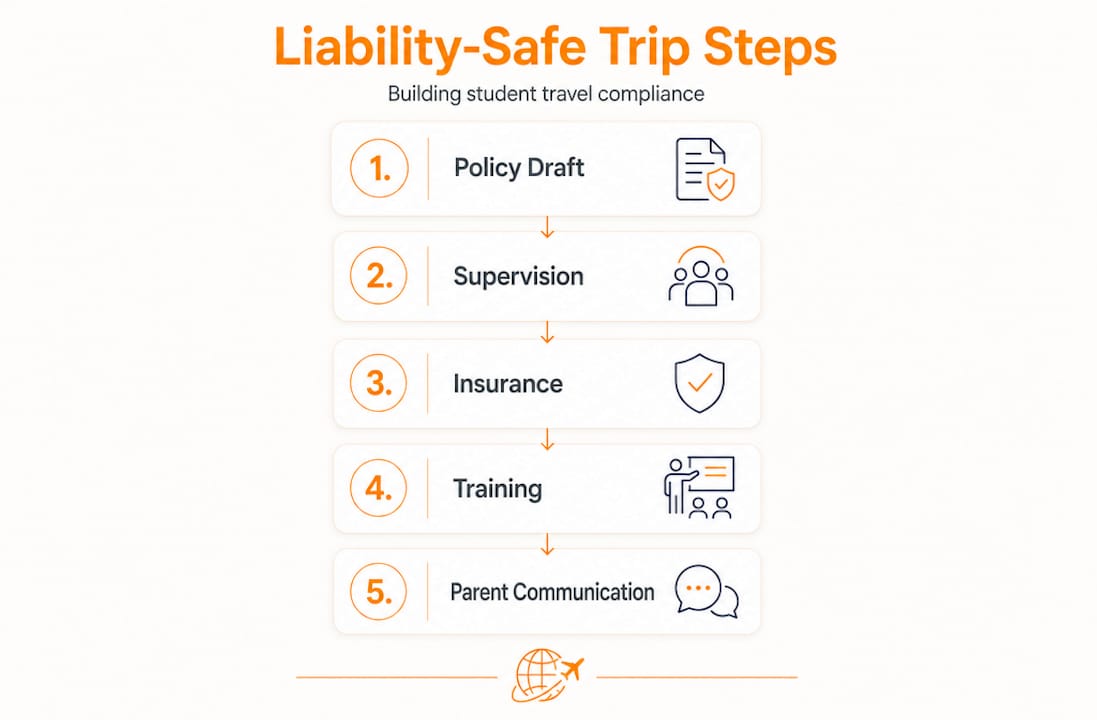
For transportation, verify that every driver, whether a district employee, hired contractor, or parent volunteer, meets your insurance requirements before departure day. Do not assume. Ask for documentation. Confirm that HNOA coverage is active if personal or rented vehicles will be used.
Train your staff before every trip, not just new staff. Emergency protocols evolve, destinations change, and refreshers matter. Brief chaperones specifically on their supervision zones, communication protocols, and how to document incidents in real time.
Pro Tip: If an incident does occur during a trip, document everything immediately: photos, written accounts, witness names, and medical records. This documentation is your primary defense if a liability claim is filed months or years later.
Communicate with parents thoroughly and early. Transparency about risks and procedures is not just a legal protection. It builds trust and reduces the likelihood of disputes after an incident. When parents feel genuinely informed, they are less likely to frame an injury as institutional negligence.
My take on what liability really comes down to
In my experience reviewing how student travel incidents actually unfold, the paperwork matters far less than most administrators think. I have seen organizations with bulletproof waiver language face serious legal exposure because supervision was sloppy. And I have seen schools with minimal paperwork avoid liability entirely because their chaperones were attentive, trained, and following a documented plan.
The real driver of student travel liability outcomes is supervision culture. Not the forms you file, not the insurance certificates you collect, but whether the adults on that trip are genuinely paying attention and acting with care. Documented risk assessments and staff training are valuable precisely because they create the conditions for that culture to exist.
What I find encouraging in 2026 is the growing use of technology in supervision and safety management. Real-time check-in systems, GPS tracking for student groups, and digital incident reporting tools are shifting liability management from reactive paperwork to active prevention. Organizations that adopt these tools do not just reduce legal exposure. They actually keep students safer, which is the whole point.
My advice: stop thinking about liability as a compliance checkbox and start thinking of it as a signal of how seriously you take your students’ wellbeing. Build the culture first. The documentation follows naturally.
— Donovan
How Grouptravelnetwork helps you plan with confidence
Managing student travel liability on your own is complicated. Between insurance layers, vendor vetting, waiver drafting, and staff training, it is easy to miss gaps that create real exposure.

Grouptravelnetwork specializes in exactly this kind of complexity. The team coordinates student group trips (opens in a new tab) with safety and compliance built into every stage of the planning process, from destination selection and vendor contracting to insurance guidance and emergency protocol setup. Every trip is managed by a dedicated coordinator who understands the legal and logistical dimensions of educational travel. Whether you are organizing a performance tour, a cultural excursion, or a multi-destination educational adventure, explore the school group travel planning guide (opens in a new tab) to see how a structured, expert-supported process keeps your students safe and your organization protected.
FAQ
What is student travel liability in simple terms?
Student travel liability is the legal responsibility your school or organization holds when students are injured or cause harm during a school-sponsored trip. It is based on the legal duty of care that requires adults to act as a reasonably prudent guardian would in similar circumstances.
Does a signed permission slip protect schools from liability?
No. Permission slips inform parents of known risks but do not shield institutions from negligence claims. Courts frequently rule against schools even when waivers were signed, particularly in cases involving poor supervision or undisclosed hazards.
What insurance coverage do schools need for student travel?
Schools typically need at least three layers of coverage: general liability insurance, professional liability insurance, and hired and non-owned auto coverage. Student travel insurance should also be secured for medical emergencies, especially on international trips.
Are optional student trips covered by duty of care requirements?
Yes. If a school organizes and controls the activity, the duty of care applies regardless of whether the trip is labeled optional. Courts recognize that social or academic pressure can make participation effectively mandatory.
How can schools reduce liability on student trips?
Schools reduce liability by maintaining proper adult-to-student ratios, vetting all vendors with verified insurance contracts, training staff on emergency protocols, conducting documented pre-trip risk assessments, and communicating transparently with parents about all known risks.
Recommended
- Student Travel Safety: Protecting Students And Schools • Group Travel Network (opens in a new tab)
- How To Plan Safe And Impactful Student Group Travel • Group Travel Network (opens in a new tab)
- Travel Insurance For School Group Trips Explained • Group Travel Network (opens in a new tab)
- Student Educational Travel: Ultimate 2025 Guide For Schools (opens in a new tab)