

April 18, 2026
How to Budget for School Trips: A Step-by-Step Guide
TL;DR:
- Effective school trip budgeting includes transportation, accommodation, meals, activities, staff, insurance, and contingency funds.
- Transparent planning, stakeholder communication, and real-time tracking help prevent cost overruns and build trust.
- Fundraising and multi-year planning enhance financial resilience and make trips more accessible for all students.
Budget overruns are one of the most common reasons school trips get canceled or scaled back after months of planning. A single overlooked expense, like a bus surcharge or admission tax, can throw off an entire payment plan and leave families frustrated. Trip coordinators who rely on rough estimates instead of structured budgets are especially vulnerable to these surprises. This guide walks you through every stage of school trip budgeting, from identifying core cost categories to benchmarking realistic price ranges, avoiding hidden fees, and communicating costs clearly to families and administrators. Follow this process and you will spend less time firefighting and more time building a trip students will remember.
Table of Contents
- Core components of a school trip budget
- Step-by-step process for accurate budgeting
- Benchmarks, cost ranges, and real-world examples
- Common pitfalls and tips for safeguarding your budget
- A smarter approach: Why planning and transparency beat guesswork
- Plan your next school trip with expert guidance
- Frequently asked questions
Key Takeaways
| Point | Details |
|---|---|
| Include all core costs | Accurate budgets cover transport, lodging, meals, activities, insurance, and extras. |
| Use tiered budgeting | Organize expenses as essential, recommended, or optional to clarify priorities. |
| Expect the unexpected | Always add a 5-10% contingency to handle unplanned expenses or changes. |
| Communicate clearly | Share detailed cost breakdowns and payment options with families and staff early. |
| Verify with benchmarks | Compare your budget to real-world cost ranges to ensure it is realistic and viable. |
Core components of a school trip budget
With the importance of avoiding cost overruns established, let’s break down what every school trip budget should include.
Every solid school trip budget starts with the same foundation: knowing exactly where money will go before a single deposit is paid. Core budget elements include transportation, accommodation, meals, activities and admissions, staff and chaperone costs, insurance, and a contingency fund of 5 to 10 percent of the total budget. Skipping even one of these categories is how coordinators end up short.
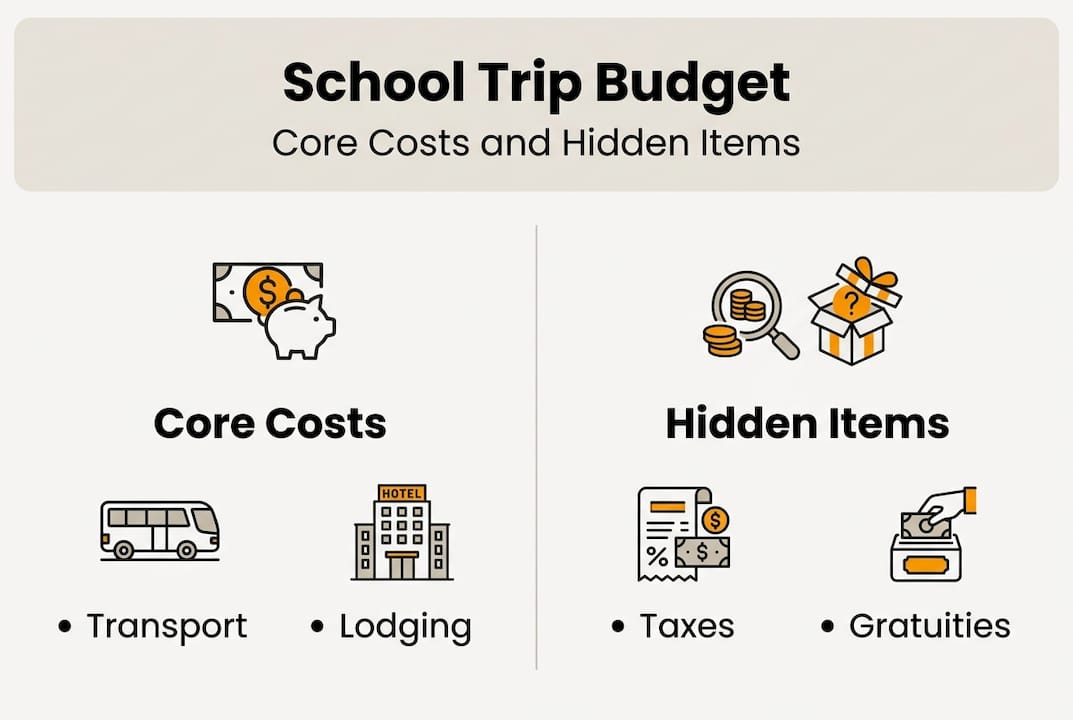
Transportation is almost always the largest line item. Charter buses, flights, and rail passes carry different price structures, and rural routes can cost significantly more per mile than urban ones. Accommodation costs vary widely based on hotel star rating, proximity to attractions, and whether the school negotiates group rates in advance. Meals need to account for dietary restrictions, and per-student meal allowances should be set before the trip, not during it.
Here is a quick breakdown of the essential budget categories every coordinator should track:
- Transportation: Charter bus, flight, rail, or a combination
- Accommodation: Hotels, hostels, or school-arranged housing
- Meals: Per-student daily allowance, including dietary needs
- Activities and admissions: Museum entries, park fees, performance tickets
- Staff and chaperone costs: Travel, lodging, and meals for adults
- Insurance: Trip cancellation, medical, and liability coverage
- Contingency fund: 5 to 10 percent of total budget for surprises
Hidden costs are where budgets quietly fall apart. Taxes on hotel rooms, mandatory gratuities for bus drivers and tour guides, and venue surcharges rarely appear in initial quotes. Always request itemized pricing from every vendor and ask explicitly about fees not included in the base rate.

| Budget category | Estimated share of total budget |
|---|---|
| Transportation | 30 to 40% |
| Accommodation | 20 to 30% |
| Meals | 10 to 15% |
| Activities and admissions | 10 to 20% |
| Staff and chaperone costs | 5 to 10% |
| Insurance | 3 to 5% |
| Contingency fund | 5 to 10% |
Pro Tip: Always allocate a 5 to 10 percent contingency fund. Even well-planned trips encounter last-minute changes, and having that buffer prevents you from going back to families for more money. Review school trip package options to see how bundled pricing can simplify this process.
Step-by-step process for accurate budgeting
Once the key categories are understood, here is a step-by-step process for building a robust budget.
Building a school trip budget is not a one-afternoon task. It requires deliberate sequencing so that each decision informs the next. Effective budgeting methodologies involve categorizing expenses clearly, using tiered activity options, setting participant numbers early for group rates, offering installment payments for families, sharing detailed breakdowns with stakeholders, and using digital tools for tracking throughout the process.
- Confirm participant and chaperone numbers first. Group rates on buses, hotels, and attractions are calculated based on headcount. Locking in numbers early gives you negotiating power and prevents repricing later.
- Categorize every expense. Use the seven categories listed in the previous section. Assign a preliminary dollar amount to each before reaching out to vendors.
- Build two budget scenarios. Create an essential-only version and a recommended version with optional upgrades. This gives administrators and families a clear choice.
- Gather vendor quotes and compare. Get at least two quotes per major expense category. Ask for group discounts and confirm what is included in writing.
- Set up digital tracking. Spreadsheets work, but purpose-built tools for travel management for teams give you real-time visibility across all expense categories.
- Share the budget breakdown with stakeholders. Parents, administrators, and teachers should all see a clear, line-by-line breakdown. Transparency reduces pushback and builds trust.
- Offer installment payment plans. Breaking the total into monthly payments makes the trip accessible to more families and reduces last-minute dropout rates.
Here is a comparison of two common budget approaches:
| Budget type | What it includes | Best for |
|---|---|---|
| Essential only | Transport, basic lodging, core meals, required admissions | Tight budgets, first-time trips |
| Recommended | All essentials plus optional activities, upgraded meals, extended itinerary | Experienced groups with fundraising support |
For a complete walkthrough of the planning sequence, the step-by-step group travel planning resource covers everything from initial proposal to final payment collection. You can also review the school trip payment guide for detailed guidance on structuring family payment schedules.
Benchmarks, cost ranges, and real-world examples
Having built your budget, it is helpful to benchmark costs and see examples from real schools.
Knowing what other schools actually spend helps you reality-check your projections before committing to a plan. Empirical cost benchmarks show that local day trips run $10 to $50 per student, regional two-day trips can exceed $500 per student, multi-day trips to cities like Washington D.C. or Boston often top $1,000 per student, and bus transportation alone ranges from $1.65 to $3.73 per mile or roughly $600 per day.
Here is a sample budget table for four common trip types:
| Trip type | Duration | Estimated cost per student |
|---|---|---|
| Local day trip | 1 day | $10 to $50 |
| Regional overnight | 2 days | $250 to $500 |
| Multi-day city trip | 3 to 5 days | $800 to $1,500 |
| International trip | 7 to 10 days | $2,500 to $5,000+ |
Several variables will push your costs toward the higher or lower end of these ranges:
- Location: Urban destinations with higher hotel and admission costs raise totals quickly
- Duration: Each additional night adds lodging, meals, and activity costs
- Season: Peak travel seasons drive up flight and hotel pricing significantly
- Group size: Larger groups unlock better per-person rates across most categories
- Fundraising coverage: Strong fundraising programs can offset a significant share of total costs
One district’s total field trip spending reached $256,000 in a single year, representing just 0.06 percent of its total budget. A large portion of that was covered through fundraising, highlighting how community support can make ambitious trips financially viable.
For strategies on closing the gap between what the school can fund and what families can afford, explore these fundraising tips for school trips that have worked for groups across the country.
Common pitfalls and tips for safeguarding your budget
Even with a solid budget, there are pitfalls. Here is how to spot and avoid them.
The most carefully built budget can still go sideways if coordinators are not watching for specific failure points. Hidden and late costs such as taxes, gratuities, and surcharges catch many schools off guard, and rural transportation can cost dramatically more per mile than urban routes. During economic downturns, roughly 33 percent of school districts cut field trips entirely, which means your budget strategy also needs a resilience plan.
Here are the most common budgeting mistakes and how to avoid them:
- Underestimating hidden expenses: Always request fully itemized vendor quotes and ask about taxes, driver gratuities, and facility fees
- Over-relying on fundraising projections: Treat fundraising income as supplemental, not foundational, until funds are actually collected
- Skipping the contingency fund: A missing contingency is the single fastest way to turn a small surprise into a full crisis
- Delayed payment collection: Late payments from families create cash flow gaps that can affect vendor deposits
- Poor communication with stakeholders: Administrators who are not kept updated often push back on costs at the worst possible moment
Digital tracking tools are not optional at this level of complexity. A shared, real-time budget document ensures that every stakeholder, from the principal to the parent committee, sees the same numbers. Explore tips to lower cost for practical ways to reduce expenses without cutting the experiences that make trips worthwhile.
Pro Tip: Send a budget update to all stakeholders at least once a month during the planning period. Regular visibility prevents last-minute surprises and keeps everyone aligned on spending decisions.
If your district faces budget pressure, consider spreading your travel program across multiple years with rotating destinations. This approach keeps trips alive even when annual budgets tighten.
A smarter approach: Why planning and transparency beat guesswork
These pitfalls show why it is worth rethinking your overall budgeting approach.
Most school trip budgets fail not because of math errors but because of process errors. Coordinators build a spreadsheet in isolation, share a total number with families, and then scramble when reality diverges from the estimate. The fix is not a better spreadsheet. It is a better process.
Digital tools and real-time tracking go beyond what spreadsheets can offer, and early stakeholder communication builds the kind of trust that keeps families engaged rather than skeptical. When parents see a transparent, itemized budget from the start, they are far more likely to commit to payment plans and support fundraising efforts.
We have seen schools transform their travel programs simply by involving families in the budget conversation earlier. Students who understand where the money goes become advocates for fundraising. Administrators who see the full picture approve trips faster. That is not a budgeting trick. It is a culture shift.
Strategic multi-year planning also changes the math entirely. Instead of treating each trip as a standalone financial event, schools that rotate destinations annually can build reserves, negotiate long-term vendor relationships, and protect their programs during lean years. Explore student educational travel tips to see how forward-thinking schools are building sustainable travel programs that survive budget cycles.
Plan your next school trip with expert guidance
Ready to put this approach into action? Here is how Group Travel Network can help.
At Group Travel Network, we work directly with school administrators and trip coordinators to take the guesswork out of school travel planning. From building your initial budget to managing vendor relationships and family payments, our team provides the structure and support that makes trips happen on time and on budget.

Our platform is built specifically for group travel for students, with tools for online registration, flexible payment plans, and real-time cost tracking. Whether you are organizing a local day trip or a multi-day performance tour, we handle the logistics so you can focus on the experience. Start planning student travel tours with a team that understands exactly what schools need.
Frequently asked questions
How much should we budget for a typical school day trip?
Local day trips cost $10 to $50 per student on average, though costs vary based on transportation distance and admission fees for activities.
What are the most commonly overlooked expenses in school trip budgets?
Hidden costs like hotel taxes, driver gratuities, venue surcharges, and trip cancellation insurance are frequently missing from first-draft budgets.
How can fundraising play a role in our school trip budget?
Fundraising can cover 45 percent or more of total trip costs in some districts, making it a critical tool for reducing the per-student financial burden on families.
What’s the best way to manage payments from families?
Breaking the total into monthly installments and using digital payment tracking keeps costs manageable for families and reduces the risk of late or missed payments.
How can we protect school trip funding during budget cuts or downturns?
Building multi-year rotating programs and maintaining a dedicated trip reserve fund gives your travel program the financial resilience to survive difficult budget years.
Recommended

Relax with our Student Travel Expertise .
We deliver stress-free student trips backed by an exceptional array of services you won’t find anywhere else:
- Stress-free, creative planning of customized itineraries
- Dedicated GTN Service host on every trip
- Extensive travel protection plan options
- Online, individual registration system
- Flexible payment plans and online payment options
- Bulk buyer discounts for great trips that cost less
Inclusion into #MyGTNFamily for life! (you don’t even have to remember our birthday!)
Spain
There is no place like Spain to offer a student performance opportunity or cultural student trip.
Myrtle Beach
All students love the beach! Especially a beach known for its 60 miles of pristine coastline.
Boston
Have your students experience colonial charm in the city that is considered the hub of New England.
London
Provide your student group with the “Royal” treatment! One of the world’s most recognized cities.
See What People Are Saying
“This was my first time using a company to plan our band trip. It was so easy working with Justin and Group Travel Network. We had to make several changes along the way, but they were accommodating changes and worked everything out for us. I would highly recommend using Group Travel Network.”
“It has been my privilege to use Group Travel Network as the exclusive travel coordinator for my band for over 10 years. I can say, without doubt or hesitation, that GTN is, by far, the best travel company for student groups currently in existence. I have often said that I wouldn’t take my band across the street without GTN and that’s not far from the truth!”
“What wonderful trip we had to NYC! Our group of 51 never missed a beat because of Group Travel Network and our wonderful guide, Tim. It was truly a theatre trip to remember! If you are looking for a travel company who really cares about the details, Group Travel Network is for you!”