


Travel safety is the deliberate practice of minimizing risks and protecting well-being during every phase of a trip. The case for prioritizing it is straightforward: travel incidents have increased recently, emphasizing the need for careful planning and response. That number alone should shift how you plan, not just how you react.
Here is what prioritizing travel safety actually delivers:
- Fewer injuries and medical emergencies on the road
- Lower financial exposure from theft, accidents, or trip disruptions
- Psychological confidence that lets travelers focus on the experience
- Legal protection for travel managers and institutions responsible for groups
- Better outcomes when something does go wrong, because preparation shortens response time
The U.S. Department of State Travel Advisories (opens in a new tab), the World Health Organization, and Johns Hopkins Medicine all point to the same conclusion: safety is not about fear. It is about informed preparation.
Why prioritize travel safety: the advisory system that guides every decision
The U.S. Department of State assigns every country a 4-level Travel Advisory rating based on measurable risk indicators, from crime and terrorism to health infrastructure and civil unrest.
| Level | Label | What it means |
|---|---|---|
| 1 | Exercise normal precautions | Standard awareness; low risk |
| — | Exercise increased caution | Specific risks present; heightened alertness needed |
| 3 | Reconsider travel | Serious risks; travel only if necessary |
| 4 | Do not travel | Extreme danger; U.S. government may have limited ability to assist |
Advisory levels directly affect travel insurance validity. Many policies exclude coverage for destinations rated Level 3 or 4, which means ignoring an advisory can leave travelers financially exposed at the worst possible moment.
Practical steps aligned with advisory levels:
- Check the advisory for every destination at Travel.State.Gov before booking
- Enroll in the Smart Traveler Enrollment Program (STEP), a free State Department service that sends real-time alerts from local U.S. embassies
- Review the country information page for local laws, health risks, and accessibility notes
- Adjust your itinerary if a destination moves to Level 3 after booking
Common travel risks and how to reduce them
Road traffic accidents are the leading cause of death among healthy international travelers, with the World Health Organization estimating over 1.19 million road traffic deaths worldwide each year. That single statistic should anchor every traveler’s risk assessment.
Statistic callout: Travel incidents rose 15% in 2024, making the risk of an incident approximately 1 in 217 trips, with road accidents, theft, and digital fraud accounting for the largest share of reported cases.
Physical theft is accelerating in popular destinations. Pickpocketing in Rome increased 68% in 2024 alone. Digital threats are growing just as fast: Booking.com phishing scams caused £370,000 in losses over 15 months, targeting travelers who assumed familiar platforms were automatically safe.
Key risk-reduction practices:
- Always wear a seat belt; insist on child restraints for younger travelers
- Avoid traveling alone at night, especially in unfamiliar areas
- Use app-based rideshare services that track routes and share trip details
- Never accept drinks from strangers; watch for signs of drink tampering
- Use a travel-specific email alias for every booking to contain damage from data breaches
- Keep a charged phone and offline maps accessible at all times
Familiarity breeds complacency (opens in a new tab). Travelers who have visited a destination before often lower their guard, which is exactly when incidents spike.

How inclusive safety planning protects every traveler
Travel safety planning that ignores diversity leaves real gaps. Families, young travelers, and differently-abled travelers (opens in a new tab) each face risks that a generic safety checklist does not address. A student with a mobility limitation needs different emergency exit planning than an adult solo traveler. A family traveling with young children faces distraction risks that increase vulnerability to theft.
Inclusive safety practices for varied traveler profiles:
- Identify mobility, medical, or communication needs before departure and map accessible routes and facilities
- Brief young travelers separately on personal safety boundaries, emergency contacts, and what to do if separated from the group
- Account for cultural dress codes and local customs to reduce unwanted attention
- Provide safety materials in multiple formats (visual, written, verbal) for travelers with different learning needs
- Assign a designated point of contact for each subgroup within a larger travel party
Pro Tip: Travel managers should collect a brief health and accessibility profile for each traveler at registration, not on arrival. Waiting until the trip starts to learn about a participant’s needs makes proactive planning impossible.
How to keep travelers informed and prepared before and during a trip
Preparation does not end when the itinerary is finalized. The most effective safe travel practices (opens in a new tab) treat communication as an ongoing process, not a one-time pre-departure briefing.
Best practices for traveler engagement:
- Hold a pre-trip safety briefing covering destination-specific risks, emergency contacts, and group protocols
- Enroll every traveler in STEP so the State Department can reach them directly during a crisis
- Share real-time alert sources (embassy notifications, local news) and explain how to act on them
- Distribute a written emergency contact card that includes the nearest U.S. embassy, local emergency numbers, and the trip coordinator’s direct line
- Use a group communication app to push safety updates during the trip without relying on travelers to check email
Travel health insurance deserves its own conversation before departure. Medicare and Medicaid do not cover medical care abroad, and many private domestic plans have the same gap. Travelers heading to remote destinations especially need coverage for emergency evacuation, which can cost tens of thousands of dollars without it.

What 2024 research reveals about evolving travel threats
The illusion of safety is one of the most documented behavioral risks in travel security. Travelers who feel comfortable, whether because a destination is familiar or because nothing has gone wrong yet, systematically underestimate their exposure. Experts now recommend treating every trip as a fresh risk assessment rather than extending assumptions from past visits.
Digital threats have moved from peripheral to central. A layered defense strategy for 2026 includes identity isolation (separate travel email aliases per vendor), hardware-based two-factor authentication, and offline data backups before departure. These are not advanced measures anymore; they are baseline.
Emergency care disparities (opens in a new tab) add another layer of urgency. Low-income regions have much higher fatality rates after accidents because emergency medical services are scarce. A survivable injury in a well-resourced country can become fatal in a region without trauma care. Travel health insurance and a pre-trip medical briefing are not optional extras for trips to those destinations.
Why informed travel planning prevents the most costly mistakes
Informed planning means researching conditions before they become problems, not after. The CDC’s Yellow Book advises healthcare professionals to give travelers destination-specific safety guidance, covering everything from road conditions and local crime patterns to vector-borne disease risk and water safety. That same depth of research belongs in every traveler’s pre-trip routine.
Booking accommodations in advance, knowing where the nearest hospital is, and understanding local laws around medications or restricted items are all decisions that cost nothing before departure and can cost everything if skipped. U.S. citizens are subject to local laws abroad, including laws that differ sharply from American norms, and ignorance is not a legal defense.
The psychological benefits of knowing you are prepared
Travelers who have done the preparation work report lower anxiety and greater enjoyment, not because the risks disappeared, but because they have a plan. That confidence is not trivial. A traveler who knows what to do if their passport is stolen, or who has already identified the nearest U.S. consulate, moves through unfamiliar environments with a fundamentally different mindset.
For group travel managers, that psychological benefit extends to the entire group. When participants trust that the organizer has thought through contingencies, they engage more fully with the experience. Student groups (opens in a new tab) in particular benefit from this: a well-briefed student is less likely to take unnecessary risks because they understand the stakes and the support structure around them.
What happens when travel safety is neglected
Neglecting travel safety creates cascading consequences. At the individual level, an uninsured medical emergency abroad can result in bills that exceed $100,000 for evacuation alone. At the public health level, travelers who skip destination health checks can carry diseases across borders, a pattern the CDC has documented repeatedly with measles, typhoid, and other vaccine-preventable illnesses.
For institutions organizing group travel, the liability exposure is direct. A school or organization that fails to conduct adequate safety planning for a student trip can face legal action if a preventable incident occurs. Courts have consistently held that duty of care extends to the planning phase, not just the trip itself.
Legal responsibilities travel managers cannot ignore
Travel managers and educational institutions carry a legal duty of care for every participant in a group trip. That duty covers pre-trip vetting of destinations, selection of safe transportation, disclosure of known risks, and having a documented emergency response plan. Failing any of those creates liability that insurance alone cannot fully cover.
U.S. citizens arrested abroad have the right to contact the nearest U.S. embassy or consulate, but the State Department cannot intervene in local legal proceedings or provide legal counsel. Travelers who unknowingly violate local laws, including laws around medications that are legal in the United States, face real consequences. Travel managers who brief participants on local legal requirements before departure reduce both the risk and their own exposure.
Plan your next group trip with safety built in from day one

Grouptravelnetwork specializes in school group travel planning (opens in a new tab) that puts safety at the center of every itinerary, from destination vetting and transportation coordination to emergency protocols and travel protection options. Every trip includes a dedicated coordinator who manages risk planning so administrators and educators can focus on the experience.
Key Takeaways
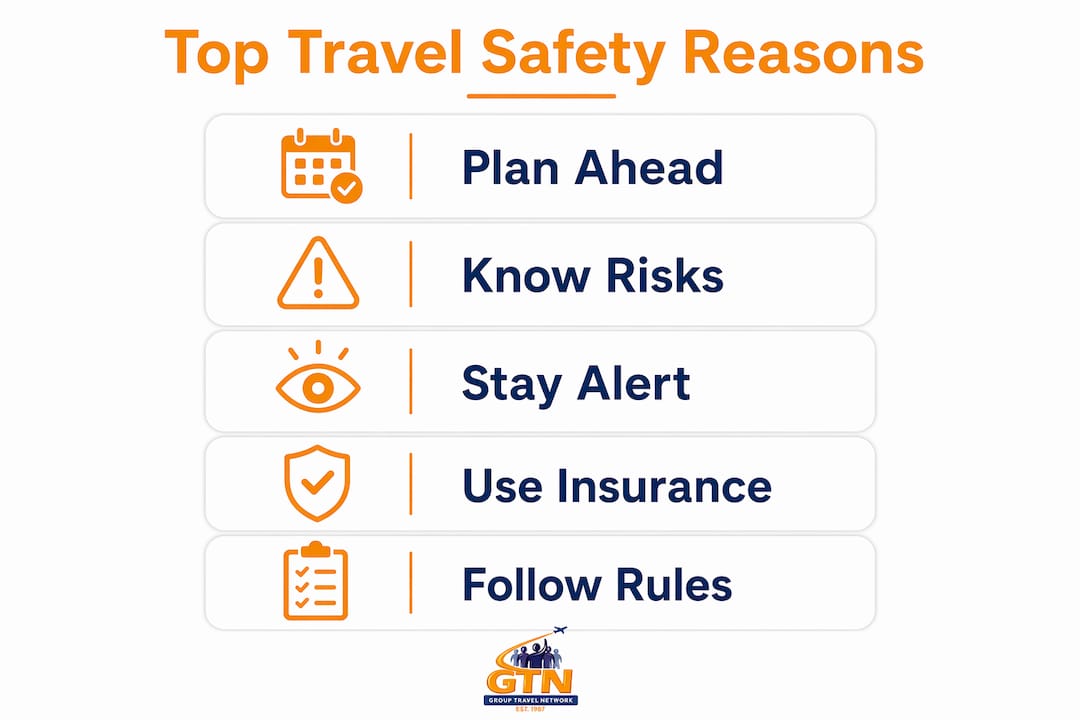
Travel safety requires proactive planning across every phase of a trip, from advisory checks before booking to real-time communication tools during travel.
| Point | Details |
|---|---|
| Check advisories first | The State Department’s 4-level system tells you what precautions each destination requires before you book. |
| Road accidents are the top risk | WHO data confirms road traffic is the leading cause of death among healthy international travelers globally. |
| Digital threats are now baseline risks | Phishing scams and identity theft targeting travelers increased sharply in 2024; layered digital defenses are now standard practice. |
| Inclusive planning closes real gaps | Families, students, and differently-abled travelers face unique risks that generic checklists miss. |
| Legal duty of care starts at planning | Travel managers face liability for preventable incidents; documented safety protocols are a legal requirement, not a formality. |
FAQ
Why should safety be the top priority when traveling?
Safety is the foundation that makes every other part of a trip possible. Without it, travelers face financial, physical, and legal consequences that can outweigh any benefit of the trip itself.
Why should travelers follow safety measures at every destination?
Local conditions, laws, and risks vary widely from the United States. The CDC and State Department both advise destination-specific preparation because a measure that is unnecessary at home can be critical abroad.
Why does safety and security matter in tourism?
Tourism depends on traveler confidence. When safety is neglected, individual travelers face direct harm, and destinations lose the trust that sustains their tourism economies over time.
Why is travel safety especially important for group trips?
Group travel managers carry a legal duty of care for every participant. A single preventable incident can result in medical costs, legal liability, and reputational damage for the organizing institution.
What is the single most effective travel safety precaution?
Enrolling in the State Department’s Smart Traveler Enrollment Program (STEP) before departure gives travelers real-time alerts from local U.S. embassies and ensures the government can reach them in an emergency.
Recommended
- Student Travel Safety: Protecting Students And Schools • Group Travel Network (opens in a new tab)
- Safe Travel Planning Steps For Student Groups In 2026 • Group Travel Network (opens in a new tab)
- Group Travel Companies: 7 Qualities To Look For In 2025 (opens in a new tab)
- How To Plan Safe And Impactful Student Group Travel • Group Travel Network (opens in a new tab)